

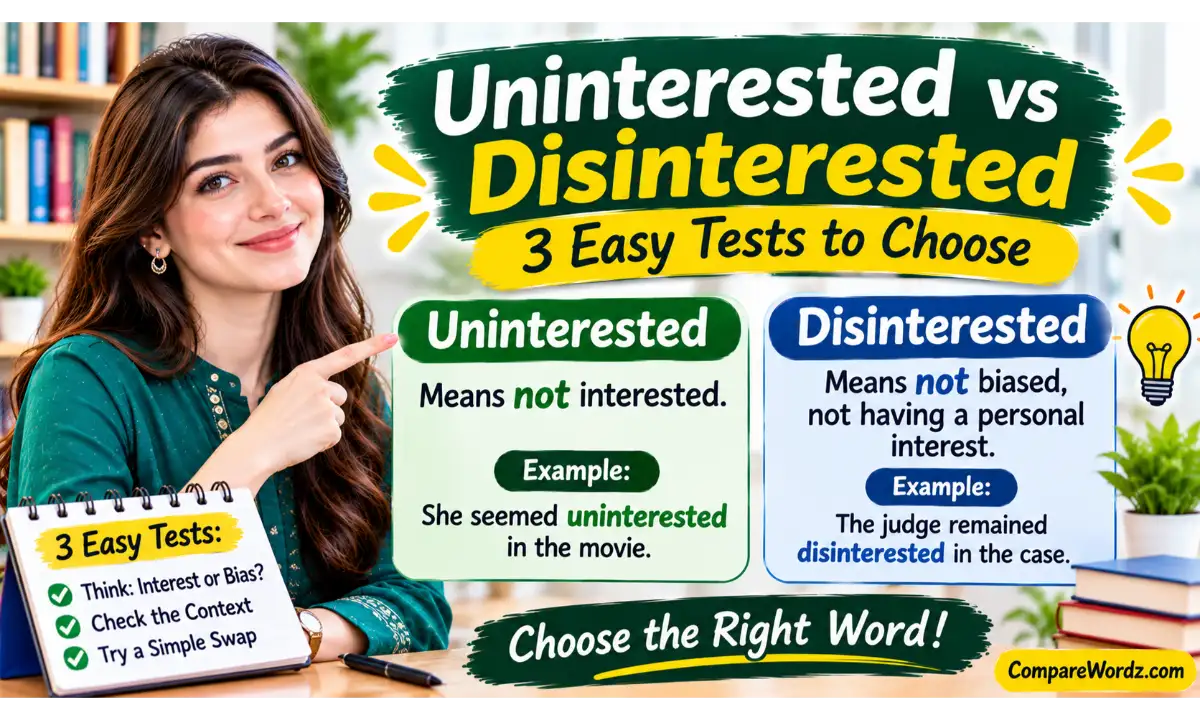
Imagine sitting through a movie that you find boring. You might say, “I’m uninterested in this movie.” But what if someone says, “I’m disinterested in this movie”? Are both sentences correct?
The difference between uninterested vs disinterested is easier to understand than it first appears. Uninterested usually describes someone who has little or no interest in something. Disinterested traditionally describes someone who is impartial and has no personal stake in a decision.
However, there is a small complication: dictionaries also recognize disinterested as meaning not interested. This overlapping usage has caused confusion among writers, students, and even experienced English speakers.
In this guide, you’ll discover the meanings of both words, three simple tests, common mistakes, and practical examples to help you choose the right word.
Quick Answer: Uninterested vs Disinterested
The main difference comes down to interest and impartiality.
- Uninterested: Not interested in something or someone.
- Disinterested: Impartial, unbiased, or free from personal involvement in an outcome.
Examples:
- Emma was uninterested in the football match.
- The company hired a disinterested mediator.
Emma does not enjoy watching football, while the mediator is expected to remain fair and neutral.
Easy rule: Use uninterested for a lack of interest and disinterested for impartiality.
Uninterested Meaning and Examples
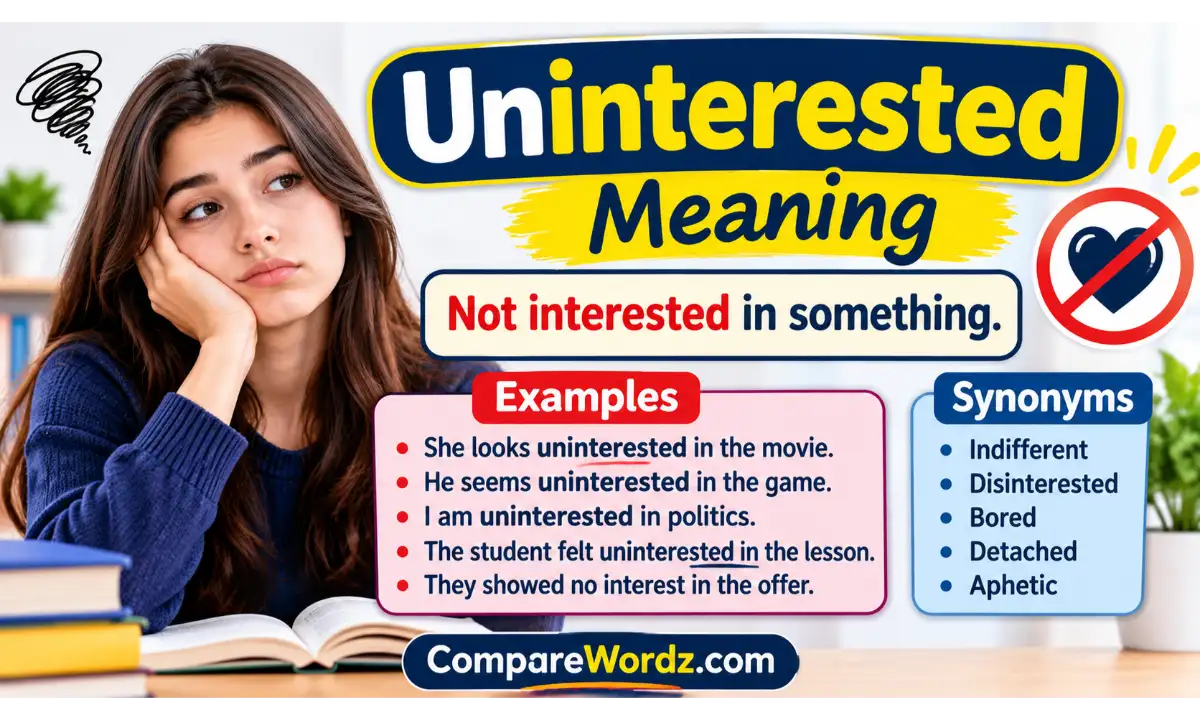
Uninterested is an adjective that describes someone who lacks curiosity, enthusiasm, or attention toward a particular subject or activity.
It often appears with the preposition in and can describe a temporary feeling or a general lack of enthusiasm.
Examples of uninterested in sentences:
- My brother is uninterested in celebrity news.
- The students looked uninterested during the long lecture.
- Sarah became uninterested in the project after several delays.
- He was uninterested in joining the school competition.
- The children seemed uninterested in visiting the museum.
In these examples, the people show little desire to participate or pay attention.
For the full dictionary definition, visit Merriam-Webster’s Uninterested entry.
Disinterested Meaning and Examples
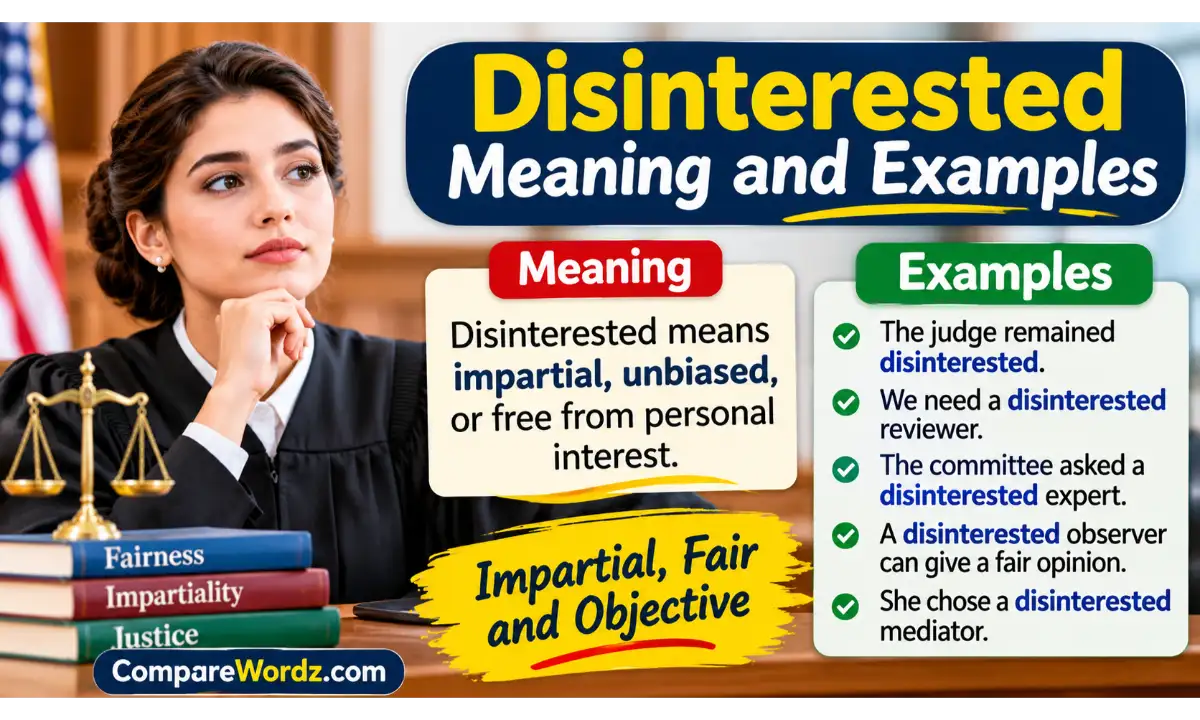
Disinterested traditionally means impartial or free from personal bias. It describes someone who can consider a situation fairly without having something personal to gain or lose.
The word commonly appears in discussions about judges, mediators, reviewers, and decision-makers.
Examples of disinterested in sentences:
- The company appointed a disinterested mediator to settle the dispute.
- The school selected a disinterested judge for the competition.
- We need a disinterested expert to review the report.
- Both parties agreed to involve a disinterested third party.
- The committee requested an independent and disinterested assessment.
A disinterested person does not have to be bored or uninterested in the subject. They simply need to approach the matter without personal bias.
Uninterested vs Disinterested: 3 Easy Tests
Still unsure which word to choose? These three simple tests can help you make the right decision.
Test 1: Ask What You Really Mean
First, identify the situation.
Are you describing someone who lacks enthusiasm, or someone who needs to remain neutral?
- Lack of enthusiasm: The audience was uninterested in the presentation.
- Neutrality: The organization hired a disinterested investigator.
This is the quickest way to separate the two meanings.
Test 2: Replace It With Not Interested
Try replacing the word with the phrase not interested.
If the sentence still expresses your intended meaning, uninterested is generally the better choice.
Example:
- Original: Jack was uninterested in learning Spanish.
- Replacement: Jack was not interested in learning Spanish.
Both sentences communicate the same idea.
Now consider this sentence:
- We need a disinterested reviewer.
Replacing disinterested with not interested changes the meaning. The reviewer needs to be impartial, not someone who lacks enthusiasm.
Test 3: Replace It With Impartial
Try substituting impartial or unbiased.
If the sentence still makes sense, disinterested is likely the right choice.
Example:
- Original: The judge remained disinterested.
- Replacement: The judge remained impartial.
Both sentences suggest that the judge is not favoring either side.
Remember: Not interested means uninterested; impartial means disinterested.
Uninterested vs Disinterested at a Glance
| Feature | Uninterested | Disinterested |
|---|---|---|
| Main meaning | Lacking interest | Impartial or unbiased |
| Part of speech | Adjective | Adjective |
| Common context | Hobbies, subjects, activities | Decisions, disputes, evaluations |
| Example | Uninterested in music | A disinterested judge |
| Formal usage | Clear choice for lack of interest | Clear choice for impartiality |
This distinction is the safest approach when writing for an academic or professional audience.
Why Are Uninterested and Disinterested Confused?
The confusion has an interesting history. The meanings of these words have changed over time, and their earliest uses did not follow the distinction commonly taught today.
According to Merriam-Webster, uninterested originally appeared with a meaning related to impartiality, while disinterested initially referred to a lack of interest.
Over the centuries, their meanings developed and overlapped. Dictionaries now recognize both the impartial and not-interested senses of disinterested.
This explains why you may encounter sentences such as:
- She seemed disinterested in the conversation.
- The committee appointed a disinterested observer.
Both uses are recorded in modern dictionaries, but they communicate different ideas.
The traditional distinction remains useful because it helps writers avoid ambiguity.
Can Disinterested Mean Not Interested?
Yes. Modern dictionaries recognize disinterested as meaning not interested, so this usage is not automatically incorrect.
However, some readers, teachers, and editors prefer the traditional distinction. They reserve disinterested for impartiality and use uninterested for a lack of interest.
Here is a practical approach:
- Academic writing: Prefer uninterested when describing a lack of interest.
- Professional communication: Use disinterested to describe an impartial person.
- Casual conversation: Both meanings may be understood from context.
- When clarity is essential: Use direct expressions such as not interested or free from bias.
For another explanation of this usage debate, read Dictionary.com’s guide to Disinterested vs. Uninterested.
Uninterested and Disinterested Grammar
Both words are adjectives, meaning they describe people or things. However, their usual sentence patterns are slightly different.
How to Use Uninterested
The common structure is:
Uninterested + in + noun or -ing verb
Examples:
- She is uninterested in photography.
- They were uninterested in attending the ceremony.
- He seems uninterested in learning another language.
How to Use Disinterested
When it means impartial, the word commonly appears before a noun or after a linking verb.
Examples:
- A disinterested observer watched the discussion.
- The mediator remained disinterested throughout the negotiations.
- Her assessment was disinterested and objective.
The word can also appear with in when it means not interested, although some readers may object to this use.
Related forms include:
- Disinterestedly: An adverb meaning impartially.
- Disinterestedness: A noun describing impartiality or freedom from personal interest.
Uninterested vs Disinterested Synonyms and Antonyms
Choosing the right synonym can make your writing more precise.
| Word | Synonyms | Antonyms |
|---|---|---|
| Uninterested | Indifferent, apathetic, unconcerned | Interested, enthusiastic |
| Disinterested (impartial) | Neutral, unbiased, objective | Biased, partial |
Here is what some of these alternatives mean:
- Indifferent: Having little preference or concern.
- Apathetic: Showing little enthusiasm or motivation.
- Unconcerned: Not worried or involved.
- Neutral: Not supporting either side.
- Unbiased: Free from unfair preference.
- Objective: Guided by facts rather than personal feelings.
These words have related meanings, but they are not interchangeable in every situation.
Uninterested vs Disinterested Pronunciation
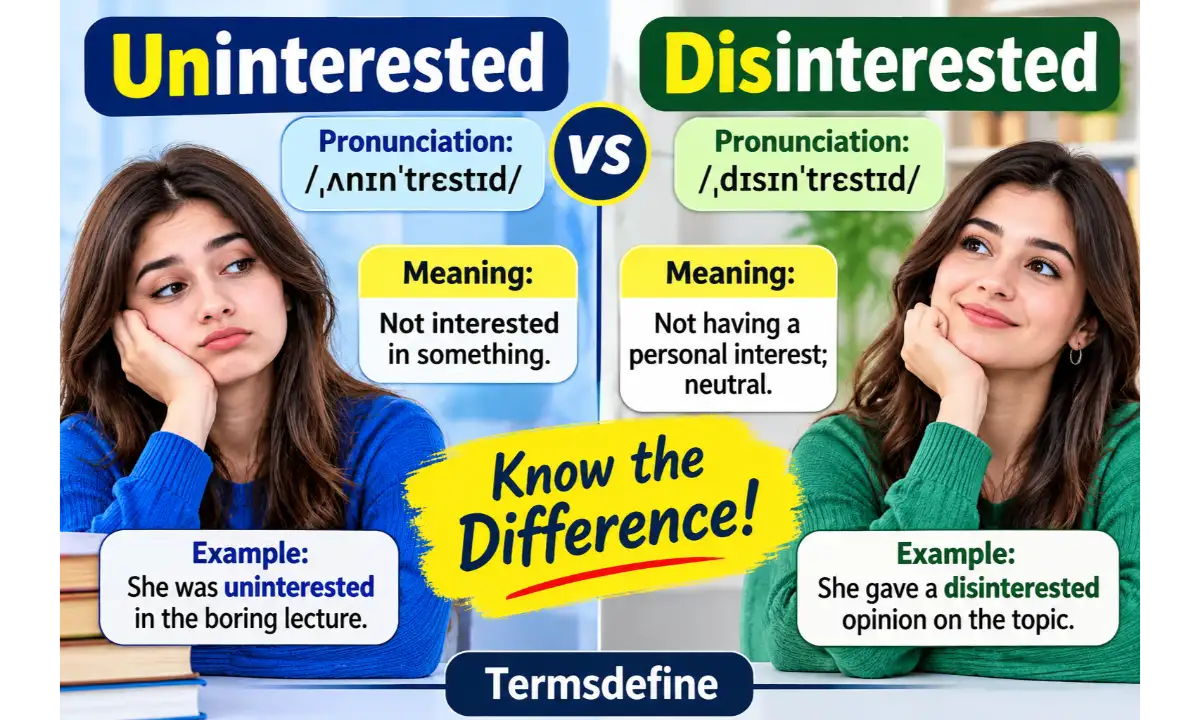
Both words share a similar ending, but their beginnings are different.
- Uninterested: un-IN-truh-stid.
- Disinterested: dis-IN-truh-stid.
The main stress usually falls on the syllable IN. Pronunciation can vary slightly between English accents.
Both spellings are used in American and British English.
Common Mistakes to Avoid
Even experienced writers sometimes mix up these adjectives. The following examples show how to correct common mistakes.
| Unclear or incorrect | Better alternative | Explanation |
|---|---|---|
| We need an uninterested judge. | We need a disinterested judge. | The judge should be impartial. |
| I was disinterested in the lecture. | I was uninterested in the lecture. | The intended meaning is a lack of interest. |
| The presentation was uninterested. | The presentation was uninteresting. | The presentation fails to attract interest. |
| The reviewer was disinterested because she was bored. | The reviewer was uninterested because she was bored. | The sentence describes a lack of engagement. |
| The mediator was uninterested in either side’s claims. | The mediator was impartial toward both sides. | The revised version makes the intended meaning clearer. |
One additional distinction is worth remembering:
- Uninterested: A person lacks interest.
- Uninteresting: Something fails to attract interest.
For example, a student may be uninterested in a lesson because the lesson is uninteresting.
Uninterested vs Disinterested Examples in Real Life
Understanding these words becomes easier when you see them in everyday situations.
At school: A student may be uninterested in mathematics but enjoy science.
At work: A company may appoint a disinterested reviewer to assess an employee’s performance fairly.
In sports: Someone who dislikes cricket may be uninterested in watching a match.
During a disagreement: Two neighbors may ask a disinterested mediator to help settle a property dispute.
In journalism: A news organization may consult a disinterested expert to examine competing claims.
In recruitment: An independent panel can provide a disinterested assessment of job applicants.
Notice how the context determines the meaning. One word describes personal interest, while the other traditionally describes fairness and neutrality.
Frequently Asked Questions
What is the difference between uninterested and disinterested?
Uninterested means lacking interest or enthusiasm. Disinterested traditionally means impartial or free from personal bias. Although dictionaries recognize both meanings of disinterested, the traditional distinction is useful in formal writing.
Can disinterested mean not interested?
Yes. Major dictionaries record this meaning, although some readers and editors object to it. Using uninterested for a lack of interest is generally the clearest choice.
Is uninterested the opposite of interested?
Yes. Uninterested describes someone who lacks interest in a subject or activity. For example, “He is uninterested in politics” means politics does not interest him.
What is a disinterested party?
A disinterested party is someone who has no personal stake in a dispute or decision and can approach the situation impartially. A neutral mediator is a common example.
Which word should I use in formal writing?
Use uninterested for a lack of interest and disinterested for impartiality. This conventional distinction is widely understood and helps prevent misunderstandings.
Final Verdict: Uninterested vs Disinterested
Choosing between these two words becomes simple when you focus on the meaning instead of their similar spelling.
Use uninterested to describe someone who lacks curiosity, attention, or enthusiasm. Use disinterested to describe someone who can assess a situation without personal bias.
Although dictionaries recognize both meanings of disinterested, the traditional distinction remains a reliable choice for academic, professional, and everyday writing. Other pairs, such as effect vs affect, also come down to meaning rather than spelling.
Remember this simple rule: A bored student is uninterested, but an impartial judge is disinterested.
Last updated: November 2026

I’m MK Jan Mustafa Kamal, the author of CompareWordz.com, specializing in English linguistics, word meanings, spelling, and language usage.
I hold an M.A. in English and have 8 years of experience in English language and vocabulary studies. My goal is to explain confusing words, spelling differences, grammar rules, and meanings in clear, simple, and accurate language. I focus on providing well-researched, fact-checked, and easy-to-understand content that helps readers use English with confidence. Through CompareWordz.com, I aim to make learning English words and their correct usage easier for everyone.