

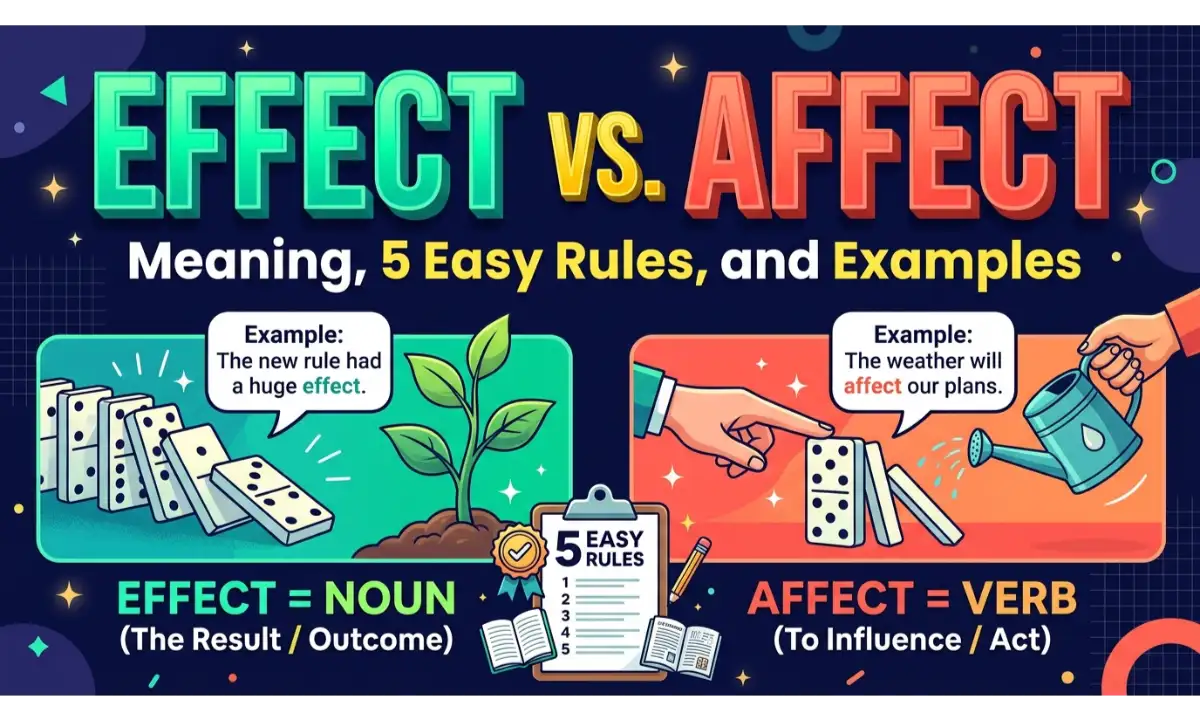
Have you ever paused while writing an email, school assignment, or website article because you could not decide between effect vs. affect?
These words look and sound similar, but they usually have different meanings and grammatical roles. The good news is that a few simple rules can help you choose the correct word.
In everyday English, affect is usually a verb meaning to influence or change something, while effect is usually a noun meaning a result or outcome.
This guide explains their meanings, pronunciation, common mistakes, and real-life examples.
You will also learn how to use affect and effect in sentences, understand phrases such as “have an effect on,” and remember the difference when writing for school, work, or everyday conversations.
Effect vs. Affect: Quick Answer
Affect is usually a verb meaning to influence or change something. Effect is usually a noun meaning a result or outcome. For example, “Lack of sleep can affect your mood” describes an influence, while “Lack of sleep can have an effect on your mood” describes a result or impact.
Easy memory trick: Affect = action; effect = end result. This rule works in most everyday situations, although both words have less common uses.
What Do Affect and Effect Mean?
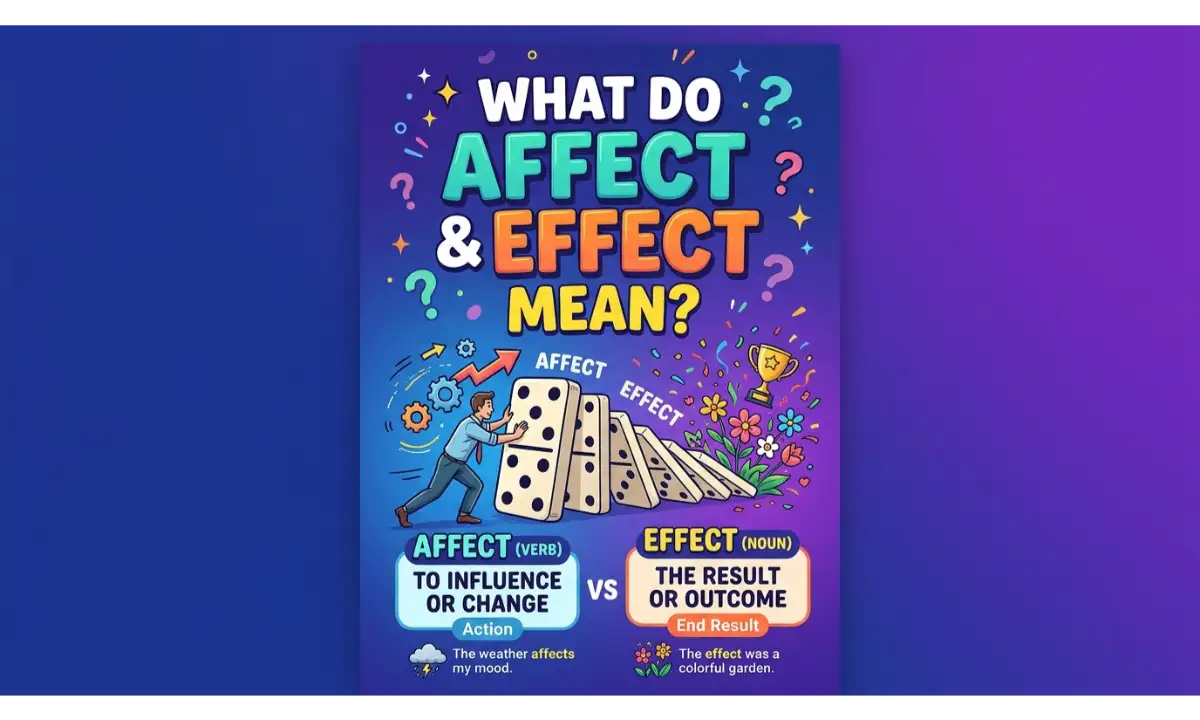
What Does Affect Mean?
Affect usually means to influence, change, or make a difference to someone or something. It describes an action or influence.
For example, heavy rain can affect traffic. The rain changes travel conditions, so affect is the correct word.
Examples:
- Lack of sleep can affect your concentration.
- The weather affected our travel plans.
- New rules may affect small businesses.
- Your attitude can affect how people treat you.
- Rising prices affect household budgets.
Common synonyms for affect include influence, change, alter, and shape.
What Does Effect Mean?
Effect usually means the result or outcome of an action, event, or change. It most often functions as a noun.
For example, “The effect of heavy rain was a traffic delay” identifies the result of the rain.
Examples:
- The medicine had a positive effect on her health.
- The new rules had an effect on small businesses.
- One effect of stress is difficulty sleeping.
- The teacher explained the effects of pollution.
- The price increase had a noticeable effect on sales.
Common synonyms for effect include result, outcome, consequence, and impact.
The Difference Between Affect and Effect in One Example
Consider these two sentences:
- Affect: The news affected Maria.
- Effect: The effect of the news was sadness.
In the first sentence, affected describes how the news influenced Maria. In the second, effect identifies the result.
The words are related, but they perform different jobs in these sentences.
Affect vs. Effect in a Sentence
Seeing both words in complete sentences is one of the easiest ways to understand their difference.
| Affect example | Effect example |
|---|---|
| Poor sleep affects my memory. | Poor sleep has an effect on my memory. |
| The weather affected our plans. | The effect of the weather was a delay. |
| Stress can affect your mood. | Stress can have an effect on your mood. |
| The policy affected employees. | The policy had an effect on employees. |
| Noise affects concentration. | Noise has an effect on concentration. |
Notice the sentence patterns. Affect often comes directly before the person or thing being influenced. Effect often follows words such as an, the, positive, or negative.
Will It Affect Me or Effect Me?
“Will it affect me?” is the correct choice when you want to ask whether something will influence, change, or have an impact on you.
Examples:
- Will the new schedule affect me?
- Will this decision affect my job?
- Will the weather affect our trip?
- Will the price increase affect my budget?
In ordinary English, effect me is generally incorrect when you mean “influence me.” However, effect can be used as a verb meaning to bring something about, as in “The changes will effect a major improvement.” This is a different and more formal meaning.
Quick tip: If you can replace the word with influence, use affect in most everyday sentences.
Affect vs. Effect on Emotions
Both words can describe situations involving emotions, but they work differently.
Use affect when describing how something influences a person’s feelings. Use effect when naming the emotional result.
Examples:
- Negative comments can affect your confidence.
- The argument affected her mood.
- The good news had a positive effect on his emotions.
- Lack of sleep can affect emotional well-being.
- One effect of prolonged stress may be irritability.
A useful comparison is “The criticism affected her” and “The effect of the criticism was disappointment.” The first describes influence; the second identifies an outcome.
There is also a specialized psychological meaning of affect. In clinical contexts, it can refer to the observable expression of emotion, such as facial expressions or emotional tone. This meaning differs from the everyday verb affect.
Effect or Affect on Someone?
The correct choice depends on the sentence structure and the meaning you want to express.
Use affect someone when describing influence:
- Your words can affect someone deeply.
- The decision may affect everyone on the team.
- Changes in routine can affect a child.
Use have an effect on someone when describing an impact or result:
- Your words can have a lasting effect on someone.
- The decision had a positive effect on the team.
- The experience had a strong effect on the child.
Both forms are correct. The key difference is grammatical: affect functions as a verb in the first pattern, while effect is a noun in the second.
Affect On or Effect On: Which Is Correct?
Both expressions can appear in correct English, but they are used in different sentence patterns.
Affect on is not normally the correct phrase when you mean that something influences something else. In that situation, use affect directly with its object.
- Incorrect: Stress can affect on your sleep.
- Correct: Stress can affect your sleep.
Effect on is correct when effect is a noun:
- The effect of stress on sleep can be significant.
- The new policy had an effect on staff morale.
- Researchers studied the effect of noise on concentration.
Remember these patterns:
- Affect something: Stress can affect your sleep.
- Have an effect on something: Stress can have an effect on your sleep.
These patterns help you avoid one of the most common mistakes involving the two words.
Side Effect vs. Affect: What Is the Difference?
A side effect is an additional result of a medicine, treatment, action, or other event. It is usually a noun phrase, so effect is the correct word.
Examples:
- Drowsiness can be a side effect of some medicines.
- The software update had an unexpected side effect.
- One side effect of the change was increased workload.
By contrast, affect is normally a verb describing influence:
- Lack of sleep can affect concentration.
- The medicine may affect how someone feels.
The phrase side affect is generally incorrect when referring to an additional result. Use side effect.
Cause and Effect or Affect?
Cause and effect is the correct expression when discussing why something happens and the result that follows. Here, effect is a noun meaning outcome.
Examples:
- The lesson explains cause and effect.
- Poor sleep can contribute to stress; stress may then affect concentration.
- The report examines the causes of pollution and its effects on public health.
In the second example, affect is a verb because it describes how stress influences concentration. In the third, effects is a noun because it identifies outcomes.
Use cause and effect when talking about relationships between events, not cause and affect.
Five Easy Rules to Remember Affect vs. Effect
Rule 1: Use Affect When You Mean Influence
If something changes, influences, or makes a difference to something else, affect is usually correct.
Examples:
- Lack of sleep can affect your memory.
- The weather affected our travel plans.
- Your choices affect your future.
Quick test: Replace affect with influence. If the sentence still makes sense, affect is probably correct.
Rule 2: Use Effect When You Mean Result
If you are naming what happened because of an action or event, use effect as a noun.
Examples:
- The effect of the storm was serious.
- The new schedule had a positive effect on productivity.
- One effect of exercise is better sleep.
Quick test: Replace effect with result. If the sentence still makes sense, effect is probably correct.
Rule 3: Remember “Have an Effect On”
The expression have an effect on means that something produces a result or makes a difference.
Examples:
- Too much screen time can have an effect on sleep.
- The price increase had an effect on sales.
- Her advice had a positive effect on me.
You can often express the same idea with affect: “The price increase affected sales.”
Rule 4: Learn the Exceptions
Although affect is usually a verb, it can be a noun in psychology, referring to the observable expression of emotion.
Example: “The clinician observed a flat affect.”
Similarly, effect can be a verb meaning to bring about or accomplish something.
Example: “The new manager hopes to effect meaningful change.”
These uses are less common in everyday writing, but recognizing them will help you understand more advanced English.
Rule 5: Check the Words Around It
The surrounding words often reveal which word you need.
- Can affect: The delay can affect our plans.
- An effect: The delay had an effect on our plans.
- Affected by: The crops were affected by the drought.
- Effects of: The effects of pollution can be harmful.
Learning these common patterns is often easier than memorizing complicated grammar rules.
Common Mistakes With Affect and Effect
Using Effect When You Mean Influence
Incorrect: The noise effected my sleep.
Correct: The noise affected my sleep.
Use affected because the intended meaning is that the noise influenced sleep.
Using Affect When You Mean Result
Incorrect: The affect of the medicine was helpful.
Correct: The effect of the medicine was helpful.
Use effect because the sentence identifies a result.
Forgetting “An” Before Effect
Incorrect: The change had effect on sales.
Correct: The change had an effect on sales.
The common expression is have an effect on something.
Confusing Affected and Effected
These words are not interchangeable.
- Affected: The weather affected the event. (The weather influenced it.)
- Effected: The team effected a change. (The team brought about a change.)
Use affected when you mean influenced or changed. Use effected when you mean brought about or accomplished.
Assuming Effect Is Always a Noun
Incorrect for the intended meaning: The government hopes to affect a major change.
Correct: The government hopes to effect a major change.
In this formal sentence, effect means to bring about. The correct choice always depends on the intended meaning and grammatical role.
Affect vs. Effect in Everyday Life, School, and Work
These words appear in many kinds of writing. The same basic distinction applies in personal messages, academic assignments, professional emails, and online content.
| Context | Affect example | Effect example |
|---|---|---|
| School | Poor sleep affects learning. | Poor sleep has an effect on learning. |
| Work | Stress can affect performance. | Stress can have an effect on performance. |
| Health | Exercise can affect sleep quality. | Exercise may have a positive effect on sleep. |
| Technology | The update may affect battery life. | The update had an unexpected effect. |
| Social media | Negative comments can affect confidence. | Negative comments can have a lasting effect. |
| Business | Rising costs affect company profits. | The change had an effect on profits. |
| Daily life | Cold weather affects my mood. | The effect of cold weather was clear. |
In workplace emails, use affect to describe an influence on a deadline, project, or team. Use effect to identify the outcome of a decision. In academic writing, the same rule helps you explain causes, changes, and results clearly.
British English vs. American English Usage
The standard meanings and grammatical uses of affect and effect are essentially the same in British and American English. Writers in both varieties usually use affect as a verb and effect as a noun.
| Feature | British English | American English |
|---|---|---|
| Affect | To influence | To influence |
| Effect | A result | A result |
| Spelling | Affect, effect | Affect, effect |
| Everyday usage | Same basic distinction | Same basic distinction |
For example, a British student might write, “The weather affected our plans,” and an American student would use the same sentence.
There is no spelling change to make when writing for readers in the UK, US, Canada, Australia, or other English-speaking regions. Choose the word that matches the meaning of your sentence.
A Simple Trick to Remember Affect vs. Effect
Think of A in affect as standing for action. Think of E in effect as standing for end result.
- Affect = Action: The rain affected our plans.
- Effect = End result: The effect was a delay.
You can also use two replacement words:
- Replace affect with influence.
- Replace effect with result.
For example, “The change affected sales” becomes “The change influenced sales.” Meanwhile, “The change had an effect on sales” becomes “The change had a result on sales,” although “had a result on” is less natural than the original phrase.
Remember that this shortcut covers the common uses, not every possible use. The verb effect and the psychological noun affect are important exceptions.
Frequently Asked Questions About Effect vs. Affect
What is the easiest way to remember affect vs. effect?
Affect usually means influence, while effect usually means result. Remember A for action and E for end result. This shortcut works for most everyday sentences.
Is it “will it affect me” or “will it effect me”?
Use “Will it affect me?” when asking whether something will influence you. Effect can be a verb meaning to bring about, but “effect me” is not the usual way to express personal influence.
Is it the effect or affect of something?
Use the effect of something when referring to its result. For example, “The effect of the storm was widespread flooding.” Use affect when describing influence: “The storm affected many homes.”
Can affect be a noun and effect be a verb?
Yes. In psychology, affect can mean the observable expression of emotion. As a verb, effect means to bring about or accomplish something, as in “The team hopes to effect change.”
What is the difference between affected and effected?
Affected usually means influenced or changed. Effected means brought about or accomplished when used as a verb. For example, “The weather affected the event” means the weather influenced it, while “The team effected a change” means the team brought about a change.
Final Thoughts on Effect vs. Affect
Understanding effect vs. affect becomes much easier when you focus on meaning rather than spelling. Affect usually describes an influence or action, while effect usually names a result. The phrases “affect something,” “have an effect on something,” and “the effects of something” are useful patterns to remember.
Keep the action-and-result trick in mind, check the words around each term, and read your sentence again before choosing. With a little practice, you can use affect and effect correctly in school assignments, professional emails, everyday messages, and online writing.

Hi, I’m Toseef Mustafa, the creator of CompareWordz.com and a qualified English linguistics professional. My expertise includes English vocabulary, spelling, grammar, word meanings, and commonly confused words. I aim to explain language differences through clear explanations, accurate information, and practical examples. My goal is to help readers understand English better and use the right words with confidence.