

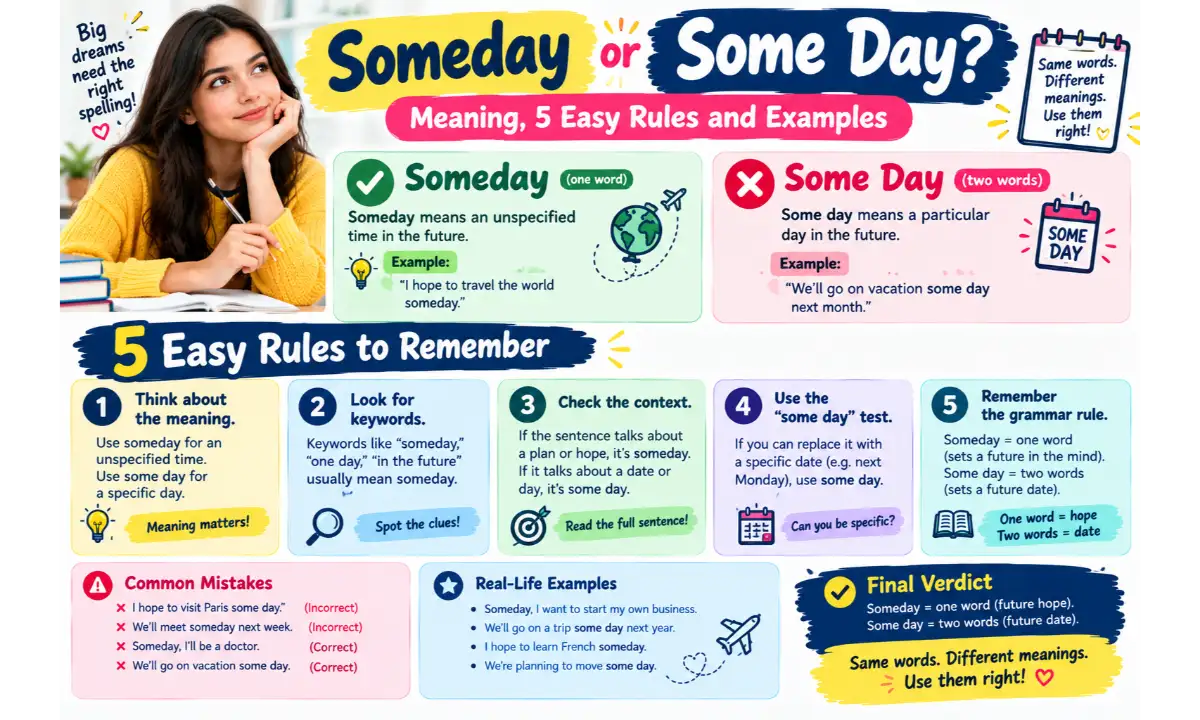
Have you ever wondered if you should write someday or some day? Both forms are correct in English, but they have slightly different meanings depending on the context. Someday usually refers to an unspecified time in the future, while some day can refer to a particular or unspecified day.
Understanding someday or some day helps you choose the correct expression in essays, emails, messages, and social media posts. In this guide, you’ll learn the meaning of each form, discover five easy rules, and explore clear examples of how to use them correctly.
By the end, you’ll understand someday or some day and know how to avoid common mistakes. You’ll also find useful synonyms and a simple memory trick to help you choose the right spelling in everyday English.
Quick Answer: Someday or Some Day?
Someday is usually used as an adverb meaning at an unspecified time in the future.
- I hope to travel to Japan someday.
- Someday, I want to write a book.
Some day uses two words and can refer to an unspecified or particular day, depending on the context.
- We should spend some day together when we are both free.
- Some day in the future, you may understand why I made that decision.
In many future-focused sentences, both forms may be possible. However, someday is generally the more natural choice when you mean “at an unspecified time in the future.”
What Does Someday Mean?

Someday means at an unknown or unspecified time in the future. It often expresses a hope, dream, plan, or possibility without giving an exact date.
For example, “I want to visit Italy someday” means the speaker hopes to visit Italy in the future but does not know when.
People commonly use someday when discussing personal goals, future ambitions, and things they hope will happen.
Examples:
- I hope to become a successful writer someday.
- Someday, we will look back on these memories and smile.
- She wants to open her own business someday.
- Maybe someday, we will meet again.
In these examples, someday refers to an uncertain future time rather than one specific day.
What Does Some Day Mean?
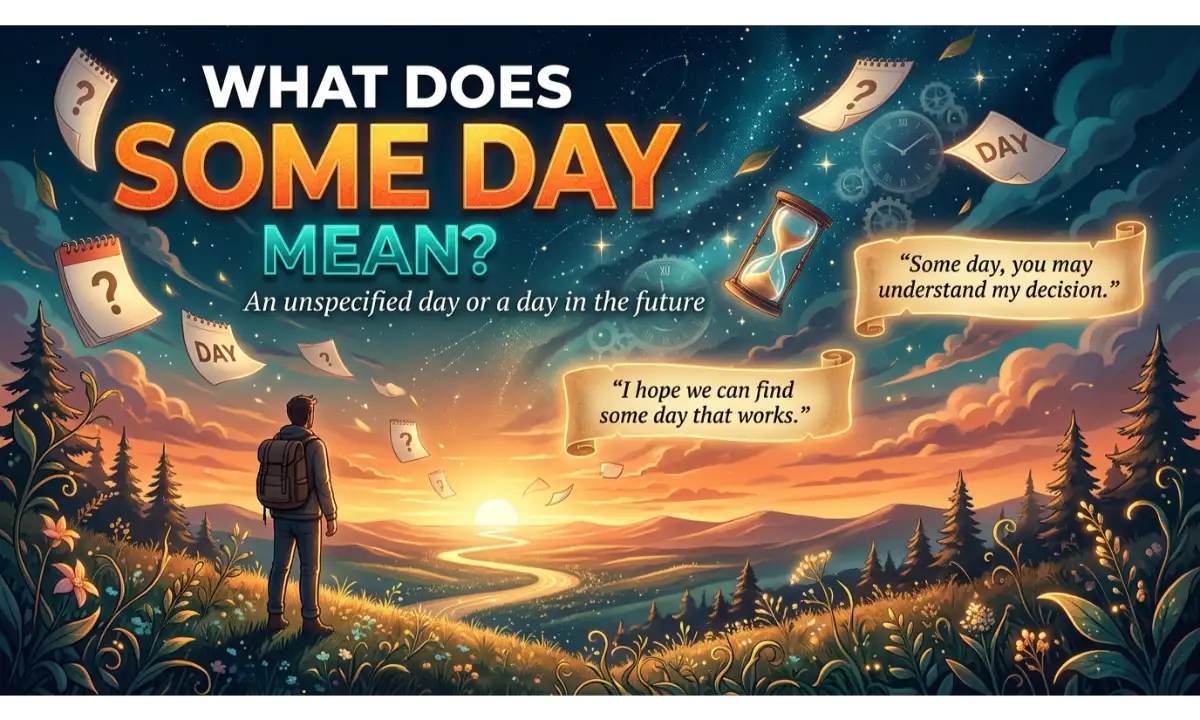
Some day is a two-word expression that can refer to an unspecified day or a day identified by the surrounding context. It may emphasize the idea of a day rather than an indefinite point in the future.
For example, “We should spend some day together” is understandable, but “We should spend a day together” sounds more natural in ordinary English. A clearer example is “Some day in the future, we may look back on this experience differently.”
Examples:
- Some day, you may understand my decision.
- I hope we can find some day that works for everyone.
- Some day in the future, this technology may become common.
Remember that some day is not automatically wrong when discussing the future. The surrounding sentence determines whether the two-word form sounds natural.
Someday vs. Some Day: What Is the Difference?
The main difference is how the expression functions in a sentence.
| Someday | Some day |
|---|---|
| Usually functions as an adverb. | Uses the determiner “some” with the noun “day.” |
| Commonly means at an unspecified future time. | Refers to a day, sometimes with emphasis on the day itself. |
| Often appears with hopes and ambitions. | Can appear when discussing a day that has not been identified. |
| Example: I will visit Paris someday. | Example: We need to find some day that suits everyone. |
These are useful patterns, not an absolute rule that the two forms can never overlap. In some contexts, writers use both to express a similar future idea.
Someday or Some Day: Which Spelling Is Correct?

Both spellings are correct in English. The best choice depends on the meaning and sentence structure.
Use someday when you mean “at an unspecified time in the future.” This is the conventional choice in sentences about dreams, hopes, and future possibilities.
Example: “I hope to see the Northern Lights someday.”
Use some day when you are referring to a day as a noun or when the sentence naturally emphasizes a day that has not been identified.
Example: “We need to choose some day for the meeting.”
In the second example, “a day” or “a date” may sound more natural, depending on the intended meaning. Always choose the expression that makes the sentence clear.
Someday or Some Day Examples
These examples show how both forms can appear in natural English.
Someday examples:
- I want to learn how to play the piano someday.
- Someday, I hope to live near the ocean.
- He believes his hard work will pay off someday.
- Maybe someday, we will travel around the world.
- She hopes to publish her first novel someday.
Some day examples:
- Some day in the future, we may meet again.
- We need to find some day when everyone is available.
- Some day, you might see the situation differently.
- They hope to choose some day for the celebration soon.
The first group uses someday as a future-time adverb. The second group includes examples where some day refers more directly to a day or emphasizes an unspecified future day.
Someday in a Sentence
Seeing the word in complete sentences makes its meaning easier to understand.
- I hope to visit New York someday.
- Someday, she wants to start her own company.
- He promised himself that he would finish the project someday.
- Maybe someday, we will understand why things happened this way.
- I would love to see the ocean someday.
- Someday, all your practice may lead to the result you want.
- They dream of building a home together someday.
- I hope we can work together someday.
In each sentence, someday refers to an unknown time in the future. No exact date or deadline is given.
Is Someday One Word or Two Words?
Someday is one word when it means “at an unspecified time in the future.” It is the usual spelling for this meaning.
For example:
- Correct and natural: I will call you someday.
- Also possible in some contexts: Some day, I will call you.
The second sentence can be understood, but someday is generally the more conventional choice when the intended meaning is simply “at some point in the future.”
When the sentence refers to a day as a noun, the two-word form may fit better.
For example: “We need to pick some day for the event” is possible, although “We need to pick a day for the event” is often more natural.
Someday or One Day: What Is the Difference?
Someday and one day can both refer to the future, and they often overlap.
Someday usually emphasizes an uncertain future time. It is especially common when talking about hopes, dreams, or possibilities.
Example: “I hope to own a house someday.”
One day can also describe an unknown future time. It may sound more like a prediction or a story about something that will happen.
Example: “One day, you will understand why this mattered.”
Both sentences can refer to the future. The difference is mainly one of emphasis and style, not a strict grammatical boundary.
Someday Synonyms
Depending on the context, these expressions can replace someday:
- One day: At an unspecified time, often in the future.
- Eventually: After some time or a series of events.
- At some point: At an unknown time.
- In the future: At a later time.
- Sooner or later: At some time, often suggesting something is likely to happen.
- In time: After enough time has passed.
Examples:
- I hope to visit Canada someday.
- I hope to visit Canada one day.
- I hope to visit Canada at some point.
These alternatives are not always interchangeable. For instance, eventually often suggests that something will happen after a process or delay, while someday can simply express a hope.
How Do You Pronounce Someday?
Someday is commonly pronounced SUM-day, with the stress on the first syllable.
The two-word phrase some day is generally pronounced in the same way when spoken naturally. The difference between the spellings is mainly grammatical and contextual, rather than a difference in pronunciation.
Example: “Maybe someday, I will learn another language.”
When speaking, listeners usually understand the meaning from the sentence. In writing, choosing the appropriate form helps make your meaning clear.
Common Mistakes With Someday and Some Day
Writers sometimes assume that one spelling is always correct and the other is always wrong. That is not accurate.
Mistake 1: Treating some day as a spelling error
The two-word form is valid when it fits the sentence.
Mistake 2: Using some day when someday sounds more natural
For example, “I want to become a doctor someday” is more conventional than “I want to become a doctor some day.”
Mistake 3: Forcing some day into awkward sentences
Instead of writing “We should choose some day next week,” write “We should choose a day next week.”
Mistake 4: Assuming the forms always have completely separate meanings
Their meanings can overlap in future-focused sentences. Consider the sentence as a whole before deciding which form to use.
Is Someday Formal or Informal?
Someday is appropriate in both everyday and formal English. It can appear in conversations, emails, personal essays, stories, and professional writing.
Examples:
- Informal: I hope we can catch up someday.
- Professional: We hope to collaborate on a project someday.
- Personal: Someday, I want to look back and feel proud of my progress.
The word itself is not overly casual. However, in formal writing, a more precise expression such as “in the coming years” or “at a later date” may be better when the timing matters.
Someday in American and British English
Someday is widely understood in both American and British English. The one-word spelling is common when the intended meaning is an unspecified time in the future.
The two-word form, some day, is also possible in both varieties when the sentence calls for it.
There is no general rule that American English must use someday while British English must use some day. Choose the form that best matches the meaning and structure of your sentence.
What Is the Origin of Someday?
Someday developed from the combination of “some” and “day.” Over time, the expression became established as a single-word adverb meaning “at an unspecified future time.”
Its meaning reflects the idea of a future day that has not been identified. Today, people often use it when discussing ambitions, possibilities, and hopes.
For example, “Someday, I want to write a book” expresses a goal without setting a deadline.
Does Someday Mean the Same as Eventually?
Not exactly. Someday refers to an unspecified time, often in the future. Eventually means that something happens after a period of time, effort, or delay.
Compare these examples:
- “I hope to visit Australia someday.” This expresses a hope without promising that it will happen.
- “After years of practice, she eventually became a skilled pianist.” This suggests that the result came after time and effort.
Someday is often about a future possibility, while eventually emphasizes what happens after a process or delay.
Is Someday Used in Songs, Movies, or Drama Titles?
Someday also appears in song titles, movie titles, and television or drama titles. Searches for phrases such as “Someday lyrics” or “Someday or Some Day drama” may refer to a particular piece of entertainment rather than the spelling question.
If you are looking for lyrics, the artist and song title will help identify the correct work. If you are searching for a drama, include the country, actors, or platform when possible.
These are separate search intents from the grammar question. They are best handled in dedicated content if keyword research shows enough demand, rather than adding lengthy entertainment information to a spelling guide.
Frequently Asked Questions
Is Someday One Word or Two?
Someday is one word when it means “at an unspecified time in the future.” Some day is also correct when the sentence refers to a day as a noun or emphasizes an unspecified day.
Is Someday Grammatically Correct?
Yes. Someday is a standard English adverb. For example, “I hope to visit Spain someday” is grammatically correct.
Can I Write Some Day in the Future?
Yes. “Some day in the future, we may understand the decision” is a valid sentence. You could also write “Someday, we may understand the decision.”
Are Someday and One Day Interchangeable?
Often, yes. Both can refer to an unknown future time. However, one day may sound more like a prediction or narrative expression, while someday often expresses a hope or possibility.
What Is Another Word for Someday?
Depending on the context, you can use one day, eventually, at some point, or in the future. Each alternative has a slightly different nuance.
Should Someday Be Used in Formal Writing?
Yes. Someday is acceptable in formal writing, although a more precise phrase may be preferable when a deadline or time frame matters.
Final Verdict: Someday or Some Day?
Both someday and some day are correct, but they are not always equally natural in every sentence.
Use someday when you mean “at an unspecified time in the future,” especially when discussing hopes, dreams, and possibilities. Use some day when the sentence naturally refers to a day as a noun or emphasizes an unspecified day.
When in doubt, read the whole sentence and consider what you want to express. In most sentences about future hopes, someday is the clearest and most conventional choice. For more examples, see Grammarly’s guide to someday vs. some day or the Merriam-Webster entry for someday.

I’m MK Jan Mustafa Kamal, the author of CompareWordz.com, specializing in English linguistics, word meanings, spelling, and language usage.
I hold an M.A. in English and have 8 years of experience in English language and vocabulary studies. My goal is to explain confusing words, spelling differences, grammar rules, and meanings in clear, simple, and accurate language. I focus on providing well-researched, fact-checked, and easy-to-understand content that helps readers use English with confidence. Through CompareWordz.com, I aim to make learning English words and their correct usage easier for everyone.