

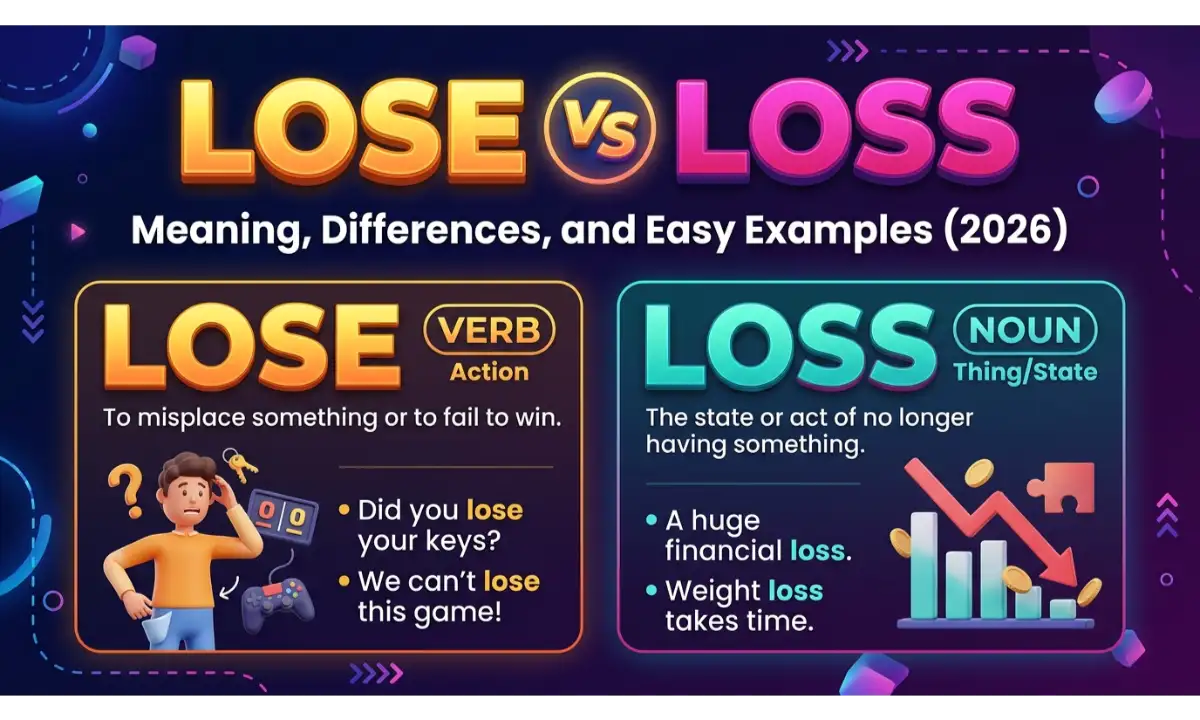
Have you ever wondered If to write lose or loss in a sentence?
You might see both words in school assignments, work emails, sports discussions, or social media posts.
Although they look similar, they have different meanings and grammar rules.
Learning the difference between lose vs loss can help you avoid common English mistakes and write with confidence.
This guide explains their meanings, pronunciation, examples, and usage in simple English.
Lose vs Loss: Quick Answer
Lose is a verb that means to misplace something, fail to win, or no longer have something.
Loss is a noun that describes the act, result, or experience of losing something.
Examples:
- I do not want to lose my phone.
- Our team suffered a painful loss.
- She wants to lose weight.
- The company reported a financial loss.
Easy rule: You lose something, but the result or experience is a loss.
What Is the Difference Between Lose and Loss?
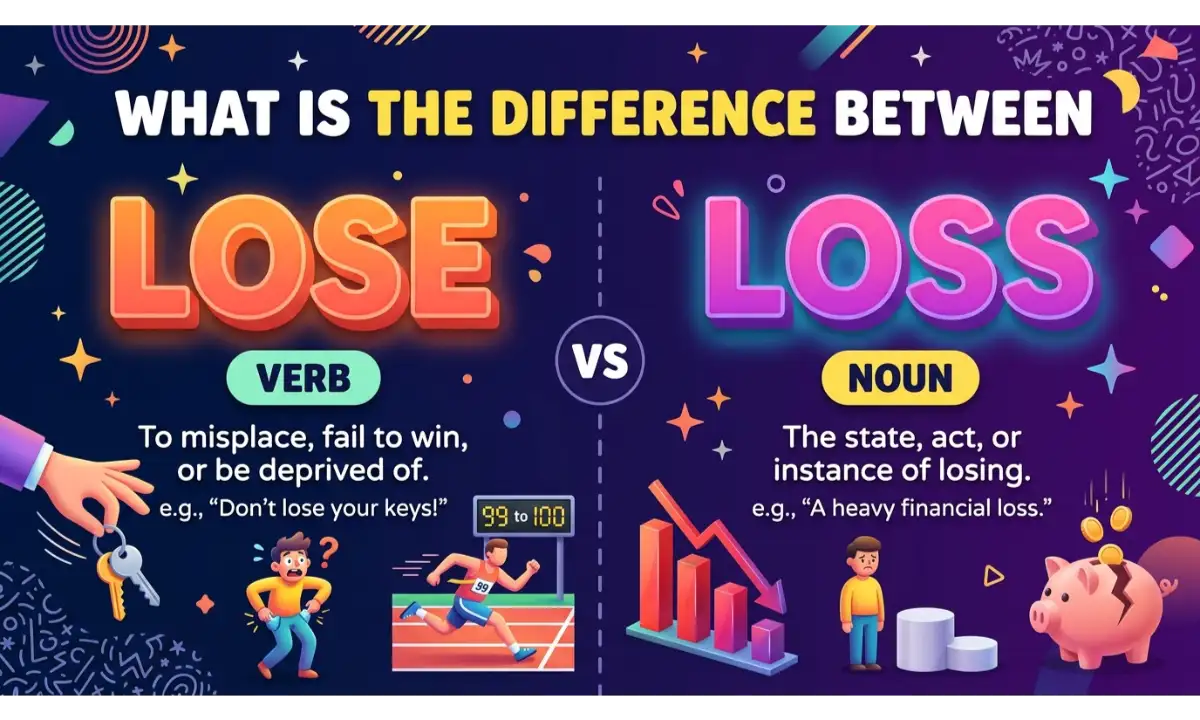
The main difference between lose and loss is their grammatical role.
Lose describes an action or change. Loss names an event, result, or experience.
For example, consider these two sentences:
- I might lose my job.
- Losing my job would be a serious loss.
The first sentence describes something that might happen. The second uses loss as a noun to describe the result.
Both words are correct English. The right choice depends on the meaning and structure of your sentence.
What Does Lose Mean?
Lose is a verb used when someone misplaces something, fails to win, or stops having something.
You can lose physical objects, money, time, opportunities, confidence, or relationships.
Examples:
- Please do not lose your house keys.
- We might lose the football match.
- He does not want to lose his job.
- You could lose money on a risky investment.
- She began to lose confidence after the mistake.
Synonyms of Lose
Depending on the context, synonyms include misplace, forfeit, waste, surrender, and fail to win.
Opposites of Lose
Common opposites include find, win, gain, keep, and retain. The best opposite depends on the sentence.
Common Forms of Lose
| Word form | Example |
|---|---|
| Lose | I never want to lose. |
| Loses | She loses her keys often. |
| Losing | We are losing the game. |
| Lost | He lost his wallet yesterday. |
Remember that lost is the past tense of lose. Loss is a separate noun.
What Does Loss Mean?
Loss is a noun that describes losing something or the result of no longer having it.
It can refer to money, competitions, relationships, health, or opportunities. It can also describe a reduction in something.
Examples:
- The team suffered its first loss.
- The business reported a financial loss.
- The loss of her pet made her sad.
- The company experienced a loss of customers.
- His weight loss took several months.
Synonyms of Loss
Depending on the situation, synonyms include defeat, reduction, decline, damage, and deprivation.
Opposites of Loss
Common opposites include gain, profit, victory, increase, and benefit.
Common Expressions With Loss
- Financial loss: Losing money in a business or investment.
- Weight loss: A reduction in body weight.
- Loss of hope: No longer feeling hopeful.
- Loss of control: Being unable to manage a situation.
- At a loss: Feeling confused or unsure what to do.
Lose vs Loss Pronunciation
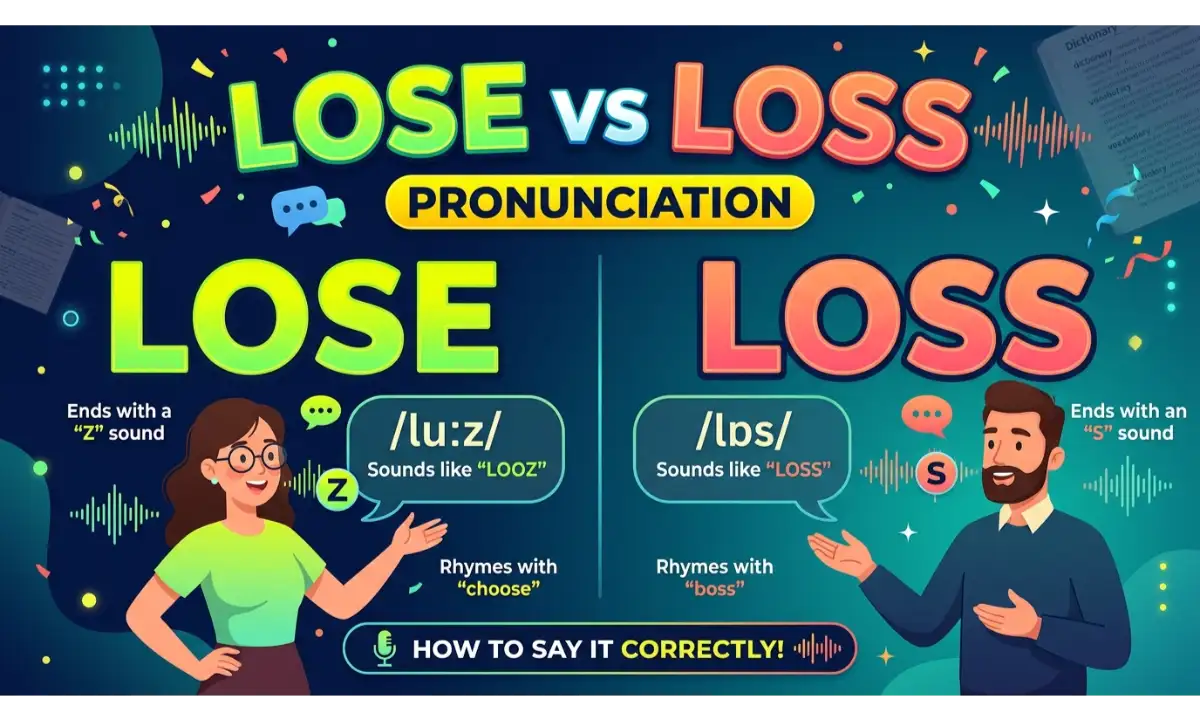
Lose and loss have different final sounds, which can help you remember them.
How to Pronounce Lose
Lose is pronounced “looz.”
- Phonetic spelling: /luːz/
- Syllables: One.
- Final sound: /z/.
Example: I do not want to lose my wallet.
How to Pronounce Loss
Loss is pronounced with a short or regional variation of the “o” sound.
- British pronunciation: /lɒs/.
- American pronunciation: Often /lɔːs/ or /lɑːs/, depending on the accent.
- Syllables: One.
- Final sound: /s/.
Example: The loss was disappointing.
Pronunciation tip: Lose ends like the “z” in zoo. Loss ends like the “s” in sun.
Lose vs Loss in British and American English
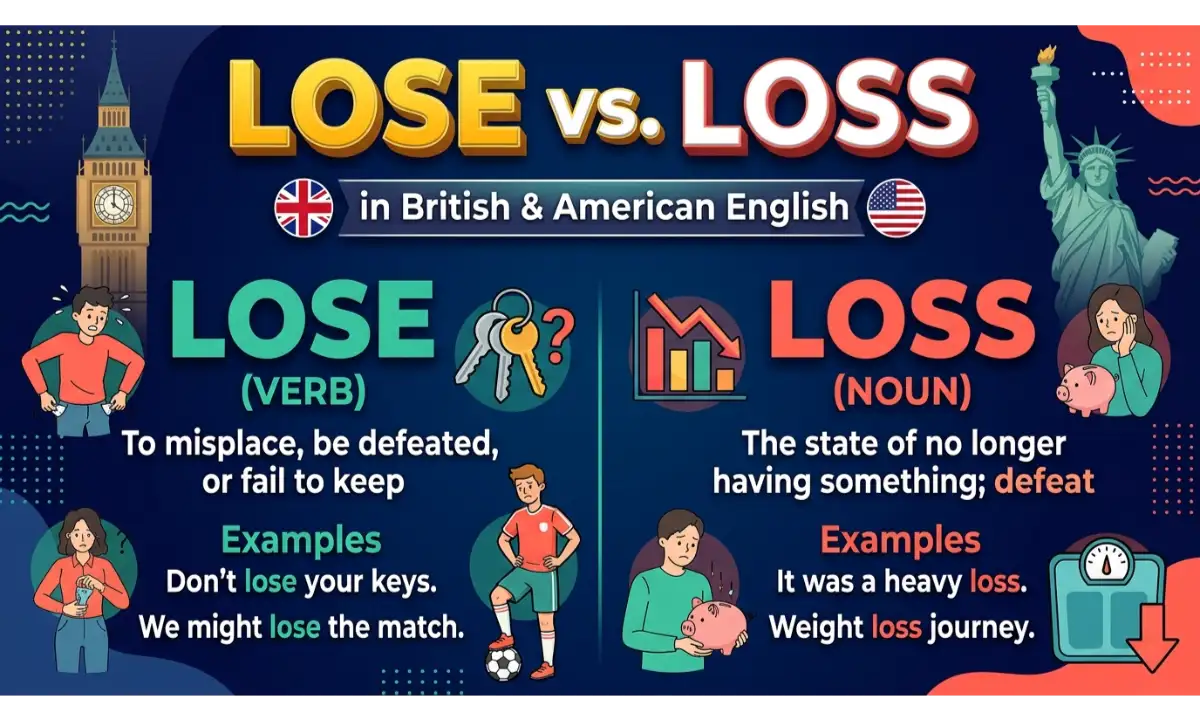
Lose and loss have the same spelling and grammatical meanings in British and American English.
| Feature | British English | American English |
|---|---|---|
| Spelling | Lose, loss | Lose, loss |
| Verb meaning | Misplace or fail to win | Misplace or fail to win |
| Noun meaning | Result of losing | Result of losing |
| Lose pronunciation | /luːz/ | /luːz/ |
| Loss pronunciation | Often /lɒs/ | Often /lɔːs/ or /lɑːs/ |
| Grammar | Same rules | Same rules |
These rules also apply to English writing in Pakistan, India, Canada, and Australia.
When Should You Use Lose or Loss?
Use lose when your sentence describes an action. Use loss when it names an event, result, or experience.
| Situation | Correct usage | Example |
|---|---|---|
| Misplacing something | Lose | Do not lose your keys. |
| Sports | Lose | We could lose the match. |
| Sports result | Loss | It was a difficult loss. |
| Health | Lose weight | She wants to lose weight. |
| Health result | Weight loss | His weight loss was gradual. |
| Business | Lose money | The company may lose money. |
| Financial result | Financial loss | The company reported a loss. |
| Emotions | Lose hope | Do not lose hope. |
| Emotional experience | Loss of hope | The loss of hope worried him. |
Is It Lose Weight or Loss Weight?
The correct phrase is lose weight when describing the action.
- Correct: I want to lose weight.
- Incorrect: I want to loss weight.
However, weight loss is correct when using a noun.
- Correct: Regular exercise can support healthy weight loss.
- Incorrect: Regular exercise can support healthy weight lose.
Is It a Lose or a Loss?
The correct expression is a loss.
- Correct: Our team suffered a loss.
- Incorrect: Our team suffered a lose.
Loss is a noun, so it can follow words such as a, the, and serious in these sentence patterns.
Common Lose vs Loss Mistakes
Mistake 1: Using Loss Instead of Lose
Incorrect: I do not want to loss my phone.
Correct: I do not want to lose my phone.
Why? The phrase “want to” requires the base form of a verb here.
Mistake 2: Using Lose Instead of Loss
Incorrect: The company suffered a big lose.
Correct: The company suffered a big loss.
Why? The sentence needs a noun to name the result.
Mistake 3: Confusing Lose With Loose
Incorrect: Do not loose your keys.
Correct: Do not lose your keys.
Lose means to misplace something. Loose means not tight.
Example: My shoelaces are loose, so I might lose my shoe.
Mistake 4: Confusing Lost With Loss
Incorrect: I loss my wallet yesterday.
Correct: I lost my wallet yesterday.
Why? Lost is the past tense of lose, while loss is a noun.
Mistake 5: Writing “Loss Weight”
Incorrect: She wants to loss weight.
Correct: She wants to lose weight.
Why? The sentence needs a verb after “wants to.”
Mistake 6: Using Lose as a Noun
Incorrect: That was our biggest lose.
Correct: That was our biggest loss.
Why? The sentence names the result of a competition, so it needs the noun loss.
Mistake 7: Using Loss as a Past-Tense Verb
Incorrect: I loss interest in the subject.
Correct: I lost interest in the subject.
Why? Use lost to describe an action that happened in the past.
Lose vs Loss Examples in Everyday Life
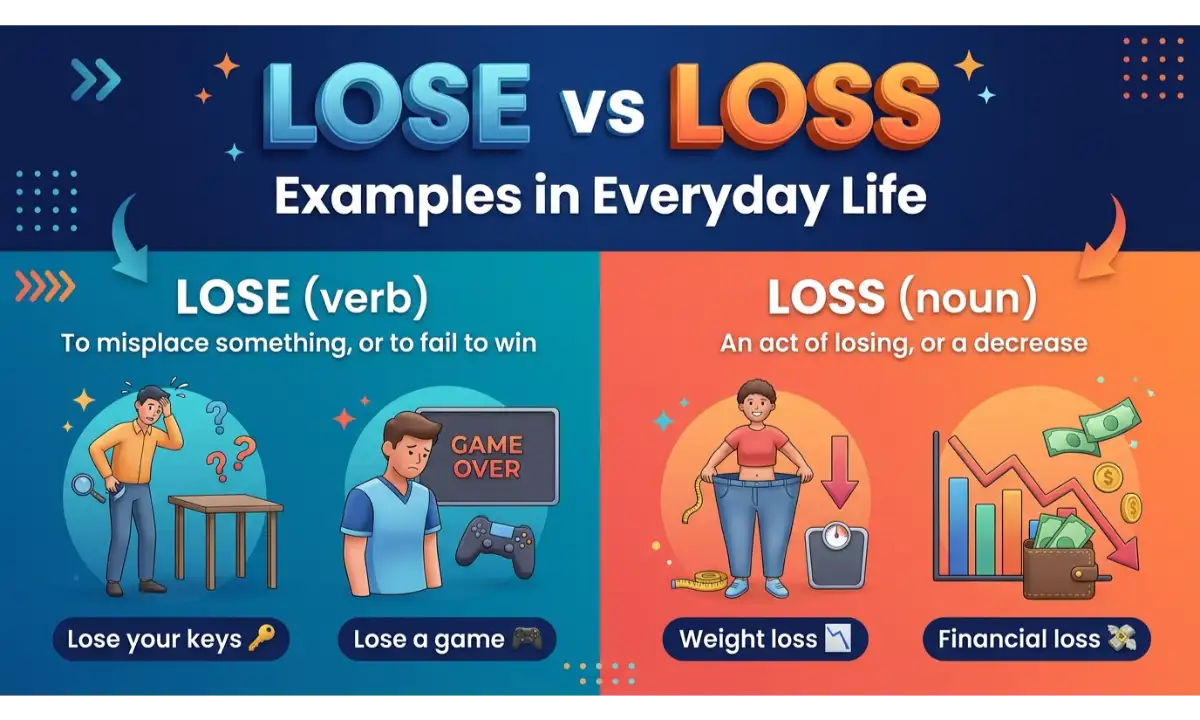
Real-life examples make the difference easier to understand.
At Work
- We could lose an important client if we miss the deadline.
- The business reported a financial loss last month.
At School
- Do not lose your homework before class.
- The loss of study time affected his preparation.
On Social Media
- I do not want to lose my followers.
- That final match was a tough loss!
In Daily Conversations
- Did you lose your phone again?
- Yes, and finding it was a huge relief after that stressful loss of time.
In Emails
- We may lose the booking unless we confirm today.
- Please explain the reason for the reported loss.
In Sports and Gaming
- Our team might lose the next game.
- The unexpected loss disappointed the fans.
Lose vs Loss in Different Contexts
Business and Finance
In business, lose describes something that a company may no longer have. Loss describes a negative result.
Examples:
- The store could lose customers because of poor service.
- The company recorded a loss during the quarter.
The phrase “loss of revenue” names a result. The phrase “lose revenue” describes what happens.
Health and Fitness
Lose often appears in phrases about weight, strength, or abilities. Loss names the reduction.
Examples:
- He wants to lose weight gradually.
- The doctor asked about his recent weight loss.
Always use lose weight for the action and weight loss for the noun phrase.
Relationships and Emotions
Lose can describe losing trust, hope, confidence, or contact with another person. Loss can describe the emotional experience.
Examples:
- I do not want to lose your trust.
- The loss of a close friendship can be painful.
These expressions show that both words can describe emotional as well as practical situations.
Education and Grammar
Students may lose marks because of spelling mistakes. A loss of marks can encourage them to review their work.
Examples:
- You may lose points for an incorrect answer.
- The loss of marks motivated her to study harder.
Learning the difference helps students write more accurate assignments and exams.
Lose vs Loss: Common Search Questions
People often search for these phrases when they need help choosing the right word. Each question reflects a slightly different writing problem.
Lose vs Loss in a Sentence
Use lose for an action and loss for a result.
Example: I might lose the game, but the loss will teach me something.
Lose or Loss in English Grammar
Lose is a verb, while loss is a noun. Check the sentence structure before choosing either word.
Is It Lose or Loss for Money?
Use lose money when describing an action or possible result. Use financial loss when naming the amount or event.
Example: The business could lose money and report a financial loss.
Lose vs Loss vs Lost
Lose is the base verb, loss is the noun, and lost is the past tense or past participle of lose.
Example: I might lose my keys. Losing them would be a loss. I lost them yesterday.
Lose vs Loss vs Loose
Lose means to misplace something or fail to win. Loss names the result. Loose means not tight.
Example: My loose pocket could cause me to lose my wallet.
Frequently Asked Questions About Lose vs Loss
What is the main difference between lose and loss?
Lose is a verb that describes an action or change. Loss is a noun that describes the act, result, or experience of losing something.
Which is correct: lose weight or loss weight?
Lose weight is correct when describing the action. Weight loss is correct when naming the reduction in weight.
Is it correct to say “I loss my job”?
No. Write “I lost my job.” Lost is the past tense of lose.
Is lose the opposite of win?
In sports and competitions, yes. Lose is the opposite of win. In other situations, the opposite might be find, keep, or gain.
What is the difference between lose and loose?
Lose is a verb meaning to misplace something or fail to win. Loose is an adjective meaning not tight.
Can loss be plural?
Yes. The plural form is losses. For example, “The company reported financial losses.”
Do British and American English use lose and loss differently?
Their spelling and grammar are the same in both varieties. Some pronunciation differences occur because of regional accents.
How can I remember lose vs loss?
Remember this simple rule: You lose something, but the result is a loss. For example, you lose a game and experience a loss.
Final Verdict: Lose vs Loss
Both lose and loss are correct English words, but they cannot replace each other in every sentence.
- Lose: A verb. Example: Do not lose hope.
- Loss: A noun. Example: The loss was disappointing.
- Lost: The past tense of lose. Example: I lost my phone.
- Loose: An adjective meaning not tight. Example: My shoes are loose.
The easiest way to choose correctly is to check whether your sentence needs an action or a noun.
Conclusion
Understanding lose vs loss can make your English clearer and help you avoid common spelling and grammar mistakes. Use lose when describing an action, such as losing a game, money, or an important item. Use loss when naming the event, result, or experience of losing something.
Practice with everyday sentences, learn common expressions, and proofread your writing before submitting it. With regular practice, choosing the correct word becomes much easier.
Remember: You lose something, but the result is a loss.

Hi, I’m Toseef Mustafa, the creator of CompareWordz.com and a qualified English linguistics professional. My expertise includes English vocabulary, spelling, grammar, word meanings, and commonly confused words. I aim to explain language differences through clear explanations, accurate information, and practical examples. My goal is to help readers understand English better and use the right words with confidence.