
Have you ever wondered If to write advise or advice in an email, school assignment, or daily conversation?
These words look similar and have related meanings, but their grammar is different.
Many English learners also confuse their pronunciation and spelling.
Understanding advise vs advice helps you write clearly and avoid common mistakes.
This guide explains their meanings, pronunciation, examples, Urdu translations, email usage, and simple grammar rules.
Advise vs Advice: Quick Answer
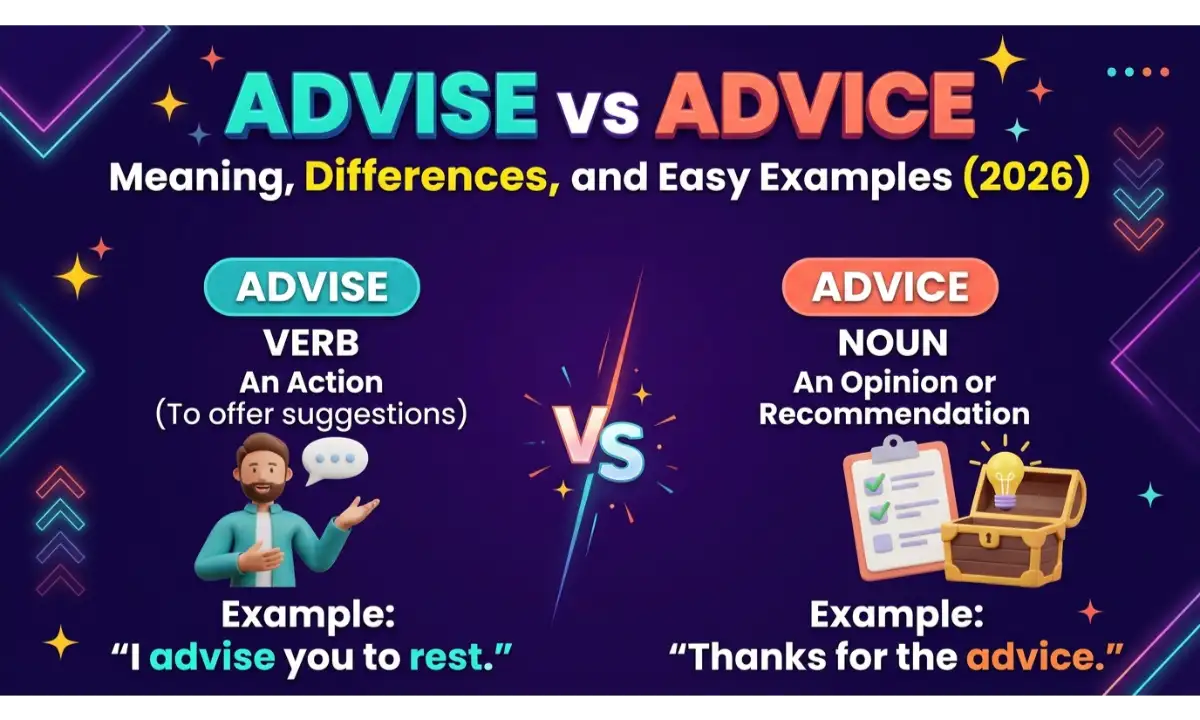
Advise is a verb that means to recommend something or tell someone what they should do.
Advice is a noun that means a suggestion, recommendation, or helpful guidance.
Examples:
- I advise you to study every day.
- My teacher gave me useful advice.
- The doctor advised me to rest.
- Thank you for your advice.
Easy rule: You advise someone, but you give someone advice.
What Is the Difference Between Advise and Advice?
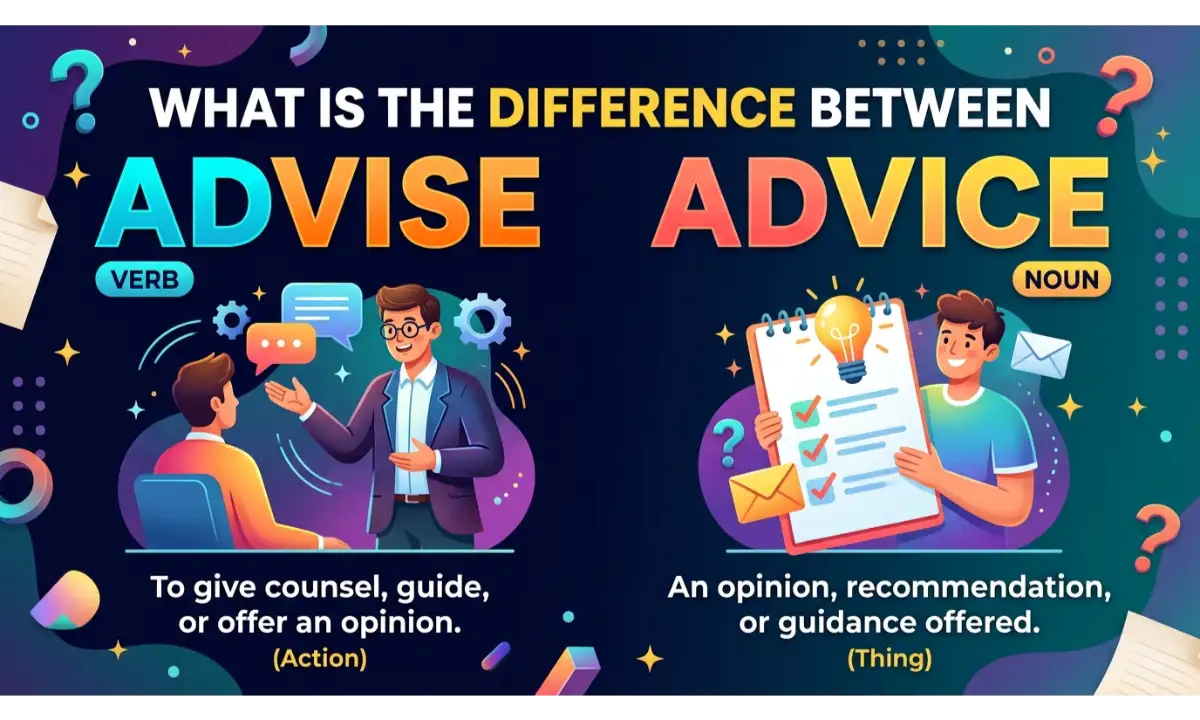
The main difference between advise and advice is their grammatical role. Advise describes an action, while advice names the guidance or recommendation.
| Feature | Advise | Advice |
|---|---|---|
| Part of speech | Verb | Noun |
| Meaning | To recommend or guide | A recommendation or guidance |
| Pronunciation | /ədˈvaɪz/ | /ədˈvaɪs/ |
| Final sound | /z/, as in zoo | /s/, as in sun |
| Past tense | Advised | Not applicable |
| Example | I advise you to wait. | I need your advice. |
| Common phrase | Advise someone to act | Give someone advice |
| Countable? | A verb | Normally uncountable |
Both words are correct English. The right choice depends on what your sentence means and how it is structured.
For example:
- Advise: My teacher advised me to practice more.
- Advice: My teacher gave me advice about practicing.
In the first sentence, advised describes an action. In the second, advice names the guidance.
What Does Advise Mean?
Advise is a verb that means to recommend an action, offer guidance, or tell someone what you think they should do.
People advise others when they want to help them make decisions. Parents advise their children, teachers advise students, and professionals advise clients.
Examples:
- I advise you to check your answers.
- My manager advised us to finish the report early.
- She advises students about career choices.
- The lawyer will advise the client.
- We advise customers to read the instructions carefully.
Advise does not always mean giving an order. It usually means suggesting a helpful action, although the level of authority depends on the situation.
Synonyms of Advise
Depending on the context, similar words include recommend, suggest, guide, counsel, and encourage.
Opposites of Advise
Possible opposites include discourage, dissuade, and misguide. The best choice depends on the meaning of the sentence.
Common Forms of Advise
| Word form | Example |
|---|---|
| Advise | I advise you to prepare early. |
| Advises | She advises new employees. |
| Advised | He advised me yesterday. |
| Advising | They are advising the client. |
Remember that advised is the past tense of advise. Advice is a separate noun, not a verb form.
What Does Advice Mean?
Advice is a noun that refers to an opinion, suggestion, or recommendation intended to help someone make a decision.
Advice can come from friends, family members, teachers, doctors, managers, or other knowledgeable people.
Examples:
- Thank you for your advice.
- Her advice helped me choose a course.
- I need some advice about my career.
- His financial advice was helpful.
- My parents always give me good advice.
Advice is normally an uncountable noun in standard English. You should not usually write “an advice” or “two advices.”
Instead, use these expressions:
- Some useful advice.
- A piece of advice.
- Two pieces of advice.
- A bit of advice.
- Professional advice.
Synonyms of Advice
Similar words include guidance, recommendation, suggestion, counsel, and opinion. Their meanings can differ slightly depending on the situation.
Opposites of Advice
Words such as misguidance and misinformation can describe harmful or incorrect guidance. However, they are not exact opposites of advice in every context.
Common Expressions With Advice
- Give advice: Offer a recommendation.
- Ask for advice: Request guidance.
- Take someone’s advice: Follow a recommendation.
- A piece of advice: One recommendation.
- Professional advice: Guidance from a qualified professional.
- Words of advice: Helpful suggestions.
Advise vs Advice Pronunciation
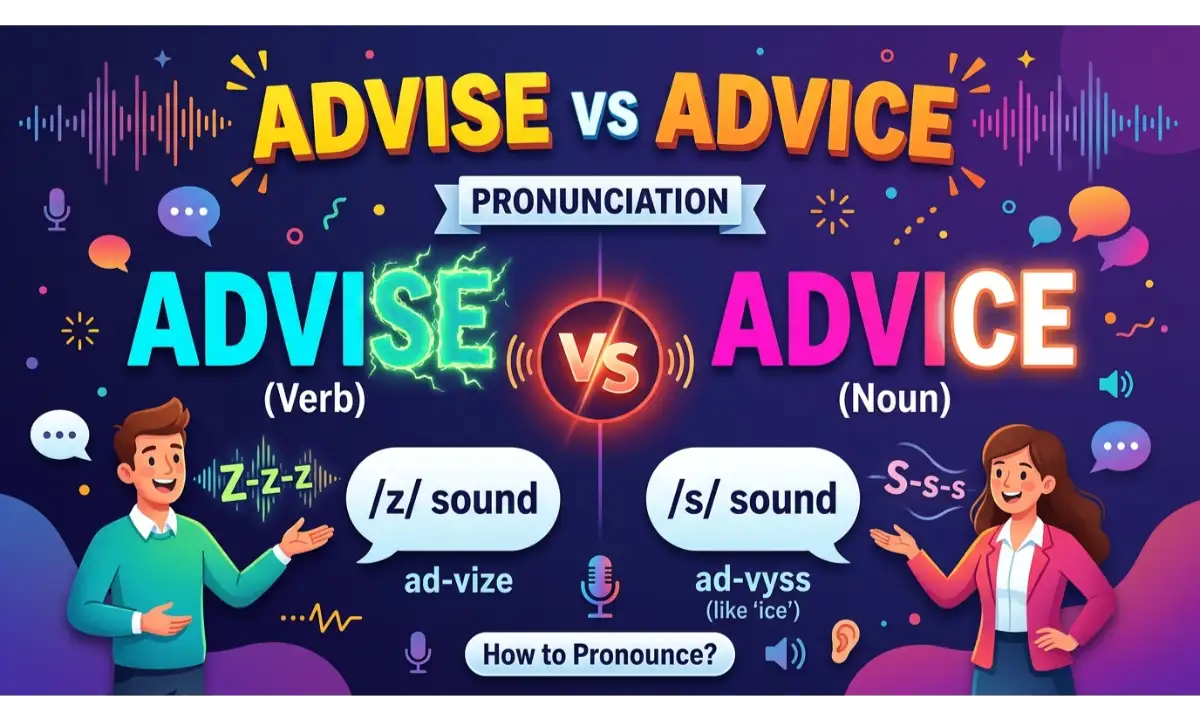
Advise and advice have similar spellings and vowel sounds, but their final consonants are different.
How to Pronounce Advise
Advise is pronounced “ad-VIZE.”
- Phonetic spelling: /ədˈvaɪz/.
- Syllables: Two.
- Final sound: /z/, as in zoo.
Example: I advise you to save your work.
How to Pronounce Advice
Advice is pronounced “ad-VICE.”
- Phonetic spelling: /ədˈvaɪs/.
- Syllables: Two.
- Final sound: /s/, as in sun.
Example: Thank you for your advice.
Easy pronunciation trick: Advise ends with a buzzing /z/ sound. Advice ends with a sharper /s/ sound.
Both words have the same main vowel sound, similar to the sound in “ice.” Listen carefully to the final consonant when speaking.
British English vs American English Advise or Advice?
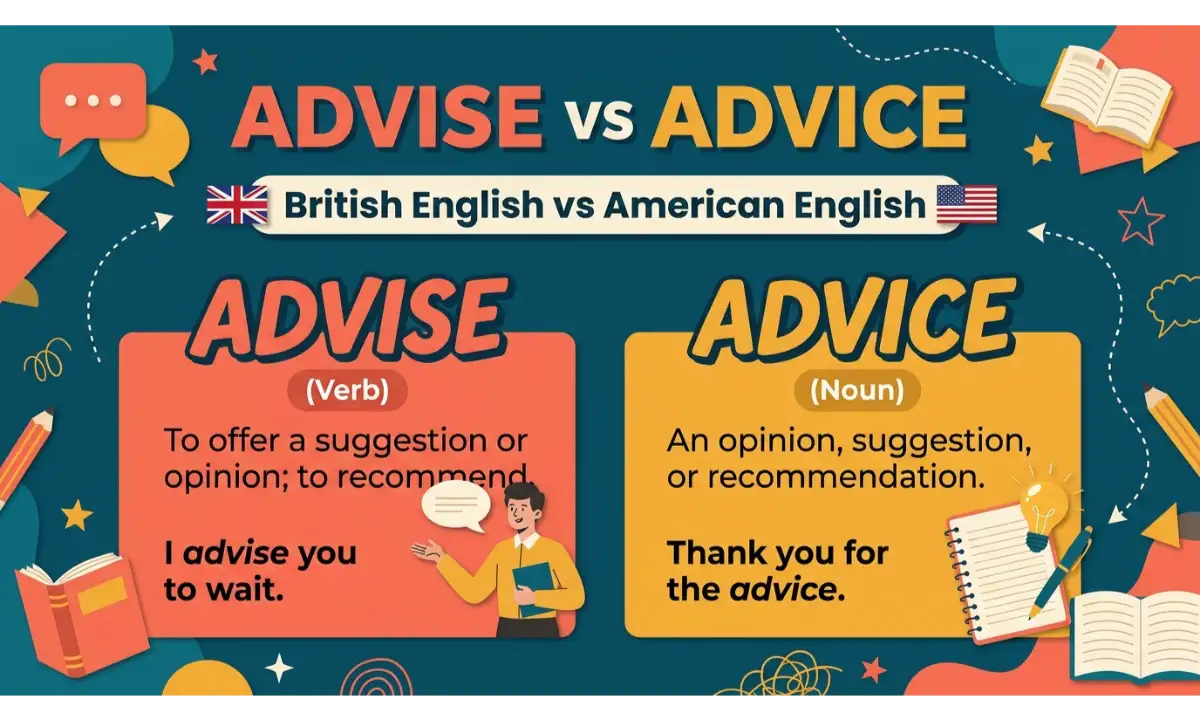
Advise and advice have the same spelling and grammatical roles in British and American English. Their main distinction is pronunciation, not meaning.
| Feature | British English | American English |
|---|---|---|
| Verb | Advise | Advise |
| Noun | Advice | Advice |
| Verb pronunciation | /ədˈvaɪz/ | /ədˈvaɪz/ |
| Noun pronunciation | /ədˈvaɪs/ | /ədˈvaɪs/ |
| Grammar rules | Same | Same |
| Countable noun usage | Advice is normally uncountable | Advice is normally uncountable |
These rules also apply to standard English writing in Pakistan, India, Canada, and Australia.
When Should You Use Advise or Advice?
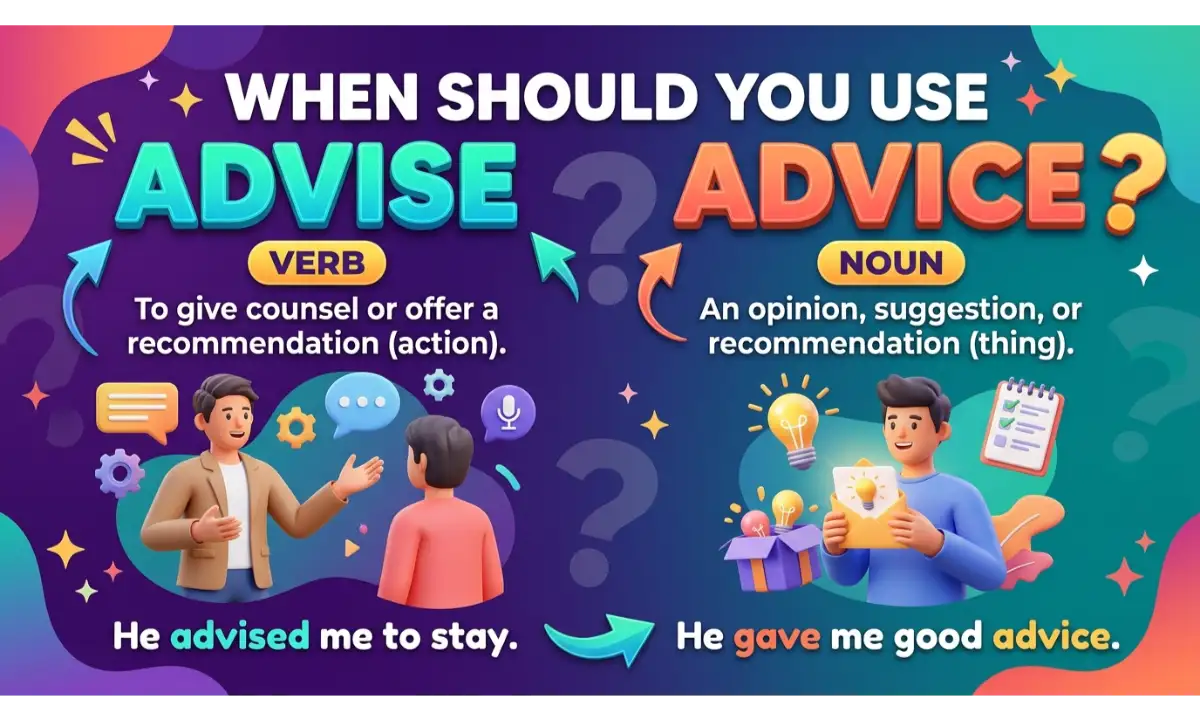
Use advise when describing the act of recommending something. Use advice when referring to the recommendation itself.
| Situation | Correct usage | Example |
|---|---|---|
| Giving guidance | Advise | I advise you to prepare early. |
| Receiving guidance | Advice | I need your advice. |
| Past recommendation | Advised | She advised me to wait. |
| Asking for guidance | Advice | Can you give me some advice? |
| Professional guidance | Advise | The lawyer will advise the client. |
| A recommendation | Advice | The lawyer gave useful advice. |
Is It Advise or Advice in a Sentence?
Both words can appear in similar sentences, but they cannot replace each other.
- Correct: Can you give me some advice?
- Correct: Can you advise me on this problem?
- Incorrect: Can you give me some advise?
- Incorrect: Can you advice me on this problem?
The phrase “give me some” needs the noun advice. The phrase “can you” needs the verb advise in the second example.
Is It “Please Advise” or “Please Advice”?
Please advise is correct when asking someone to provide guidance, information, or a recommendation.
Examples:
- Please advise me on the next steps.
- Please advise whether the meeting time is suitable.
- Please advise us if any documents are missing.
“Please advice” is incorrect because advice is a noun, not a verb.
However, you can write, “Please share your advice on this matter.”
Common Mistakes With Advise vs Advice
Mistake 1: Writing Advise Instead of Advice
Incorrect: Thank you for your advise.
Correct: Thank you for your advice.
Why it happens: Both words relate to giving guidance, so writers sometimes choose the wrong form.
Correction tip: After expressions such as “thank you for your,” use advice when referring to the guidance received.
Mistake 2: Writing Advice Instead of Advise
Incorrect: Can you advice me?
Correct: Can you advise me?
Why it happens: The writer remembers the meaning but forgets the grammar.
Correction tip: After “can you,” use the base verb advise in this sentence.
Mistake 3: Writing “An Advice”
Incorrect: My teacher gave me an advice.
Correct: My teacher gave me a piece of advice.
Why it happens: Many English nouns can be counted individually, but advice is normally uncountable.
Correction tip: Use “a piece of advice” when referring to one recommendation.
Mistake 4: Using “Advices” as the Plural
Incorrect: She gave me three useful advices.
Correct: She gave me three useful pieces of advice.
Why it happens: Writers try to make advice plural in the same way as ordinary countable nouns.
Correction tip: Count pieces of advice, not advices.
Mistake 5: Confusing Advised With Advice
Incorrect: My father advice me to be careful.
Correct: My father advised me to be careful.
Why it happens: The sentence describes a past action, but the writer uses the noun or base word incorrectly.
Correction tip: Learn the verb forms together: advise, advises, advised, and advising.
Mistake 6: Writing “Please Advice”
Incorrect: Please advice me about the meeting.
Correct: Please advise me about the meeting.
Why it happens: The expression is common in emails, but writers may confuse the noun and verb.
Correction tip: Use advise when asking someone to perform the action of giving guidance.
Mistake 7: Writing “Advise Me a Suggestion”
Incorrect: Can you advise me a suggestion?
Correct: Can you give me a suggestion?
Another correct option: Can you advise me on what to do?
Why it happens: Advise does not fit every sentence pattern used with give.
Correction tip: Say “give me advice” or “advise me on the matter.”
Advise vs Advice Examples in Everyday Life
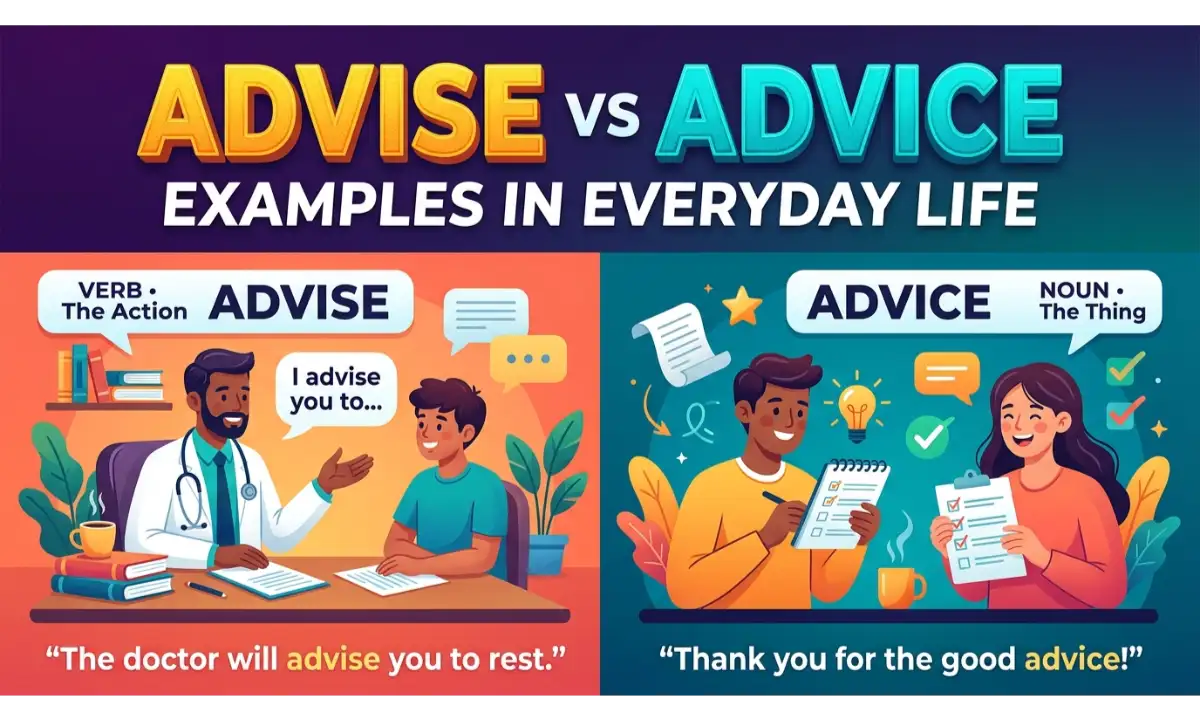
Real-life examples make the difference easier to understand.
At Work
- I advise you to check the report before sending it.
- Thank you for your advice on the new project.
At School
- My teacher advised me to practice writing daily.
- Her advice helped me improve my grades.
On Social Media
- I advise everyone to check the facts before sharing a post.
- Thanks for the advice, everyone!
In Daily Conversations
- Can you advise me on which course to choose?
- I need some advice about my new phone.
In Emails
- Please advise us on the next steps.
- Thank you for your advice regarding the application.
In Text Messages
- What do you advise me to do?
- I really need your advice right now.
In Professional Services
- The accountant advised the business owner to review the budget.
- The business owner requested financial advice.
Advise vs Advice in Different Contexts
Business and Finance
Professionals use advise when describing the act of guiding a client. They use advice when referring to the guidance provided.
Examples:
- The consultant will advise the company about its strategy.
- The company received advice on managing expenses.
In finance, advice can influence important decisions. Check the qualifications of professionals before relying on financial recommendations.
Education and Career Choices
Teachers, counselors, and mentors advise students about subjects, careers, and study methods.
Examples:
- My counselor advised me to explore different careers.
- Her advice helped me prepare for the interview.
Health and Well-Being
Healthcare professionals may advise patients about general care, treatment options, or healthy habits. Advice names the information or recommendations they provide.
Examples:
- The doctor advised him to get more rest.
- The patient followed the doctor’s advice.
For personal medical decisions, seek guidance from a qualified healthcare professional who understands your circumstances.
Relationships and Emotions
Friends and family members often advise each other during difficult situations.
Examples:
- I advised my friend to speak honestly.
- Her advice helped me think more clearly.
Good advice can support decision-making, but the final choice usually belongs to the person receiving it.
Advise vs Advice in Urdu
For Urdu-speaking English learners, these words may be easier to understand through simple translations.
- Advise: مشورہ دینا (mashwara dena).
- Advice: مشورہ (mashwara).
Examples:
- I advise you to study. — میں آپ کو پڑھنے کا مشورہ دیتا ہوں۔
- Thank you for your advice. — آپ کے مشورے کا شکریہ۔
- My teacher advised me to practice. — میرے استاد نے مجھے مشق کرنے کا مشورہ دیا۔
The main grammar rule remains the same. Advise describes the act of giving guidance, while advice names the guidance itself.
Advise vs Advice in Email Writing
Both words are common in workplace emails, but they serve different purposes.
Use advise when requesting guidance or asking someone to recommend an action.
Examples:
- Please advise me on the next steps.
- Could you advise us on the best option?
- Please advise whether the proposed date is suitable.
- Kindly advise if further information is required.
Use advice when referring to guidance you need or have received.
Examples:
- I would appreciate your advice on this matter.
- Thank you for your advice regarding the project.
- Could you share some advice about preparing the report?
- Your advice helped us make a better decision.
Professional writing tip: “Please advise” is grammatically correct. “Please advice” is incorrect because advice is a noun, not a verb.
Advise vs Advice: What Does a Doctor Use?
Doctors can use both words when discussing health and treatment.
- Advise: The doctor advised me to get more rest.
- Advice: The doctor gave me advice about managing my symptoms.
- Advise: The doctor may advise the patient to discuss treatment options.
- Advice: The patient asked for advice about recovery.
Use advise when describing what the doctor recommends doing. Use advice when referring to the recommendation itself.
For personal medical concerns, follow guidance from a qualified healthcare professional who understands your circumstances.
Advise vs Advice: Common Google Search Questions
People search for these phrases because the words look similar but have different grammar rules. Understanding each query can help you use the words correctly.
Advise vs Advice Examples
Use advise for an action and advice for the recommendation.
Example: I advise you to listen carefully. My advice is to take notes.
Advise Meaning
Advise means to recommend an action or guide someone. For example, “I advise you to arrive early.”
Advise vs Advice Meaning
Advise is a verb, while advice is a noun. One describes giving guidance; the other names the guidance.
Advise vs Advice Pronunciation
Advise ends with a /z/ sound, while advice ends with an /s/ sound. Both words have two syllables.
Advise vs Advice in Urdu
Advise means مشورہ دینا, while advice means مشورہ. These translations help Urdu-speaking learners understand the difference between the action and the recommendation.
Advise vs Advice in Email
Use “Please advise” when requesting guidance. Use “I appreciate your advice” when referring to guidance someone has provided.
Please Advise vs Advice
“Please advise” is correct because advise is a verb. “Please advice” is incorrect in this context.
Advise vs Advice Doctor
A doctor advises a patient by recommending an action. The advice is the recommendation the patient receives.
Expert Tips to Remember Advise vs Advice
Tip 1: Remember the Grammar Rule
Advise is a verb. Advice is a noun.
Tip 2: Listen to the Final Sound
Advise ends in /z/, while advice ends in /s/.
Tip 3: Learn Common Phrases
Practice “give advice,” “ask for advice,” “follow advice,” and “please advise.”
Tip 4: Remember That Advice Is Uncountable
Write “some advice” or “a piece of advice,” not “an advice.”
Tip 5: Check the Sentence Structure
If you need an action, use advise. If you need to name a recommendation, use advice.
Tip 6: Learn the Verb Forms
Remember advise, advises, advised, and advising.
Tip 7: Proofread Professional Writing
Check emails, reports, and school assignments before sending or submitting them.
Quick Practice Test
Choose advise, advice, or advised to complete each sentence.
- Can you give me some _____?
- I _____ you to check the details.
- The teacher _____ me to practice more.
- Please _____ us on the next steps.
- She gave me a useful piece of _____.
Answers: 1. advice, 2. advise, 3. advised, 4. advise, 5. advice.
Frequently Asked Questions About Advise vs Advice
What is the main difference between advise and advice?
Advise is a verb meaning to recommend or guide. Advice is a noun meaning a recommendation or helpful guidance.
Is it advice or advise?
Both words are correct. Use advice for a recommendation and advise for the act of giving guidance.
Is “Please advise” correct English?
Yes. “Please advise” is a common expression in professional communication when requesting guidance or a response.
Can I say “an advice”?
No. Advice is normally uncountable. Use “a piece of advice” when referring to one recommendation.
What is the past tense of advise?
The past tense is advised. For example, “My teacher advised me to study harder.”
Do advise and advice sound different?
Yes. Advise ends with a /z/ sound, while advice ends with an /s/ sound. Both have two syllables.
Is advice plural or singular?
Advice is an uncountable noun and does not normally have a plural form. Use “pieces of advice” to count individual recommendations.
How can I remember advise vs advice?
Remember this sentence: “I advise you, and I give you advice.” Advise is the action, and advice is the recommendation.
Final Verdict: Advise vs Advice
Advise and advice have similar meanings, but they perform different jobs in a sentence.
- Advise: A verb. Example: I advise you to wait.
- Advice: A noun. Example: Thank you for your advice.
- Advised: The past tense of advise. Example: She advised me yesterday.
The simplest rule is to use advise when someone gives guidance and advice when referring to the guidance itself.
Conclusion
Understanding advise vs advice can help you write clearer sentences and communicate more confidently. Use advise when describing the act of recommending something, and use advice when talking about the recommendation itself.
Remember that advice is an uncountable noun, so phrases such as “some advice” and “a piece of advice” are correct. Practice these examples in emails, school assignments, and daily conversations to build stronger English skills.
Final memory trick: You advise someone, but you give them advice.

I’m MK Jan Mustafa Kamal, the author of CompareWordz.com, specializing in English linguistics, word meanings, spelling, and language usage.
I hold an M.A. in English and have 8 years of experience in English language and vocabulary studies. My goal is to explain confusing words, spelling differences, grammar rules, and meanings in clear, simple, and accurate language. I focus on providing well-researched, fact-checked, and easy-to-understand content that helps readers use English with confidence. Through CompareWordz.com, I aim to make learning English words and their correct usage easier for everyone.