


Have you ever confused accepting vs excepting while writing an email, doing homework, or reading a sentence?
These words look and sound similar, but they have different meanings.
Accepting means receiving or agreeing to something, while excepting means leaving someone or something out.
Understanding the difference helps you write clearly at school, at work, and in everyday conversations.
This guide explains their meanings, grammar rules, pronunciation, and examples in simple English.
Accepting vs Excepting: Quick Answer
Accepting means receiving something, agreeing to an offer, or recognizing a situation.
Excepting means excluding someone or something from a group or statement.
Examples:
- She is accepting the job offer.
- The store is accepting new orders.
- Excepting one student, everyone passed the test.
- Excepting the final chapter, I enjoyed the book.
Simple rule: Accepting means receiving or agreeing. Excepting means excluding. In everyday English, except is usually more natural than excepting.
What Is the Difference Between Accepting and Excepting?
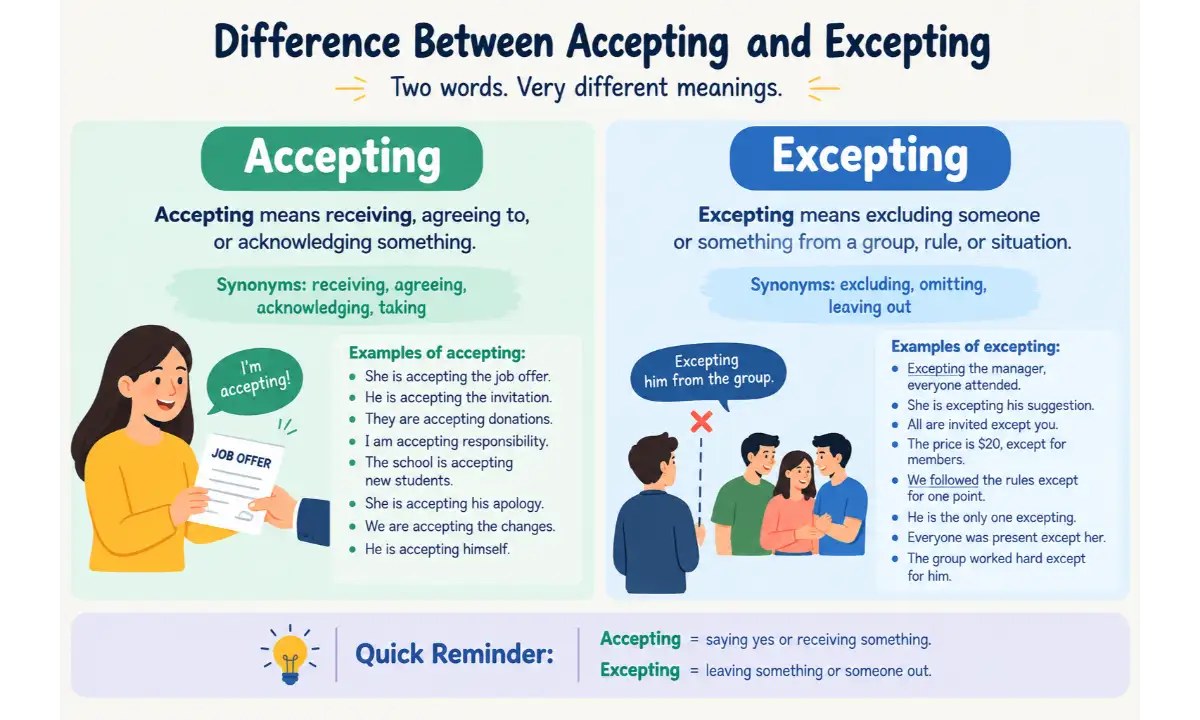
The main difference between accepting and excepting is their meaning. Accepting comes from the verb accept, while excepting comes from the verb except.
| Feature | Accepting | Excepting |
|---|---|---|
| Base word | Accept | Except |
| Meaning | Receiving or agreeing | Excluding or leaving out |
| Grammar | -ing verb form; can be a gerund | -ing verb form; can indicate exclusion |
| Common use | Offers, gifts, applications, responsibility | Exceptions and exclusions |
| Example | I am accepting the invitation. | Everyone came, excepting Ali. |
| More natural alternative | Receiving or agreeing | Except or excluding |
| Everyday usage | Common | Less common |
Both words are correct, but they cannot replace each other.
- Correct: She is accepting the invitation.
- Correct: Everyone attended except Ali.
- Incorrect for the intended meaning: She is excepting the invitation.
Use accepting when someone agrees to something. Use excepting only when you mean excluding.
What Does Accepting Mean?

Accepting is the -ing form of the verb accept. It means receiving something willingly, agreeing to an offer, welcoming an idea, or recognizing something as true.
People use accepting in personal conversations, education, business, relationships, and everyday life.
Common Meanings of Accepting
1. Receiving something
Accepting can describe receiving a gift, payment, object, or offer.
Example: She is accepting a gift from her friend.
2. Agreeing to an offer
It can mean agreeing to a job, invitation, request, or proposal.
Example: He is accepting the new job offer.
3. Taking responsibility
Accepting can mean admitting responsibility for an action or mistake.
Example: I am accepting responsibility for the error.
4. Recognizing reality
It can mean understanding and acknowledging a situation.
Example: She is accepting the fact that plans have changed.
5. Welcoming differences
Accepting can describe treating people or different opinions with openness and respect.
Example: The school encourages accepting people from different backgrounds.
Synonyms of Accepting
Depending on the context, similar words include receiving, agreeing, welcoming, acknowledging, admitting, and embracing.
These words do not always have exactly the same meaning. For example, accepting a gift and accepting responsibility describe different situations.
Opposites of Accepting
Possible opposites include rejecting, refusing, declining, denying, and resisting.
Example: She is accepting the invitation, while her brother is declining it.
What Does Excepting Mean?
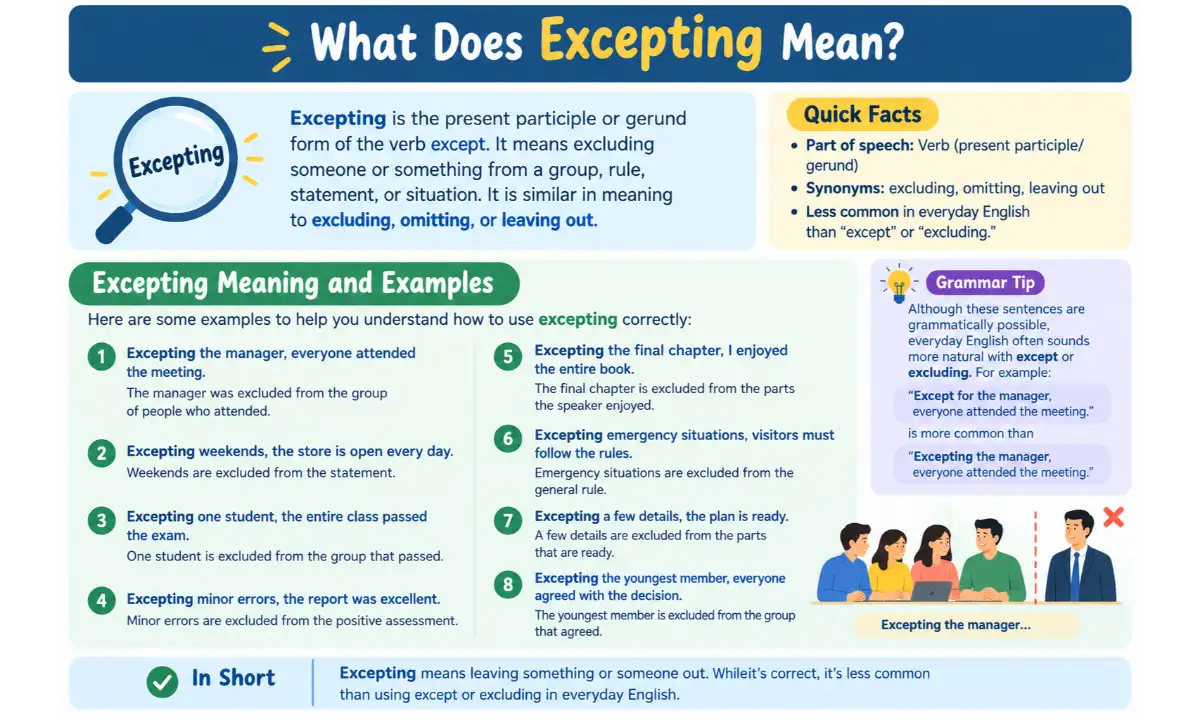
Excepting means excluding someone or something from a group, statement, or general rule. It comes from the verb except.
Although excepting is a correct English word, it is less common than except or excluding in everyday writing.
Common Meanings of Excepting
1. Leaving someone out
Example: Excepting one student, everyone completed the test.
This means one student is excluded from the statement about everyone.
2. Excluding an item
Example: Excepting the final chapter, I enjoyed the book.
This means the final chapter is not included in the statement.
3. Making an exception
Example: Excepting a few minor errors, the report was excellent.
A more natural version is: The report was excellent except for a few minor errors.
Synonyms of Excepting
Depending on the sentence, similar expressions include excluding, leaving out, omitting, and making an exception for.
Opposites of Excepting
Possible opposites include including, encompassing, and incorporating.
Example: The price includes all items rather than excluding certain products.
Accepting vs Excepting Pronunciation

Accepting and excepting have similar sounds, which can make them confusing for English learners. Their first vowel sounds differ in standard pronunciation.
How to Pronounce Accepting
Accepting is pronounced approximately as ak-SEP-ting.
- Phonetic spelling: /əkˈsɛptɪŋ/.
- Syllables: Three.
- Stress: The second syllable, SEP.
- Base word: Accept.
Example: She is accepting the invitation.
How to Pronounce Excepting
Excepting is pronounced approximately as ik-SEP-ting.
- Phonetic spelling: /ɪkˈsɛptɪŋ/.
- Syllables: Three.
- Stress: The second syllable, SEP.
- Base word: Except.
Example: Excepting one small detail, the plan is complete.
Pronunciation tip: Listen to the first vowel sound. The words are similar, but their meanings and spellings are different.
Accepting vs Excepting Grammar Rules
Understanding the grammar behind these words makes it easier to use them correctly.
How to Use Accepting
Accepting is the present participle of accept. It can appear in continuous verb forms or function as a gerund.
Examples:
- The store is accepting online payments.
- She is accepting the changes.
- Accepting help can make difficult tasks easier.
- We are accepting applications until Friday.
In the first, second, and fourth examples, accepting describes an action. In the third, it acts as a noun-like gerund.
How to Use Excepting
Excepting is related to the verb except and means excluding. It can introduce an exception, but it often sounds formal or less natural in everyday sentences.
Examples:
- Excepting one minor error, the report was accurate.
- Excepting the final chapter, I enjoyed the book.
- Excepting two late arrivals, everyone reached the office on time.
Clearer alternatives include:
- The report was accurate except for one minor error.
- I enjoyed the book except for the final chapter.
- Everyone reached the office on time except two late arrivals.
Grammar tip: Use accepting for receiving or agreeing. Use except or excluding for most everyday statements about exceptions.
Accept and Except: Meaning and Difference
Accept and except are different English words that often confuse beginners.
Accept is a verb that means to receive, agree to, or approve something.
Example: I accept your invitation.
Except usually works as a preposition or conjunction. It means excluding someone or something.
Example: Everyone accepted the invitation except Jack.
The main difference is simple: accept means to receive or agree, while except means to leave something or someone out.
Accept and Except Homophones
Accept and except are sometimes described as near-homophones because they sound similar. However, they are not exact homophones in standard English pronunciation.
- Accept: /əkˈsɛpt/ — to receive or agree.
- Except: /ɪkˈsɛpt/ — to exclude or leave out.
Their first vowel sounds differ, although some speakers may pronounce them similarly.
Example: I accept every invitation except the ones I cannot attend.
This sentence uses both words correctly. Accept describes agreeing to invitations, while except identifies the invitations that are excluded.
Accept Meaning: What Does Accept Mean?
Accept is a verb that means receiving something willingly, agreeing to an offer, approving a proposal, or recognizing a situation as true.
Its exact meaning depends on the context.
Common Uses of Accept
To receive something
Example: She accepted the gift from her friend.
To agree to an offer
Example: He accepted the job offer.
To approve something
Example: The teacher accepted my assignment.
To recognize reality
Example: She accepted that the situation had changed.
To take responsibility
Example: He accepted responsibility for his mistake.
Common synonyms include receive, approve, agree to, acknowledge, and embrace. Their meanings vary depending on the sentence.
Accept and Except Meaning in Everyday English
Accept and except may look similar, but they perform different jobs.
| Word | Meaning | Example |
|---|---|---|
| Accept | Receive or agree | I accept your offer. |
| Except | Exclude or leave out | Everyone came except Ali. |
| Accepting | Receiving or agreeing | She is accepting the offer. |
| Excepting | Excluding | Excepting one item, the list is complete. |
| Accepted | Past tense of accept | They accepted the invitation. |
| Exception | Something excluded from a rule | The teacher made one exception. |
Remember that accepting and excepting come from different base words. Their meanings follow the same basic distinction.
Accept and Except in a Sentence
Here are examples showing how accept and except work together.
- I accept all the invitations except the one for Monday.
- She accepted every gift except the broken one.
- The school accepts applications from everyone except applicants who miss the deadline.
- I accept your explanation, except for one detail that remains unclear.
- He accepted the offer but requested a later starting date.
The last example is clearer without using except because it describes an additional condition rather than excluding an item.
Accepting vs Excepting Sentences
These accepting vs excepting sentences demonstrate the difference between the words.
Accepting Examples
- The company is accepting new applications.
- I am accepting responsibility for the mistake.
- She is accepting the invitation to dinner.
- The website is accepting credit card payments.
- The teacher is accepting late assignments.
Excepting Examples
- Excepting one student, everyone passed the test.
- Excepting the final page, the document was complete.
- Excepting a few small errors, the essay was well written.
- Excepting the damaged items, all products were ready for sale.
- Excepting one late arrival, the team was present.
In everyday English, these sentences often sound more natural when rewritten with except or excluding.
For example, “Everyone passed the test except one student” is clearer than “Excepting one student, everyone passed the test.”
Accepting vs Excepting in Everyday Life

At Work
- The manager is accepting applications for the new position.
- Everyone finished the report except two team members.
At School
- The teacher is accepting late assignments.
- Except for one question, I answered the entire test.
In Emails
- We are accepting registrations until Friday.
- All files are complete except the attached document.
In Daily Conversations
- I am accepting your invitation to dinner.
- Everyone liked the meal except my younger brother.
On Social Media
- I am accepting new followers this week.
- Everyone liked the pictures except one person.
In Business
- The store is accepting online payments.
- All products are available except discontinued items.
In Relationships
- She is accepting her partner’s decision.
- Everyone agreed with the plan except one family member.
Accepting vs Excepting in Different Contexts
Education
Students may see accepting when discussing school admissions, invitations, or ideas. Excepting can describe an exception to a general statement.
Examples:
- The college is accepting applications for next semester.
- Except for one difficult question, the exam was easy.
Business and Technology
Businesses use accepting when discussing payments, applications, orders, or terms. Excepting may appear in formal descriptions of exclusions.
Examples:
- The website is accepting credit card payments.
- All products are available except discontinued items.
Personal Growth
Accepting can describe recognizing feelings, changes, or personal responsibility.
Example: He is accepting that learning a new skill takes time.
Excepting is not usually used to describe emotional acceptance. It refers to leaving something out.
Writing and Editing
Accepting can describe agreeing to suggestions or changes. Excepting may indicate that one part is excluded from a general statement.
Examples:
- The editor is accepting the suggested changes.
- The article needs no revisions except in the conclusion.
Accepting vs Excepting Worksheet
Test your understanding by choosing the correct word in each sentence.
- The store is (accepting / excepting) new orders.
- Everyone attended the party (accepting / excepting) Sara.
- He decided to (accept / except) the job offer.
- I enjoyed every chapter (accept / except) the last one.
- She is (accepting / excepting) responsibility for the error.
- The school is (accepting / excepting) applications for next year.
- We invited everyone (accepting / excepting) two guests who were unavailable.
- They (accepted / excepted) the invitation.
Worksheet Answers
- Accepting.
- Excepting, although “except Sara” is more natural.
- Accept.
- Except.
- Accepting.
- Accepting.
- Excepting, although “except two guests” is more natural.
- Accepted.
Learning tip: Ask whether the sentence means receiving or agreeing, or whether it means excluding. This simple check helps you choose the right word.
Common Mistakes With Accepting vs Excepting
Mistake 1: Using Accepting When You Mean Excluding
Incorrect: Accepting John, everyone attended the meeting.
Correct: Everyone attended the meeting except John.
Accepting means receiving or agreeing, not leaving someone out.
Mistake 2: Using Excepting When You Mean Agreeing
Incorrect: She is excepting the job offer.
Correct: She is accepting the job offer.
Use accepting when someone agrees to an offer.
Mistake 3: Confusing Accept and Except
Incorrect: I except your apology.
Correct: I accept your apology.
Accept means receive or agree. Except means exclude.
Mistake 4: Using Excepting When Except Is More Natural
Less natural: Everyone attended, excepting Sarah.
More natural: Everyone attended except Sarah.
Except is usually simpler and more common in everyday writing.
Mistake 5: Confusing Accepting With Expecting
Incorrect: I am accepting a package tomorrow, when I mean I am waiting for it to arrive.
Correct: I am expecting a package tomorrow.
Expecting means anticipating something. Accepting means receiving or agreeing.
Mistake 6: Using the Wrong Word for Applications
Incorrect: The company is excepting new applications.
Correct: The company is accepting new applications.
Use accepting when an organization is receiving applications.
Mistake 7: Making an Exception Unclear
Less clear: Excepting the final section, the document is complete.
Clearer: The document is complete except for the final section.
Choose wording that makes the exception easy to understand.
Expert Tips to Remember Accepting vs Excepting
- Learn the base words. Accepting comes from accept; excepting comes from except.
- Remember the meanings. Accepting means receiving or agreeing. Excepting means excluding.
- Check the sentence context. If someone agrees to something, use accepting.
- Use except for simple sentences. It is usually clearer than excepting when listing exclusions.
- Avoid confusing similar words. Accepting, excepting, and expecting have different meanings.
- Read the sentence aloud. Ask whether it describes agreement or exclusion.
- Proofread your writing. Check emails, assignments, and reports for the correct word.
Frequently Asked Questions About Accepting vs Excepting
1. What is the main difference between accepting and excepting?
Accepting means receiving, agreeing, or acknowledging something. Excepting means excluding someone or something from a group or statement.
2. Is accepting a correct English word?
Yes. Accepting is the -ing form of accept. For example, “She is accepting the invitation.”
3. Is excepting a real word?
Yes. Excepting means excluding. However, except or excluding is often more natural in everyday sentences.
4. How do you use accepting in a sentence?
You can write, “The company is accepting applications.” This means the company is receiving applications.
5. How do you use excepting in a sentence?
You can write, “Excepting one small error, the report was excellent.” A more natural alternative is “The report was excellent except for one small error.”
6. Is accepting the same as expecting?
No. Accepting means receiving or agreeing, while expecting means anticipating something that may happen.
7. Should I use excepting or except?
Use except in most everyday sentences because it is simpler and more common. Excepting is also correct when it fits the sentence.
8. What is an easy way to remember accepting vs excepting?
Remember this rule: You accept an offer, but you use except when leaving something out.
9. Are accept and except homophones?
They are similar in sound but are not exact homophones in standard English pronunciation. Accept means receive or agree, while except means exclude.
10. What is the difference between accept and except in a sentence?
Example: “I accept every invitation except the one for Monday.” Accept means agree to receive or attend, while except identifies the excluded invitation.
Final Verdict: Accepting vs Excepting
Accepting and excepting are both correct words, but their meanings differ.
- Accepting: Receiving, agreeing, or acknowledging something.
- Excepting: Excluding someone or something.
- Except: The more common everyday word for expressing an exception.
The easiest memory trick is to connect accepting with accepting an offer and except with leaving something out.
Conclusion
Understanding accepting vs excepting helps you write clearer sentences and avoid confusing readers. Use accepting when describing agreement, receiving something, or recognizing a situation. Use excepting when you mean excluding, although except is usually more natural in everyday English.
Remember the difference between accept and except, and check the meaning of your sentence before choosing a word. You accept what you receive, but you use except when leaving something out.

Hi, I’m Toseef Mustafa, the creator of CompareWordz.com and a qualified English linguistics professional. My expertise includes English vocabulary, spelling, grammar, word meanings, and commonly confused words. I aim to explain language differences through clear explanations, accurate information, and practical examples. My goal is to help readers understand English better and use the right words with confidence.