


You are reading a menu and see “hardy stew” on the board. Or you are writing a garden label and wonder if the plant is hardy or hearty. That small pause is very common, and it is why hardy vs hearty is searched so often.
The two words sound almost the same, so hardy vs hearty trips up students, writers, and even busy workers. You see them in school essays, work emails, social media captions, texts, and daily talk. A clear hardy vs hearty answer saves you from a silly slip.
People usually search for: hardy vs hearty meaning, correct spelling, pronunciation, examples, usage, definition, and the grammar difference.
Hardy vs Hearty: Quick Answer
👉 Hardy = tough, strong, and able to survive hard conditions
👉 Hearty = warm and cheerful, or big and filling
Examples:
- The hardy hikers walked through the snow. ✅
- The cafe serves a hearty lentil soup. ✅
- She gave us a hearty welcome. ✅
- These hardy plants survive frost. ✅
- He ate a hearty breakfast. ✅
Simple Rule:
👉 Hardy has “hard” inside it, so it is about toughness. Hearty has “heart” inside it, so it is about warmth and fullness.
What Does Hardy vs Hearty Mean?

The two words share a loose idea of strength, but they do different jobs.
Hardy describes a person, plant, or animal that can handle rough weather or a hard life. It is a strength word. Think of a farmer who works through winter, or a flower that does not die in the cold.
Hearty has a softer feel. It can mean friendly and warm, like a hearty handshake. It can mean loud and joyful, like hearty laughter. It can also mean big and satisfying, like a hearty meal. People also use it for a strong appetite or good health.
So hardy is about surviving. Hearty is about feeling full, warm, or glad.
Synonyms
- Hardy: tough, sturdy, strong, resilient, durable
- Hearty: warm, friendly, filling, generous, cheerful
Opposites
- Hardy: weak, fragile, delicate, tender
- Hearty: cold, unfriendly, light, small
Related Terms
Foolhardy, hale and hearty, hardiness zone, hardy perennial, heartfelt, wholehearted.
Common Variations
You may also see “hearty or hardy,” “hardy or hearty,” “party hearty,” and “party hardy.” They all come from the same mix up.
The Origin of Hardy and Hearty
According to Etymonline, “hardy” comes from the old French word hardi, which meant bold or brave. That word grew from a root meaning “to make hard.” This is why the word still points to toughness.
“Hearty” comes from the English word heart plus the ending “y.” In old English thinking, the heart was the center of feeling, courage, and life. So hearty first meant full of heart, and later it came to mean warm, strong, and filling.
Both words are old, and both have changed over time. Today they sit side by side in dictionaries, and that is why they get mixed up.
How to Pronounce Hardy and Hearty
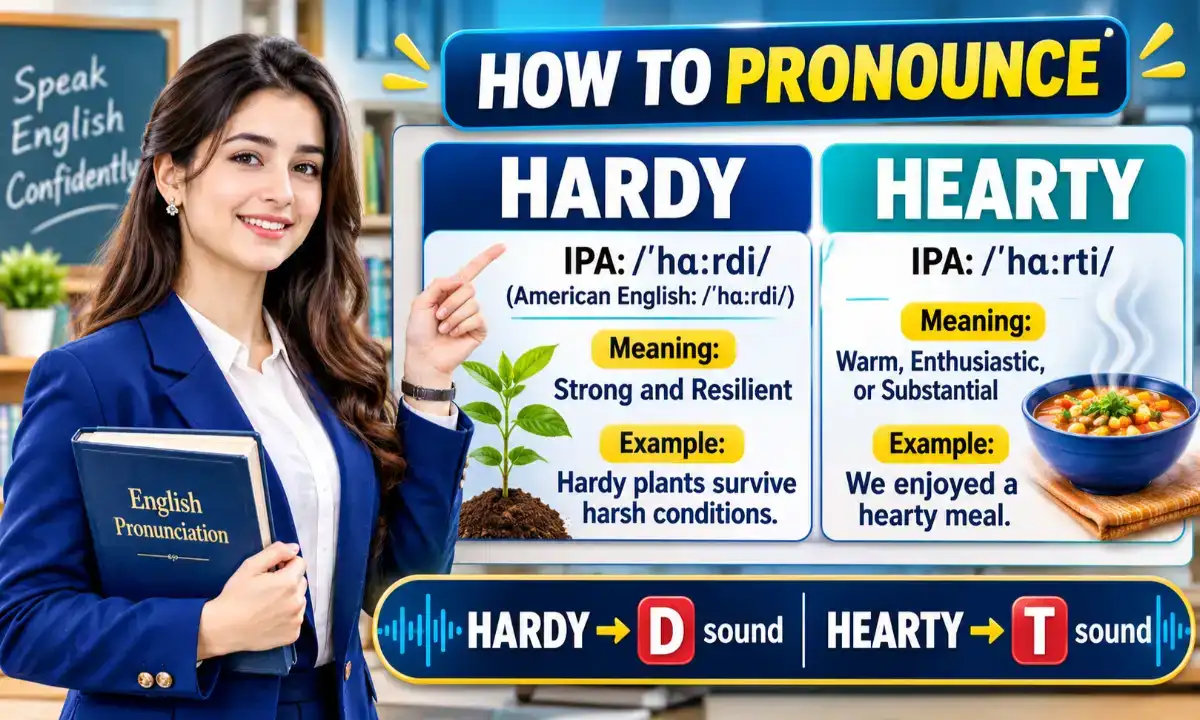
- Hardy → HAR dee
- Hearty → HAR tee
Both words have two syllables, and the stress falls on the first one. The only difference is the middle sound: a “d” in hardy and a “t” in hearty.
Easy speaking trick: In fast American speech, the “t” in hearty often sounds soft, almost like a “d.” That is the main reason people confuse them. Say hearty slowly and press the “t” a little harder.
Common mistakes: Saying “hear” like the word ear, or dropping the “r” sound in American English.
British English vs American English Usage

The good news is simple. Hardy and hearty are spelled the same everywhere, and their meanings do not change by country.
| Feature | British English | American English | Notes |
|---|---|---|---|
| Spelling | hardy, hearty | hardy, hearty | No difference |
| Pronunciation | HAH dee, HAH tee | HAR dee, HAR tee | Americans say the “r” |
| The “t” sound | Clear | Often soft, like “d” | Main cause of confusion |
| Meaning | Same | Same | Worldwide agreement |
| Garden use | Hardy plants | Hardy plants, hardiness zones | USDA zones are a US idea |
Which One Should You Use? Hardy vs Hearty
Use the word that matches your meaning, not the sound.
- Formal and academic writing: Use hardy for toughness and hearty for warmth or fullness. Write “hale and hearty” in full form.
- Workplace writing: “We want a hearty welcome for new staff.” ✅
- Branding and menus: “Hearty soups” sounds filling and warm. “Hardy soups” sounds odd.
- Texting and social media: “Party hearty” is the original form. “Party hardy” is a common casual variant.
| Situation | Best Word | Example |
|---|---|---|
| Plant in cold weather | hardy | Hardy roses live through winter. |
| Big meal | hearty | A hearty dinner |
| Warm greeting | hearty | A hearty hello |
| Strong traveler | hardy | A hardy explorer |
Common Mistakes With Hardy vs Hearty
Mistake 1: Calling a meal hardy
❌ A hardy bowl of chili
✔ A hearty bowl of chili. A meal is filling, not tough. People make this mistake because both words sound strong. Tip: If you can eat it, it is hearty.
Mistake 2: A hardy welcome
❌ They gave us a hardy welcome.
✔ They gave us a hearty welcome. A welcome is warm. Tip: Warm feelings come from the heart.
Mistake 3: A hardy laugh
❌ He had a hardy laugh.
✔ He had a hearty laugh. Laughter is loud and joyful. People slip here because the sounds are close.
Mistake 4: Hearty plants
❌ Hearty plants survive frost.
✔ Hardy plants survive frost. Surviving cold is about toughness. Tip: Think “hard winter, hardy plant.”
Mistake 5: Hale and hardy in formal writing
❌ She is hale and hardy.
✔ She is hale and hearty. Many people say the first one, but the dictionary form is the second. Tip: Use the standard idiom in school and work.
Mistake 6: Mixing the party phrase
❌ Let’s party hearty or hardy, I forget which.
✔ Party hearty is the original. Party hardy came later from mishearing. Both are understood, but pick one and stay with it.
Hardy vs Hearty in Everyday Examples
- Work: “Thank you for the hearty welcome on my first day.”
- School: “The hardy settlers survived a long winter.”
- Social media: “Sunday brunch with a hearty plate of pancakes 🥞”
- Daily life: “Grandpa is eighty and still hale and hearty.”
- Emails: “We offer hearty thanks for your help.”
- Text messages: “Make something hearty tonight, it’s freezing.”
- Online content: “Top 10 hardy plants for beginners.”
- Conversations: “That was a hearty laugh!”
Hardy vs Hearty in Different Contexts
Gardening
Gardeners use “hardy” all the time. A hardy annual survives light frost. A hardy perennial returns every year. Many US garden labels also show a hardiness zone number from the USDA Plant Hardiness Zone Map, so you know if the plant will live in your area.
Food and Restaurants
Menus love “hearty.” Hearty soup, hearty stew, and hearty breakfast all promise a full stomach. It is a warm, cozy word that helps sell food.
Writing and Communication
Writers use “hardy” for brave or tough characters, and “hearty” for friendly or joyful ones. Choosing the right word makes your writing clear and kind.
Health and Wellbeing
“Hearty” can describe a strong appetite or good health. “Hardy” suggests a body that can handle stress and hard weather.
Hardy vs Hearty: Google Trends and Usage Data
People search for this pair when they write menus, plant labels, essays, and captions. The confusion shows up in the US, UK, India, Pakistan, Canada, and Australia, because the words sound alike in fast speech.
Related searches include “hardy or hearty,” “hearty vs hardy,” “hardy meaning,” and “party hearty or party hardy.” Voice search questions are common too, such as “Is it hardy or hearty soup?” and “What does hale and hearty mean?” Search interest often rises in autumn and winter, when people think about stews and cold weather gardens.
Comparison Table: Hardy vs Hearty
| Feature | Hardy | Hearty |
|---|---|---|
| Main meaning | Tough, able to survive | Warm, cheerful, or filling |
| Pronunciation | HAR dee | HAR tee |
| Grammar role | Adjective | Adjective |
| Used with | Plants, travelers, animals | Meals, welcomes, laughter |
| Root word | Hard | Heart |
| Professional use | Gardening, outdoor work | Food, hospitality, greetings |
| Academic use | History, nature writing | Descriptive writing |
| Common mistake | Used for food | Used for plants |
Hardy vs Hearty in Professional Life

The right word makes you look careful. A restaurant owner who writes “hearty menu” sounds welcoming. A nursery owner who writes “hardy shrubs” sounds trustworthy.
In business emails, “hearty thanks” sounds warm and sincere. In sales pages for outdoor gear, “hardy materials” tells the buyer the product is strong. One small word can change how people trust your brand.
If you like clear word choice, you may also enjoy our guide on uninterested vs disinterested.
Hardy vs Hearty for Students and Beginners
Beginners struggle because the words look close, sound close, and both hint at strength. Spoken English makes it worse, since the “t” in hearty often sounds like a “d.”
Here are easy shortcuts:
- Ask, “Is it tough?” Write hardy.
- Ask, “Is it warm or filling?” Write hearty.
- Look for the small word inside: hard or heart.
Practice with five sentences a day, and the choice will soon feel natural. Another pair that confuses learners is insure vs ensure.
Common Uses of Hardy and Hearty
Where you see hardy:
- Garden labels and seed packets
- Hiking and camping gear
- History and survival stories
- Animal breeds that handle cold
Where you see hearty:
- Menus and recipe blogs
- Greeting cards and thank you notes
- Stories about friendly characters
- Phrases like hearty laugh and hearty appetite
Simple Trick to Remember Hardy vs Hearty
Hardy has HARD. Hearty has HEART.
Think of it this way: a hardy plant fights the winter, and a hearty soup warms your heart. One is about toughness, and the other is about feeling.
If you want a picture, imagine a snowy hill with a tough little tree (hardy), then a warm kitchen with a big pot of stew (hearty).
Expert Tips for Hardy vs Hearty
- Read it aloud slowly. The “t” or “d” sound becomes clear when you slow down.
- Use the swap test. If “tough” fits, write hardy. If “warm” or “filling” fits, write hearty.
- Proofread menus and labels twice. These are the most common places for slips.
- Keep idioms standard. Write “hale and hearty” in formal work.
- Make a small word list. Keep five hardy examples and five hearty examples in your notes.
Related Searches People Also Ask
- Hardy or hearty soup: The correct word is hearty, because soup is filling.
- Hearty vs hardy meaning: Hearty is warm or filling, and hardy is tough.
- Hale and hearty meaning: It means healthy and strong.
- Party hearty or party hardy: Party hearty is the original phrase.
- Hardy plants meaning: Plants that survive cold and rough weather.
- Hardy pronunciation: HAR dee.
- Hearty pronunciation: HAR tee.
- Hardy vs hearty examples: See the examples section above.
- Is hearty a compliment: Often yes, because it means warm and generous.
- Hardy vs hardly: Different words. Hardly means barely.
- Hearty appetite meaning: A big, healthy hunger for food.
- Why do people confuse hardy and hearty: They sound alike and both suggest strength.
FAQs About Hardy vs Hearty
Hardy vs hearty: which is correct?
Both are correct words. Use hardy for toughness and hearty for warmth or fullness.
Is it hardy or hearty soup?
It is hearty soup. The word hearty means filling and satisfying.
Does hearty mean healthy?
Sometimes. It can mean strong and in good health, as in “hale and hearty.”
Can hardy describe a person?
Yes. A hardy person can handle hard work and rough conditions.
Is it party hearty or party hardy?
Party hearty is the original. Party hardy is a later variant with the same meaning.
Is it hale and hearty or hale and hardy?
Use “hale and hearty” in formal writing, because it is the standard form.
How do you pronounce hardy and hearty?
Say HAR dee for hardy and HAR tee for hearty.
What is the easiest way to remember the difference?
Hardy has “hard” inside. Hearty has “heart” inside.
Final Verdict: Hardy vs Hearty
Use hardy for toughness and hearty for warmth or fullness. The easiest memory rule is hard in hardy and heart in hearty. If the sentence is about food, a welcome, or laughter, hearty is almost always right. Beginners, take a breath, run the swap test, and you will get it right.
Conclusion Hardy vs Hearty
The hardy vs hearty choice is not hard once you know what you want to praise. If you mean toughness, write hardy. If you mean warmth, enthusiasm, or a satisfying meal, write hearty.
Next time you write a menu, a plant label, or a friendly email, pause for one second and ask which meaning you want to express. Understanding the difference between hardy and hearty helps make your writing clear, natural, and trustworthy.
One last trick: a hardy plant fights the cold, and a hearty soup warms the heart. 🌱🍲
Last updated: November 2026

I’m MK Jan Mustafa Kamal, the author of CompareWordz.com, specializing in English linguistics, word meanings, spelling, and language usage.
I hold an M.A. in English and have 8 years of experience in English language and vocabulary studies. My goal is to explain confusing words, spelling differences, grammar rules, and meanings in clear, simple, and accurate language. I focus on providing well-researched, fact-checked, and easy-to-understand content that helps readers use English with confidence. Through CompareWordz.com, I aim to make learning English words and their correct usage easier for everyone.