

You type a word, and a red line pops up under it. You look closer and realize you wrote “mispell.” That’s a little funny, because it’s the word for getting spelling wrong.
If that sounds familiar, you’re in good company. People searching misspell or mispell usually want to know which one is right, and why it has two s’s. The short answer is misspell.
In this guide, you’ll learn 5 easy tricks to never get it wrong again, plus how to spell misspelled and misspelling with confidence.
Misspell or Mispell: Quick Answer
Misspell is correct. Mispell is a common typo.
The word has two parts: the prefix mis (meaning “wrongly”) plus the verb spell. When you join them, you keep every letter, so you get two s’s.
- She tends to misspell long names. ✅
- She mispelled the word twice. ❌
Simple rule: mis + spell = misspell. Don’t drop a letter.
What Does Misspell Mean?
To misspell a word means to spell it incorrectly. It’s a verb, and it works like any other verb in English.
Here are all the forms you’ll need.
| Form | Part of speech | Example |
|---|---|---|
| misspell | verb | I always misspell “separate.” |
| misspells | verb | He misspells her name. |
| misspelled | past tense | She misspelled the title. |
| misspelling | noun or verb | That misspelling cost us a sale. |
Notice that every form keeps the double s.
You may also hear the word “typo.” A typo is usually a slip of the fingers, like typing “teh” for “the.” A misspelling often happens because you’re not sure how the word is spelled. Both are common, and both are easy to fix with a quick proofread.
Why Does Misspell Have a Double S?
It comes from simply joining two pieces. The prefix mis ends in an s. The word spell starts with an s. When you attach one to the other, both letters stay.
The same thing happens with other words that begin with s.
| Prefix + word | Result |
|---|---|
| mis + spell | misspell |
| mis + state | misstate |
| mis + step | misstep |
| mis + spend | misspend |
| mis + shape | misshape |
Words that begin with other letters only show one s, such as mislead, misplace, misread, and misuse. So the real question is: does the base word start with s? If yes, you’ll have two s’s.
Here’s a quick check you can use anytime. Say the prefix and the base word separately, then write them side by side. If the prefix ends in s and the base word starts with s, you keep both. That small habit settles every misspell or mispell style question.
Misspelled or Misspelt?

Both forms exist, but your audience decides which one fits.
- Misspelled is the standard past tense in American English.
- Misspelt appears more often in British English and other varieties.
Since you’re writing for readers in the USA, choose misspelled. Either way, the extra s and double l stay put.
If you enjoy these small American and British differences, take a look at our guide on towards or toward.
How to Pronounce Misspell

Say it as mis-SPELL, with the stress on the second part. The two s sounds blend, so it sounds like one long “s” before the “p.”
That’s also why people write it wrong. When you only hear the word, you hear one “s,” so your fingers type one.
An Easy Way to Remember Misspell or Mispell
Try this trick: break the word into two chunks.
MIS + SPELL
Write each chunk fully, and you’ll end up with misspell. A second trick: the word has two s’s in the middle and two l’s at the end, so think of it as double trouble.
Think of it this way: you’re not adding an extra s, you’re just not deleting one.
Common Mistakes With Misspell or Mispell
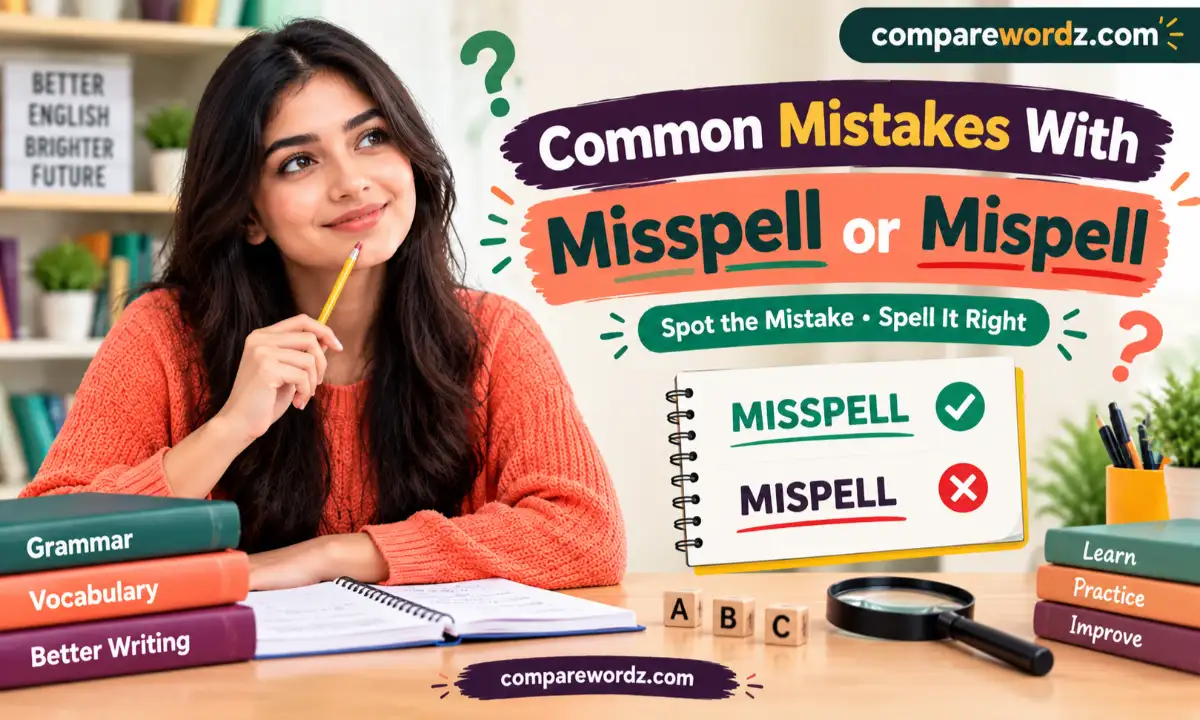
| Wrong | Right | Why people write it |
|---|---|---|
| mispell | misspell | They hear one “s.” |
| mispelled | misspelled | The same dropped s carries over. |
| mispelling | misspelling | It looks fine at a glance. |
| misspeled | misspelled | They forget the double l. |
| misspelt (in a US document) | misspelled | It’s the British form. |
Why this happens: The word is spoken quickly, and the double s is hidden in speech. Because the error is so common, it also looks familiar, which makes it harder to notice.
Other Words People Often Misspell
If you tend to misspell “misspell,” you’re not alone, and you may also trip over a few other words. Here are some common ones.
| Often written | Correct spelling |
|---|---|
| definately | definitely |
| seperate | separate |
| neccessary | necessary |
| occured | occurred |
| recieve | receive |
Like “misspell,” most of these look right at first glance, which is why they slip through. A slow second read usually catches them.
Why Spelling Slips Matter in Writing
A small spelling slip won’t ruin your message, but it can pull your reader’s attention away from it. In a job application, a client email, or a school essay, the reader may notice the error before they notice your point.
That’s why a quick proofread is worth the thirty seconds. It’s not about being perfect. It’s about making sure your words get the attention they deserve.
Misspell or Mispell in Real Life
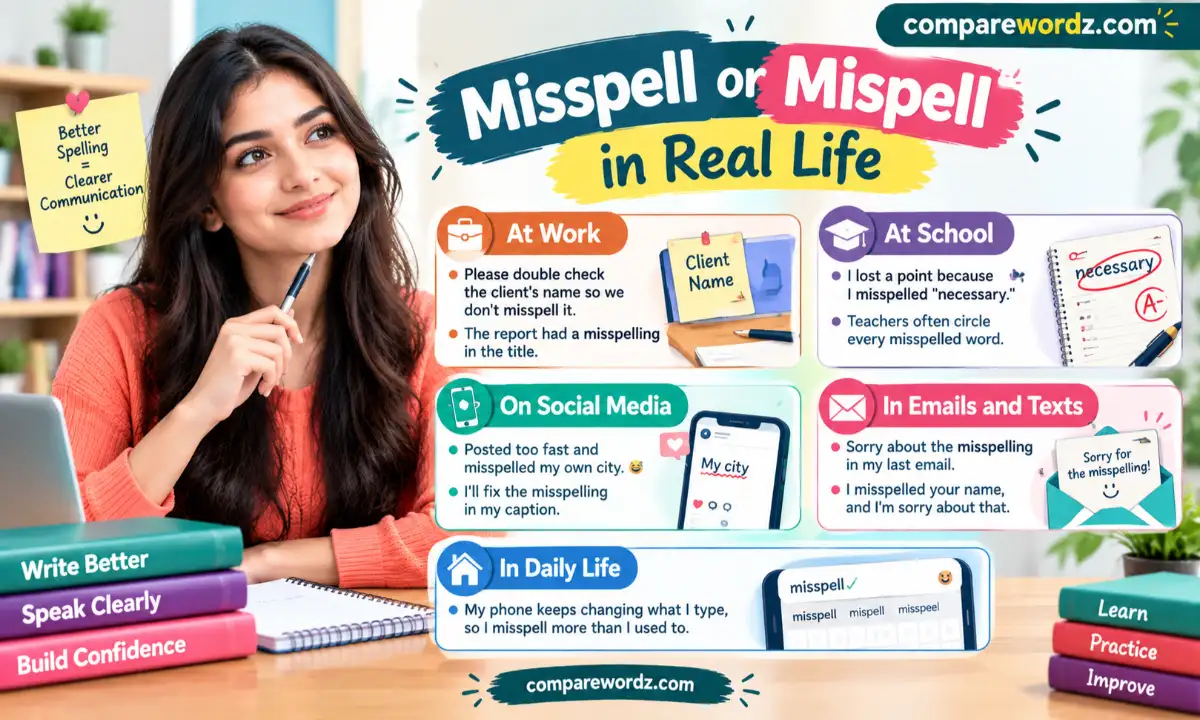
At work
- Please double check the client’s name so we don’t misspell it.
- The report had a misspelling in the title.
At school
- I lost a point because I misspelled “necessary.”
- Teachers often circle every misspelled word.
On social media
- Posted too fast and misspelled my own city. 😅
- I’ll fix the misspelling in my caption.
In emails and texts
- Sorry about the misspelling in my last email.
- I misspelled your name, and I’m sorry about that.
In daily life
- My phone keeps changing what I type, so I misspell more than I used to.
Misspell or Mispell for Students and Beginners
Beginners often struggle with this word because English spelling doesn’t always match English sound. You hear one long “s,” so your brain writes one.
Here is a simple routine for students:
- Say the word in two chunks: mis and spell.
- Write it out slowly, one chunk at a time.
- Check it against the word “spell” to confirm the second s is there.
After a few tries, the pattern sticks. Teachers and tutors often use this same chunking method for longer words.
Misspell or Mispell in Professional Writing
At work, spelling shows care. A misspelled client name or a typo in a proposal can make a good message look rushed. The misspell or mispell question matters most in places like resumes, emails, and public posts, where many people will read your words.
A quick checklist helps: run spell check, read the final version out loud, and ask a coworker to look at anything important. Two sets of eyes catch what one set misses.
Expert Tips to Avoid Misspelling Words
- Check names twice. A misspelled name feels more personal than a misspelled word.
- Don’t trust spell check alone. It catches “mispell,” but it can miss a real word that’s wrong, like “form” instead of “from.”
- Read it backwards. Start at the last sentence and move up. You’ll see spelling errors more clearly.
- Keep a short list. Write down words you often get wrong and review them once a week.
- Set your spell checker to US English. It will match your American audience and flag British forms like “misspelt.”
Related Questions About Misspell or Mispell
Is “mispell” a real word? No. It’s a common typo of “misspell.”
Why do so many people write “mispell”? It’s how the word sounds when it’s spoken fast.
Is “miss spell” two words? No. Use one word: “misspell.”
Does “misspell” have two l’s? Yes. The ending is “ell,” with a double l.
Is “misspeak” spelled the same way? Yes. It’s mis + speak, so it also has two s’s.
FAQs
Which is correct, misspell or mispell?
“Misspell” is correct. “Mispell” is always a typo.
How many s’s are in misspell?
Two. The first comes from “mis,” and the second comes from “spell.”
Is it misspelled or mispelled?
It’s “misspelled,” with two s’s and two l’s.
What is the noun form of misspell?
The noun is “misspelling,” as in “I found a misspelling in the title.”
Can spell check catch “mispell”?
Usually, yes. Because “mispell” isn’t a real word, most tools flag it, but they can miss real words used in the wrong place.
What is the opposite of misspell?
There isn’t a single word for it. You can say “spell correctly.”
From My Experience
In my 5 years of explaining grammar, the most common thing I notice about the misspell or mispell question is that people feel embarrassed after misspelling the word “misspell.” There’s no reason to. It’s one of the easiest slips to make, because the double s doesn’t show up in speech. Once you remember it’s just “mis” plus “spell,” you won’t forget it.
Final Verdict: Misspell or Mispell?
“Misspell” is the correct spelling, and “mispell” is a typo. Remember the formula: mis + spell. In American English, the past tense is “misspelled,” and the noun is “misspelling.” Keep every letter, and you’ll get it right.
Conclusion
The misspell or mispell question comes down to one small fact: you’re joining two parts, so nothing gets dropped. Two s’s in the middle, two l’s at the end, and you’re done.
Everyone misspells something now and then, even the word “misspell.” Check names, read backwards, and use spell check as a helper, not a judge. Small habits like these keep your writing clean and confident.
Reviewed by Toseef Mustafa, MA English. Facts checked against Merriam-Webster and standard American usage. Last updated: October 2026.

Hi, I’m Toseef Mustafa, the creator of CompareWordz.com and a qualified English linguistics professional. My expertise includes English vocabulary, spelling, grammar, word meanings, and commonly confused words. I aim to explain language differences through clear explanations, accurate information, and practical examples. My goal is to help readers understand English better and use the right words with confidence.
5 thoughts on “Misspell or Mispell: 5 Easy Tricks to Never Get It Wrong”
Comments are closed.