
You’re halfway through a graduation card, pen already on the paper, when your brain stalls.
Is that a T or a D in the middle? It happens to almost everyone, and always when there’s no undo button.
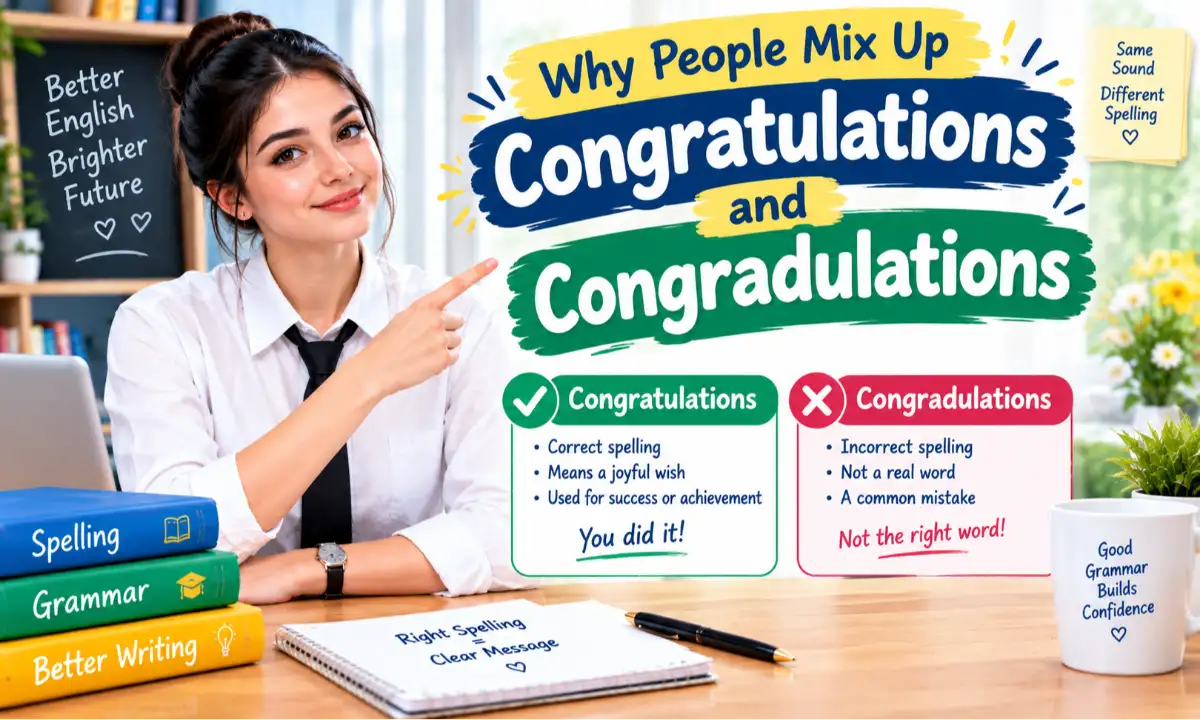
People search congratulations or congradulations because the word sounds like it has a D, but the D doesn’t look quite right on the page.
This guide gives you the answer, the reason behind the mix up, the mistakes to avoid, and a few tricks that make the spelling stick.
You’ll also find real examples for cards, emails, and texts.
Quick Answer
The correct spelling is congratulations, with a T. Congradulations is a misspelling, not a standard English word. So if you’re stuck choosing between congratulations or congradulations, go with the T every time.
The word comes from a Latin root about joy and thanks, and it has nothing to do with graduation. Here it is in action:
- “Congratulations on your new job!”
- “Congratulations, Sam!”
- “Congrats on the big win!”
Why People Mix Up Congratulations and Congradulations
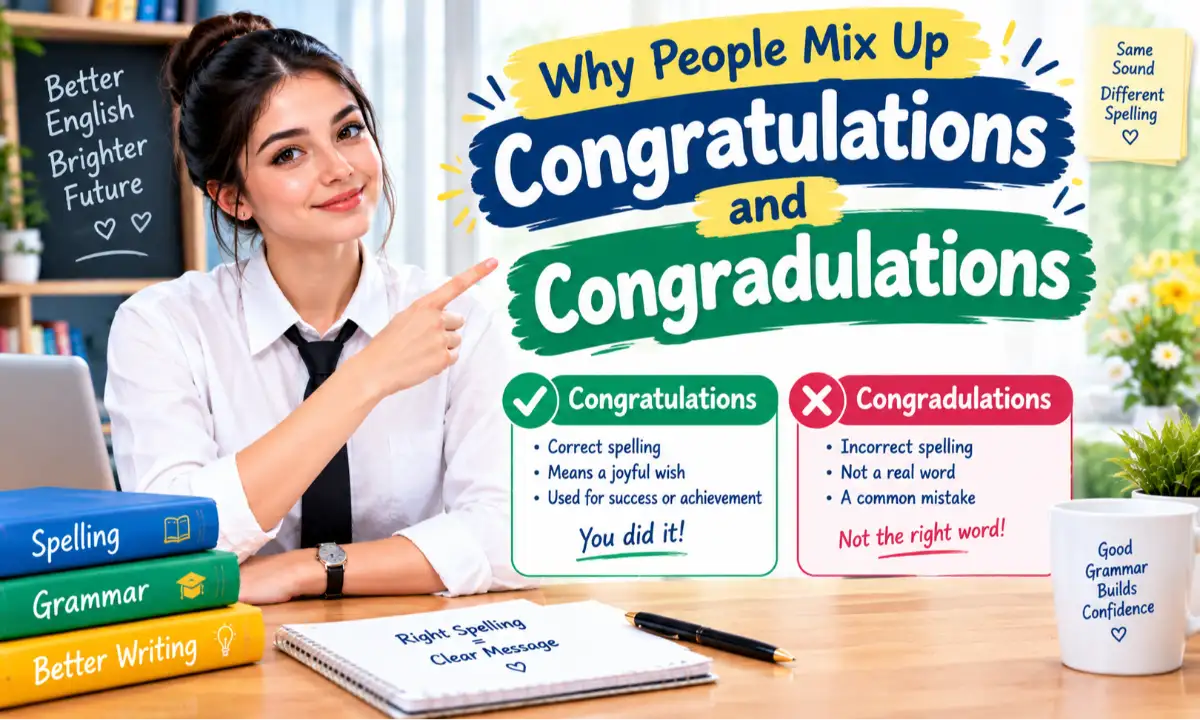
Blame the way we talk. In everyday American speech, a T before a U often softens into a “ch” or “j” sound. That soft sound sits close to a D, so the wrong spelling starts to feel natural.
Graduation adds to the mess. The two words show up at the same parties, on the same cards, and in the same captions, so your brain lets “grad” slip into a word where it doesn’t belong. They aren’t related, though. Graduation comes from the Latin gradus, meaning “step.”
Typing makes it worse. Autocorrect may quietly rescue you in a text, but handwritten cards, forms, and quick social posts have no safety net.
How to Pronounce Congratulations
Many Americans say it as kuhn GRATCH uh LAY shunz, with the biggest emphasis on LAY. Merriam-Webster lists both a “ch” and a “j” sound for the T in the related word congratulate, so both are normal in conversation.
The careful version, con GRAT yoo LAY shunz, is the one to hear in your head when you write. It keeps the T audible, which makes the spelling easier to catch.
How to Spell Congratulations Step by Step
Break the word into five small chunks and it stops feeling so long:
- con
- grat
- u
- la
- tions
Say each chunk out loud as you write it, slowly, even if you normally rush through the word. The T in “grat” is the letter people lose, so give that chunk a little extra attention.
Where Congratulations Comes From, and Why the T Belongs
The word goes back to the Latin congratulari, which Merriam-Webster and Etymonline both translate as “to wish joy.” It joins com, meaning “with” or “together,” and gratulari, meaning “to give thanks” or “show joy.” That second part comes from gratus, which means “pleasing” or “agreeable.”
Etymonline traces gratus to an old root meaning “to favor.” That same family likely includes grateful, gratitude, gratify, and grace, and every one of them keeps its T. Congratulating someone is really sharing their joy, and the spelling carries that history.
You can check it yourself on the Merriam-Webster entry for congratulate and the Etymonline page for congratulate.
Congratulations or Congradulations: What the Dictionaries Say
Here’s how the common forms compare:
| Form | Correct? | Notes |
|---|---|---|
| Congratulations | Yes | The standard greeting, always plural |
| Congradulations | No | Common misspelling, not a dictionary word |
| Congrats | Yes, informal | Fine for texts and casual posts |
| Congrads | No | The same D error in a short form |
The spelling is identical in American and British English, so there’s nothing to switch for readers in the UK or Canada.
Congrats vs Congratulations: Which One Should You Use?
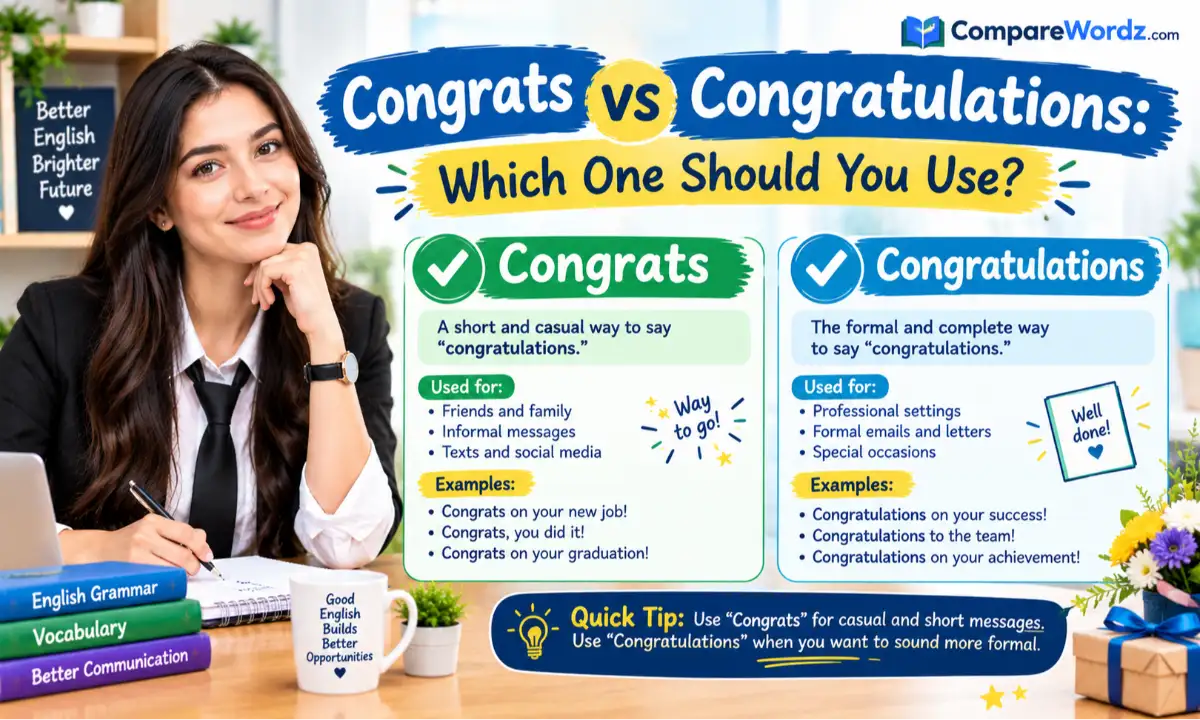
Congrats is the casual, clipped form, and it’s a real word. Etymonline dates it to 1884 as a colloquial shortening of congratulations. It still keeps the T and the S, with no apostrophe.
Use the full word in formal places, like resumes, client emails, printed cards, and notes to someone senior. Save congrats for texts, comments, and quick messages to friends.
Gamers shortened it even further to “grats” in online chat by around 2000, according to Etymonline. That’s fine in a game lobby, but skip it everywhere else.
Congratulate, Congratulation, Congratulatory: Word Forms at a Glance
The same T shows up in every member of the family. Here’s the quick map:
| Word | Type | Example |
|---|---|---|
| congratulate | verb | “I’d like to congratulate you.” |
| congratulated | past tense | “She congratulated the winner.” |
| congratulating | verb, ing form | “He’s congratulating the team.” |
| congratulation | singular noun | “A word of congratulation goes a long way.” |
| congratulations | greeting | “Congratulations on the win!” |
| congratulatory | adjective | “She sent a congratulatory note.” |
Etymonline dates congratulatory to the 1520s. The typos follow the same pattern across the whole family, so “congradulated” and “congradulatory” are just the same slip in a different outfit. If you can spell congratulations, you can spell all of them.
When to Say Congratulations and When Another Phrase Fits
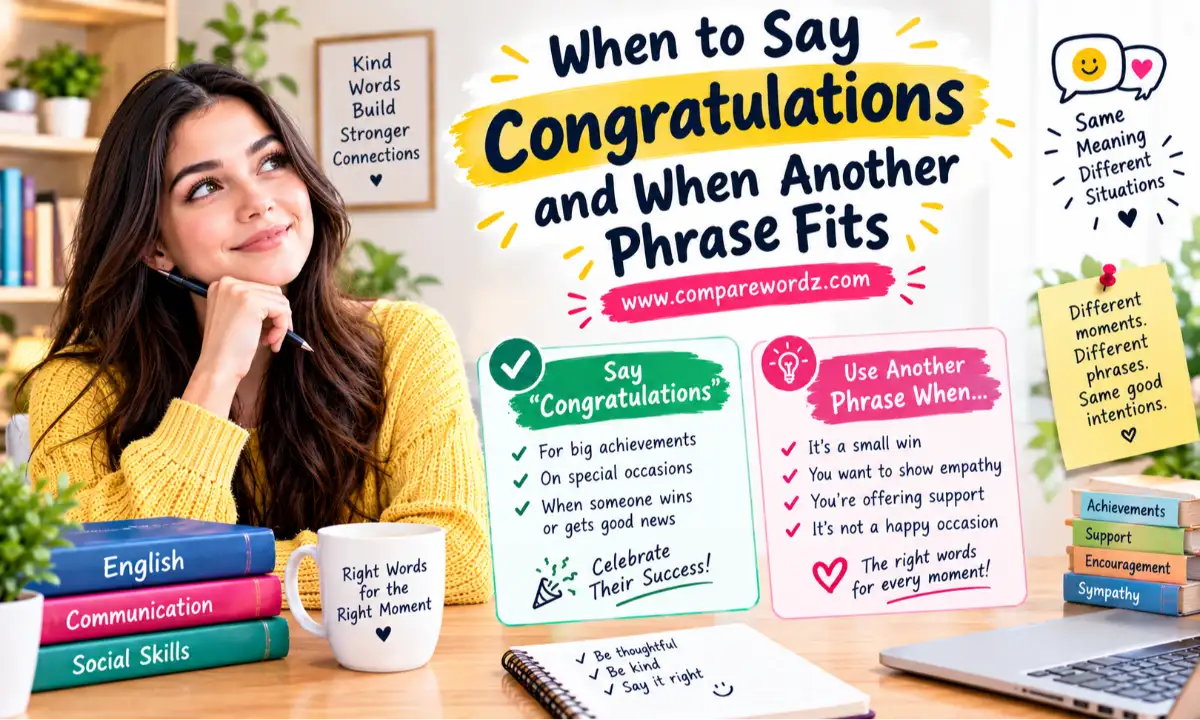
Use it when someone has achieved or received something good: a graduation, a promotion, a wedding, a new baby, a win. It’s about the person’s good news, so it works for big milestones and small victories alike.
Skip it when the moment isn’t an achievement. A birthday usually calls for “Happy birthday,” and a sympathy card needs very different words. If someone hasn’t shared personal news themselves, such as a pregnancy, a warm “I’m so happy for you” is the safer opening.
6 Common Congratulations Mistakes and How to Fix Them
Slips like these are more common than most writers admit. Even the word misspell trips people up, and our guide on misspell or mispell shows how easily a single letter goes missing. Here are the six to watch for:
- Wrong: congradulations. Right: congratulations. Why: the soft “ch” sound feels like a D.
- Wrong: “Congratulation on your wedding!” Right: “Congratulations on your wedding!” Why: the greeting is always plural, even when you’re talking to one person.
- Wrong: congrates or congrads. Right: congrats. Why: short forms keep the T, but people guess at the ending.
- Wrong: congradulate. Right: congratulate. Why: the verb shares the same root, so the T stays.
- Wrong: “Congratulations for your promotion.” Right: “Congratulations on your promotion.” Why: “on” is the usual partner. “For” creeps in from phrases like “thank you for.”
- Wrong: congratulatons or conratulations. Right: congratulations. Why: it’s a long word, and fast typing drops a letter.
Congratulations in Real Life: Cards, Emails, and Texts

Seeing the word in context helps it stick. Here are six lines you can borrow:
- Graduation card: “Congratulations, Mia! We’re so proud of everything you’ve done.”
- Work email: “Congratulations on the promotion, Daniel. It’s well deserved.”
- Text to a friend: “Congrats on the new place! Housewarming soon?”
- Social media caption: “Congratulations to the whole team on launch day!”
- Wedding card: “Congratulations, you two! Wishing you a lifetime of laughter.”
- Job offer note: “Congratulations on getting the job! I knew they’d pick you.”
Quick Self-Check: Pick the Right Spelling
Try these before you move on. Choose the correct word in each line.
- “Congradulations / Congratulations on the new house!”
- “Congrats / Congrads, Maria, you did it!”
- “She wanted to congradulate / congratulate her team.”
- “Congratulation / Congratulations on your promotion!”
Answers: 1. Congratulations. 2. Congrats. 3. Congratulate. 4. Congratulations.
4 Practical Tips to Get It Right Every Time
- Set up a text shortcut. Most phones let you create a replacement, so a short code like “cgt” expands to the full word. The spelling stays right even when you’re typing fast.
- Practice on scrap paper. A crossed out word looks messy in a card. Write it once on a sticky note, then copy it with confidence.
- Proofread printed items letter by letter. Banners, custom cakes, and invitations are expensive to fix. Read the word out loud one chunk at a time, or ask someone else to check it.
- Search your draft before you publish. Press Ctrl+F (Cmd+F on a Mac) and look for “congrad.” One search catches congradulations, congradulate, and congradulatory in a single pass.
Sound traps like this one are everywhere. Gross and grose is another good example, and the guide on gross or grose explains why one spelling wins.
Related Questions About Writing Congratulations
Do you put a comma after congratulations?
Yes, when a name follows: “Congratulations, Sam!” With no name, skip it: “Congratulations on the win!”
Should congratulations be capitalized?
Capitalize it at the start of a sentence or greeting. Mid sentence it stays lowercase: “I wanted to say congratulations.”
Does it need an exclamation mark?
No. An exclamation mark adds warmth, while a period suits a calm or formal note.
Frequently Asked Questions
Is it congratulations or congradulations?
Congratulations is correct. Congradulations is a common misspelling and isn’t a standard English word.
How many Ts are in congratulations?
Two. The word has 15 letters, and none of them is a D.
Is congratulations one word?
Yes. Write it as one word, never split into “con gratulations” or “congrat ulations.”
What does congratulations mean?
It’s what you say to share someone’s joy about their success or good news.
Final Verdict
Congratulations, with a T, is the only correct spelling. Congradulations is a slip caused by how the word sounds, not a real word. Here’s the memory rule: spot the rat hiding in the middle, congRATulations, and the D never gets a seat. Before you write it in a card, give it one last look.
Conclusion
Spelling this word right comes down to one small habit, and now you have a few to choose from.
Next time you wonder about congratulations or congradulations, look for the T first, then write the rest around it.
Save a few of the example lines above for your next card, email, or text.
The people you’re celebrating will remember your kind words, not the spelling.

Hi, I’m Toseef Mustafa, the creator of CompareWordz.com and a qualified English linguistics professional. My expertise includes English vocabulary, spelling, grammar, word meanings, and commonly confused words. I aim to explain language differences through clear explanations, accurate information, and practical examples. My goal is to help readers understand English better and use the right words with confidence.