

You’re filling out a form, writing a caption, or texting a friend about something truly disgusting.
You type “grose,” and it looks okay. Then you stop.
Is it gross or grose? It’s a fair question, because the word sounds a lot like “rose,” and your fingers may follow the sound instead of the spelling.
This page clears it up fast. You’ll learn which spelling is correct, why the wrong one feels
natural, and what gross means, from yucky to money to the number 144. You’ll also get a
simple trick to remember it.
Quick Answer Gross or Grose?
Gross is the correct spelling. It can mean disgusting, a total before deductions, or the number 144. Grose isn’t a standard English word. It’s usually a typo, though it can appear as a surname.
For gross or grose, pick the one with the double s. Examples: “That smell is gross.” “Her gross pay was higher than her take-home pay.” “We ordered a gross of pencils.”
Gross or Grose: Why the Wrong Spelling Feels Right

The word is pronounced “grohss,” with a long “o” sound. English has plenty of words with that sound spelled with an “o” and a silent “e”: rose, nose, hose, close. So when you write by sound, “grose” seems to fit the pattern.
Gross doesn’t follow that pattern. It ends in a double s, and the long “o” sound comes from the “o” alone. English has many spellings like this, and they don’t always match how a word sounds.
Here’s what usually makes the mix-up more likely:
- You’ve seen “-ose” words so often that the pattern feels automatic.
- Fast typing hides the double s.
- Social media posts and texts rarely get proofread, so a typo can look normal after you’ve seen it a few times.
What Does Gross Mean?
Gross is one of those words that does several jobs. It started out meaning “big” or “thick,” and that older idea still shows up in some of the meanings below. The word came into English from Old French gros.
| Meaning | What it says | Example |
|---|---|---|
| Disgusting (informal) | Something that makes you say “ew” | “The fridge smelled gross.” |
| Total before deductions | Money before taxes or costs come out | “Gross income” |
| Obvious and serious | A very clear wrong or error | “Gross negligence” |
| Total weight | Weight including packaging | “Gross weight” |
| The number 144 | Twelve dozen | “A gross of pencils” |
Gross vs. net
Gross and net are opposites in money talk. Gross is the total before anything is taken out. Net is what’s left after taxes, fees, or costs. If a form asks for gross pay, it wants the bigger number, before deductions.
This is general information, not tax or financial advice. For tax terms, check the IRS or your employer.
How Do You Pronounce Gross?
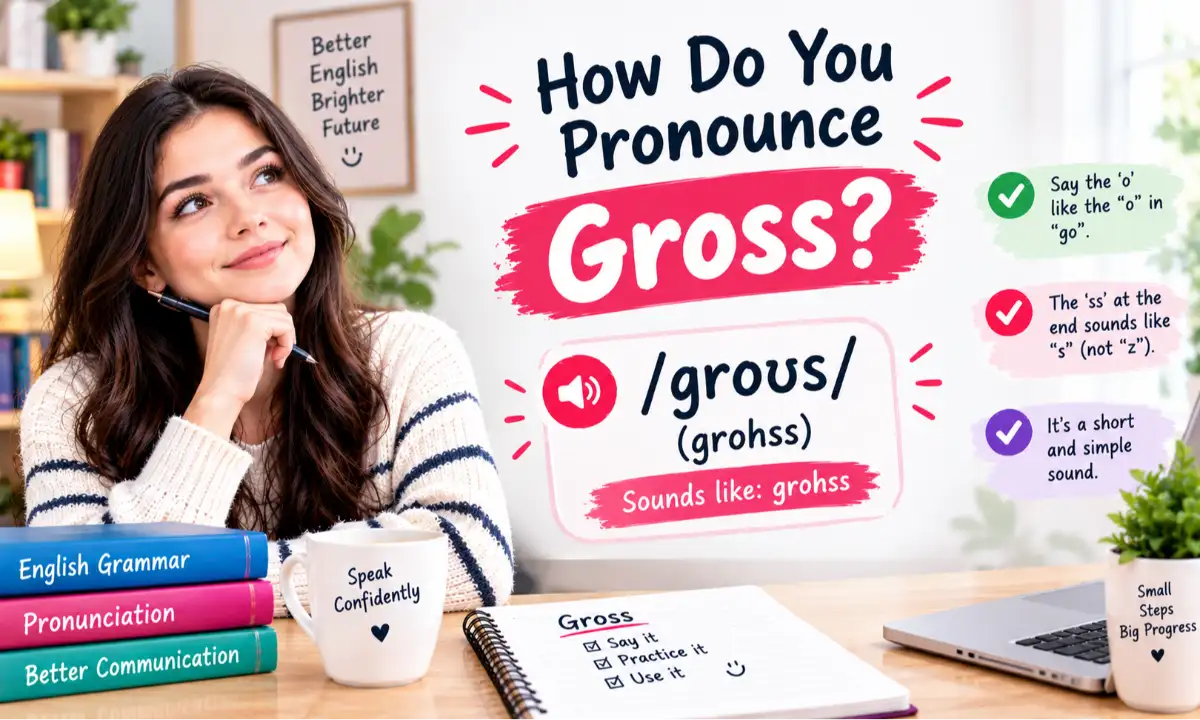
In American English, it sounds like grohss. It starts like “grow” and ends with a crisp “s.”
That “s” at the end is a hard one, like in “dose.” Say it out loud and you’ll hear the difference from “grows,” which ends in a “z” sound. We’ll come back to that mix-up below.
Is “Grose” Ever Correct?
Sometimes, but not as a regular English word. Here are the rare cases:
- A surname. Grose is a real family name, so a person might spell it that way. If it’s someone’s name, write it exactly as they do.
- A brand or business name. Companies choose unusual spellings on purpose. Copy theirs.
- A longer name that looks similar. “Grosse” appears in some place names, such as Grosse Pointe in Michigan. That’s a name, not a spelling option for the everyday word.
For normal writing, like a text, essay, or product review, use gross.
Is There a British vs. American Difference? Gross or Grose?
No. Both use “gross,” and “grose” is wrong in both.
4 Common Mistakes (and How to Fix Them)
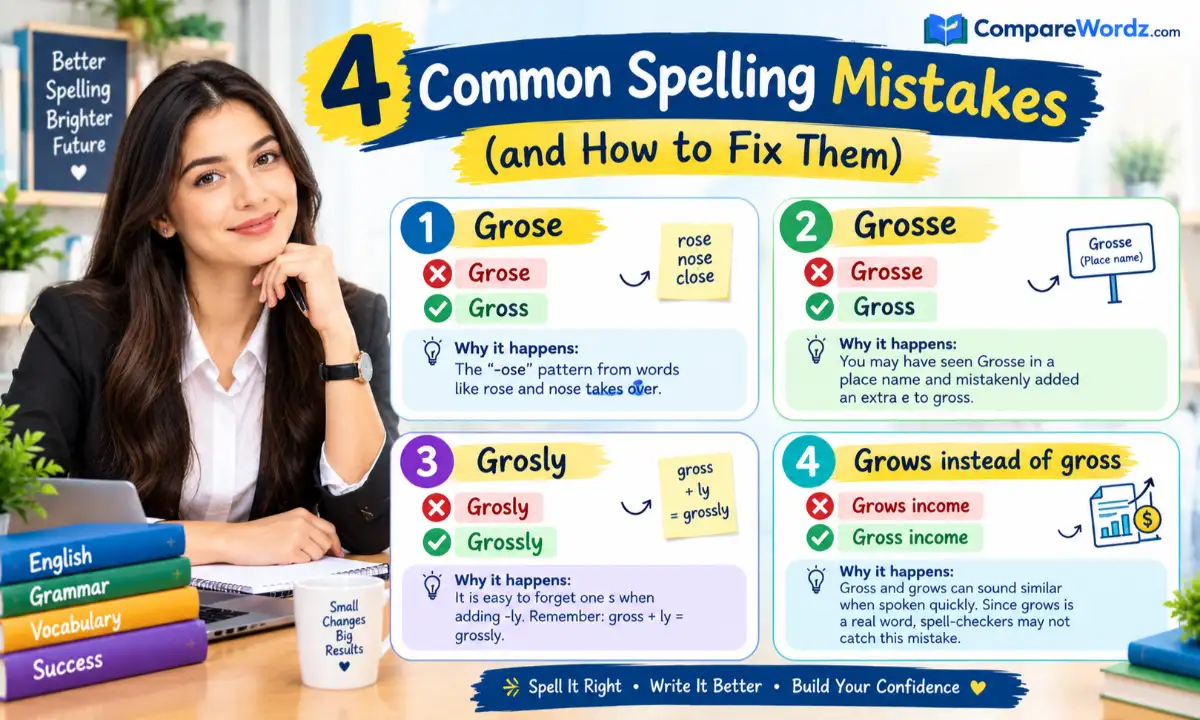
1. Grose
- Right: gross
- Why it happens: The “-ose” pattern from words like rose and nose takes over.
2. Grosse
- Right: gross
- Why it happens: You may know “Grosse” from a place name and carry the extra “e” over.
3. Grosly
- Right: grossly
- Why it happens: It’s easy to drop one “s” when adding “-ly.” Keep both: gross + ly = grossly.
4. Grows instead of gross
- Right: “Gross income,” not “grows income”
- Why it happens: The two words sound close when you say them fast, so a spell-checker may not catch it because “grows” is a real word.
Gross vs. Grows: Don’t Mix Them Up
These two trip people up because both are real words, which means spell-check won’t always flag the error.
- Gross is an adjective or noun about disgust, totals, or size.
- Grows is a verb. It means something gets bigger or develops.
Compare: “Her garden grows fast” and “Her gross sales were strong.” If you can swap in “gets bigger,” you want grows. If you mean a total or something yucky, you want gross.
Real-Life Examples Gross or Grose?
Here’s how the correct spelling looks in everyday writing:
- Text to a friend: “Someone left a banana peel in the car. So gross.”
- Pay stub or job form: “Enter your gross monthly income.”
- Product listing: “Gross weight: 2.4 kg.”
- Restaurant review: “The soup was cold and the table was sticky. Honestly, kind of gross.”
- School supply order: “Two gross of pencils for the whole grade.”
Expert Tips Gross or Grose?
- Search for “grose” before you publish. Press Ctrl+F (Cmd+F on a Mac) and look for it. It takes seconds and catches the typo in menus, posts, and web pages.
- Mind your tone. “Gross” in the “disgusting” sense is casual. In a formal report or business email, words like “unpleasant” or “unacceptable” usually fit better.
- Check what a form is asking for. Money forms often ask for gross or net. Read the label twice before you type a number.
- Use “gross” for the plural of 144, too. You’d write “two gross of pencils,” not “two grosses,” though people sometimes use “grosses” in casual writing.
- Look it up when unsure. The Merriam-Webster entry for gross lists every meaning in one place.
Related Questions
What does “gross out” mean?
To disgust someone, as in “That video grossed me out.”
How do you spell the adverb form?
Grossly, with two s’s: “grossly unfair.”
What is gross weight?
The total weight of an item including its packaging or container.
Where does the word gross come from?
Old French gros, which meant big or thick.
Is “gross” the plural of 144?
No. It means 144 itself. For more than one, people usually keep it as “gross”: “two gross of eggs.”
What’s the difference between gross profit and gross income?
They’re different measures. Gross profit is usually about a business’s sales minus the direct costs of making the product.
Gross income is a broader term, often used for a person’s total earnings before deductions.
Frequently Asked Questions
Is it gross or grose?
It’s gross. “Grose” is a misspelling.
Is grose a real word?
Not in standard English dictionaries. It’s usually a typo, though Grose exists as a surname.
How do you spell gross?
G-R-O-S-S.
What does gross mean in English?
It can mean disgusting, total before deductions, very obvious (as in gross error), or 144.
Is gross a bad word?
No. It’s informal, but not a swear word. It’s fine in casual speech and writing.
How many is a gross?
144, or twelve dozen.
What is the difference between gross and net?
Gross is the total before deductions. Net is what remains after them.
Final Verdict
Use gross. It’s the only correct spelling, and it covers disgusting things, money totals, and the number 144. Here’s your memory rule: gross has two s’s, like the “sss” sound you make when something’s yucky. Keep “grose” out of anything you publish unless it’s someone’s name.
Conclusion
You now know how to settle the gross or grose question for good.
The mistake happens because the word sounds like “rose,” even though it’s spelled with a double s.
Before you post, send, or publish, take five seconds to search your text for “grose.”
It’s a tiny check that makes your writing look careful and polished.

I’m MK Jan Mustafa Kamal, the author of CompareWordz.com, specializing in English linguistics, word meanings, spelling, and language usage.
I hold an M.A. in English and have 8 years of experience in English language and vocabulary studies. My goal is to explain confusing words, spelling differences, grammar rules, and meanings in clear, simple, and accurate language. I focus on providing well-researched, fact-checked, and easy-to-understand content that helps readers use English with confidence. Through CompareWordz.com, I aim to make learning English words and their correct usage easier for everyone.