


You’re texting a friend about a party, and you type, “There were so meny people there.”
Something looks wrong, but the word sounds exactly right when you say it. So you stop and wonder: is it “many” or “meny”?
If that sounds familiar, you’re not alone. People searching many or meny usually want to know which spelling is correct, and why a
word that sounds like it starts with “men” is written with an “a.”
The short answer is many. In this guide, you’ll learn why, where the odd spelling comes from, and 5 easy tricks to get it right every time.
Many or Meny: Quick Answer
Many is correct. Meny is a common spelling mistake, and it isn’t a standard English word.
“Many” means a large number of people or things. It’s spelled m-a-n-y, and it’s pronounced like “MEN-ee.”
- Many people came to the party. ✅
- How many apples do you need? ✅
- There were so meny people there. ❌
Simple rule: many = m + any. If you can spell “any,” you can spell “many.”
Why Is “Meny” Wrong?

Because the word has always been spelled with an a in the middle. Dictionaries list “many” as the standard form, and “meny” has no place in standard English.
Dictionary.com shows the pronunciation as “men-ee.” That sound is the problem. The spelling doesn’t match the sound, so “meny” feels natural, even though it isn’t correct. Spell checkers usually flag “meny” with a red line, which is a helpful sign that something is off. Still, it’s better to know the reason than to rely on the tool.
Why Do People Write “Meny”?
Most people spell by sound. When you say “many,” you hear a short e, just like in “men,” “ten,” and “penny.” So the hand writes an e.
This is one of the most common reasons for spelling slips in English. The sound points one way, and the spelling points another. You can see the same thing in other pairs, like our guide on gross or grose, where the sound is clear but the spelling takes learning.
| What you hear | What many people write | The correct spelling |
|---|---|---|
| MEN-ee | meny | many |
| PEN-ee | (penny is correct) | penny |
Notice that “penny” really is spelled with an e. That’s why “many” is so tricky: it rhymes with a word that follows the sound rules.
Why Does Many Have an A?
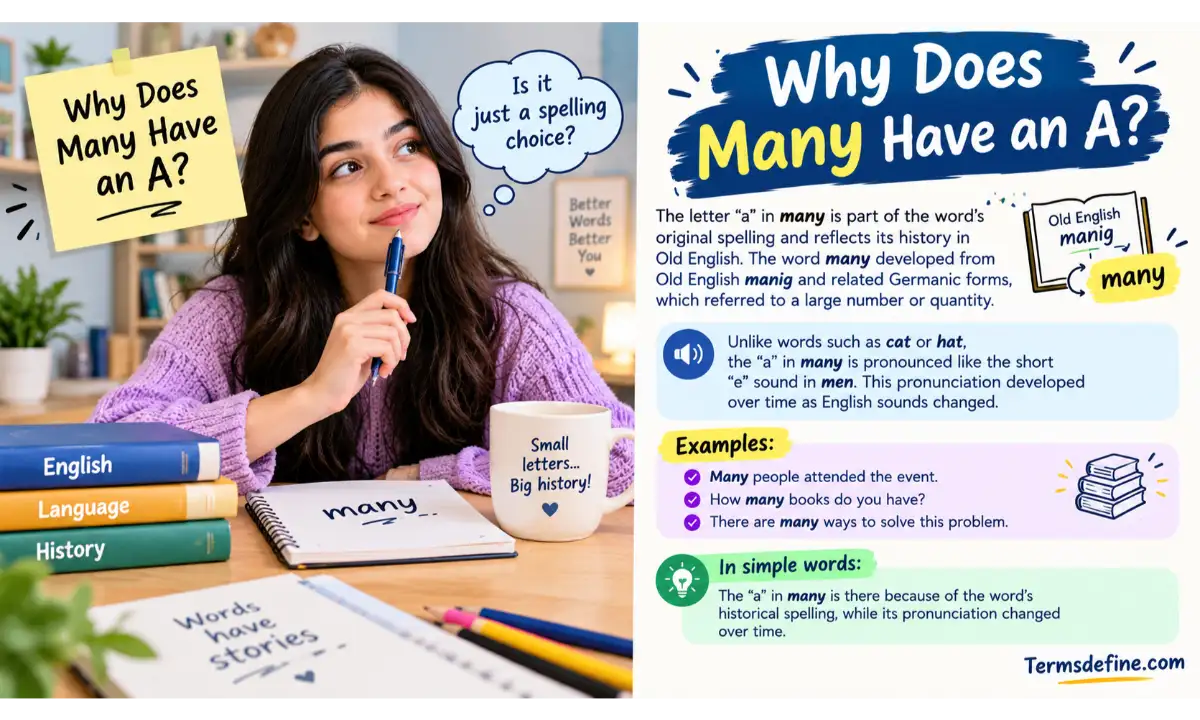
This is the part most spelling pages skip, and it’s the key to remembering the word.
According to Etymonline, “many” comes from Old English manig, and its pronunciation was later altered by the influence of the word any. So the spelling kept the old a, while the sound shifted toward the e sound we hear today.
That’s why “any” and “many” are a pair. They both have an a and end in -ny, and they both start with the “e” sound you hear in “men.”
| Word | Spelling | Sounds like |
|---|---|---|
| any | a-n-y | EN-ee |
| many | m-a-n-y | MEN-ee |
Etymonline also notes that the word “manifold” kept the original pronunciation of “many,” which is a fun clue that the old sound was closer to the spelling.
How to Pronounce Many
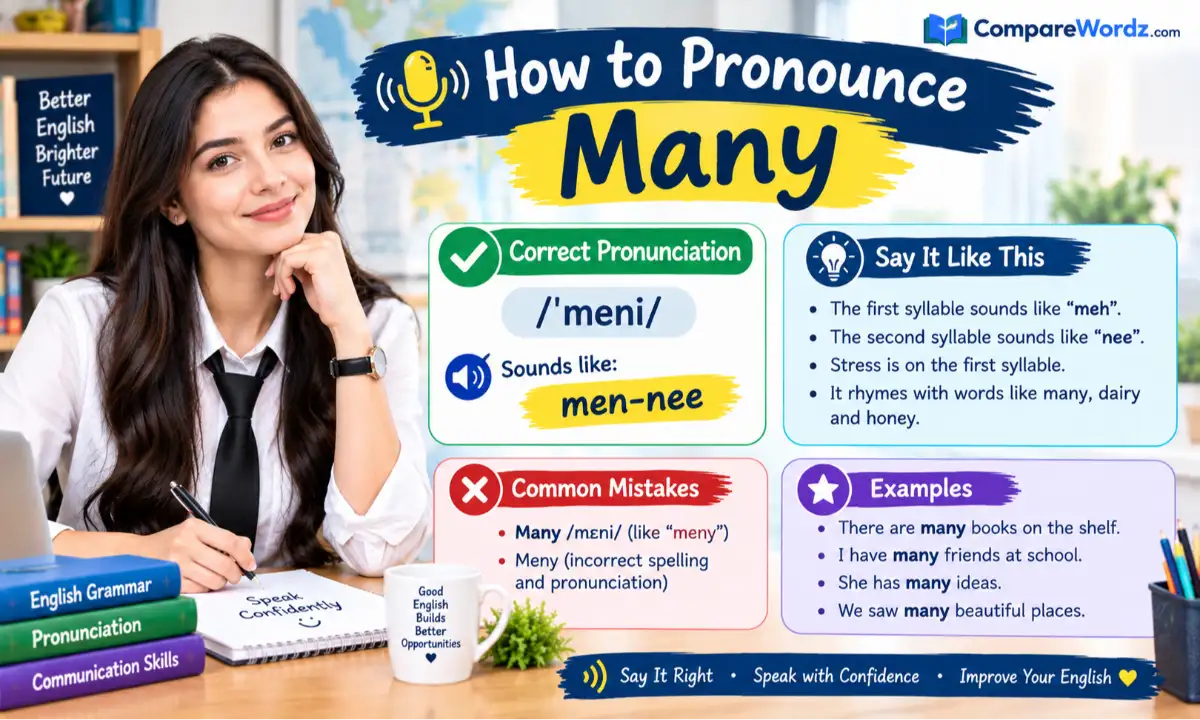
Say it as MEN-ee. It has two syllables, with the stress on the first one. It rhymes with “penny” and “Jenny.”
The vowel sound is the same short e you hear in “men.” That sound is the one that fools the spelling, so remember: say “men,” but write “man.”
Many vs Much
Many and much both talk about amount, but they work with different kinds of nouns.
| Word | Used with | Example |
|---|---|---|
| many | things you can count | many apples, many people |
| much | things you can’t count | much water, much time |
Wikipedia describes “many” as a quantifier used with count nouns, meaning a large but indefinite number.
If you’re unsure, try “a lot of.” It works with both: “a lot of apples” and “a lot of water.”
Many, More, and Most

“Many” has its own comparison forms, and they don’t follow the usual pattern. According to Dictionary.com, the forms are many, more, most.
- Many people came last year.
- More people came this year.
- Most people stayed until the end.
You don’t say “manier” or “maniest.” The word borrows “more” and “most” instead.
Common Phrases With Many
You’ll see “many” in many fixed phrases, and the many or meny question applies to every one of them.
- how many
- too many
- as many as
- a good many
- a great many
- many a (followed by a singular noun, as in “many a man”)
- the many (meaning the majority of people)
The last two are older, more formal uses. “The many” appears in sentences like “the many are kept in ignorance.” It’s rare today, but you may meet it in books.
Common Mistakes With Many or Meny
| Wrong | Right | Why people write it |
|---|---|---|
| meny | many | They spell by sound. |
| meney | many | They add extra letters to match the sound. |
| menny | many | They copy the “penny” pattern. |
| mainy | many | They try to show the vowel with “ai.” |
| manny (for many) | many | “Manny” is a different, informal word for a male nanny. |
| many water | much water | “Many” is for things you can count. |
Why this happens: The many or meny mix up is common because “many” is among the first words we learn to say, and most people learn the spelling later.
Many or Meny in Real Life

At work
- We received many emails about the new policy.
- How many people are joining the meeting?
At school
- Many students forget their homework on Mondays.
- There are too many words on this list to learn at once.
At home
- How many eggs do we have left?
- There were as many cousins as chairs.
On social media
- So many good memories from this trip. 📸
- Many thanks to everyone who came! 🙏
Why Getting Many Right Matters
“Many” is one of the most common words in English. You’ll write it in emails, essays, captions, and messages almost every day. That’s why a typo like “meny” stands out so quickly.
A small slip won’t ruin your message, but it can distract your reader. Fixing the many or meny habit once saves you from the same slip for good.
Many or Meny for Students and Beginners
Learners often mix up “many” and “much,” or write “meny” because the many or meny spelling feels random. A quick drill helps.
Fill in each blank with many or much:
- How ___ people came?
- We don’t have ___ time.
- There are too ___ cars here.
- She drank too ___ water.
Answers: many, much, many, much. Two are for things you can count, and two are for things you can’t.
5 Easy Tricks to Spell Many Right Every Time

Use these every time the many or meny question comes up.
- Use the “m + any” trick. If you can spell “any,” just add an m in front.
- Say “man-y” in your head. Silently pronounce it as “man” plus “y” while you write. The odd sound becomes a spelling map.
- Remember it’s the odd one out. “Many” rhymes with “penny,” but only “penny” uses an e.
- Search before you publish. Use find and replace to look for “meny” in your documents.
- Keep a short list. Write down words you often get wrong and review them weekly. For other common slips, see our guides on misspell or mispell, halt or hault, and volume or volumn.
Related Questions About Many or Meny
Is “many” singular or plural? It’s plural. You say “many people are,” not “many person is.”
Is “many” formal? It’s a common, everyday word. Dictionary.com notes that “numerous” is the more formal choice.
Is “many” a noun? Sometimes. In “the many,” it means the majority of people.
Is “manny” the same as “many”? No. “Manny” is a separate, informal word for a male nanny.
Does “many” change in British English? No. The spelling and meaning are the same in American and British English.
FAQs
Which is correct, many or meny?
“Many” is correct. “Meny” is a spelling mistake.
How do you spell many?
M-A-N-Y. It’s “m” plus “any.”
What does many mean?
It means a large, indefinite number of people or things.
What is the opposite of many?
The opposite is “few,” as in “few people came.”
How many syllables does many have?
Two: man-y, said like “MEN-ee.”
Final Verdict: Many or Meny?
“Many” is the correct spelling, and “meny” is a mistake. The word keeps its old a even though it sounds like “men.” Remember the trick: many = m + any. If you can spell “any,” you can spell “many.”
Conclusion
The many or meny question has a clear answer, and a good story behind it. The word sounds like “men,” but history left the a in place, and “any” is the clue that holds it together.
Next time your fingers want to type “meny,” think “m + any.” That small check keeps your writing clean, whether you’re texting a friend or writing an essay.
Related spelling guides: more slips that come from sound, like volume or volumn and gross or grose, plus our full list of commonly misspelled words.
Reviewed by Toseef Mustafa, MA English. Facts checked against Dictionary.com and Etymonline. Last updated: October 2026.

Hi, I’m Toseef Mustafa, the creator of CompareWordz.com and a qualified English linguistics professional. My expertise includes English vocabulary, spelling, grammar, word meanings, and commonly confused words. I aim to explain language differences through clear explanations, accurate information, and practical examples. My goal is to help readers understand English better and use the right words with confidence.