


You’re writing a quick note at work: “We need to hault production until Monday.” You pause. The word looks a little off, but you can’t say why.
If that sounds familiar, you’re not alone. People searching halt or hault usually want to know which spelling is correct, why the “u” feels like it belongs, and what the word actually means. The short answer is halt. In this guide, you’ll learn why, where the word comes from, and 5 easy tricks to spell it right every time.
Written by Toseef Mustafa, MA English, English Grammar Specialist with 5 years of experience | Last updated: October 2026
From my experience: In my 5 years of explaining grammar, the halt or hault slip usually comes from sound, not carelessness. English writes the same vowel sound in different ways, so the brain guesses. Once you see the pattern, the guessing stops.
Halt or Hault: Quick Answer
Halt is correct. Hault is a spelling mistake, and it isn’t a standard English word.
“Halt” means to stop, or a stop. It’s spelled h-a-l-t. There is no u.
- The police asked the driver to halt. ✅
- The parade came to a halt at the main square. ✅
- The storm caused a hault in traffic. ❌
Simple rule: halt rhymes with salt, and both end in -alt.
Why Is “Hault” Wrong?
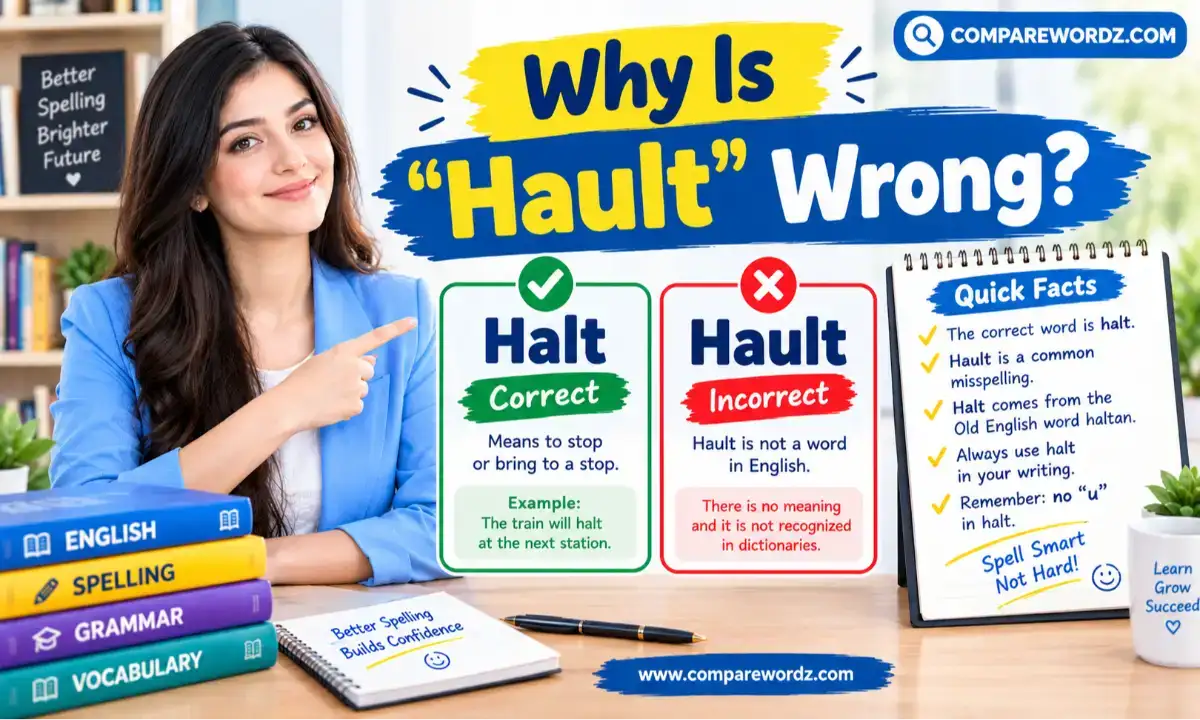
In modern standard English, the word is only spelled “halt.” A version with a u shows up only as a typo.
Dictionaries list “halt” as a verb, a noun, and an old-fashioned adjective. According to Spellzone, the noun means an interruption or end of movement or progress, and the verb means to cause something to stop.
Why Do People Write “Hault”?
The reason is probably the sound. In many accents, “halt” has the same vowel sound as “fault” and “vault.” But those words are spelled with -ault. The brain remembers that pattern and applies it to halt. This is my explanation, not a dictionary claim, but it matches what I see.
| Spelled -alt | Spelled -ault |
|---|---|
| halt | fault |
| salt | vault |
| malt | assault |
| exalt | somersault |
Same sound, two spellings. The only way to be sure is to learn which group a word belongs to, and “halt” belongs in the left column.
What Does Halt Mean?
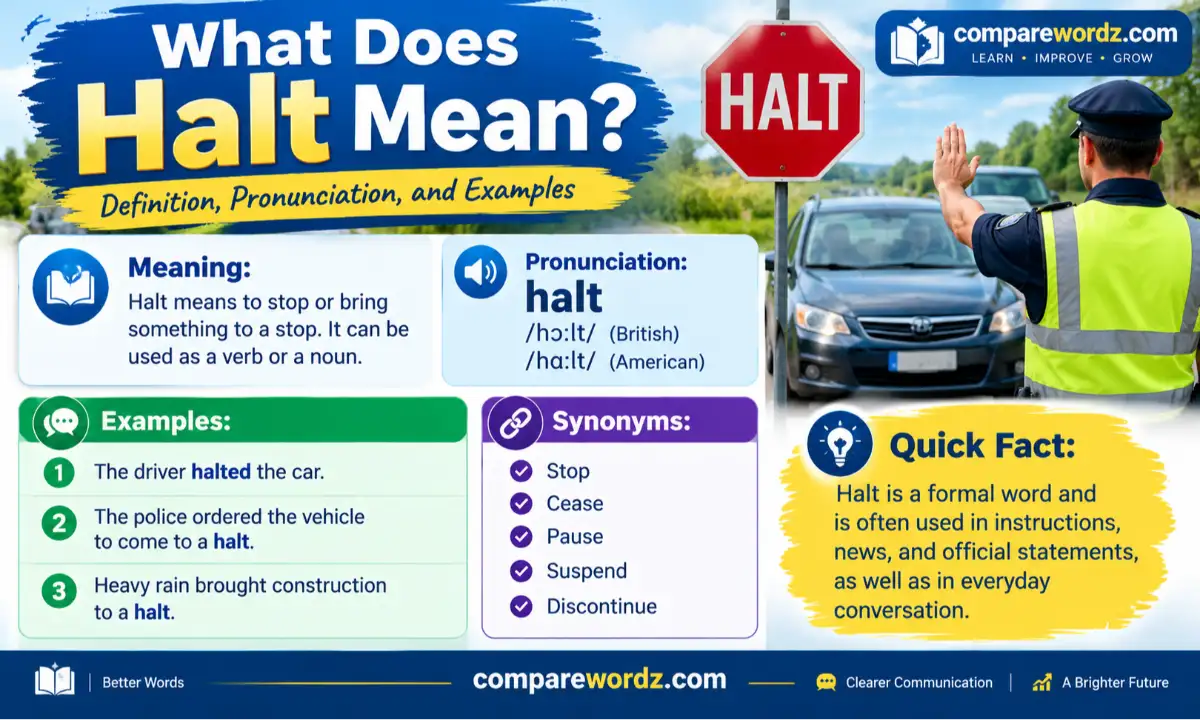
“Halt” is a flexible word. It can be a verb, a noun, or, rarely, an adjective.
| Use | Meaning | Example |
|---|---|---|
| Verb | To stop, or to make something stop | The company halted production. |
| Noun | A stop or pause | The train came to a halt. |
| Adjective (old-fashioned) | Lame, unable to walk well | “The halt and the lame” |
Most of the time, you’ll meet the verb and the noun.
Where Does the Word Halt Come From?
According to Etymonline, the noun “halt” meaning “a stop” appeared in the 1590s. It came from French halte or Italian alto, which in turn came from German Halt, the command form of halten (“to hold”). It was a German military order borrowed into other languages.
The older adjective “halt,” meaning lame, has a different history. Etymonline traces it back to Old English. So two separate words ended up with the same spelling.
Halt vs Stop: What’s the Difference?
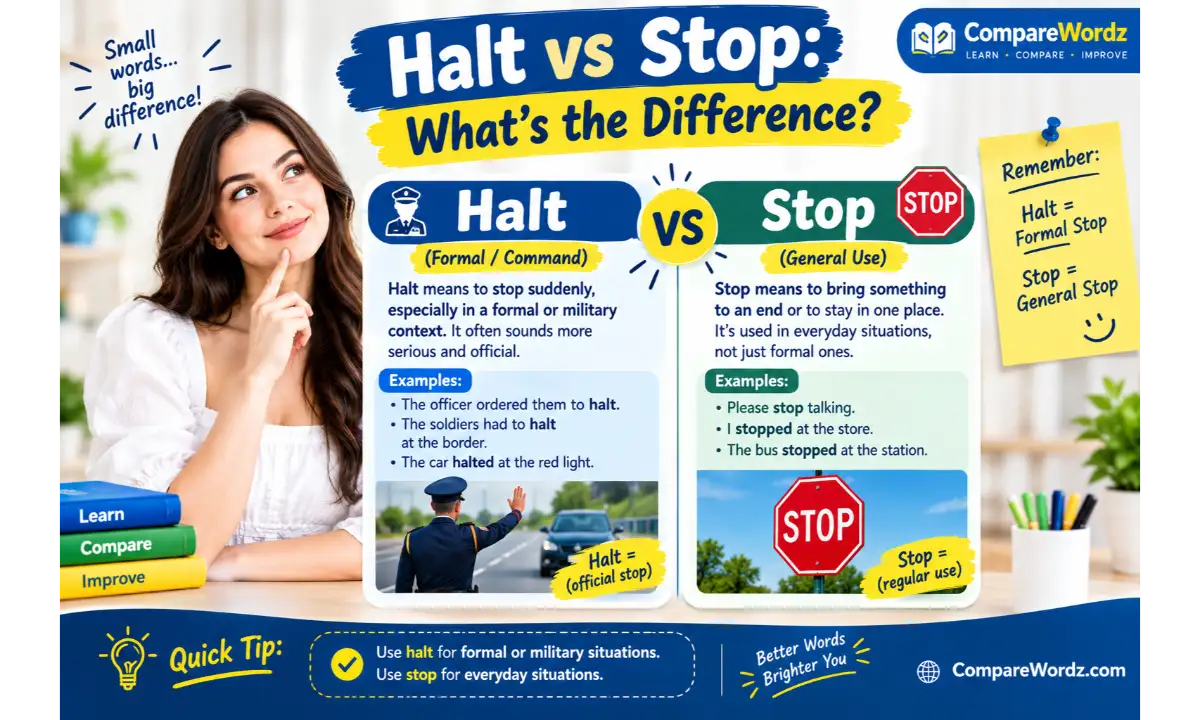
Both mean to stop moving, but they feel different.
| Word | Feels like | Example |
|---|---|---|
| stop | everyday, general | Please stop talking. |
| halt | formal, strong, or dramatic | The government halted all exports. |
Use “stop” in daily talk. Choose “halt” when the stop is serious, sudden, or forced.
Common Phrases With Halt
- come to a halt
- grind to a halt
- bring something to a halt
- call a halt to something
- put a halt to something
You’ll also see the adjective “halting,” as in “a halting voice,” which means slow and uncertain.
Forms of Halt
| Form | Example |
|---|---|
| halt | Please halt the machine. |
| halts | She halts at every crossing. |
| halted | The work was halted on Friday. |
| halting | He is halting the project. |
The word follows the usual pattern: add -s, -ed, or -ing. There’s still no u in any form.
How to Pronounce Halt
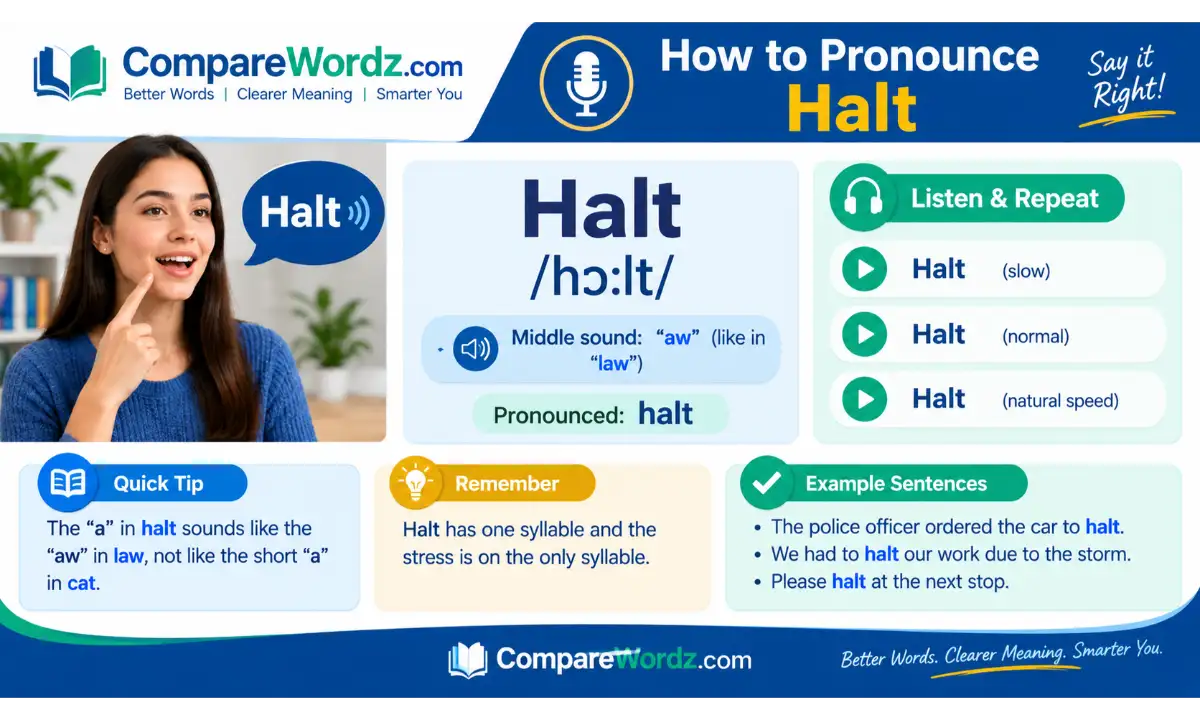
Say it as hawlt, one syllable, with a clear “t” at the end. For most speakers it rhymes with “salt” and “fault,” though the exact vowel varies by accent (for example, British /hɒlt/ and American /hɔːlt/).
That last rhyme is the source of the trouble. “Fault” is spelled with a u, but “halt” is not, even though they sound alike.
Common Mistakes With Halt or Hault
| Wrong | Right | Why people write it |
|---|---|---|
| hault | halt | They borrow the u from fault. |
| haulted | halted | The same extra u carries over. |
| haulting | halting | The mistake follows the word. |
| grind to a hault | grind to a halt | A fixed phrase doesn’t change the spelling. |
| haul (for halt) | halt | “Haul” is a different word, meaning to pull. |
Why this happens: The halt or hault mix-up is common because English has two ways to spell the same vowel sound, and the right one has to be learned word by word.
Halt or Hault in Real Life
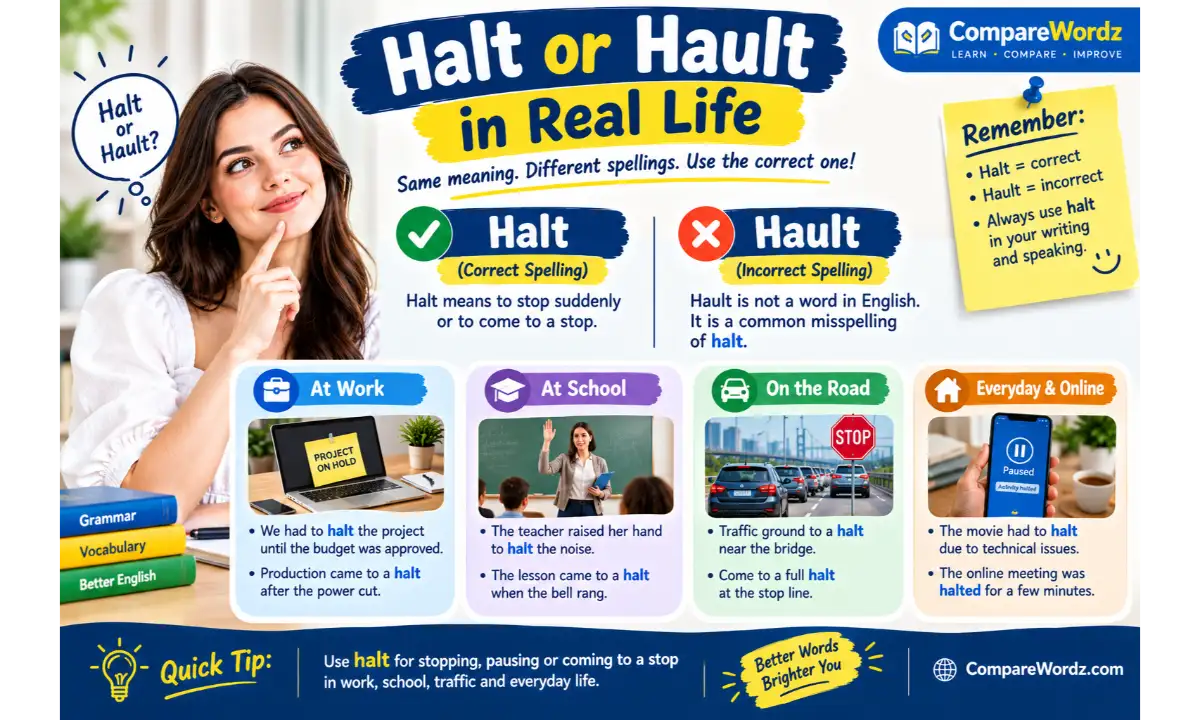
At work
- We had to halt the project until the budget was approved.
- Production came to a halt after the power cut.
At school
- The teacher raised her hand to halt the noise.
- The lesson came to a halt when the bell rang.
On the road
- Traffic ground to a halt near the bridge.
- Come to a full halt at the stop line.
Everyday and online
- My weekend plans came to a halt thanks to the rain.
Halt or Hault for Students and Beginners
Learners often ask how to know which words take -alt and which take -ault. The honest answer is practice. Here’s a quick drill.
Fill in the blank with alt or ault:
- h___
- f___
- s___
- v___
Answers: halt, fault, salt, vault. Two use -alt, and two use -ault.
5 Easy Tricks to Spell Halt Right Every Time
Use these whenever the halt or hault question comes up.
- Join the -alt family. Halt, salt, and malt all end in -alt.
- Match it to “stop.” Both words have four letters, so there’s no room for an extra u.
- Picture the salt shaker. Say “I halt at the salt,” and the -alt spelling sticks.
- Ask if it’s a fault word. Only words like fault, vault, and assault take the extra u. If it isn’t one of those, leave the u out.
- Search before you publish. Use find and replace to look for “hault” and “haulted” in your documents.
Want to catch other common slips? See our guides on misspell or mispell, occurred or occured, and volume or volumn.
Related Questions About Halt or Hault
Is “halting” correct? Yes. It can be the verb form or an adjective meaning slow and uncertain.
Is “halt” formal? It’s more formal than “stop,” and it often suggests a strong or forced stop.
Is “haul” the same as “halt”? No. “Haul” means to pull or carry something.
What does “the halt and the lame” mean? It’s an old phrase where “halt” means unable to walk well.
What does “call a halt to” mean? It means to order something to stop.
FAQs
Which is correct, halt or hault?
“Halt” is correct. “Hault” is a spelling mistake.
How do you spell halt?
H-A-L-T. It’s four letters, with no u.
What does halt mean?
It means to stop, or a stop. It can also describe a pause in progress.
What is the past tense of halt?
The past tense is “halted.”
How many syllables does halt have?
One. It’s a short, single-syllable word.
Is halt a noun or a verb?
Both. You can say “come to a halt” or “halt the car.”
Final Verdict: Halt or Hault?
“Halt” is the correct spelling, and “hault” is a mistake. Remember the rule: halt joins salt in the -alt family, and only words like fault and vault take the extra u. If you’re unsure, count four letters and stop there.
Conclusion
The halt or hault question comes down to one small fact. Halt has no u, even though it sounds like fault. Once you remember that, the spelling takes care of itself.
Next time your fingers want to type that extra u, picture the word “salt.” That quick check keeps your writing clean, whether you’re sending an email or posting online.
Reviewed by Toseef Mustafa, MA English. Facts checked against Etymonline and Spellzone. Last updated: October 2026.

Hi, I’m Toseef Mustafa, the creator of CompareWordz.com and a qualified English linguistics professional. My expertise includes English vocabulary, spelling, grammar, word meanings, and commonly confused words. I aim to explain language differences through clear explanations, accurate information, and practical examples. My goal is to help readers understand English better and use the right words with confidence.