

You’re writing a message, finishing homework, or checking an email when you pause over one small word: should you write which
or wich? Both forms may look similar, and a missing letter can slip into your writing when you type quickly.
The correct spelling for the everyday English word is which.
The spelling wich is generally incorrect when you want to ask about a choice or refer to something in a sentence.
The good news is that you can remember the correct form with a simple spelling pattern.
A few examples and practical tips will help you use which correctly in school assignments, work emails, social media posts, and everyday writing.
Quick Answer: Which or Wich?
Which is the correct standard spelling when asking about a choice or referring to something already mentioned. Wich is generally a misspelling when you mean this everyday English word.
- Correct: Which book should I read first?
- Incorrect: Wich book should I read first?
- Correct: I bought a new laptop, which works well.
Easy rule: When you mean the common English word, spell it W-H-I-C-H.
Which or Wich: Which Spelling Is Correct?
The correct spelling is which, not wich, when you mean the common English question word or relative pronoun.
The difference is one letter. Which contains an H immediately after W. Leaving out that H creates a spelling mistake in ordinary sentences.
| Word | Correct for everyday use? | Example |
|---|---|---|
| Which | Yes | Which color do you prefer? |
| Wich | Generally no | Wich color do you prefer? |
The letters wich can appear in proper names and other special contexts. For example, the sequence appears at the end of the place name Sandwich. This does not make wich a standard alternative spelling of which.
If you often struggle with similar spelling choices, see our guide to misspell or mispell.
What Does Which Mean?

The word which helps you ask questions, identify something, or add information about a person or thing. Its exact function depends on the sentence.
Which as a question word
Use which when asking someone to identify an option, especially when the choices are limited or already understood.
Examples:
- Which shirt should I wear, the blue one or the white one?
- Which subject do you like best?
- Which bus goes to the city center?
Which to add information
You can also use which to introduce extra information about something already mentioned.
Examples:
- My phone, which I bought last week, has a great camera.
- She chose the red dress, which looked beautiful.
- We visited the museum, which was closed the next day.
For more grammatical examples, consult the Cambridge Dictionary’s explanation of which.
Is Wich a Word?
In ordinary English writing, wich is usually a spelling error when someone intends to write which. It is not the standard spelling of the everyday question word.
However, wich can appear as part of proper names and in specialized contexts. Its appearance in a name does not mean it can replace which in a normal question.
Compare these examples:
- Correct: Which movie do you want to watch?
- Incorrect: Wich movie do you want to watch?
- Correct: I cannot decide which option is better.
When proofreading everyday writing, use which whenever you mean the standard English word.
Which or Wich in Example Sentences
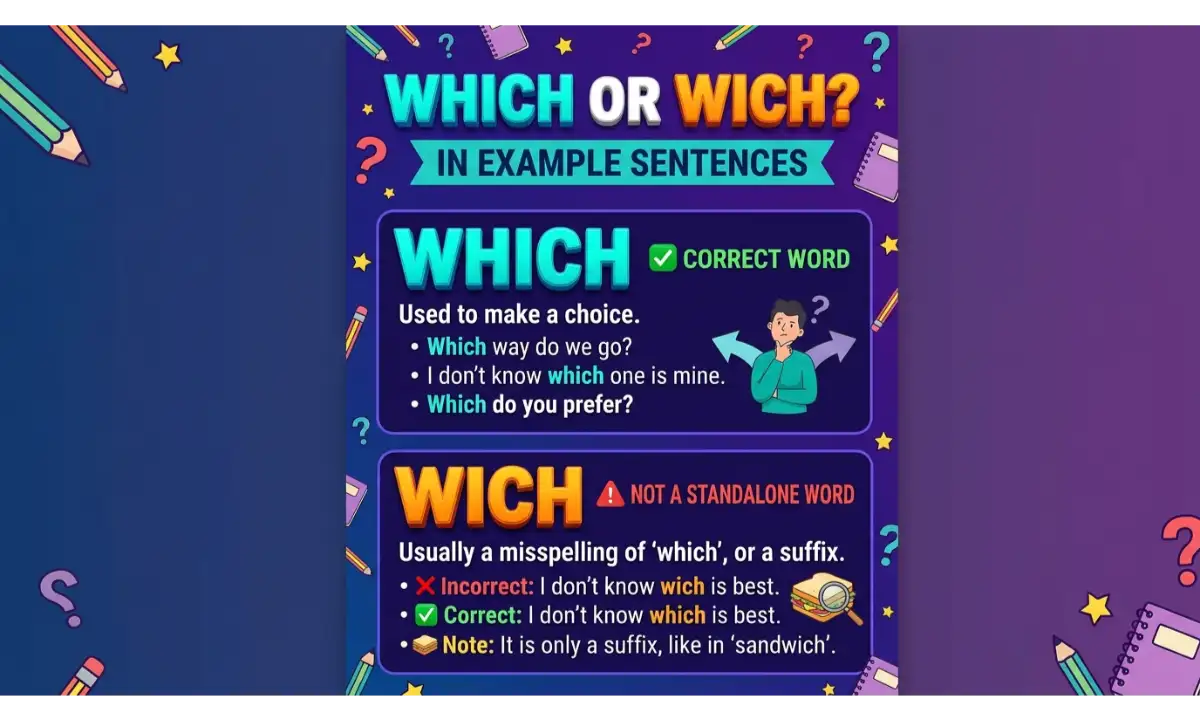
Examples show how which works in different situations. Notice that the spelling stays the same whether you are asking a direct question or adding information.
| Example sentence | Purpose |
|---|---|
| Which book belongs to you? | Identifies a book |
| Which route is faster? | Asks someone to choose |
| Which shoes should I buy? | Requests help with a choice |
| I found the key, which was under the table. | Adds information about the key |
| Tell me which answer you selected. | Identifies an answer |
| She showed me the photo, which was beautiful. | Adds information about the photo |
| Which team won the match? | Asks for specific information |
| I forgot which door we entered through. | Identifies a particular door |
Each sentence uses which, with the H in the correct position.
How to Spell Which Correctly
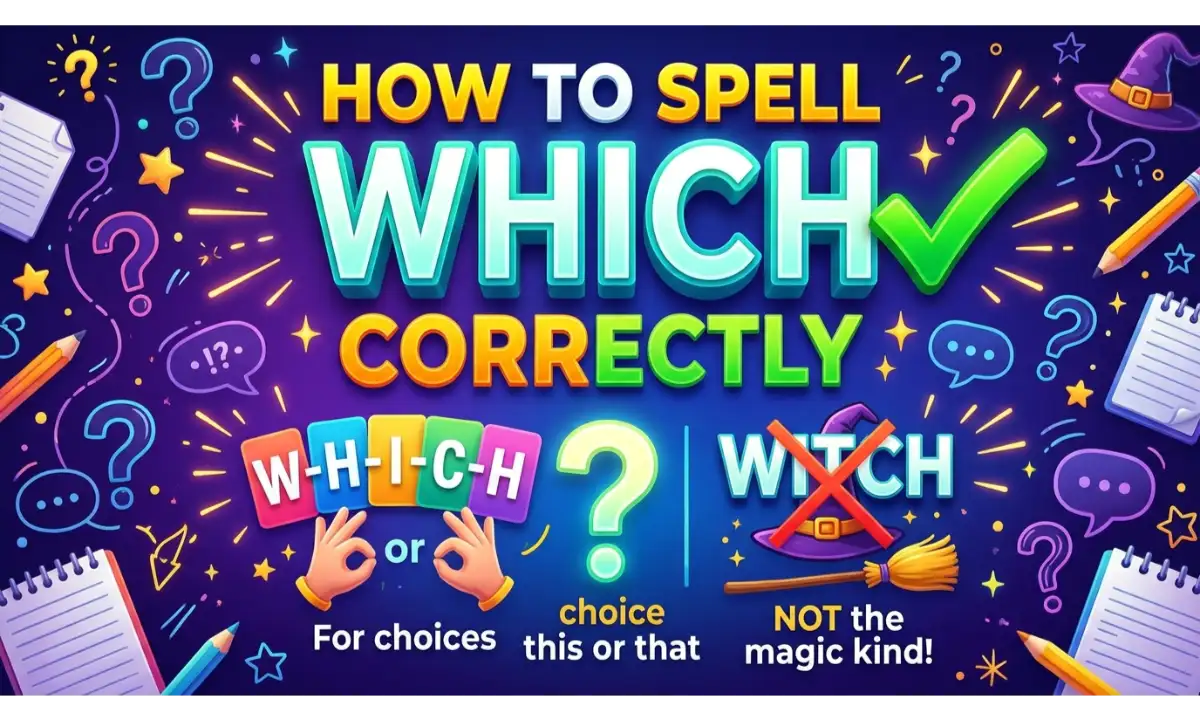
The word which contains five letters:
W – H – I – C – H
The common mistake is leaving out the first H and writing wich. To prevent this, remember the opening letters WH before completing the rest of the word.
Try this quick practice:
- Correct: WHICH
- Incorrect: WICH
Write the correct form a few times, then use it in a sentence such as “Which one do you want?” This helps you connect the spelling with its everyday use.
5 Easy Tricks to Remember the Spelling of Which
These five techniques can help you remember the correct spelling and catch mistakes before you finish writing.
1. Remember the first two letters
Start with WH. The word begins with W followed immediately by H.
When practicing, say “W-H” before completing the word. This draws attention to the letter people often leave out.
2. Break the word into parts
Remember the pattern:
WH + I + CH = WHICH
This makes the five-letter spelling easier to check. If the H after W is missing, you know the word needs correction.
3. Learn it inside a question
Use a familiar sentence such as “Which one do you want?” Connecting the word to a sentence you use often makes the spelling easier to recall.
4. Compare the two forms visually
Write the spellings side by side:
- WHICH — correct
- WICH — generally incorrect for the everyday word
The missing H becomes easier to spot when you compare the forms directly.
5. Search for the common typo
Before sending an important email or publishing an article, search your draft for wich. If you intended to use the everyday word, replace it with which.
This proofreading habit is especially useful when you type quickly or rely on automatic spelling suggestions.
Which vs. That: What Is the Difference?
Both which and that can introduce clauses about things, but they are not interchangeable in every sentence.
In American English, a common writing guideline is to use that for information needed to identify something and which for additional information set off by commas.
| Word | Example | Purpose |
|---|---|---|
| That | The book that I borrowed is missing. | Identifies which book |
| Which | My book, which I borrowed yesterday, is missing. | Adds extra information |
Usage can vary with sentence structure and style guides, so this is a useful guideline rather than an absolute rule for every sentence.
Which or What: What Is the Difference?
Both words can ask questions, but the choice often depends on the range of possible answers.
Use which when the options are limited or understood. Use what when the question is more open.
- Which dessert would you like, cake or ice cream?
- What would you like for dessert?
The first question gives two specific options. The second allows a wider range of answers. The Cambridge Dictionary’s guide to which or what explains this distinction in more detail.
Which Is Correct in British and American English?
Which is the standard spelling in both American and British English. There is no regional spelling difference for this word.
You do not need to change which to wich when writing for a British audience. The H remains part of the word in both varieties.
Common Mistakes to Avoid When Using Which
| Wrong form or usage | Correct form | Why |
|---|---|---|
| Wich book is yours? | Which book is yours? | The H is missing. |
| Wich way should we go? | Which way should we go? | The standard spelling begins with WH. |
| I don’t know wich one. | I don’t know which one. | The typo appears in an indirect question. |
| The book, that I borrowed, is useful. | The book that I borrowed is useful. | The commas are unnecessary if the clause identifies the book. |
The final example is a punctuation and grammar issue, not a spelling error. Correcting the right type of mistake helps make your writing clearer.
Expert Tips for Getting It Right
- Use spell-check tools carefully. Review suggestions instead of accepting every automatic correction.
- Read the whole sentence. Check that which refers to the right choice or thing.
- Proofread short words. Familiar words are easy to mistype because you may read past the error.
- Keep a personal error list. If you often type wich, write down the correct spelling and review it before important writing tasks.
These habits can also help with other commonly confused spellings, such as helped or helpped.
Frequently Asked Questions About Which or Wich
How do you spell which correctly?
The correct spelling is which: W-H-I-C-H. The form wich is generally a misspelling when you mean the everyday English word.
Why do people write wich instead of which?
People may leave out the H because they type quickly or overlook the missing letter. Checking the first two letters can help prevent this mistake.
Can I use wich in formal writing?
Not as a standard alternative to which. In formal writing, use which when you mean the common question word or relative pronoun.
Does which have the same spelling in the US and UK?
Yes. American and British English both use which. The spelling does not change by region.
What is an easy way to remember which?
Remember that the word starts with WH. Say the letters slowly as you write them: W-H-I-C-H.
Final Verdict: Which or Wich?
When choosing between which and wich, use which for the standard English word that asks about a choice or adds information. The other spelling is generally a typo in everyday writing. Remember the opening letters WH, practice with a familiar sentence, and check your work before publishing or sending it.
Conclusion
A missing letter can make a familiar word look wrong, but the fix is simple. Once you remember that which starts with WH, you can avoid this spelling mistake in schoolwork, emails, and online writing. Make a habit of checking common typos before you finish a document. A quick review can help you communicate clearly and present more polished writing.
Last updated: October 2026

Hi, I’m Toseef Mustafa, the creator of CompareWordz.com and a qualified English linguistics professional. My expertise includes English vocabulary, spelling, grammar, word meanings, and commonly confused words. I aim to explain language differences through clear explanations, accurate information, and practical examples. My goal is to help readers understand English better and use the right words with confidence.