

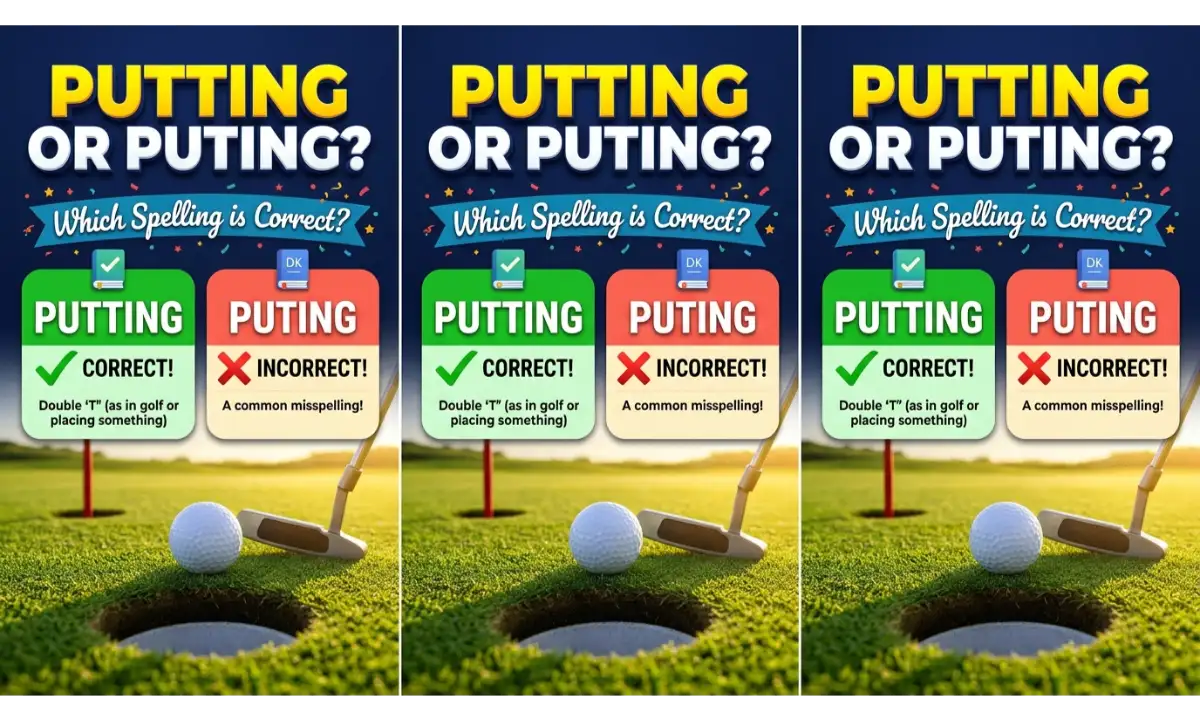
You’re typing a quick text: “Be there soon, just puting my shoes on.” Something looks off.
Your thumb hovers over send, and you wonder if that second T is really needed.
It’s a fair doubt. Words ending in -ing add and drop letters in ways that can feel random, and fast typing makes slips easy.
So you search putting or puting and hope for a straight answer. Here it is, with the reasoning behind it.
You’ll see why the double T is right, how the golf word putt fits in, and which close mistakes, like “puting green,” catch people out.
Quick Answer
Putting is the correct spelling. Puting is a misspelling, not an English word. For putting or puting, the rule is simple: put is a short word that ends in one vowel and one consonant, so you double the T before adding -ing.
- I’m putting the groceries away.
- She’s putting extra time into the project.
- He kept putting from the same spot on the green.
Why the double T wins
Put has one syllable and ends in a single vowel (U) followed by a single consonant (T). When a short word has that pattern, the last consonant doubles before an ending that starts with a vowel. The extra T keeps the U short. With one T, readers would expect a long U, as in muting.
| Base word | -ing form |
|---|---|
| put | putting |
| sit | sitting |
| cut | cutting |
| mute (silent E) | muting |
Words like mute end in a silent E, so they drop the E instead of doubling anything. Put has no E to drop, which is why “puting” looks tempting but doesn’t work. Longer words add a stress check, as you can see in occurred.
Also Read This : Anymore or Any More? 4 Easy Tests To Get It Right
Put vs. putt: both give you “putting”
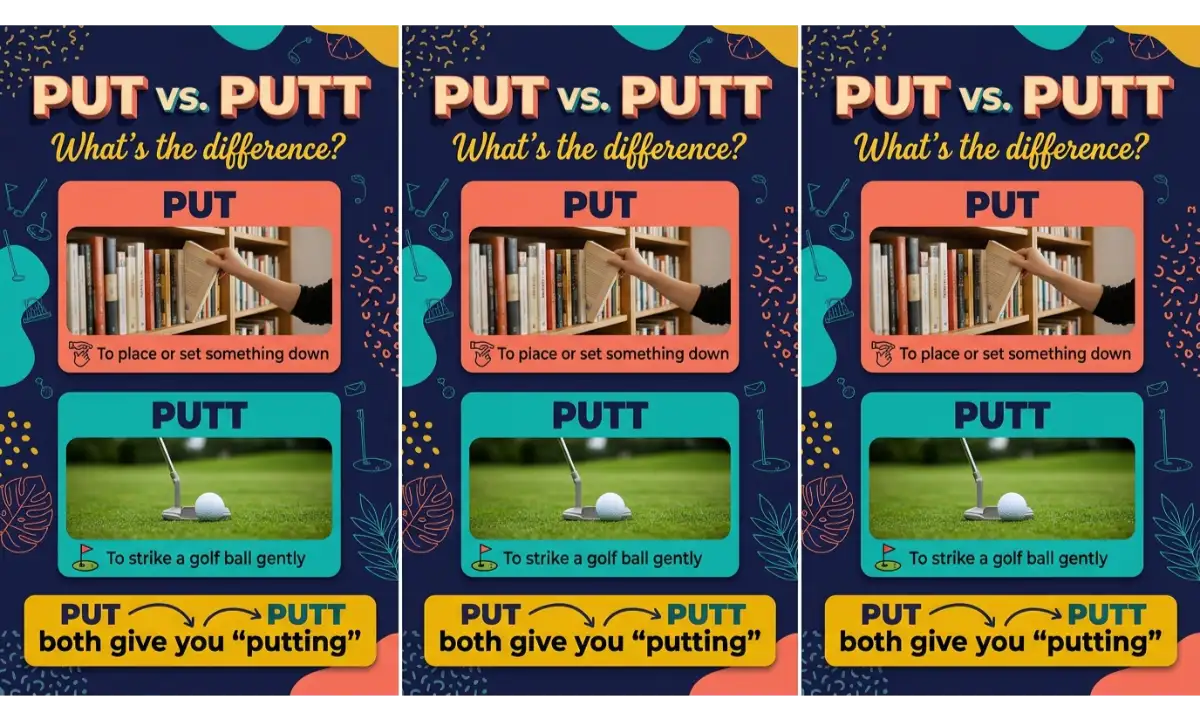
Putting is the -ing form of two different verbs. Put means to place something. Putt means to hit a golf ball gently toward the hole. Merriam-Webster lists both: put and putt.
The spelling is the same, but the verbs behave differently.
| Verb | Past tense | Vowel sound (US) |
|---|---|---|
| put | put | rhymes with foot |
| putt | putted | rhymes with but |
So “putting the ball in your bag” and “putting from ten feet” share a spelling but not a vowel sound.
Common mistakes
| Wrong | Right | Why it happens |
|---|---|---|
| puting my shoes on | putting my shoes on | Mixing it up with silent-E words like muting |
| I putted my keys down | I put my keys down | Putted belongs to golf. Put never changes. |
| puting green | putting green | The golf word looks like a different word, so people skip the doubling |
| puting off the call | putting off the call | The spelling slips in phrasal verbs, where the verb is easy to overlook |
Real-life examples
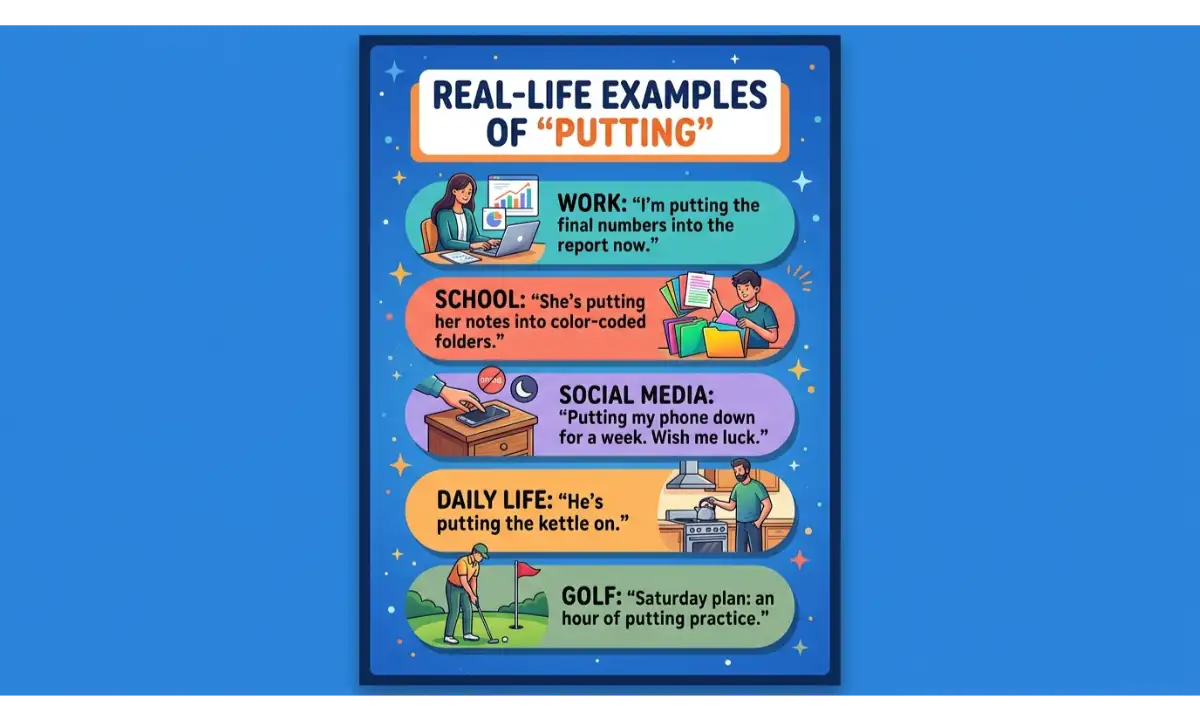
- Work: “I’m putting the final numbers into the report now.”
- School: “She’s putting her notes into color-coded folders.”
- Social media: “Putting my phone down for a week. Wish me luck.”
- Daily life: “He’s putting the kettle on.”
- Golf: “Saturday plan: an hour of putting practice.”
Expert tips
- Search for whole words only. “Puting” hides inside real words like computing and disputing. If you fix typos with find and replace in Word, tick Find whole words only and avoid Replace All.
- Type a twin. If you’re unsure, write sitting next to it. If sitting looks right, putting is right too.
- Watch single-T pairs that are real words. Hoping and hopping are different words, and so are taping and tapping. One letter changes the meaning, so spell-check won’t save you.
Related questions
Does every short verb double its last letter?
No. Words ending in two consonants, like help, don’t double, so you get helped. Words ending in W, X, or Y don’t double either: showing, fixing, playing.
Why isn’t it “openned” if the rule doubles letters?
Longer words only double when the stress falls on the last syllable. Open stresses the first, so you write opened.
What about “putting up with” and “putting off”?
The spelling stays the same: putting up with means tolerating, and putting off means delaying. Both keep the double T.
FAQs
Is it putting or puting?
It’s putting, with two T’s. “Puting” is a misspelling.
Is puting a word?
Not in English. It exists in other languages, such as Indonesian, where it has its own meaning, but English dictionaries list only putting.
Is putting a word?
Yes. It’s the -ing form of both put and putt.
How do you spell putting in golf?
The same way: putting. The golf verb is putt, and its -ing form doubles the T too.
Final verdict
Putting, with two T’s, is correct whether you’re placing an object or lining up a golf shot. “Puting” isn’t an English word. The rule: one short syllable, one vowel, one consonant, so double the consonant. And keep the past tense straight: put for placing things, putted only for golf.
Conclusion
Next time putting or puting crosses your mind, trust the double T and keep typing.
One extra letter is a small thing, but readers notice it, even when they can’t say why.
Before you send anything important, give your -ing words one last look.
It takes two seconds, and it saves you from a typo you’d spot only after hitting send.
Last updated: October 2026

Hi, I’m Toseef Mustafa, the creator of CompareWordz.com and a qualified English linguistics professional. My expertise includes English vocabulary, spelling, grammar, word meanings, and commonly confused words. I aim to explain language differences through clear explanations, accurate information, and practical examples. My goal is to help readers understand English better and use the right words with confidence.