


A coffee shop sign says, “Fresh pastries baked everyday.” You slow down for a second. Something feels off, but the word looks fine on its own.
That’s the trouble with everyday or every day.
The two versions look almost the same, and in normal speech you can’t hear any difference, so even careful writers pick the wrong one.
The mistake is small, but readers notice it, especially on signs, emails, and headlines. Once you know what the word is doing in the sentence, the choice gets easy.
Quick Answer
Everyday or every day? Both are correct, but they do different jobs. Everyday (one word) is an adjective that means ordinary, and it comes before a noun. Every day (two words) means each day.
Rule: if you can say “each day,” write every day.
- She wears her everyday shoes.
- She wears them every day.
- Every day is a fresh start.
What Does Everyday Mean?

Everyday is an adjective. It describes a noun and means ordinary, usual, or routine. Grammarist describes it the same way: it modifies nouns and means usual, typical, and ordinary.
- Jeans are my everyday clothes.
- Spelling slips are an everyday problem for most writers.
Because it’s an adjective, it usually sits right before the noun it describes. It doesn’t have to happen daily. An everyday event is simply a commonplace one.
Dictionaries also record a rare noun use, meaning a typical or ordinary day, but you’ll almost never need it.
What Does Every Day Mean?

Every day is two separate words: every (an adjective) plus day (a noun). Together they usually work as an adverbial phrase, which tells you when or how often something happens. In “We study every day,” the phrase describes the verb.
- The bakery opens at six every day.
- I check the mail every day.
It can also act as a noun phrase. The Grammarphobia blog notes that the two-word phrase can function as a noun, as in “Every day is an adventure.” That’s why “make every day count” is correct, too.
In both cases, it never describes a noun the way everyday does.
The 3 Quick Tests for Everyday or Every Day
Run these in order. The first one settles it most of the time.
| Test | If it works | Example |
|---|---|---|
| Swap in “each day” | Write every day | I run each day. So: I run every day. |
| Slip “single” in the middle | Write every day | I swim every single day. So: every day. |
| Swap in “ordinary” | Write everyday | An ordinary meal. So: an everyday meal. |
The “single” trick comes from Merriam-Webster. If you can put another word between “every” and “day,” you need the two-word form. merriam-webster
One caution about the third test. “Ordinary” works for most everyday uses, but not all. In “everyday clothes,” the meaning is closer to “for ordinary days.” So start with the “each day” test, and use “ordinary” as a backup.
Can “Everyday” Mean “Each Day”?
You’ll see it in casual writing, like “I run everyday.” It’s not new, either. Grammarphobia points out that Merriam-Webster’s usage guide has examples going back decades, and the editors say the two-word styling is still more common for the adverbial use.
So the honest answer is that some writers do it, but most dictionaries and style guides still want two words. If your work will be edited, graded, or read by a client, use every day.
Related Phrases and Word Forms
A few phrases cause the same trouble, so here’s how they work:
- Every other day: three words. “We meet every other day.”
- Every single day: still two words, with “single” in the middle.
- All day, every day: both parts are separate words.
- Everyday life: one word, because it describes the noun life.
- Everyday use: one word, for the same reason.
If a noun follows right after, you probably need everyday. If a verb comes first and the word tells when, you probably need every day.
How to Say Them Everyday or Every Day?
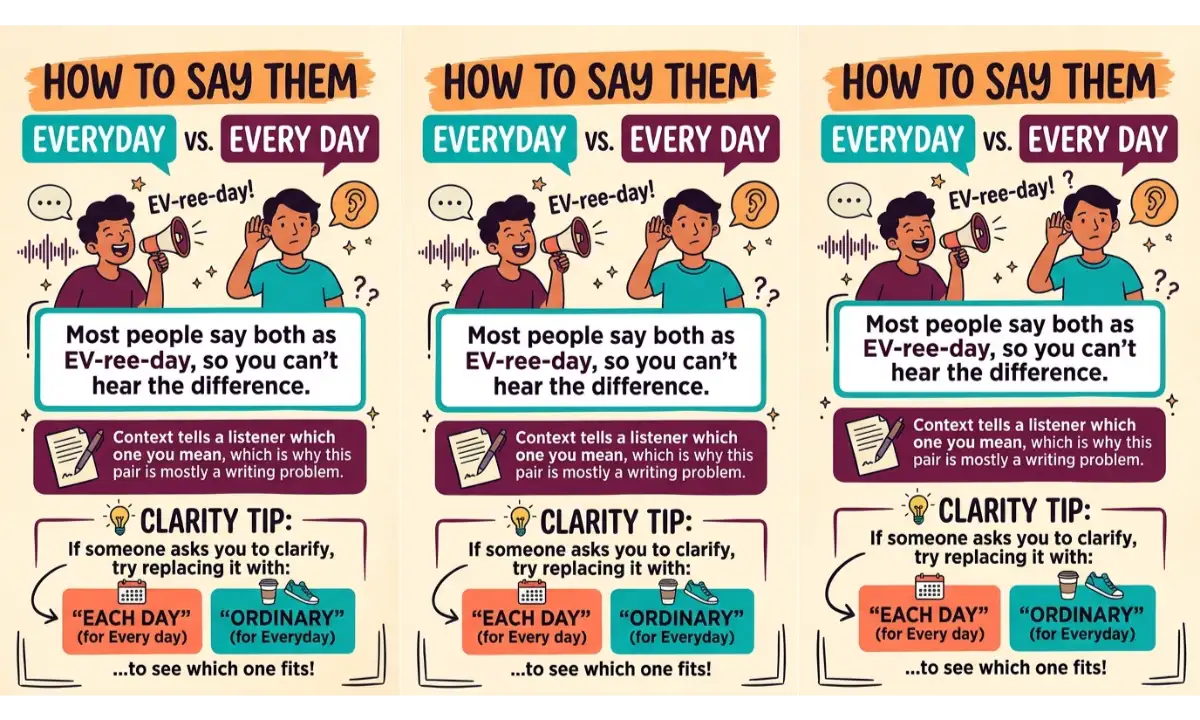
Most people say both as EV-ree-day, so you can’t hear the difference. Context tells a listener which one you mean, which is why this pair is mostly a writing problem. If someone asks you to clarify, try replacing it with “each day” or “ordinary” out loud.
Common Mistakes
Writing “I walk everyday.” The word tells how often, so it needs two words: I walk every day.
Writing “your every day clothes.” The phrase describes clothes, so it’s one word: your everyday clothes.
Writing “Open everyday!” on signs and ads. Short text hides this slip. It should read Open every day!
Writing “Everyday is a gift.” The sentence means each day, so use Every day is a gift.
Splitting “everyday life” into “every day life.” The word describes the noun, so keep it as one word.
Real-Life Examples
- At work: “Our team shares notes every day before lunch.” / “Email is an everyday tool for us.”
- At school: “Read for ten minutes every day.” / “Teachers use everyday examples to explain new ideas.”
- At home: “I make my bed every day.” / “Rice is an everyday meal in many homes.”
- On social media: “Posting every day for a week was harder than I expected.” / “Everyday moments make the best photos.”
Expert Tips
Search both forms. Use Find for “everyday” and for “every day” in your document, and test each hit. Mistakes go in both directions.
Check signs, buttons, and ads. Short text hides slips, and “Open everyday” is a classic one. Read the shortest lines twice before you print or publish.
Rewrite when you’re stuck. “Open every day” can become “open daily,” and “everyday clothes” can become “regular clothes.” If you’re writing something formal, this is the fastest way to avoid the problem.
If you like quick word checks, see our guide on misspell or mispell. For a second opinion on this pair, the Merriam-Webster entry for everyday is a good place to confirm.
Related Questions
What about “every other day”? It’s three separate words: every other day.
Is “everyday” ever a noun? Rarely. Some dictionaries list it as a noun meaning an ordinary day, but you’ll almost always see it as an adjective.
Do British and American English differ here? No. Both follow the same rule.
Frequently Asked Questions
Is it everyday or every day?
Both are correct. Use everyday before a noun and every day for how often.
Is everyday one word or two?
It depends on the meaning. The adjective is one word, and the phrase meaning “each day” is two words.
Is it “every day” or “everyday” at the end of a sentence?
Use every day. The adjective needs a noun after it, so at the end of a sentence you almost always mean “each day.”
Does everyday mean daily?
Not exactly. Everyday means ordinary, and every day means each day.
What is the easiest test?
Say “each day.” If it fits, write two words.
Final Verdict
Both are correct, but only one fits each sentence. Write everyday when the word describes a noun, and every day when it tells how often. If you’re unsure, try the “each day” swap first. Neither form is more formal or more casual, because the meaning decides.
Conclusion
The everyday or every day choice is small, but readers notice it, even when they can’t say why. Treat it like a quick routine: read the sentence, ask what the word is doing, then pick. After a few rounds, the right choice starts to feel natural. If you write for work, keep the “each day” test handy and run it on your next headline.
Last updated: October 2026

Hi, I’m Toseef Mustafa, the creator of CompareWordz.com and a qualified English linguistics professional. My expertise includes English vocabulary, spelling, grammar, word meanings, and commonly confused words. I aim to explain language differences through clear explanations, accurate information, and practical examples. My goal is to help readers understand English better and use the right words with confidence.