


You’re typing up a recipe for your family, and you get to the best part: the chicken. You write “fryed chicken,” then stare at it. Something looks off, but you can’t say why.
If that sounds familiar, you’re not alone. People searching fried or fryed usually want to know which spelling is right, why the “y” seems to disappear, and how to spell forms like frying and fries. The short answer is fried. In this guide, you’ll learn the simple rule behind it, plus 5 easy tips to spell it right every time.
Written by Toseef Mustafa, MA English, English Grammar Specialist with 5 years of experience | Last updated: October 2026
From my experience: In my 5 years of explaining grammar, the verbs that end in a consonant plus y are among the ones I see people question most. The fried or fryed question is a perfect example. Most people already know how to spell “tried,” so once I show them the link, the rule clicks right away.
Fried or Fryed: Quick Answer
Fried is correct. Fryed is a common spelling mistake.
“Fried” is the past tense and the past participle of the verb fry. The rule is simple: when a verb ends in a consonant plus y, change the y to i before adding -ed.
- I fried the eggs this morning. ✅
- She has fried rice for dinner. ✅
- He fryed the fish. ❌
Simple rule: fry + ed = fried. Change the y to i.
Why Is It “Fried” and Not “Fryed”?
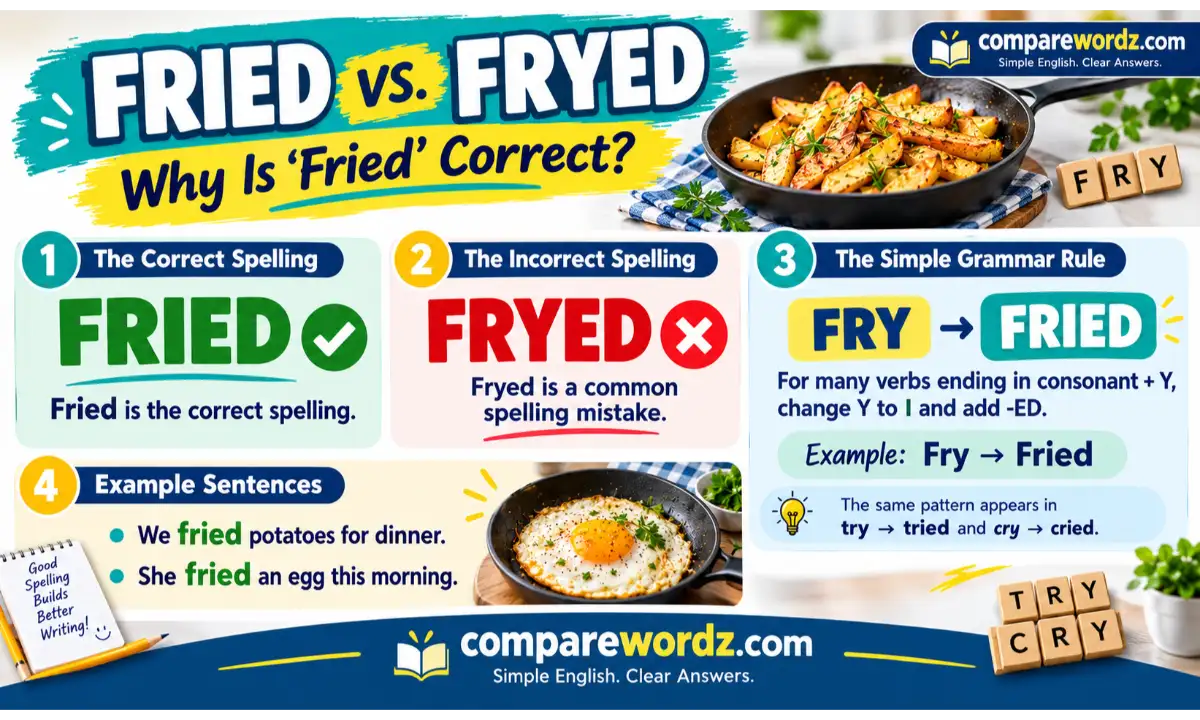
English has a spelling pattern for verbs that end in a consonant followed by y. Before adding -ed, the y turns into an i. That’s all there is to it.
In “fry,” the letter before the y is r, which is a consonant. So the y becomes i, and you get fried.
According to Dictionary.com, “fried” is the simple past tense and the past participle of “fry.” It also works as an adjective, as in “fried rice.”
All the Forms of Fry
Knowing every form helps you spot where the y changes and where it stays.
| Form | What it is | Example |
| fry | base verb | I fry onions every morning. |
| fries | third person singular | She fries them in butter. |
| fried | past tense | We fried the fish last night. |
| fried | past participle | They have fried all the chicken. |
| frying | present participle | He is frying an egg. |
Notice the pattern: frying keeps the y. English avoids writing two i’s in a row, so “friing” never shows up.
Fry, Fries, and Fried: Verb or Noun?
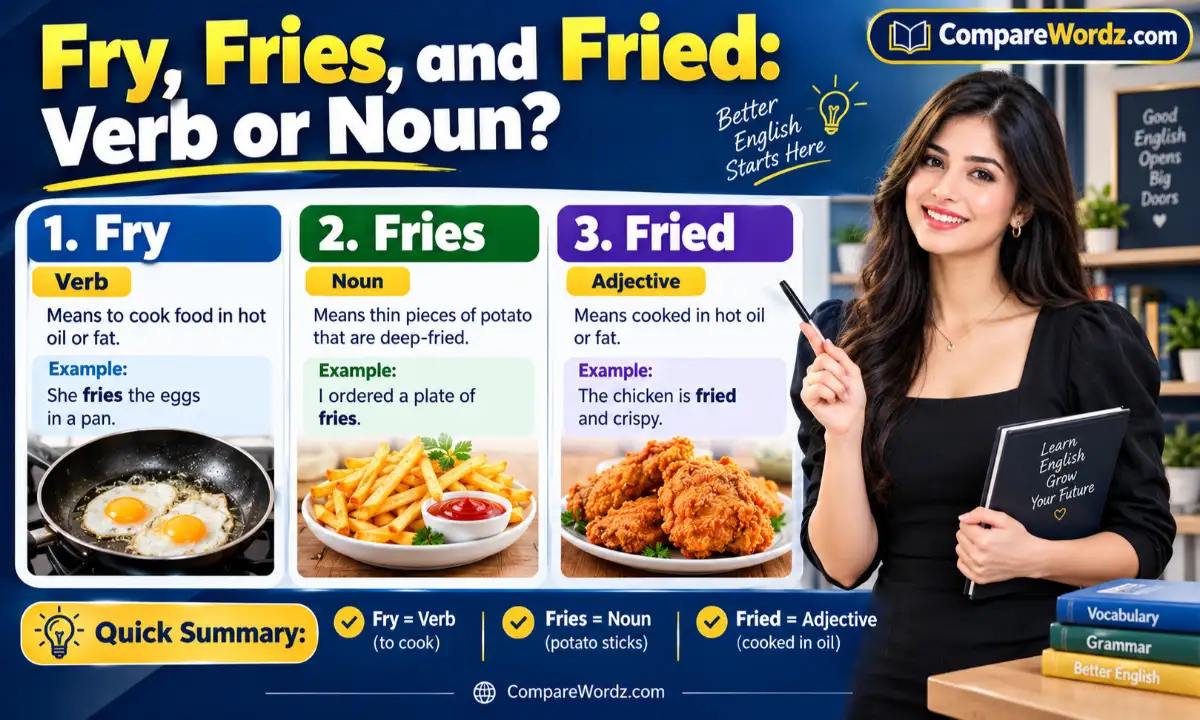
These three words are easy to mix up because they look so close.
- Fry is the base verb (“I fry eggs”). It can also be a noun, as in “small fry” or “fish fry,” a common gathering in parts of the US.
- Fries can be the verb for he, she, or it (“she fries eggs”), or the plural noun in “French fries.”
- Fried is the past tense, the past participle, and an adjective (“fried rice”).
Never write “fry’s” for the plural. An apostrophe isn’t needed: it’s simply “fries.”
Which Words Change Y to I?
The same rule applies to many everyday verbs. When a consonant comes before the y, it becomes i.
| Verb | Past tense |
| fry | fried |
| try | tried |
| cry | cried |
| dry | dried |
| carry | carried |
| study | studied |
| reply | replied |
And Which Words Keep the Y?
When a vowel comes before the y, the y stays.
| Verb | Past tense |
| play | played |
| stay | stayed |
| enjoy | enjoyed |
| obey | obeyed |
| delay | delayed |
So the real question is always the same: what letter comes right before the y? A consonant means change it, and a vowel means keep it.
Here’s a quick test. Compare “play” and “fry.” In “play,” a vowel (a) sits before the y, so you write played. In “fry,” a consonant (r) sits before the y, so you write fried. Same ending, different letter before it, different result.
How to Pronounce Fried
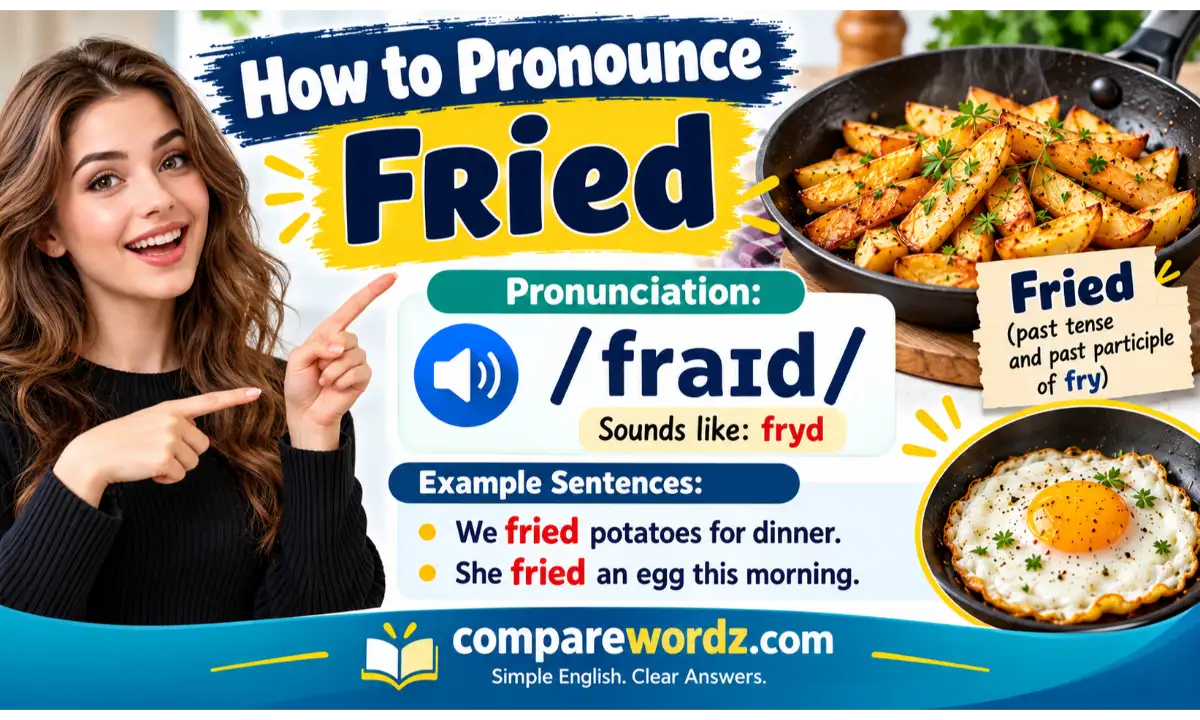
Say it as fried, rhyming with “tried” and “cried.” Dictionary.com shows the pronunciation as /fraɪd/, which is simply “fry” plus a soft “d” at the end.
You can hear the “eye” sound before the final “d.” That sound is spelled with an i in “fried,” the same way it is in “tried” and “cried.”
An Easy Way to Remember Fried or Fryed
Try this quick comparison:
try → tried, so fry → fried.
If you can spell “tried,” you can spell “fried.” They follow the same rule.
Think of it this way: the y gets “fried” and turns into an i.
Fried Beyond the Kitchen
“Fried” has a second life in everyday talk. According to Dictionary.com, people also use it informally to mean exhausted, as in “I’m totally fried.”
- My brain is fried after that exam.
- We were fried by the end of the trip.
You’ll also hear it used when a device stops working because of too much heat or power, as in “my charger got fried.” In every case, the spelling stays fried.
Common Mistakes With Fried or Fryed

| Wrong | Right | Why people write it |
| fryed | fried | They keep the y from “fry.” |
| fryed chicken | fried chicken | The mistake sits in an adjective. |
| friing | frying | They apply the y to i rule too far. |
| fryes | fries | They forget the y changes to i before -es. |
Why this happens: The fried or fryed mix up is common because most people know that “fry” has a y, so they simply add -ed. The rule feels invisible until someone points it out.
Fried or Fryed in Real Life

In the kitchen
- First, I fried the onions until they turned golden.
- The recipe calls for fried garlic on top.
On menus
- Fried chicken, fried rice, and fried eggs are everyday favorites.
- Today’s special: fried fish with lemon.
At work and school
- She fried the sample in oil for the food science class.
- Our team is fried after that deadline.
On social media
- Fried chicken Sunday is the best Sunday. 🍗
- Brain officially fried. Goodnight. 😴
5 Easy Tips to Spell Fried Right Every Time

Use these every time the fried or fryed question comes up.
- Check the letter before the y. A consonant means change y to i. A vowel means keep the y.
- Search before you publish. Use find and replace to look for “fryed” in recipes and menus.
- Proofread titles first. Recipe names and menu items are the first things readers see, and they’re where the slip hides most often.
- Read it out loud. If it rhymes with “tried,” it’s spelled with an i.
- Keep a short list. Write down the verbs you often get wrong, and review them once a week. If you want to avoid other common slips, our guide on misspell or mispell is a good next read.
Related Questions About Fried or Fryed
Is “frying” spelled with an i? No. It’s “frying,” with the y kept.
Is “fries” spelled with a y? No. It’s “fries,” with an i.
Is it “fries” or “fry’s”? It’s “fries.” The apostrophe is a mistake.
Is “fired” the same as “fried”? No. “Fired” comes from “fire,” and “fried” comes from “fry.”
Is “fried” a noun? No. It’s a verb form and an adjective.
Do British and American English spell it differently? No. Both use “fried.”
Frequently Asked Questions
Which is correct, fried or fryed?
“Fried” is correct. “Fryed” is a spelling mistake.
What is the past tense of fry?
The past tense is “fried.” It’s also the past participle.
Why does the y change to i in fried?
Because “fry” ends in a consonant plus y. English changes the y to i before adding -ed.
Is it fried chicken or fryed chicken?
It’s “fried chicken.” It uses the same spelling as the past tense.
How do you spell the “ing” form of fry?
It’s “frying.” The y stays so you don’t end up with two i’s in a row.
Does “fried” ever mean something other than cooked?
Yes. Informally, it can mean exhausted, as in “I’m totally fried.”
Final Verdict: Fried or Fryed?
“Fried” is the correct spelling, and “fryed” is a mistake. Remember the rule: consonant plus y becomes i before -ed. If you can spell “tried,” you can spell “fried.” Keep the y in “frying,” and change it in “fries.”
Conclusion
The fried or fryed question has a clear answer, and a simple rule behind it. When a verb ends in a consonant plus y, change the y to i and add -ed. That’s why we say “tried,” “dried,” and “fried.”
Next time you write a recipe or menu, double-check the spelling of fried or fryed. Remember, fried is the correct spelling, while fryed is incorrect.
Using the keyword “fried or fryed” naturally in your writing helps readers find the right spelling and makes your content clear and useful.
Reviewed by Toseef Mustafa, MA English. Facts checked against Dictionary.com. Last updated: October 2026.

Hi, I’m Toseef Mustafa, the creator of CompareWordz.com and a qualified English linguistics professional. My expertise includes English vocabulary, spelling, grammar, word meanings, and commonly confused words. I aim to explain language differences through clear explanations, accurate information, and practical examples. My goal is to help readers understand English better and use the right words with confidence.