

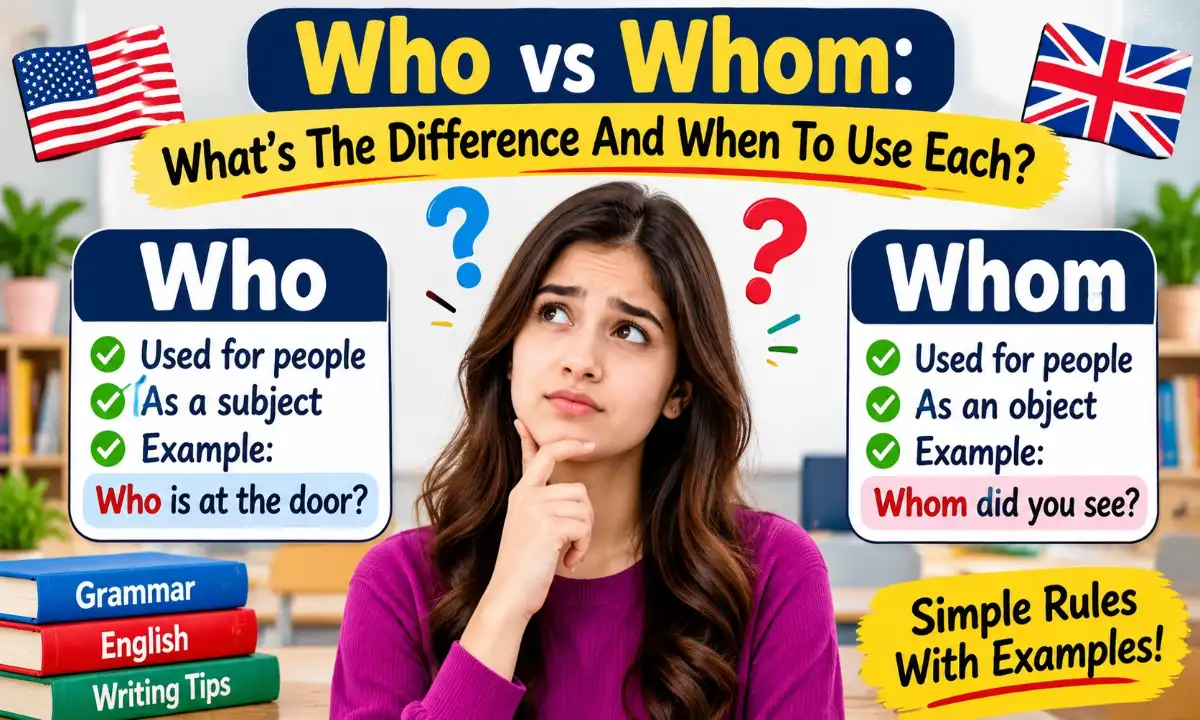
You are about to send an important email. You type, “To who should I send the report?” Then you stop. Something sounds off. Should it be whom?
You are not alone. The who vs whom question confuses students, workers, and even writers who use English every day. Both words refer to people, and both show up in questions and longer sentences.
In this guide, you will learn what each word means, how to choose in seconds, and when casual speech lets you relax. You will also get an easy trick, real examples, and the most common mistakes to avoid.
Quick Answer: Who vs Whom
Use who for the subject, the person doing the action. Use whom for the object, the person receiving the action. Try the he/him test: if “he” fits, use who. If “him” fits, use whom.
Examples:
- “Who called you?” (He called you.)
- “Whom did you call?” (You called him.)
- “To whom should I send this?” (Send it to him.)
- “The teacher who helped me is kind.” (She helped me.)
Meaning of Who
Who is a pronoun. It stands in for a person, and it works as the subject of a verb.
Pronunciation: /huː/. It rhymes with “too.” The “w” is silent.
A subject is the person or thing doing the action. “Who” is a subject pronoun like I, he, she, we, and they.
You can use who in two main ways:
- To ask a question: “Who is at the door?”
- To describe a person: “She is the girl who won the prize.”
Examples:
- Who wrote this email?
- I know someone who speaks four languages.
- Who is coming to the meeting?
Related forms: whoever, whose, who’s
Meaning of Whom
Whom is also a pronoun. It stands in for a person, and it works as the object of a verb or a preposition.
Pronunciation: /huːm/. It sounds like “hoom” and rhymes with “room.”
An object is the person who receives the action. “Whom” is an object pronoun like me, him, her, us, and them.
Examples:
- Whom did you invite?
- She is the person with whom I work.
- To whom should I address the letter?
- The man whom we met was kind.
Related forms: whomever
Whom is a real, correct word. It is not a spelling mistake. It is more formal than who, and many people skip it in casual talk.
Key Differences Between Who and Whom
Grammar role. Who is the subject. Whom is the object. This is the main difference.
Replacement test. Who matches he, she, and they. Whom matches him, her, and them.
After prepositions. After words like to, for, with, and from, use whom: “to whom,” “with whom,” “for whom.”
Formality. Whom sounds formal. Who is more common in speech and chat.
Pronunciation. Whom adds an “m” sound at the end. Who does not.
Position in the sentence. Who often comes before the verb. Whom often comes after the verb or after a preposition.
Comparison Table: Who vs Whom
| Feature | Who | Whom |
|---|---|---|
| Correct word? | Yes | Yes |
| Part of speech | Pronoun | Pronoun |
| Grammar role | Subject | Object |
| Replaces | he, she, they | him, her, them |
| Pronunciation | /huː/ | /huːm/ |
| Used after prepositions? | No (formal use) | Yes: to whom, with whom |
| Formality | Everyday and formal | Formal; less common in speech |
| Example | “Who is calling?” | “Whom did you call?” |
| Common mistake | Using it after a preposition | Using it as a subject |
| Memory clue | He and who go together | Him and whom both end in M |
Word Forms and Related Spellings
This is a grammar topic, so word forms matter more than statistics. Here is what to know.
| Word | Meaning | Example |
|---|---|---|
| who | subject pronoun | Who is there? |
| whom | object pronoun | Whom did you see? |
| whose | shows ownership | Whose bag is this? |
| who’s | who is or who has | Who’s coming tonight? |
| whoever | any person (subject) | Whoever wins gets a prize. |
| whomever | any person (object) | Give it to whomever you like. |
Whose vs who’s. These two are easy to mix up. Whose shows that something belongs to someone. Who’s is short for “who is” or “who has.” If you can replace it with “who is,” use who’s.
Whoever vs whomever. They follow the same rule as who and whom. Use whoever for the doer and whomever for the receiver.
If another “wh” word ever trips you up, see our guide on which or wich.
Origin and History of Who and Whom
Both words are very old, and they began as different forms of the same word.
Where whom came from. Whom comes from Middle English, which came from Old English “hwām,” the dative form of “hwā,” meaning who. In Old English, the dative case marked the person who received something.
Old forms. Old English had four forms: “hwā” (subject), “hwone” (object), “hwǣm” (to whom), and “hwæs” (whose). Only some survive today: who, whom, and whose.
A shared ancestor. Whom came from a Proto-Germanic form, and the root is a very old Indo-European base used in questions and relative pronouns. German still has a close cousin, the word “wem.”
A silent “w.” The “w” in “who” is a fossil. It reflects the old spelling “hwā.” The pronunciation changed, but the spelling did not.
Mixing them up is old too. Etymonline notes that using “who” instead of “whom” appears in writing from around 1300. So people have been confused about this pair for roughly seven centuries.
British English vs American English
Both American and British English use who and whom in the same way. The spelling and pronunciation are the same in the USA, UK, Canada, Australia, India, and Pakistan.
The main differences are in style, not rules.
| Feature | American English | British English |
|---|---|---|
| Spelling | who / whom | who / whom |
| Pronunciation | /huː/, /huːm/ | /huː/, /huːm/ |
| Formal writing | Uses whom correctly | Uses whom correctly |
| Casual speech | “Who” often replaces “whom” | “Who” often replaces “whom” |
| Collective nouns | “The team that won” | “The team who won” is also common |
One more note: In British English and other non-American varieties, “who” is often used with collective nouns, such as team, family, or club, when the focus is on the individuals. American writers more often use “that” or “which” there.
Both varieties are also loosening the rule in speech. Merriam-Webster says its evidence shows “whom” is not likely to disappear soon. For another UK/US usage pair, see towards or toward.
When to Use Who
Use who when the word is the subject, the person doing the action.
Formal writing and reports
- “The manager who approved the plan has left the company.”
Workplace and email
- “Who is responsible for this task?”
Academic writing
- “Researchers who study sleep found a clear pattern.”
Daily conversation
- “Who wants pizza?”
Casual speech
- “Who did you talk to?” Most people say this, and it sounds natural in everyday talk.
Useful phrases: who is, who was, who has, who can, who will, who says
When to Use Whom
Use whom when the word is the object, the person receiving the action. Also use it right after a preposition.
Formal writing
- “The award goes to the student whom the teachers chose.”
Business letters
- “To whom it may concern.”
After prepositions
- “With whom did you travel?”
- “The people for whom we work are kind.”
Academic and legal writing
- “The witness, whom the lawyer questioned, left early.”
Spoken English
- “Whom did you meet?” It sounds correct but formal. Many people say “Who did you meet?” in speech.
Useful phrases: to whom, with whom, for whom, from whom, of whom, by whom
Common Mistakes with Who and Whom
Mistake 1: Using “who” after a preposition
- Incorrect: To who should I send the invoice?
- Correct: To whom should I send the invoice?
- Why it happens: People hear “who” much more often than “whom.”
- Tip: After to, for, with, or from, choose whom.
Mistake 2: Using “whom” as a subject
- Incorrect: Whom is calling?
- Correct: Who is calling?
- Why it happens: Writers want to sound formal, so they overcorrect.
- Tip: “He is calling” works, so use who.
Mistake 3: Using “whom” for a person who does an action
- Incorrect: The man whom lives next door is a doctor.
- Correct: The man who lives next door is a doctor.
- Why it happens: “Whom” feels fancy and safe.
- Tip: “He lives next door” works, so use who.
Mistake 4: Getting confused by “do you think”
- Incorrect: Whom do you think is coming?
- Correct: Who do you think is coming?
- Why it happens: The phrase “do you think” makes the sentence look like it has an object.
- Tip: Remove the extra phrase: “Who is coming?” Then add it back.
Mistake 5: Mixing up who’s and whose
- Incorrect: Who’s coat is this?
- Correct: Whose coat is this?
- Why it happens: Both sound identical, and an apostrophe often signals ownership with nouns.
- Tip: If you can say “who is,” use who’s. If it shows ownership, use whose.
Mistake 6: Writing “To who it may concern”
- Incorrect: To who it may concern,
- Correct: To whom it may concern,
- Why it happens: The phrase is old and fixed, but people say it fast.
- Tip: “To” is a preposition, so whom is the right fit.
Mistake 7: Mixing whoever and whomever
- Incorrect: Give the prize to whomever wins.
- Correct: Give the prize to whoever wins.
- Why it happens: The word “to” comes right before it, which suggests whom.
- Tip: Look at the verb after it. “He wins” works, so use whoever.
Easy Trick to Remember
Think of it this way: Who is like he, and whom is like him.
Here is a simple way to use it:
- Answer the question in your head with “he” or “him.”
- If “he” fits, write who.
- If “him” fits, write whom.
Quick example: “Who/Whom did you call?” Answer: “I called him.” So the answer is whom.
Another memory clue: him and whom both end in m. If the answer is “him,” your word is “whom.”
Everyday Examples
At work
- “Who is leading the meeting?”
- “To whom should I send the report?”
At school
- “Who wrote this poem?”
- “The teacher with whom I studied was strict.”
On social media
- “Who else is watching the game tonight?”
- “Tag someone who loves coffee.”
In daily life
- “I know a barber who is very good.”
- “That is the friend whom I told you about.”
In email
- “Please tell me who will attend.”
- “Please let me know with whom I should follow up.” (If you often write about next steps, see follow-up or followup.)
In text messages
- “Who are you meeting later?”
- “Guess who I just saw.”
Different Contexts and Usage
Business and workplace
Emails often use “to whom” in formal openings. In everyday team chat, “who” is more natural.
Education and exams
Teachers test who and whom often. In school, use the strict rule.
Legal and official writing
Contracts use “whom” often: “the person to whom the notice is addressed.” Formal documents follow the rule closely.
Journalism
News writing uses whom when it sounds natural: “the victims, many of whom were children.” Casual headlines often use who.
Social media and marketing
Brands usually use “who” because it sounds friendly: “Who’s ready for the sale?”
Grammar learning
Learners often practice with the he/him test. It is the quickest classroom method.
Google Trends and Search Insights
I did not have live Google Trends access when writing this, so I am not including figures or regional rankings.
Here is what likely drives the searches:
- Rule confusion. Many people never learned the subject/object idea clearly.
- Formal writing. Emails, essays, cover letters, and exams push people to get it right.
- Sound. Whom feels old-fashioned, so people doubt if it is still needed.
- Fixed phrases. People check “to whom it may concern” and “with whom.”
Useful long-tail queries: who or whom, whom or who, who vs whom examples, to who or to whom, who vs whom trick, whoever vs whomever, who vs whom in a question.
Related Searches and People Also Ask
Is it “to who” or “to whom”?
To whom. “To” is a preposition, so you use the object form.
Is it “who” or “whom” in a question?
Use who if “he” answers the question. Use whom if “him” answers it.
What does “whom” mean?
It means “what person” as an object, as in “Whom did you see?”
How do you pronounce whom?
/huːm/. It sounds like “hoom.”
Is “whom” still used?
Yes. It is common in formal writing, though less common in casual speech.
Can I use “who” instead of “whom”?
In casual speech, yes. In formal writing, use whom for objects.
What is the he/him trick?
Replace the word with he or him. He means who. Him means whom.
Is it “who’s” or “whose”?
Who’s means “who is.” Whose shows ownership.
What does “to whom it may concern” mean?
It is a formal greeting when you do not know the reader’s name.
Is it “whoever” or “whomever”?
Use whoever as a subject and whomever as an object.
Is it “who do you think” or “whom do you think”?
“Who do you think” is correct when who is the subject of the next verb.
Can “whom” be a subject?
No. Whom is never the subject of a verb.
Why does “whom” end in “m”?
It comes from an old dative form, which ended in “m.” It matches him, them, and whom.
Is “whom” used in questions today?
Yes, in formal questions like “Whom should I contact?”
Frequently Asked Questions
What is the difference between who and whom?
Who is the subject and whom is the object.
How do I choose between who and whom?
Replace the word with he or him. If “he” fits, use who. If “him” fits, use whom.
Is “whom” correct?
Yes. It is the correct object form of who.
Can I use “who” in casual speech?
Yes. Most speakers use who where formal grammar would use whom.
Should I use “whom” after a preposition?
Yes, in formal writing. Say “to whom,” “with whom,” and “for whom.”
Is “who vs whom” different in British and American English?
No. The rule is the same in both.
Can whom be a subject?
No. Whom is always an object.
What is the difference between who and whose?
Who is a pronoun for a person. Whose shows ownership.
Is “who’s” the same as “whose”?
No. Who’s means “who is” or “who has.”
Is “whom” going away?
Not soon. Merriam-Webster’s evidence says it is likely to stay for a long time.
What is the simplest memory trick?
Whom and him both end in “m.”
Final Verdict
Who is for the doer. Whom is for the receiver. If you can say “he,” use who. If you can say “him,” use whom.
For emails, essays, and exams, follow the rule carefully. In relaxed speech, who is fine for most questions. The easiest memory rule: him and whom both end in m.
Conclusion
The who vs whom puzzle looks hard, but a small test solves it. Ask yourself whether the answer is “he” or “him.” That quick check works in emails, essays, tests, and everyday writing.
Whom may sound formal, but it still matters, especially after words like to, with, and for. Who is perfectly fine for subjects and for casual talk. Over time, the swap becomes automatic, and you will stop second-guessing yourself.
Next time you pause, try the test before you hit send. You will pick the right word and sound clear and confident.
Memory tip: Who matches he. Whom matches him, and both end in “m.”

Hi, I’m Toseef Mustafa, the creator of CompareWordz.com and a qualified English linguistics professional. My expertise includes English vocabulary, spelling, grammar, word meanings, and commonly confused words. I aim to explain language differences through clear explanations, accurate information, and practical examples. My goal is to help readers understand English better and use the right words with confidence.