

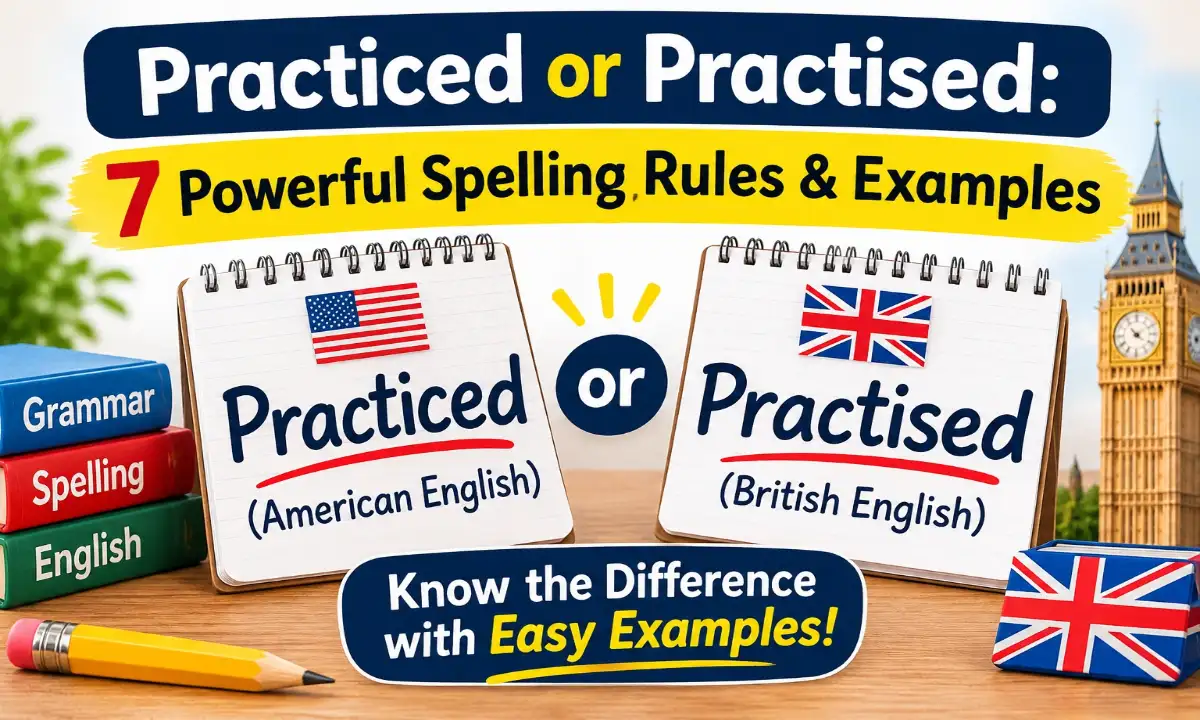
Have you ever written practiced or practised and wondered which spelling is correct? You are not alone. Both versions are correct, but the right choice depends on the type of English you use.
American English generally prefers practiced, while British English uses practised. Both words describe an activity that someone repeated to improve a skill or gain experience. Their meanings and pronunciations are exactly the same.
In this guide, you will learn the difference between practiced and practised, their meanings, pronunciation, grammar rules, and everyday examples. You will also discover seven common spelling mistakes and easy ways to remember the correct form.
Quick Answer: Practiced or Practised?
Both practiced and practised are correct spellings of the past tense and past participle of the verb meaning to train, repeat, or perform an activity to improve a skill.
- Practiced: Standard American English spelling.
- Practised: Standard British English spelling.
Examples:
- American: She practiced the piano yesterday.
- British: She practised the piano yesterday.
- American: He practiced medicine for 20 years.
- British: He practised medicine for 20 years.
Both words have the same meaning, pronunciation, and grammatical function. Only their spelling differs.
What Does Practiced Mean?
Practiced is the American English spelling of the past tense and past participle of the verb practice.
It means performing an activity repeatedly to improve a skill, develop knowledge, or gain experience.
It can also work as an adjective to describe someone who has become skilled through experience.
Part of Speech
Practiced can function as:
- Verb (past tense): Describes an action completed in the past.
- Verb (past participle): Used with helping verbs such as has, have, and had.
- Adjective: Describes someone who is experienced or skilled.
Pronunciation
Practiced is pronounced:
/ˈpræk.tɪst/
It sounds like PRAK-tist. The -ed ending sounds like /t/, not /ed/.
Examples of Practiced in Sentences
- She practiced speaking English before her interview.
- The students practiced their spelling words.
- He has practiced law for several years.
- The singer gave a practiced performance.
- They practiced the dance before the competition.
Synonyms of Practiced
Depending on the context, useful synonyms include:
- Trained
- Rehearsed
- Experienced
- Skilled
- Prepared
- Proficient
- Repeated
For example:
Original: She is a practiced speaker.
Alternative: She is an experienced speaker.
What Does Practised Mean?
Practised is the standard British English spelling of the past tense and past participle of the verb practise.
It has exactly the same meaning as practiced. It describes an activity that someone performed repeatedly to improve their ability or gain experience.
It can also function as an adjective.
Part of Speech
Practised can function as:
- Verb (past tense): Describes an action completed in the past.
- Verb (past participle): Used with helping verbs to form perfect tenses.
- Adjective: Describes someone who has developed experience or skill.
Pronunciation
Practised is pronounced:
/ˈpræk.tɪst/
It sounds exactly like practiced. The spelling changes, but the pronunciation stays the same.
Examples of Practised in Sentences
- She practised the guitar for two hours.
- The children practised their reading skills.
- He has practised medicine for years.
- The practised speaker answered every question confidently.
- They practised the performance several times.
Synonyms of Practised
Useful synonyms include:
- Experienced
- Skilled
- Trained
- Rehearsed
- Prepared
- Proficient
- Seasoned
Key Differences Between Practiced and Practised
The main difference between practiced and practised is regional spelling. Neither word is incorrect when used according to the appropriate English spelling convention.
American vs. British Spelling
American English uses practiced, while British English uses practised.
- US: I practiced my presentation yesterday.
- UK: I practised my presentation yesterday.
Meaning and Definition
Both words have the same meaning. They describe training, repeated actions, or skills developed through experience.
Grammar and Word Forms
The two spelling systems follow different patterns.
| Word form | American English | British English |
|---|---|---|
| Noun | Practice | Practice |
| Base verb | Practice | Practise |
| Third-person singular | Practices | Practises |
| Past tense | Practiced | Practised |
| Past participle | Practiced | Practised |
| Present participle | Practicing | Practising |
Pronunciation
Both words have the same pronunciation: /ˈpræk.tɪst/.
Adjective Usage
Both spellings can describe someone who has experience or skill.
- American: She is a practiced teacher.
- British: She is a practised teacher.
Practiced vs. Practised Comparison Table
| Feature | Practiced | Practised |
|---|---|---|
| Correct spelling | Yes | Yes |
| Regional use | American English | British English |
| Meaning | Trained or repeated | Trained or repeated |
| Part of speech | Verb and adjective | Verb and adjective |
| Pronunciation | /ˈpræk.tɪst/ | /ˈpræk.tɪst/ |
| Past tense | Yes | Yes |
| Past participle | Yes | Yes |
| Adjective | Yes | Yes |
| Formal writing | Correct in US style | Correct in UK style |
| Example | She practiced daily. | She practised daily. |
Important: Both spellings are valid. Do not mark one as incorrect simply because it differs from your preferred English variety.
Spelling Rules and Important Word Forms
Understanding the related word forms makes it easier to choose the correct spelling.
American English Word Forms
American English uses practice as both a noun and a verb.
| Form | Example |
|---|---|
| Practice | I practice English daily. |
| Practices | She practices the piano. |
| Practiced | He practiced yesterday. |
| Practicing | They are practicing now. |
British English Word Forms
British English uses practice as a noun and practise as a verb.
| Form | Example |
|---|---|
| Practice | I need more practice. |
| Practise | I practise English daily. |
| Practises | She practises the piano. |
| Practised | He practised yesterday. |
| Practising | They are practising now. |
The important rule is that practice remains the noun in both varieties.
This is similar to the difference between advice and advise. Advice is a noun, while advise is a verb.
You can also explore our guides on toward or towards and misspell or mispell to understand other English spelling differences.
Origin and History of Practiced and Practised
The words practiced and practised come from the verb practice and its British spelling variation practise.
The word practice entered English through French and ultimately has roots in the Greek word praktikos, associated with action and doing.
Over time, American and British English developed different spelling conventions.
British English maintained a distinction between the noun and verb:
- Practice: Noun.
- Practise: Verb.
American English generally uses practice for both forms.
When the verb changes into the past tense, the two systems produce practiced and practised.
British English vs. American English: Practiced or Practised
The spelling difference mainly depends on regional English conventions.
American English
American English uses practiced as the past tense and past participle of practice.
Examples:
- She practiced her speech.
- We practiced basketball yesterday.
- He has practiced medicine for years.
British English
British English uses practised as the past tense and past participle of practise.
Examples:
- She practised her speech.
- We practised basketball yesterday.
- He has practised medicine for years.
Usage in Different Countries
| Country | Common spelling | Usage |
|---|---|---|
| USA | Practiced | American English |
| UK | Practised | British English |
| Canada | Both | Depends on style and publication |
| Australia | Practised | British-style convention |
| India | Practised | Common in British-influenced writing |
| Pakistan | Practised | Common in British-influenced writing |
Canadian English uses both conventions, so follow your publication’s style guide. India and Pakistan also use different English conventions depending on the institution and audience.
When to Use Practiced
Use practiced when writing in American English. It is suitable for formal, informal, academic, and professional communication.
In Formal Writing
The company practiced strict safety procedures during the training session.
In Academic Writing
The students practiced their pronunciation before the examination.
In Workplace Communication
Our employees practiced the new customer service process.
In Daily Conversations
I practiced driving before taking my road test.
When to Use Practised
Use practised when writing in British English or following a British-style spelling guide.
In Formal Writing
The organization practised responsible business management.
In Academic Writing
The children practised their handwriting during the lesson.
In Workplace Communication
The manager practised her presentation before the meeting.
In Daily Conversations
I practised playing the guitar last night.
Remember: Do not switch between practiced and practised in the same document unless you are discussing the spelling differences themselves.
Common Mistakes When Using Practiced and Practised
Beginners sometimes confuse these spellings because they sound identical. Here are seven mistakes to avoid.
Using Practised in American English
Incorrect for standard American English: He practised his speech before the meeting.
Correct: He practiced his speech before the meeting.
Explanation: American English uses practiced for the past tense.
Why beginners make this mistake: They may follow British spelling rules without realizing the regional difference.
Easy tip: Use practiced when writing for an American audience.
Using Practiced in British English
Incorrect for standard British English: She practiced the piano every morning.
Correct: She practised the piano every morning.
Explanation: British English uses practised as the past form of the verb practise.
Why beginners make this mistake: American spelling is common on international websites.
Easy tip: Remember that the British verb uses -ise.
Using Practise as a Noun in British English
Incorrect: I need more practise before the competition.
Correct: I need more practice before the competition.
Explanation: Practice is the noun in both American and British English.
Why beginners make this mistake: They assume the British verb spelling also applies to the noun.
Easy tip: Remember: practice is the noun.
Using the Present Form for a Past Action
Incorrect: Yesterday, I practice my English.
Correct: Yesterday, I practiced my English. (US)
Correct: Yesterday, I practised my English. (UK)
Explanation: A completed past action needs the past-tense form.
Why beginners make this mistake: They forget to change the verb when describing an earlier event.
Easy tip: Look for words such as yesterday, last week, and earlier.
Mixing American and British Word Forms
Inconsistent British English: She practises every day and practiced yesterday.
Correct British English: She practises every day and practised yesterday.
Explanation: British verb forms follow the practise spelling pattern.
Why beginners make this mistake: They learn individual words without studying the complete word forms.
Easy tip: Follow one spelling system throughout your document.
Using Practiced Instead of Practicing
Incorrect: She is practiced the piano now.
Correct US: She is practicing the piano now.
Correct UK: She is practising the piano now.
Explanation: Continuous tenses require the -ing form.
Why beginners make this mistake: They confuse the past tense with the present participle.
Easy tip: Use is, am, or are with the correct -ing form.
Assuming Both Words Have Different Pronunciations
Incorrect assumption: Practiced and practised have different pronunciations.
Correct understanding: Both words are pronounced /ˈpræk.tɪst/.
Explanation: Their difference is spelling, not sound.
Why beginners make this mistake: They expect every spelling difference to change pronunciation.
Easy tip: Remember that practiced and practised sound exactly alike.
Easy Trick to Remember Practiced or Practised
Here is a simple way to remember both spellings:
- Practiced = American English
- Practised = British English
Think of it this way:
The letter C in practiced can remind you of American spelling conventions, while the S in practised can remind you of British spelling conventions.
Also remember:
- Practice = Noun in both varieties.
- Practise = British verb.
- Practice = American verb.
Once you learn these three rules, choosing the correct spelling becomes much easier.
Practiced or Practised in Everyday Examples
Here are natural examples from different situations.
Work
- American: The team practiced the new safety rules.
- British: The team practised the new safety rules.
School
- American: We practiced our spelling words before the test.
- British: We practised our spelling words before the test.
Social Media
- American: I’ve practiced this dance all week.
- British: I’ve practised this dance all week.
Daily Life
- American: My brother practiced driving yesterday.
- British: My brother practised driving yesterday.
Emails
- American: I practiced my presentation and am ready for the meeting.
- British: I practised my presentation and am ready for the meeting.
Text Messages
- American: I practiced a lot today!
- British: I practised a lot today!
Conversations
- American: Have you practiced your speech?
- British: Have you practised your speech?
Different Contexts and Usage
Both spellings appear in many areas of life. The correct choice depends on the English variety.
Education and Learning
Students practice or practise reading, writing, mathematics, and speaking.
Example: The students practised their pronunciation before the examination.
Business and Professional Communication
Employees describe completed training and professional experience.
Example: The staff practiced the new customer support process.
Medical and Legal Professions
The word can describe working in a profession.
Example: She practised medicine in London.
Sports and Fitness
Players use the word when describing training sessions.
Example: The football team practiced before the match.
Marketing and Digital Content
Businesses can use the word when describing methods or activities.
Example: The agency practised ethical marketing.
Technology and Online Training
Users can describe learning software or developing technical skills.
Example: She practiced coding through online lessons.
Google Trends and Search Insights
People search for practiced or practised because both spellings look correct and appear in English-language content.
The main confusion comes from different spelling conventions in American and British English.
Why Do People Search for This Keyword?
Common reasons include:
- Checking spelling for school assignments.
- Writing professional emails and reports.
- Understanding British and American English.
- Correcting spelling mistakes.
- Learning the past tense of practice or practise.
- Understanding the difference between practice and practise.
Main Search Intentions
| Search intention | What readers want |
|---|---|
| Spelling | Which spelling is correct? |
| Grammar | Is practiced a past-tense verb? |
| Regional English | Is practised British or American? |
| Pronunciation | Do both words sound the same? |
| Examples | How do I use each word? |
| Word forms | Is it practiced, practising, or practised? |
No verified live Google Trends figures are included. These insights describe the common language questions behind the search.
Related Searches and People Also Ask
Is Practiced or Practised Correct?
Both are correct. Practiced is American English, while practised is British English.
Is Practised British or American?
Practised is the standard British English spelling.
Is Practiced American English?
Yes. Practiced is the standard American English spelling.
How Do You Spell Practiced in the UK?
The British spelling is practised.
How Do You Spell Practised in the USA?
The American spelling is practiced.
Are Practiced and Practised Pronounced the Same?
Yes. Both have the pronunciation /ˈpræk.tɪst/.
What Is the Past Tense of Practice?
It is practiced in American English and practised in British English.
What Is the Past Participle of Practise?
The British English past participle is practised. The American equivalent is practiced.
Is Practicing or Practising Correct?
Both are correct. Practicing is American English, while practising is British English.
Is Practice a Noun or a Verb?
It is both in American English. In British English, practice is the noun and practise is the verb.
Is Practised a Real Word?
Yes. Practised is a valid British English spelling.
What Is the Adjective Form of Practiced?
Practiced can also be an adjective describing someone who is skilled or experienced.
Is Practised Correct in Australian English?
Yes. Practised is the standard Australian English spelling.
Do Canadians Use Practiced or Practised?
Both spellings appear in Canadian English. Usage depends on the writer and style guide.
What Is the Difference Between Practice and Practise?
Practice is both a noun and a verb in American English. British English uses practice as a noun and practise as a verb.
Frequently Asked Questions
Is Practiced or Practised More Correct?
Neither is more correct. Practiced is preferred in American English, while practised is preferred in British English.
Can I Use Practiced in British English?
It is understandable, but practised is the standard British spelling.
Can I Use Practised in American English?
It is recognized, but practiced is the standard American spelling.
Is Practiced a Past-Tense Verb?
Yes. Practiced is the American English past tense of practice.
Is Practised a Past-Tense Verb?
Yes. Practised is the British English past tense of practise.
Can Practiced Be Used as an Adjective?
Yes. For example, she is a practiced speaker.
Can Practised Be Used as an Adjective?
Yes. For example, he is a practised musician.
Do Practiced and Practised Have the Same Meaning?
Yes. Both words have the same meaning, pronunciation, and grammatical functions.
Is It Practice Makes Perfect or Practise Makes Perfect?
The correct expression is Practice makes perfect in both varieties because practice is a noun in this expression.
Should I Write Practiced or Practised in an International Article?
Choose one spelling style and use it consistently. Use practiced for an American audience and practised for a British-oriented audience.
Final Verdict: Practiced or Practised?
The choice between practiced and practised depends on your preferred English spelling system.
- Practiced: Correct for American English.
- Practised: Correct for British English and standard Australian English.
- Both: Have the same meaning, pronunciation, and grammatical functions.
Neither spelling is a mistake when used in the appropriate regional style.
The easiest way to remember the difference is to connect practiced with American English and practised with British English.
Conclusion
Understanding practiced or practised is simple once you know the difference between American and British English. Both spellings are correct, and both describe an action that someone performed to improve a skill or gain experience. American English uses practiced, while British English uses practised.
Their meanings and pronunciations remain the same. You can use either spelling in formal writing, academic work, professional communication, and everyday conversations, as long as it matches your chosen English style. Remember that practice is the noun in both varieties, but the verb changes according to regional spelling rules. Keep this simple tip in mind: Practiced for American English and practised for British English.

I’m MK Jan Mustafa Kamal, the author of CompareWordz.com, specializing in English linguistics, word meanings, spelling, and language usage.
I hold an M.A. in English and have 8 years of experience in English language and vocabulary studies. My goal is to explain confusing words, spelling differences, grammar rules, and meanings in clear, simple, and accurate language. I focus on providing well-researched, fact-checked, and easy-to-understand content that helps readers use English with confidence. Through CompareWordz.com, I aim to make learning English words and their correct usage easier for everyone.