

You are writing an email to a client. You type, “It have been a long week.” Then you pause. That does not sound right. Should it be “has been”?
You are not alone. The has been vs have been question confuses students, workers, and many English learners. The words look similar, and both talk about time between the past and now.
In this guide, you will learn which form goes with which subject, what each form means, and how to avoid common mistakes. You will also get an easy trick, clear examples, and answers to the most asked questions.
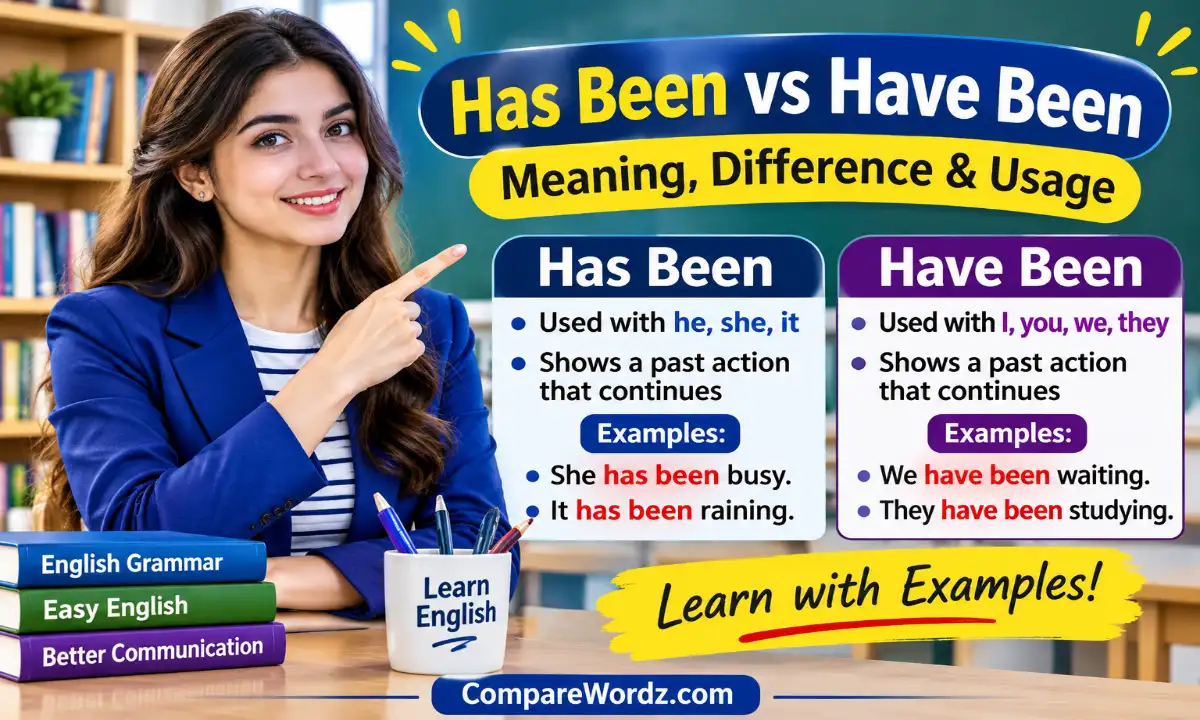
Quick Answer: Has Been vs Have Been
Use has been with he, she, it, and singular nouns. Use have been with I, you, we, they, and plural nouns. Both are present perfect forms of “be,” and both connect the past to the present.
Examples:
- “She has been here since noon.”
- “They have been here since noon.”
- “I have been busy this week.”
- “It has been a long day.”
Meaning of Has Been
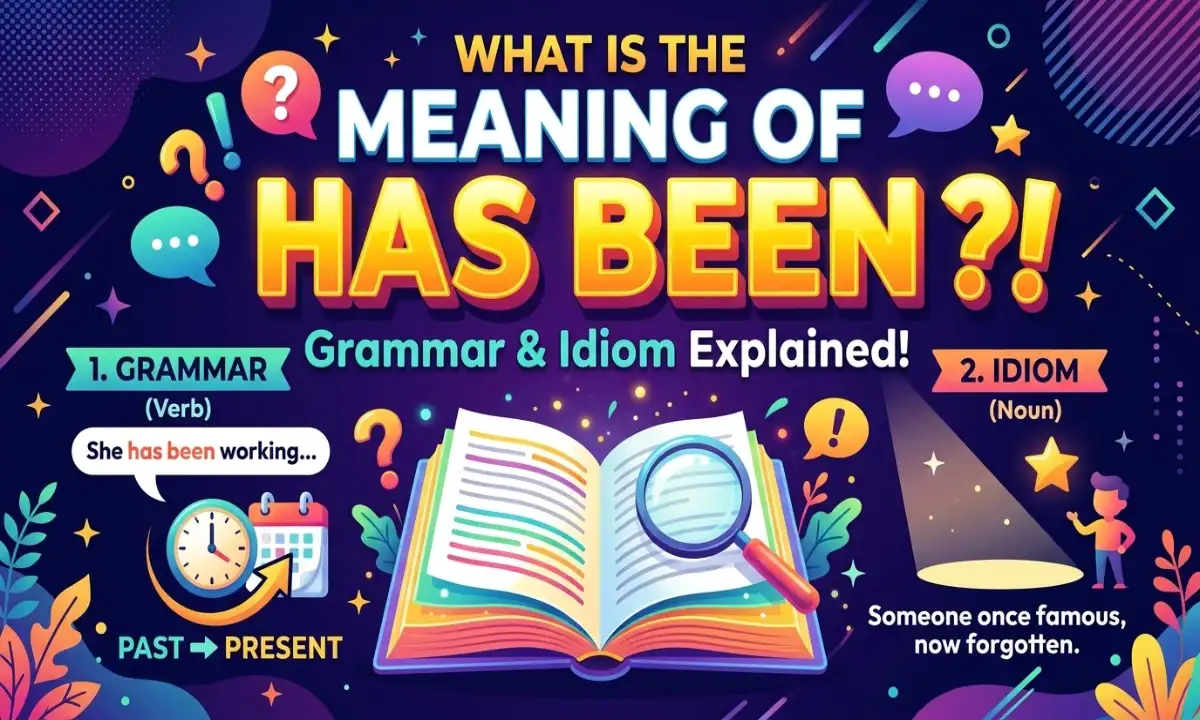
Has been is a verb phrase. It is the present perfect form of “be,” used with a singular third-person subject.
Pronunciation: /hæz bɪn/ (American) or /hæz biːn/ (often British). In fast speech, “has” sounds like /həz/.
Here is how it works. “Has” is the helping verb. “Been” is the past participle of “be.” Together they show that something started in the past and still matters now.
Use has been with:
- he, she, it
- singular nouns: the teacher, my brother, the report
- words like everyone, someone, nobody, each
Examples:
- He has been sick since Monday.
- The shop has been closed all week.
- Everyone has been very kind.
- My phone has been acting strangely.
Contraction: he’s been, she’s been, it’s been
Negative: has not been, hasn’t been
Meaning of Have Been
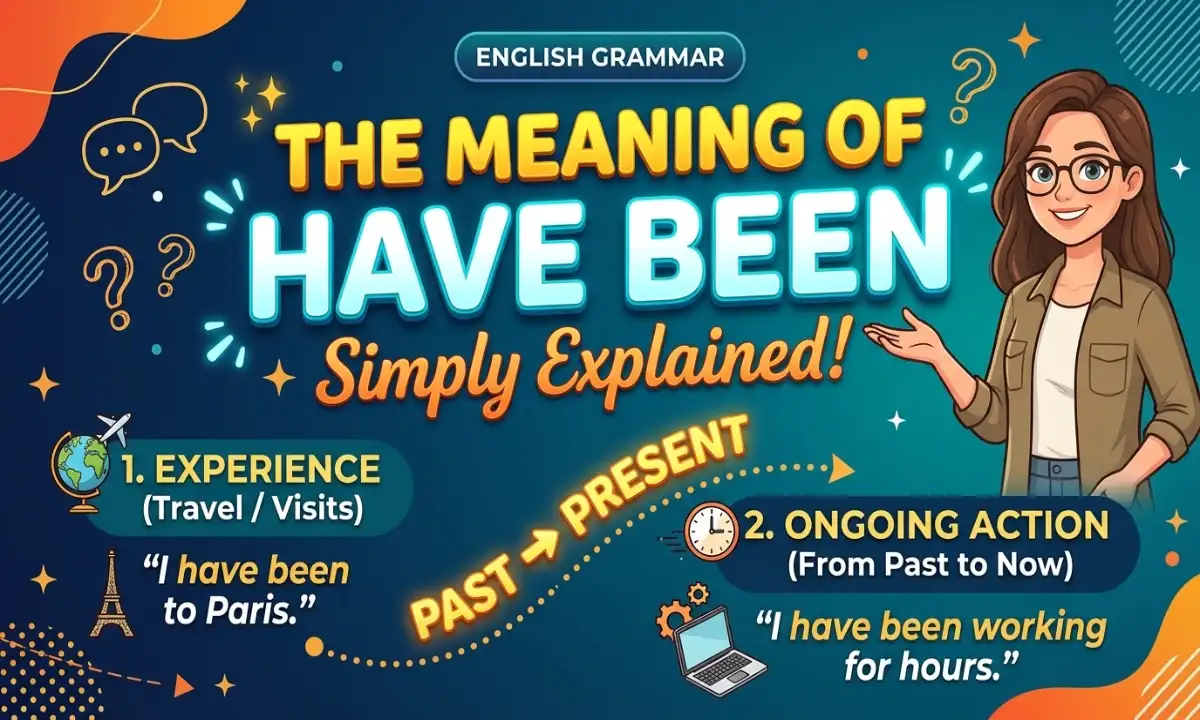
Have been is also a verb phrase. It is the present perfect form of “be,” used with I, you, we, they, and plural subjects.
Pronunciation: /hæv bɪn/ (American) or /hæv biːn/ (often British). In fast speech, “have” sounds like /həv/.
“Have” is the helping verb, and “been” is the past participle. The meaning is the same as has been. Only the subject changes.
Use have been with:
- I, you, we, they
- plural nouns: the students, my friends, the results
- two or more subjects joined by “and”: Sara and Ali
Examples:
- I have been here before.
- You have been a great help.
- The students have been studying hard.
- We have been friends for years.
Contraction: I’ve been, you’ve been, we’ve been, they’ve been
Negative: have not been, haven’t been
Both forms are correct English. Neither is a mistake. Each fits a different subject.
Key Differences Between Has Been and Have Been
Subject. Has been goes with he, she, it, and singular nouns. Have been goes with I, you, we, they, and plural nouns.
Meaning. There is no difference in meaning. Both show a link between the past and the present.
Spelling. “Has” and “have” are different words. Only “has” ends in “s.”
Pronunciation. “Has” ends with a /z/ sound. “Have” ends with a /v/ sound.
Contractions. “Has been” shortens to ‘s been. “Have been” shortens to ‘ve been.
Special case. “I” and “you” always use have, even when you mean one person. You say “I have been” and “you have been.”
Comparison Table: Has Been vs Have Been
| Feature | Has been | Have been |
|---|---|---|
| Correct? | Yes | Yes |
| Tense | Present perfect | Present perfect |
| Used with | he, she, it, singular nouns | I, you, we, they, plural nouns |
| Pronunciation | /hæz bɪn/ | /hæv bɪn/ |
| Contraction | he’s been, it’s been | I’ve been, they’ve been |
| Negative | hasn’t been | haven’t been |
| Question form | Has she been here? | Have you been here? |
| Example | “The meeting has been moved.” | “The meetings have been moved.” |
| Common mistake | Using it with I, you, or plural subjects | Using it with he, she, it, or singular nouns |
| Memory clue | He/she/it gets the “s” in has | Everyone else uses have |
Word Forms and Verb Patterns
This is a grammar topic, so verb forms matter more than statistics. Here is what to know.
Present perfect of “be”
| Subject | Positive | Negative | Question |
|---|---|---|---|
| I | I have been | I haven’t been | Have I been? |
| You | You have been | You haven’t been | Have you been? |
| He / she / it | He has been | He hasn’t been | Has he been? |
| We | We have been | We haven’t been | Have we been? |
| They | They have been | They haven’t been | Have they been? |
Present perfect continuous. Add an -ing verb after been: “She has been working.” “They have been waiting.” This shows an action that is still going on. As Dictionary.com’s guide notes, has been and have been are combined with the present participles of other verbs to form the present perfect continuous tense.
Past perfect. For the past, use “had been.” Unlike the present perfect, “had” stays the same no matter what the subject is. Example: “I had been waiting for an hour when she arrived.”
Related spellings. If past forms of verbs confuse you, see our guides on chosen or choosen and occurred or occured.
Origin and History of Has Been and Have Been
These small words have a long history.
Where “been” came from. “Been” comes from Middle English, which came from the Old English word “(ġe)bēon.” It is the past participle of “be.”
A verb built from three roots. The verb “to be” is unusual because it was built from several old word families. “Been” comes from the root that gave Old English “bēon,” meaning “to be” or “to become.” The forms “am,” “is,” “are,” and “was” come from other roots. That is why “be” looks so irregular today.
Where “have” and “has” came from. “Have” goes back to the Old English word “habban.” “Has” is simply the form used with he, she, and it.
A common pattern. Middle English often used “have” to build perfect tenses. That habit still shapes English today. You can read more about “be” in the Merriam-Webster entry for be.
British English vs American English
Both American and British English use has been and have been in the same way. The spelling, grammar, and meaning are the same in the USA, UK, Canada, Australia, India, and Pakistan.
The differences are small:
| Feature | American English | British English |
|---|---|---|
| Spelling | has been / have been | has been / have been |
| Pronunciation of “been” | /bɪn/ | /biːn/ is common |
| Collective nouns | “The team has been” | “The team have been” is common |
| Casual speech | “I’ve been” | “I’ve been” |
Pronunciation. Merriam-Webster lists /bɪn/ as the standard form and notes that a pronunciation like “bean” is chiefly British.
Collective nouns. American English treats words like team, family, and committee as singular: “The team has been practicing.” British English often treats them as plural: “The team have been practicing.” Both are correct in their own regions.
When to Use Has Been
Use has been when the subject is singular.
Formal writing and reports
- “The project has been delayed by two weeks.”
Workplace and business
- “Our manager has been out of office since Monday.”
Academic writing
- “The theory has been tested many times.”
- “It has been a pleasure working with you.”
Daily conversation
- “She has been late all week.”
Useful phrases: it has been a while, there has been a change, everyone has been told, nothing has been decided
When to Use Have Been
Use have been when the subject is I, you, we, they, or a plural noun.
Formal writing and reports
- “Several changes have been made to the policy.”
Workplace and business
- “We have been working on this plan since May.”
Academic writing
- “Researchers have been studying sleep for decades.”
- “I hope you have been well.”
Daily conversation
- “They have been very helpful.”
Useful phrases: I have been, you have been, we have been, there have been two calls, the results have been posted
Common Mistakes with Has Been and Have Been
Using “has been” with I
- Incorrect: I has been here since morning.
- Correct: I have been here since morning.
- Why it happens: Learners mix up “has” with the “s” ending on third-person verbs.
- Tip: “I” always takes have.
Using “have been” with he, she, or it
- Incorrect: He have been late twice.
- Correct: He has been late twice.
- Why it happens: “Have” is the most common form, so it feels natural.
- Tip: If the subject is he, she, or it, switch to has.
Mixing up “there has been” and “there have been”
- Incorrect: There have been a problem with the order.
- Correct: There has been a problem with the order.
- Why it happens: The word “there” does not tell you the number. The noun after it does.
- Tip: Look at the noun after “been.” One problem takes has. Many problems take have: “There have been many problems.”
Using “have been” with everyone, someone, or nobody
- Incorrect: Everyone have been invited.
- Correct: Everyone has been invited.
- Why it happens: “Everyone” sounds like many people.
- Tip: Words that end in -one or -body are singular. Use has.
Mixing up “a number of” and “the number of”
- Incorrect: The number of complaints have been rising.
- Correct: The number of complaints has been rising.
- Why it happens: The plural noun “complaints” sits right before the verb.
- Tip: “The number” is singular, so use has. “A number of” means “several,” so use have: “A number of people have been waiting.”
Using the present perfect with a finished time
- Incorrect: I have been to the market yesterday.
- Correct: I went to the market yesterday.
- Why it happens: Learners think any past event needs “have been.”
- Tip: If you name a finished time, like yesterday or last week, use simple past. For more on past-tense forms, see helped or helpped.
Mixing up since and for
- Incorrect: She has been working here since five years.
- Correct: She has been working here for five years.
- Why it happens: Both words connect to time.
- Tip: Use “since” with a starting point (since 2020). Use “for” with a length of time (for five years).
Easy Trick to Remember
Think of it this way: The “s” in has goes with he, she, it. Everyone else gets have.
Here is a quick method:
- Find the subject of the sentence.
- Ask yourself, “Could I replace it with he, she, or it?”
- If yes, write has been. If not, write have been.
Quick examples:
- “My sister ___ been here.” → She → has
- “My sisters ___ been here.” → They → have
A second clue: I and you are special. They always use have, even when you mean one person.
Everyday Examples
At work
- “The report has been sent to the manager.”
- “We have been waiting for approval.”
At school
- “The homework has been posted online.”
- “Students have been preparing for the exam.”
On social media
- “It has been a crazy week, and I love it.”
- “We have been waiting for this trailer all year.”
In daily life
- “My dad has been cooking all morning.”
- “My neighbors have been so kind.”
In email
- “It has been a while since we last spoke.”
- “I hope you have been well.”
In text messages
- “Where have you been?”
- “She has been asking about you.”
Different Contexts and Usage
Present perfect for experience
Use “have been to” when someone went and came back: “I have been to Dubai.” Use “have gone to” if the person is still there: “He has gone to Dubai.”
Present perfect continuous
Add an -ing verb for an action that is still going on: “She has been studying for hours.” “They have been waiting since noon.”
Job interviews and CVs
People use has been and have been to describe work history: “I have been a nurse for ten years.”
News and journalism
Headlines often use has been: “A new law has been passed.” The form shows the news still matters today.
Technology and notifications
Messages often use has been: “Your order has been shipped.” “Your account has been updated.”
Grammar learning
Teachers compare has been, have been, and had been. Had been is for something that happened before another past event.
A noun with a hyphen
A “has-been” is a noun for someone who was once famous or successful but is not anymore. It is informal and can sound unkind.
Google Trends and Search Insights
I did not have live Google Trends access when writing this, so I am not including figures or regional rankings.
Here is what likely drives the searches:
- Subject agreement. Many people are unsure which helping verb to pair with a subject.
- Tricky subjects. Words like everyone, “there,” “the number of,” and team names cause doubt.
- Tense confusion. Writers also compare “has been” with “was” and “had been.”
- Formal writing. Emails, essays, and exams push people to check.
Useful long-tail queries: has been or have been, has been or had been, has been or was, there has been or there have been, have been to or have gone to, has been vs have been examples, has been vs have been in a sentence.
Related Searches and People Also Ask
Is it “has been” or “have been”?
Use has been with he, she, it, and singular nouns. Use have been with I, you, we, they, and plural nouns.
Is it “there has been” or “there have been”?
Look at the noun after “been.” “There has been a delay.” “There have been delays.”
What is the difference between “has been” and “had been”?
Has been connects the past to now. Had been describes something before another past event.
What is the difference between “has been” and “was”?
Was refers to a finished past time. Has been links the past with the present.
What does “has been” mean?
It means something started in the past and still matters now.
Can I use “has been” with “you”?
No. Always say “you have been.”
Is “everyone has been” correct?
Yes. Everyone is singular.
Is it “the team has been” or “the team have been”?
Both are correct. American English prefers has. British English often uses have.
What is the contraction of “has been”?
It is “‘s been,” as in “He’s been late.” Context shows that “‘s” means “has.”
What does “have been to” mean?
It means you visited a place and came back.
What is the difference between “have been to” and “have gone to”?
Have been to means the person returned. Have gone to means the person is still there.
What does “has-been” mean as a noun?
It describes someone whose best days are in the past.
Is “has been” passive or active?
It can be both. “The door has been opened” is passive. “She has been running” is active.
How do you pronounce “been”?
It is /bɪn/ in the USA and often /biːn/ in the UK.
Frequently Asked Questions
What is the difference between has been and have been?
Only the subject changes. Has is for he, she, it, and singular nouns. Have is for I, you, we, they, and plural nouns.
Is “has been vs have been” about meaning or grammar?
It is about grammar. The meaning is the same.
Is “I has been” ever correct?
No. Say “I have been.”
Can I use “have been” with a singular noun?
Not usually. “The report has been sent” is correct.
What tense is “has been”?
It is the present perfect tense.
Is “has been” formal?
It works in both formal and casual writing.
How do I form a question with has been?
Move the helping verb first: “Has she been here?” “Have you been here?”
What is the negative form of has been?
It is “has not been” or “hasn’t been.”
Can has been refer to the future?
Not directly. It talks about the past and present, though it may hint at what comes next.
Do British and American English use has been and have been differently?
Not in grammar. The main difference is how they treat collective nouns.
What is the easiest way to remember the difference?
The “s” in has goes with he, she, and it.
Final Verdict
Has been is for he, she, it, and singular nouns. Have been is for I, you, we, they, and plural nouns. The meaning is the same, and only the subject decides which form you need.
For tricky cases, look at the true subject of the sentence, not the word right before the verb. The easiest memory rule: the “s” in has goes with he, she, it.
Conclusion
The has been vs have been puzzle is simple once you focus on the subject. Ask yourself who or what is doing the action. If it is he, she, it, or a singular noun, use has been. For everyone else, use have been.
Special words like “there,” “everyone,” and team names can cause doubt, but the same method still works. Find the subject, test it, and choose the matching form.
With a little practice, this choice becomes automatic. Your emails, essays, and messages will sound clear and confident.
Memory tip: The “s” in has goes with he, she, and it.

Hi, I’m Toseef Mustafa, the creator of CompareWordz.com and a qualified English linguistics professional. My expertise includes English vocabulary, spelling, grammar, word meanings, and commonly confused words. I aim to explain language differences through clear explanations, accurate information, and practical examples. My goal is to help readers understand English better and use the right words with confidence.