

You’re writing a funny caption about a banana slip, and you want to say people burst into laughter. Is it a peel of laughter or a peal of laughter?
Many people pause here, and that’s normal. The two words sound identical, and they look almost the same.
This guide clears up the peel vs peal question with simple definitions, clear examples, and an easy memory trick.
You’ll learn what each word means, where each comes from, and how to use them in emails, school work, and social posts.
By the end, you’ll know which spelling fits in just a few seconds.
Peel vs Peal: Quick Answer
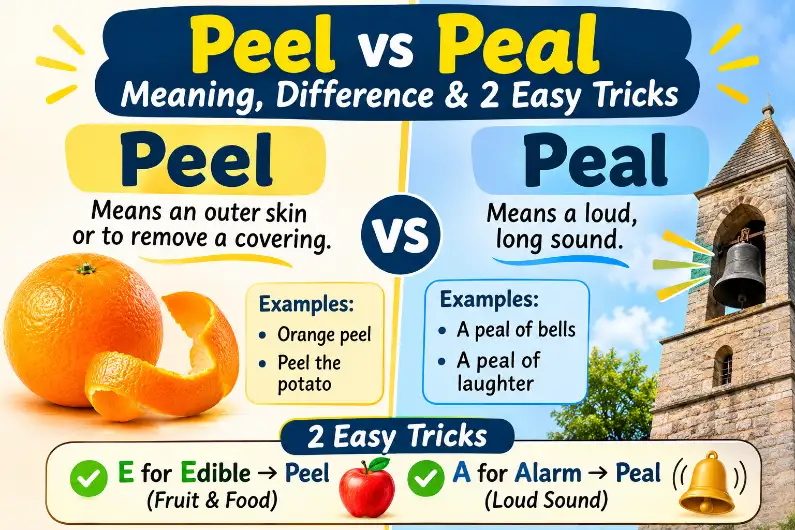
Peel and peal sound the same but mean different things. Peel means to remove the outer skin or layer, like peeling an orange. Peal means a loud ringing sound, like bells, thunder, or laughter. Say “peel the banana” and “a peal of laughter.”
- Please peel the potatoes before dinner.
- The church bells let out a loud peal.
- The class burst into peals of laughter.
- The paint started to peel off the wall.
What Does Peel Mean?
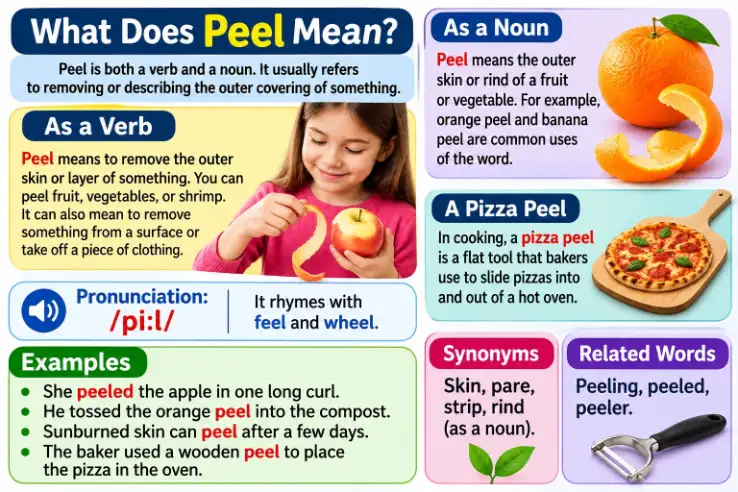
Peel is both a verb and a noun.
As a verb, it means to strip off the outer layer of something. You can peel fruit, vegetables, or shrimp, and you can peel something away or off a surface. You can also peel off a piece of clothing.
As a noun, it means the skin or rind of a fruit, like orange peel or banana peel. It’s the skin or rind of a fruit. It can also mean a long flat tool bakers use to slide pizza into an oven.
Pronunciation: /piːl/. It rhymes with feel and wheel.
Examples:
- She peeled the apple in one long curl.
- He tossed the orange peel into the compost.
- Sunburned skin can peel after a few days.
Synonyms: skin, pare, strip, rind (for the noun).
Related words: peeling, peeled, peeler.
What Does Peal Mean?
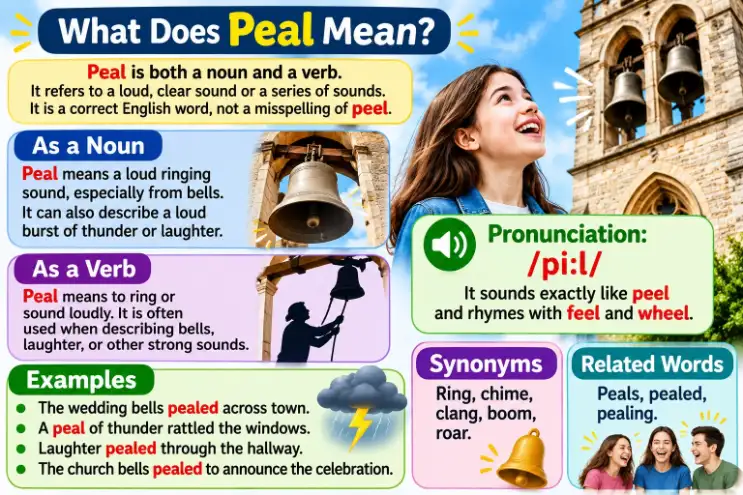
Peal is mostly a noun, and it can also be a verb. It’s a fully valid word, not a typo for peel.
As a noun, it means a loud ringing of bells, or a loud sound or series of sounds. A peal of thunder is one example. People also say a peal of laughter.
As a verb, peal means to ring or sound loudly. Bells pealed out is a common example.
Pronunciation: /piːl/, exactly like peel.
Examples:
- The wedding bells pealed across town.
- A peal of thunder rattled the windows.
- Laughter pealed through the hallway.
Synonyms: ring, chime, boom, roar.
Related words: peals, pealed, pealing.
Key Differences Between Peel and Peal
The biggest difference is meaning. Peel is about removing a layer. Peal is about a loud, ringing sound.
Spelling: Peel has “ee” in the middle. Peal has “ea.”
Grammar: Peel is a common verb and noun. Peal is mainly a noun, with a verb use that’s less common.
Pronunciation: There’s no difference. They’re homophones.
Usage: Peel shows up in cooking, home projects, and skincare. Peal shows up with bells, thunder, and laughter.
Peel vs Peal Comparison Table
| Feature | Peel | Peal |
|---|---|---|
| Correct spelling? | Yes | Yes |
| Main part of speech | Verb and noun | Noun and verb |
| Core meaning | Remove an outer layer; the skin of fruit | A loud ringing or series of loud sounds |
| Pronunciation | /piːl/ | /piːl/ |
| Typical subjects | Fruit, paint, skin, stickers | Bells, thunder, laughter |
| Example | She peeled the orange. | A peal of laughter filled the room. |
| Common mistake | Writing “peal an orange” | Writing “peel of laughter” |
Spelling Rules and Word Forms
Both words keep their vowels when you add endings. You don’t double any letters.
| Word | Present | Third person | Past | -ing form |
|---|---|---|---|---|
| Peel (verb) | peel | peels | peeled | peeling |
| Peal (verb) | peal | peals | pealed | pealing |
The plural nouns are peels and peals. Notice that peeled and pealed also sound the same. For another tricky vowel pair, see buoy or bouy.
Useful related words include peeler (a kitchen tool) and unpeeled (still has its skin).
In bell ringing, peal can have a strict technical meaning. A full peal means at least 5,040 changes rung on a set of bells.
Origin and History of Peel and Peal
Where Peel Comes From
The verb peel goes back to Old English. It developed from Old English pilian and Old French pillier, both from Latin pilare, meaning to strip of hair. Over time, the meaning moved from stripping hair to stripping the skin or rind from things.
The phrase peel off has an aviation twist. Pilots used it in World War II to mean veer away from a formation.
Where Peal Comes From
Peal has a different story. It first appeared in the mid 1300s as a bell ringing that called people to church, and it’s generally considered a shortened form of appeal. The idea was that a bell “summons” people.
The wider sense of loud bell ringing is first recorded in the 1510s, and it later spread to other loud sounds like thunder, cannon fire, shouts, and laughter.
British English vs American English
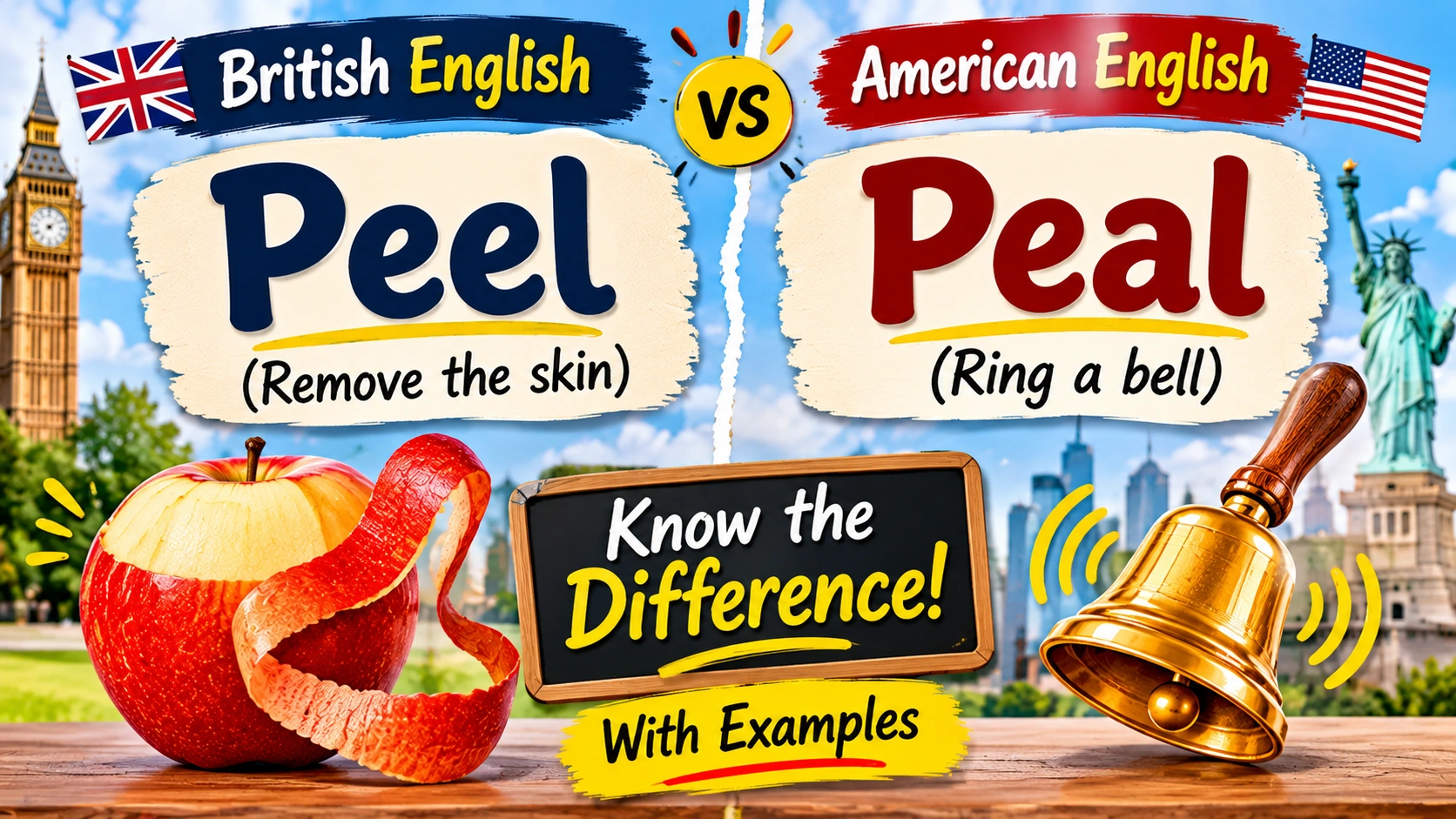
There is no spelling or pronunciation difference between British and American English here. Both are /piːl/. The same rules apply to readers in Canada, Australia, India, and Pakistan.
One small note: “mixed peel” is a baking term you’ll often see in British recipes. It means chopped candied citrus rind. The word is still spelled peel.
| Feature | American English | British English |
|---|---|---|
| Peel spelling | peel | peel |
| Peal spelling | peal | peal |
| Pronunciation | /piːl/ | /piːl/ |
| Meanings | Same | Same |
When to Use Peel
Use peel when you remove an outer layer, or when you mean the skin of a fruit.
- Formal and academic writing: “Researchers peeled the tissue away from the sample.”
- Workplace writing: “Remove the label by peeling the backing off.”
- Daily conversation: “Can you peel these carrots while I start the sauce?”
- Emails: “Please peel the protective film from the screen before use.”
When to Use Peal
Use peal for loud ringing, especially bells, or for a series of loud sounds like thunder or laughter.
- Formal and academic writing: “A peal of church bells marked the end of the war.”
- Workplace writing: “A peal of laughter came from the break room.”
- Daily conversation: “I heard a loud peal of thunder last night.”
- Emails: Peal is less common in emails. Use it when you want a vivid sound image.
Peal is not wrong when used as a verb. It’s only wrong when you mean removing a layer.
Common Mistakes with Peel and Peal
Mistake: Writing peal for removing skin
- Incorrect: She pealed the orange.
- Correct: She peeled the orange.
- Why: Removing a skin or layer is always peel.
- Why beginners miss it: The words sound alike, so the spelling gets blurry.
- Tip: If you can remove it with your fingers, use peel.
Mistake: Writing peel for laughter
- Incorrect: The class burst into peels of laughter.
- Correct: The class burst into peals of laughter.
- Why: A loud series of sounds is a peal.
- Why beginners miss it: Peel is the more common word, so it comes to mind first.
- Tip: Laughter rings like a bell. Think “peal.”
Mistake: Using peeled for thunder
- Incorrect: Thunder peeled across the sky.
- Correct: Thunder pealed across the sky.
- Why: The verb for loud sounds is peal.
- Why beginners miss it: The past tenses sound identical.
- Tip: Match the sound verb to the sound word. Thunder pealed.
Mistake: Writing banana peal
- Incorrect: Don’t slip on that banana peal.
- Correct: Don’t slip on that banana peel.
- Why: The skin of a fruit is a peel.
- Why beginners miss it: Typing fast leads to the wrong letter.
- Tip: Think “peel” has two e’s, like the two ends of a banana.
Mistake: Mixing up the -ing forms
- Incorrect: The pealing paint looks terrible.
- Correct: The peeling paint looks terrible.
- Why: Paint coming off in layers is peeling.
- Why beginners miss it: The -ing forms sound the same.
- Tip: Picture strips coming off. Peeling.
Mistake: Trusting spell check
- Incorrect: Her sunburn is pealing.
- Correct: Her sunburn is peeling.
- Why: Both words are real, so spell check often misses the error.
- Why beginners miss it: Software checks spelling, not meaning.
- Tip: Reread any sentence with either word before you send it. For more spelling traps, see misspell or mispell.
Easy Trick to Remember Peel vs Peal
Think of it this way: peel has two e’s like the two ends of a banana you peel, and peal has “ea” like the ringing of an alarm bell.
- Peel = two e’s, like two hands peeling a fruit.
- Peal = “ea” at the center of “bell ringing” sounds.
Another quick check: if the sentence is about taking something off, pick peel. If it’s about a loud sound, pick peal.
Everyday Examples of Peel and Peal

Work: “Please peel the sticker off the old file cabinet.”
School: “We heard a peal of the school bell right at noon.”
Social media: “That video sent me into peals of laughter 😂.”
Daily life: “I peel an orange every morning with my breakfast.”
Email: “A peal of applause greeted the speaker at the end.”
Text message: “Can you peel the potatoes for tonight?”
Online content: “How to Peel a Mango in Under a Minute.”
Conversation: “Did you hear that peal of thunder? It shook my windows.”
Different Contexts and Usage
Cooking and Kitchen
In the kitchen, peel can mean the skin of citrus fruit. Cooks often grate it into recipes for flavor. Bakers also use a flat wooden tool called a pizza peel to slide pizza in and out of an oven.
Home Projects and DIY
Peel shows up all the time around the house. Paint can peel, wallpaper can peel, and stickers can peel off. Many products now come as peel and stick tiles or wallpaper.
Skincare and Beauty
In skincare, a peel is a treatment that removes the top layer of skin, such as a chemical peel. Skin that flakes after a sunburn is also said to be peeling.
Bells and Music
Bell ringers use peal for the sound of bells. In strict bell ringing terms, a peal is a long, planned sequence of changes rung on a set of bells. Most people simply use it to describe the loud ringing of church bells.
Weather and Sounds
Peal also describes loud, rolling sounds in nature. Thunder is the classic example. Writers also use it for echoing laughter or applause.
Aviation and Driving
The phrase peel off means to veer away, as in a plane leaving a formation or a car turning off from traffic. Peel out means to accelerate fast so the tires squeal.
Education and Grammar Learning
Teachers often use peel and peal to show how homophones work. Another near match worth practicing is which or wich.
Google Trends and Search Insights
I couldn’t pull live Google Trends figures, so I won’t quote numbers or regional rankings. What I can say is why people keep searching this pair.
What drives the searches:
- The words are homophones, so your ear gives no clue.
- Spelling differs by one letter.
- Spell check usually stays quiet, since both are real words.
- The phrase “peal of laughter” is not common in everyday talk, so people double check it.
Useful long-tail searches include: peel or peal of laughter, peeled vs pealed, peeling vs pealing, peel off vs peal off, and peal of thunder meaning.
Related Searches and People Also Ask
Is it peel or peal? Use peel for removing a layer. Use peal for a loud ringing sound.
Is it a peal of laughter or a peel of laughter? The correct phrase is peal of laughter.
What does peal of thunder mean? It means a loud, rolling crash of thunder.
What is a peal of bells? It’s the loud ringing of bells, often in a pattern.
What is a peal in bell ringing? In strict terms, it’s a long sequence of changes rung on bells, at least 5,040 changes for a full peal.
Is it peeled or pealed? Use peeled for removing a layer. Use pealed for bells or loud sounds.
Is it peeling or pealing? Use peeling for paint, skin, and fruit. Use pealing for bells and loud sounds.
Is it peel off or peal off? It’s peel off. Peal off is not a standard phrase.
What does peel out mean? It means to speed away so the tires squeal.
What does peel back the layers mean? It means to look closely at something step by step.
Is peal a verb? Yes. It means to ring or sound loudly.
Is peal short for appeal? Etymologists generally treat it that way.
Frequently Asked Questions
Are peel and peal homophones?
Yes. They sound exactly the same but have different spellings and meanings.
Can peel and peal ever mean the same thing?
No. Peel is about removing a layer. Peal is about loud ringing sounds.
Is peal a noun or a verb?
It’s mostly a noun, but it can be a verb too, meaning to ring or sound loudly.
What is the plural of peal?
The plural is peals, as in peals of laughter.
Does spell check catch peel vs peal mistakes?
Usually not. Both are real words, so you need to reread the sentence.
Is peel only used for fruit?
No. You can peel paint, stickers, skin, and wallpaper too.
Is “peel” ever used for bells?
No. For bells, the word is peal.
Why do people say a peal of laughter?
Laughter can sound like a loud ringing, so the bell sound word is borrowed for it.
Final Verdict
Use peel when you remove a layer or mean the skin of a fruit. Use peal when you mean a loud ringing sound, like bells, thunder, or laughter.
The easiest rule: peel has two e’s like the ends of a banana, and peal rings like a bell. If you remember that, you’ll rarely mix them up.
Conclusion
The peel vs peal question comes down to one idea. Peel is about taking a layer off, while peal is about a loud, ringing sound. They sound the same, so your ears won’t help you. Your eyes and the meaning will.
Before you hit send, ask yourself one thing: am I removing a layer, or describing a sound? Pick peel for the first and peal for the second. For an extra check, the Merriam-Webster guide to peel and peal is a handy reference. And if you’re ever unsure, remember this tip: peel has two e’s like a banana, and peal rings like a bell.

Hi, I’m Toseef Mustafa, the creator of CompareWordz.com and a qualified English linguistics professional. My expertise includes English vocabulary, spelling, grammar, word meanings, and commonly confused words. I aim to explain language differences through clear explanations, accurate information, and practical examples. My goal is to help readers understand English better and use the right words with confidence.