


You’re typing a sentence about chemicals in a river, and autocorrect flips a word. Is it leach or leech? Many writers freeze at this point, and it’s easy to see why. Both words sound exactly alike, and they differ by one letter.
This guide settles the leach vs leech question with plain answers, real examples, and a simple memory trick. You’ll learn what each word means, where each one comes from, and how to avoid the most common mistakes in school papers, work emails, and social media posts. By the end, you’ll pick the right word in just a few seconds, every time.
Leach vs Leech: Quick Answer
Leach and leech sound the same but mean different things. Leach is a verb for liquid pulling substances out of something solid, like rain washing nutrients from soil. Leech is a bloodsucking worm, or a person who takes without giving back.
- Rain can leach minerals from the soil.
- We found a leech on my brother’s leg.
- Old pipes may leach lead into water.
- He’s a leech who never pays for lunch.
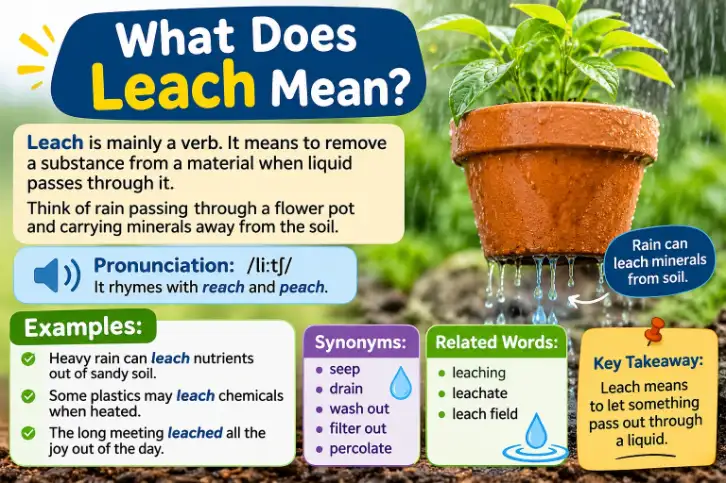
Leach is mainly a verb. It means to dissolve something out by a liquid passing through, or for substances to pass out of a material this way. Think of rain moving through a flower pot and carrying minerals away.
Pronunciation: /liːtʃ/. It rhymes with reach and peach.
Examples:
- Heavy rain can leach nutrients out of sandy soil.
- Some plastics leach chemicals when heated.
- The long meeting leached all the joy out of the day.
Leach can also mean to drain something away slowly, even in a non-science way, as in the last example. In older and technical use, it can be a noun too, such as the tub or wood ashes used to make lye. It’s also a less common spelling of the sailing term leech.
Synonyms: seep, drain, wash out, filter out, percolate.
Related words: leaching, leachate, leach field.
What Does Leech Mean?

Leech is both a noun and a verb, and it’s a fully valid word. It is not a misspelling of leach.
As a noun, it has three main meanings:
- A bloodsucking worm, usually found in fresh water.
- A person who clings to someone else to gain something.
- A sailing term for an edge of a sail (more on that below).
As a verb, leech means to attach yourself to someone and take from them, or to bleed a person with leeches. It can also mean to drain the substance of something.
Pronunciation: /liːtʃ/, exactly like leach.
Examples:
- A leech clung to my boot after the swamp hike.
- She stopped letting her cousin leech off her streaming account.
- The long commute leeched his energy.
Synonyms (for the person): parasite, sponge, freeloader.
Key Differences Between Leach and Leech
The biggest difference is meaning. Leach describes a process, where a liquid carries something out. Leech names a creature or a taker, or describes the act of clinging and draining.
Spelling: Leach has “ea” in the middle. Leech has “ee.”
Grammar: Leach is mostly a verb. Leech is a noun and a verb.
Pronunciation: There’s no difference. They’re homophones.
Tone: Leach is neutral and often scientific. Leech is usually negative when used for people.
Usage: Leach shows up in science, gardening, and food. Leech shows up in nature, insults, and sailing.
Leach vs Leech Comparison Table
| Feature | Leach | Leech |
|---|---|---|
| Correct spelling? | Yes | Yes |
| Main part of speech | Verb | Noun and verb |
| Core meaning | Liquid dissolves and carries substances out | Bloodsucking worm, or a person who takes and gives nothing back |
| Pronunciation | /liːtʃ/ | /liːtʃ/ |
| Typical subjects | Soil, water, chemicals, ashes | Worms, people, sails |
| Tone | Neutral or technical | Often negative |
| Example | Rain leaches nutrients from soil. | He’s a leech who always borrows money. |
| Common mistake | Writing “leech” for chemicals | Writing “leach” for the worm or the freeloader |
Spelling Rules and Word Forms
Both words are regular and easy to change. Neither doubles its last letter, and both add “es” for the third person.
| Word | Present | Third person | Past | -ing form |
|---|---|---|---|---|
| Leach (verb) | leach | leaches | leached | leaching |
| Leech (verb) | leech | leeches | leeched | leeching |
The noun leech becomes leeches in the plural. Plural spelling can trip people up with other words too, such as thieves or thiefs.
Useful related words include leachate (the liquid that leaches out, like landfill runoff) and leach field (a part of many septic systems).
Origin and History of Leach and Leech
Where Leach Comes From
Dictionaries call the exact origin of leach uncertain. It may come from the Old English word leccan, meaning to moisten or irrigate, and it appears in cookery by the 1660s. It’s also linked to the same root as leak. That link explains why leach and leak feel related.
Where Leech Comes From
The worm sense goes back to Old English. The bloodsucking worm comes from the Old English word læce, of unknown origin.
Leech also once meant a doctor. The two words merged in Middle English, probably by folk etymology. The mix-up makes sense because doctors used leeches to draw blood. By about 1700, calling a doctor a leech was no longer current. People were being compared to leeches by 1784.
The sailing sense is a separate word that dates to the 15th century and is tied to an older term for a rope edge.
British English vs American English
There is no spelling or pronunciation difference between British and American English here. Both are pronounced /liːtʃ/ in the UK and the US. The same rules apply to readers in Canada, Australia, India, and Pakistan.
| Feature | American English | British English |
|---|---|---|
| Leach spelling | leach | leach |
| Leech spelling | leech | leech |
| Pronunciation | /liːtʃ/ | /liːtʃ/ |
| Meanings | Same | Same |
When to Use Leach
Use leach when a liquid pulls something out of a solid, or when something slowly drains away.
- Formal and academic writing: “The study measured how heavy metals leach from mine waste.”
- Workplace writing: “We tested the coating to see if it would leach into food.”
- Daily conversation: “Don’t soak the herbs too long, or they’ll leach out their flavor.”
- Emails: “The report says the container won’t leach chemicals.”
When to Use Leech
Use leech for the worm, for a person who takes without giving back, or for the verb of clinging and draining.
- Formal and academic writing: “Leeches are segmented worms with a sucker at each end.”
- Workplace writing: “Avoid leeching off a teammate’s work. Share the credit.”
- Daily conversation: “Stop being a leech and chip in for pizza.”
- Emails: Keep the personal sense polite. It can sound harsh in a professional note.
Leech is not wrong when used for a person or for the worm. It’s only wrong when you mean a liquid carrying substances out of a material.
Common Mistakes with Leach and Leech
Mistake: Using leech for chemicals in soil
- Incorrect: Lead paint can leech into the ground.
- Correct: Lead paint can leach into the ground.
- Why: Leach is the standard word for liquids carrying substances out.
- Why beginners miss it: The words sound the same, and “leech” appears in some news writing.
- Tip: Picture rain, water, or chemicals. Pick leach.
Mistake: Using leach for a freeloader
- Incorrect: He’s such a leach.
- Correct: He’s such a leech.
- Why: A person who clings and takes is a leech.
- Why beginners miss it: “Leach” is a real word, so spell check stays quiet.
- Tip: Leeches cling to you. Picture two eyes watching you: “ee.”
Mistake: Using leach for the worm
- Incorrect: We saw a leach in the pond.
- Correct: We saw a leech in the pond.
- Why: The animal is always spelled leech.
- Why beginners miss it: The words are homophones.
- Tip: If it’s alive and wriggly, use leech.
Mistake: Mixing up the past tense
- Incorrect: Rain leeched the color from the fabric.
- Correct: Rain leached the color from the fabric.
- Why: The verb follows the base word.
- Why beginners miss it: People change the ending but keep the wrong middle.
- Tip: Fix the base word first, then add -ed or -ing.
Mistake: Wrong plurals
- Incorrect: leachs, leechs
- Correct: leaches, leeches
- Why: Words ending in “ch” add “es.”
- Why beginners miss it: They add only “s,” like most nouns.
- Tip: Say the word out loud. You hear the extra syllable.
Mistake: Trusting spell check
- Incorrect: We installed a new leech field.
- Correct: We installed a new leach field.
- Why: Both words are real, so spell check often misses the error. Autocorrect may also suggest one word in place of the other.
- Why beginners miss it: Software only checks spelling, not meaning.
- Tip: Reread any sentence with either word before you hit send. For more spelling traps, see misspell or mispell.
Easy Trick to Remember Leach vs Leech
Think of it this way: leach shares “ea” with leak, and leech has two e’s like two eyes on a creature that watches and clings.
- Water leaks through a pot, so it leaches nutrients out.
- A leech has ee, like two eyes on you.
Another quick check: if the sentence has a liquid, pick leach. If it has a living thing, a person who takes, or a sail, pick leech.
Leach vs. Leech in Everyday Examples
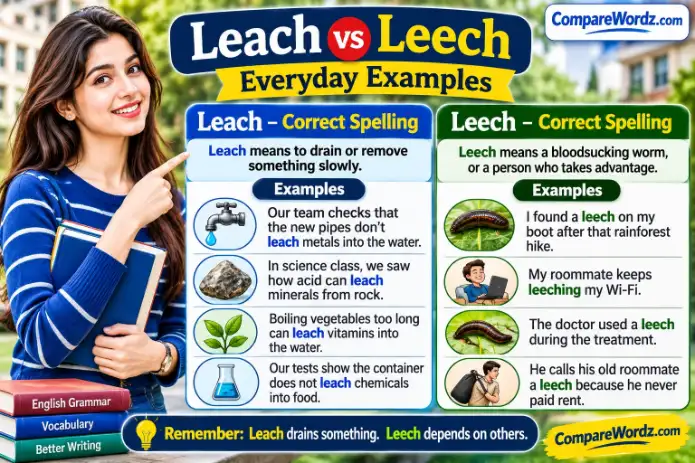
Work: “Our team checks that the new pipes don’t leach metals into the water.”
School: “In science class, we saw how acid can leach minerals from rock.”
Social media: “Found a leech on my boot after that rainforest hike 😬.”
Daily life: “Boiling vegetables too long can leach vitamins into the water.”
Email: “Our tests show the container does not leach chemicals into food.”
Text message: “My roommate keeps leeching my Wi-Fi 😂.”
Online content: “How to Stop Fertilizer From Leaching Out of Your Garden Beds.”
Conversation: “He calls his old roommate a leech because he never paid rent.”
Different Contexts and Usage
Science and Environment
Scientists use leach for the way liquids carry substances out of rock, soil, or waste. Leachate is the liquid that results. Miners may also leach copper from crushed rock using a liquid solution.
Gardening and Farming
Heavy rain can leach nutrients out of loose, sandy soil. Gardeners often add compost or mulch to slow this down.
Medicine and Health
In older medicine, leeches were used for bloodletting. The practice is part of the word’s history. Today, you’ll mostly see leech in health writing as a historical or biological term.
Workplace and Business
At work, leech is a blunt word for a person who takes credit or resources without contributing. It’s usually better to be specific and polite in professional writing.
Sailing
Sailors use leech for an edge of a sail. It names either vertical edge of a square sail, or the back edge of a fore-and-aft sail. Leach is a less common spelling, so you may see both in sailing forums.
Technology and Online Communities
In file sharing, a leech is a user who downloads without sharing back. The verb can mean to drain resources without giving back, as in grabbing files and never uploading any. The same idea shows up in “Wi-Fi leeching.”
Education and Grammar Learning
Teachers often use leach and leech to show how homophones work. Other near matches worth practicing include everyday or every day.
Google Trends and Search Insights
I couldn’t pull live Google Trends figures, so I won’t quote numbers or regional rankings. What I can say is why people keep searching this pair.
What drives the searches:
- The words are homophones, so your ear gives no clue.
- Spelling differs by only one letter.
- Spell check usually stays quiet, since both are real words.
- Each word lives in a different world, one scientific and one about worms and people.
Useful long-tail searches include: leach vs leech in soil, leeching vs leaching, leach field meaning, leech meaning slang, and leach vs leech sailing.
Related Searches and People Also Ask
Is it leach or leech? Use leach for liquids pulling substances out. Use leech for the worm or a person who takes.
What is the meaning of leach vs leech? Leach is a process. Leech is a creature, a taker, or a sail edge.
How do you pronounce leach and leech? Both are /liːtʃ/ and rhyme with reach.
What is a leach field? It’s a part of a septic system where liquid drains into the ground.
What is leachate? It’s the liquid that comes out after water passes through waste or soil, carrying substances with it.
Is it leached or leeched? Use leached for liquids carrying things out. Use leeched for a person who took from others.
Is it leaching or leeching? Use leaching for science and soil. Use leeching for taking without giving back.
Does a chemical “leech into soil” or “leach into soil”? Leach is standard. Some news writing uses leech, but leach is safer.
What does leech mean in slang? It’s a person who takes advantage of others or uses resources without paying.
Is leach related to leak? Dictionaries link them to the same older root, so they feel connected.
What is a leech on a sail? It’s an edge of the sail, either a vertical edge or the back edge, depending on sail type.
Did leech once mean doctor? Yes, in older English. That use faded by about 1700.
Frequently Asked Questions
Are leach and leech homophones?
Yes. They sound exactly the same but have different spellings and meanings.
Can leach and leech ever mean the same thing?
Sometimes they overlap. Leech can mean to drain something of its substance. Still, leach is the standard choice when a liquid carries substances out of a material.
Is leach a noun or a verb?
It’s mostly a verb. It also has older noun uses, like the tub or ashes used to make lye.
What is the plural of leech?
The plural is leeches. The third person verb form is also leeches.
Does spell check catch leach vs leech mistakes?
Usually not. Both are real words, so you need to reread the sentence.
Which word do scientists use?
Scientists use leach, leaching, and leachate. They use leech only for the worm.
Is Leach also a surname?
Yes. Leach is a surname and also the name of a place in Oklahoma. That’s separate from the verb.
Is leech a rude word?
Calling a person a leech is an insult. The word itself, for the worm, is perfectly fine.
Final Verdict
Use leach when a liquid carries substances out of something solid. Use leech for the bloodsucking worm, for a person who takes without giving back, or for the sail edge.
The easiest rule: leach goes with leak, and leech has two eyes. If you remember that, you’ll rarely mix them up.
Conclusion
The leach vs leech question comes down to one idea. Leach is about liquid pulling things out of a solid, while leech is about a worm or someone who clings and takes. They sound alike, so your ear won’t help you. Your eyes and the meaning will.
Before you hit send, ask yourself one thing: is a liquid involved, or a living thing or a person? Pick leach for the first and leech for the second. For a deeper look at word meanings, the Merriam-Webster entry for leech is a handy reference. And if you ever feel unsure, remember this tip: leach goes with leak, and leech has two eyes.

Hi, I’m Toseef Mustafa, the creator of CompareWordz.com and a qualified English linguistics professional. My expertise includes English vocabulary, spelling, grammar, word meanings, and commonly confused words. I aim to explain language differences through clear explanations, accurate information, and practical examples. My goal is to help readers understand English better and use the right words with confidence.