

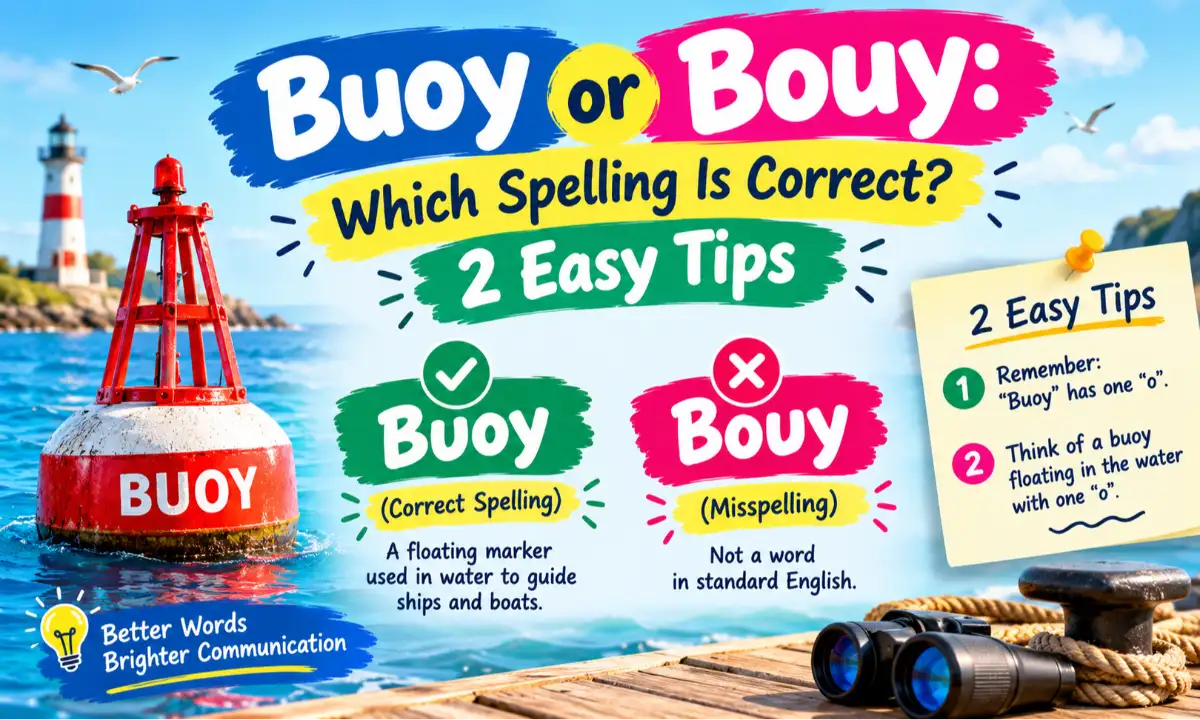
Quick test: how do you spell the floating marker that shows boats where the channel runs? If you hesitated, you’re in good company.
People search buoy or bouy because the word looks nothing like it sounds. It has four letters, three of them vowels, and many people say it like “boy,” so the order feels easy to scramble.
It’s a small word, but it shows up in captions, school reports and news writing, so it’s worth getting right once.
Below, you’ll find the correct spelling, two accepted ways to say it, and the difference between buoy and boy. A few proofreading habits at the end keep the typo from sneaking back in.
Quick Answer
Buoy or bouy? Buoy is the correct spelling. Bouy is a common typo.
The rule: U comes before O.
- The boat passed the red buoy.
- Two buoys marked the swimming area.
- The good news buoyed her mood.
The same order holds in every related word: buoys, buoyed, buoyant, buoyancy. Spell it b-u-o-y in essays, emails and captions alike. Whether you say it “boy” or “BOO-ee,” the spelling doesn’t change.
What Does Buoy Mean?
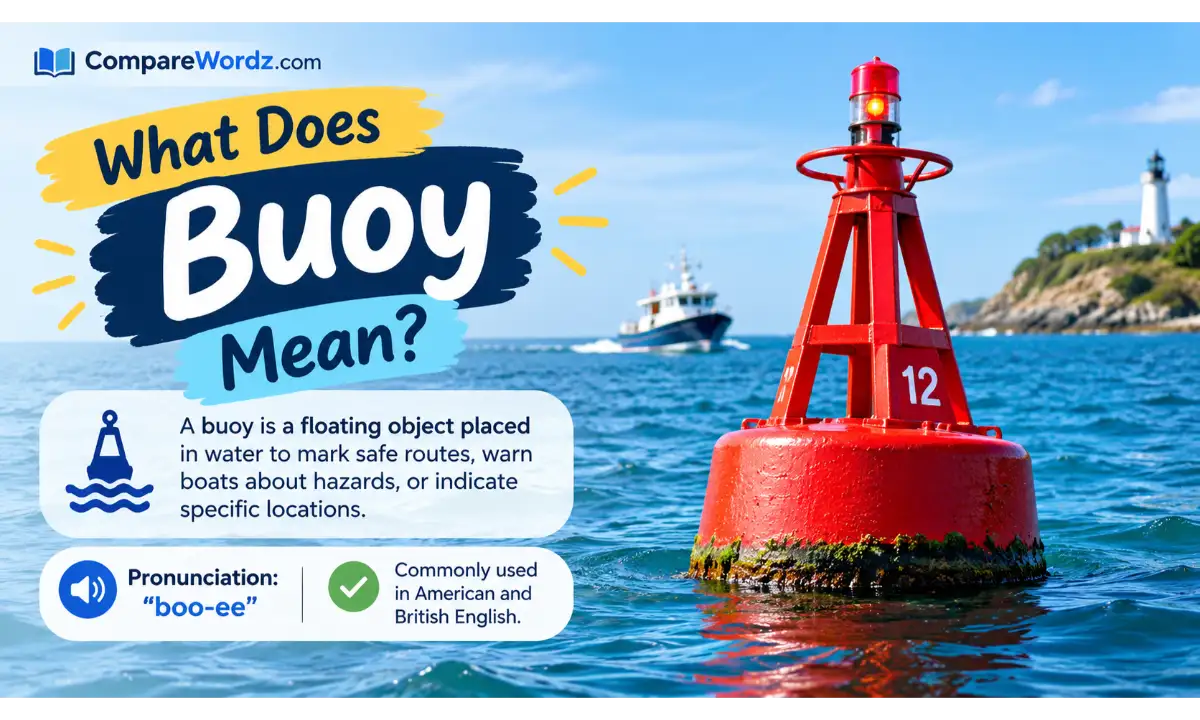
A buoy is a floating object anchored to the bottom of a lake, river or sea. It can mark a channel, warn about hidden danger, or show where boats can tie up.
Some buoys carry instruments instead. NOAA’s National Data Buoy Center gathers weather and ocean readings from buoys in the water.
As a verb, to buoy something means to keep it afloat or lift it up. You’ll often see that meaning in news stories that have nothing to do with boats.
How Do You Pronounce Buoy?
Dictionaries list two accepted pronunciations:
- “BOO-ee,” which many Americans use
- “boy,” which is common in British English
Neither one is wrong. The Merriam-Webster entry for buoy lets you hear the word if you want audio. Pick the version that feels natural and use it consistently.
Buoy or Bouy: Why Do People Mix It Up?
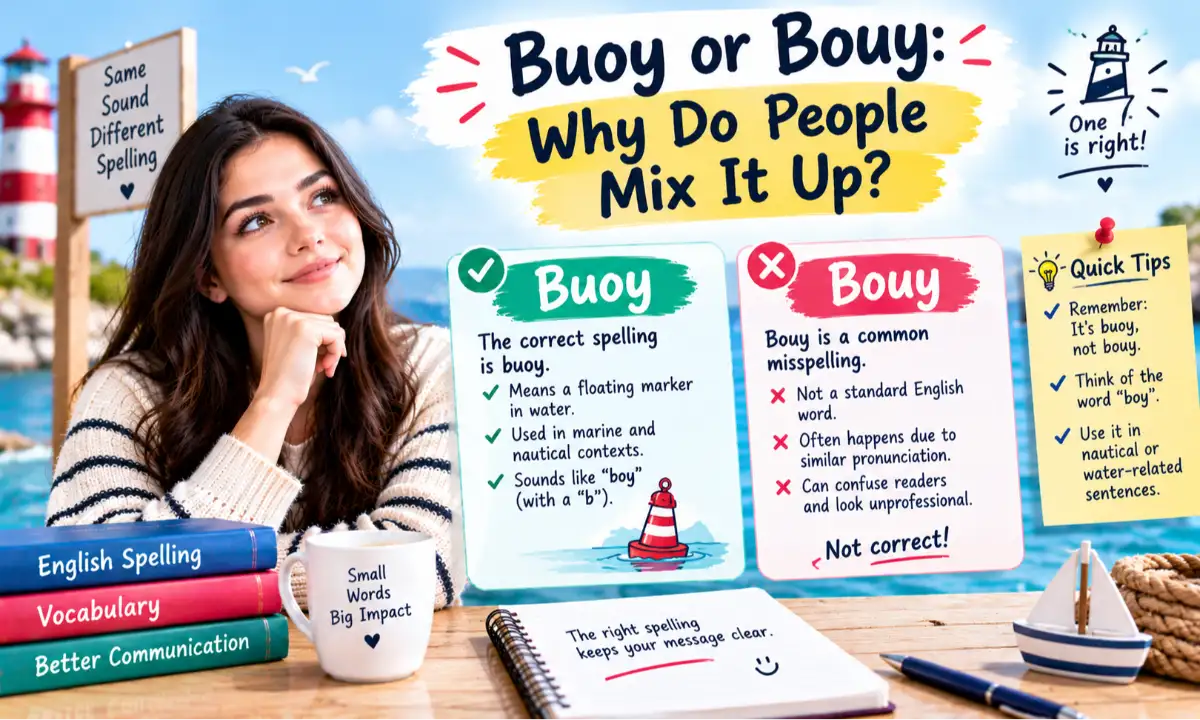
Three things work against you.
First, the vowel pile-up. When three of four letters are vowels, the order is hard to picture. English has other words where a simple sound hides an odd spelling, like gauge or gage.
Second, the “boy” pronunciation. Your ear hears B-O-Y, so the U feels like an extra letter that could go anywhere.
Third, your fingers. The U and O are close enough on the keyboard that a fast typist flips them without noticing.
Buoy vs. Boy
When you use the “boy” pronunciation, these two sound identical. Since “boy” is a real word, a spell checker won’t flag it.
| Word | Meaning | Example |
|---|---|---|
| buoy | a floating marker, or to keep afloat | The buoy bobbed near the rocks. |
| boy | a young male | The boy waved from the dock. |
Buoy as a Verb
Away from the water, buoy usually means “to lift” or “to support.”
| Form | Example |
|---|---|
| buoy / buoys | Good news buoys the whole office. |
| buoyed | Early orders buoyed the launch. |
| buoying | Her encouragement is buoying him. |
| buoy up | They tried to buoy up the team after the loss. |
The family also includes buoyant (able to float, or cheerful) and buoyancy (the upward push that keeps things afloat).
Common Mistakes With Buoy
| Wrong | Right | Why it happens |
|---|---|---|
| bouy | buoy | The U and O swap places. |
| bouys | buoys | Same swap, plus an S. |
| bouyed | buoyed | The error carries into the verb. |
| bouyant | buoyant | Writers spell it the way it sounds. |
| bouyancy | buoyancy | The same swap in a longer word. |
| boy (for the marker) | buoy | The words sound alike. |
Buoy in Real Life

- Social media: “Anchored next to the orange buoy all afternoon.”
- School: “Buoyancy is the upward push that keeps a buoy afloat.”
- Work: “Strong preorders buoyed the launch.”
- Daily life: “The lifeguard asked us to stay inside the buoys.”
Expert Tips to Spell Buoy Right
- Split it in two. Write bu, then oy. The ending is the same “oy” as in boy and toy, so only the front needs attention.
- Search before you publish. In a long document, use Find to look for “bouy.” It takes seconds and catches every instance. Our guide on misspell or mispell has more habits like this.
- Reread sentences about water. Autocorrect can turn a typo into “boy,” and nothing will warn you.
Related Questions
What is the plural of buoy? It’s buoys.
What is the past tense of buoy? It’s buoyed, as in “buoyed by good news.”
Is lifebuoy one word? Dictionaries list it as one word, though “life buoy” also appears.
Frequently Asked Questions
Is it buoy or bouy?
It’s buoy. Bouy is a misspelling.
Is bouy ever correct?
Not as a word for a floating marker. A brand or personal name might use it, but that’s a name, not a spelling of buoy.
How do you pronounce buoy?
Either “BOO-ee” or “boy.” Both are listed in dictionaries.
Is buoyant spelled with the U first too?
Yes. It’s buoyant, and the noun is buoyancy.
Do Americans and Brits spell buoy differently?
No. The spelling is the same. Only the pronunciation tends to differ.
Final Verdict: Buoy or Bouy?
Buoy is correct, and bouy is only a typo. The memory rule: U comes before O. Keep that order in buoys, buoyed, buoyant and buoyancy, and use it every time, in every form of the word.
Conclusion
The next time buoy or bouy stops you mid-sentence, you’ll know what to type. Say it however feels natural, but spell it the same way every time.
Words that don’t sound like they look, such as volume or volumn, respond to the same approach: learn the root once, then trust it. Then give the final draft one slow read, since typos hide best in words you’ve typed a hundred times.
Last updated: October 2026

Hi, I’m Toseef Mustafa, the creator of CompareWordz.com and a qualified English linguistics professional. My expertise includes English vocabulary, spelling, grammar, word meanings, and commonly confused words. I aim to explain language differences through clear explanations, accurate information, and practical examples. My goal is to help readers understand English better and use the right words with confidence.