


You set a bowl on a kitchen scale and spot a button labeled “Tare.” For a second, you wonder if it’s a typo for “tear.” Nothing is being ripped, so what does the button do?
That small moment is why people search tear vs tare. The two words can sound exactly alike, yet they mean very different things, and mixing them up causes real confusion in recipes, shipping papers, and everyday writing.
In this article, you’ll learn what each word means, how to say it, where it comes from, and three quick tests that make the choice easy. It’s a small question with a surprisingly clear answer.
Tear vs Tare: Quick Answer
Tare is the weight of an empty container, which you subtract to find the net weight. Tear means to rip something, or it names a drop of liquid from the eye. Tare and the “rip” kind of tear sound the same, so the spelling is your only clue.
- Press the tare button before you add the flour.
- Please don’t tear the page.
- A single tear rolled down her cheek.
What Does Tear Mean?
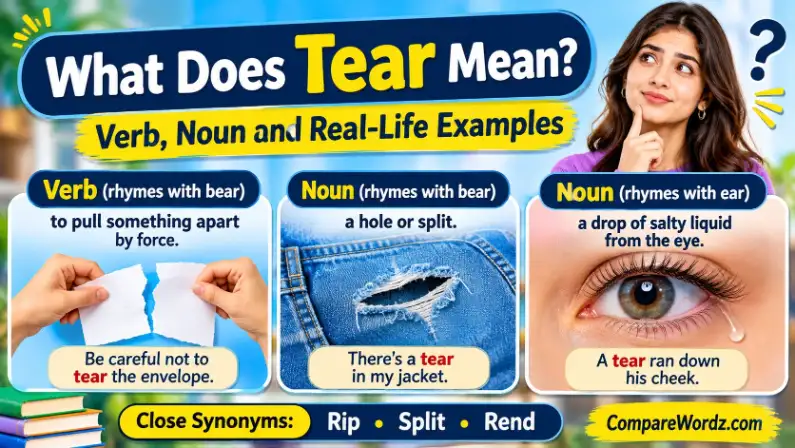
“Tear” is a verb and a noun, and its meanings sound different from each other. According to Grammarly, the rip meanings rhyme with “bear,” and the eye meaning rhymes with “ear.”
- Verb (rhymes with bear): to pull something apart by force. Be careful not to tear the envelope.
- Noun (rhymes with bear): a hole or split. There’s a tear in my jacket.
- Noun (rhymes with ear): a drop of salty liquid from the eye. A tear ran down his cheek.
Close synonyms for the rip meaning include rip, split, and rend.
What Does Tare Mean?
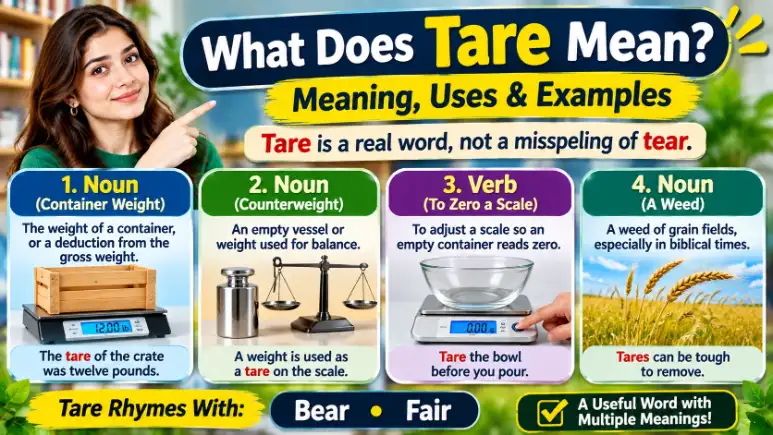
“Tare” is its own valid word, not a misspelling of “tear.” Merriam-Webster lists several meanings, and the first one is the one most people need.
- Noun, container weight: the weight of a container, or a deduction from the gross weight to allow for it. The tare of the crate was twelve pounds.
- Noun, counterweight: an empty vessel or weight used for balance. This appears in lab and scale work.
- Verb, to zero a scale: to adjust a scale so an empty container reads as zero. Tare the bowl before you pour.
- Noun, a weed: a weed of grain fields, especially in biblical times. In this sense, it often appears as the plural “tares.”
Tare rhymes with “bear” and “fair,” just like the rip meaning of tear.
Key Differences Between Tear vs Tare
The simplest difference is the job each word does.
- Meaning: Tare is about weighing. Tear is about ripping or crying.
- Spelling: Tare ends in “are.” Tear ends in “ear.”
- Grammar: Tear is a verb and a noun. Tare is a noun and a verb, but the verb only means to adjust or weigh for the container.
- Pronunciation: Tare matches the rip meaning of tear. The eye meaning of tear sounds different.
Tear vs Tare Comparison Table
| Word and sense | Part of speech | Sounds like | Example |
|---|---|---|---|
| tear (rip) | verb, noun | bear, fair | Don’t tear the receipt. |
| tear (from the eye) | noun | ear, peer | She wiped away a tear. |
| tare (container weight) | noun | bear, fair | Subtract the tare from the total. |
| tare (zero a scale) | verb | bear, fair | Tare the scale first. |
| tare (a weed) | noun | bear, fair | The field was full of tares. |
How Gross, Tare, and Net Weight Fit Together
Tare makes sense once you see the three weights it connects. The formula is simple: gross weight minus tare equals net weight.
| Term | What it means | Example |
|---|---|---|
| gross weight | everything together, container included | 520 grams |
| tare | the empty container | 120 grams |
| net weight | only the contents | 400 grams |
Merriam-Webster notes that for a vehicle, tare weight means the vehicle’s weight without any load. If you’re curious about the word “gross” itself, our guide on gross or grose covers its spelling.
Word Forms and Spelling Rules for Tear and Tare
The two words have different verb patterns, which makes them easy to separate in writing.
| Word | Plural or -s form | Past tense | Past participle | -ing form |
|---|---|---|---|---|
| tear | tears | tore | torn | tearing |
| tare | tares | tared | tared | taring |
Tare follows a regular rule: it ends in a silent e, so the e is dropped before -ing (taring). Tear is irregular, so you can’t predict “tore” and “torn” from the base word.
Dictionary.com notes that “tare” was once an old past tense of “tear.” That use is archaic, so today you should write “tore.”
Origin and History of Tear and Tare
The weighing word has a travel story. Merriam-Webster traces the container meaning to Old Italian tara and to Arabic ṭarḥa, which literally means “that which is removed.” That fits the idea of subtracting the container. It also notes that an early English record lists barrels of gunpowder weighing a certain amount “besides the tare.”
The weed meaning has a different history. Merriam-Webster says it is probably related to a Middle Dutch word for wheat, which makes sense for a plant growing in grain fields.
Tear, in the rip sense, comes from the Old English word teran, according to Grammarist. So the two words sound alike by coincidence, not because they share a root.
British English vs American English
The spelling and meaning stay the same on both sides of the Atlantic. We found no regional spelling difference in the American and British dictionary entries we checked. Only the accent changes the sound.
| Feature | American English | British English |
|---|---|---|
| Spelling of tare | tare | tare |
| Spelling of tear | tear | tear |
| Sound of tare | tair, with a final r | tair, without a final r |
| Meaning of both words | same | same |
Dictionary.com shows the American pronunciation with a final r and the British pronunciation without one. We found nothing to suggest different spellings in Canada, Australia, India, or Pakistan.
When to Use Tear
Use “tear” whenever something is being pulled apart, damaged, or when an eye is watering.
- Formal writing: Reports describing damage use it. The inspector noted a tear in the seal.
- Informal writing: Casual messages use it often. I tore my sleeve on the fence.
- Academic work: Essays and papers may refer to emotion or damage. The poem describes a single tear.
- Emails and workplaces: Instructions use it too. Tear along the dotted line.
- Daily talk: Phrases like “tear up,” “tear down,” and “wear and tear” are everywhere.
The phrase “on a tear” means being in a lively streak of activity, as in She’s on a tear this week.
When to Use Tare
Use “tare” only when the topic is a container’s weight, a scale, or the plant called a tare. It is a real word, so don’t treat it as a spelling error, and don’t use it for ripping.
- Formal documents: Shipping forms often list tare weight. Record the tare weight on the form.
- Informal speech: Cooks talk about it casually. Let me tare the scale.
- Academic work: Science labs mention it. The balance was set with a tare.
- Workplaces and emails: Logistics teams use it. Please confirm the tare before loading.
- Daily life: Kitchen scales show it on a button. Press tare.
Common Mistakes With Tear vs Tare
Writing “tear weight” instead of “tare weight”
- Incorrect: The tear weight of the box is two pounds.
- Correct: The tare weight of the box is two pounds.
- Why: Tare is the term for container weight.
- Why beginners do it: “Tear” is the word they know.
- Easy tip: If the sentence involves weighing, write tare.
Calling the scale button “tear”
- Incorrect: Press the tear button to zero the scale.
- Correct: Press the tare button to zero the scale.
- Why: The button subtracts the container’s weight.
- Why beginners do it: The word looks unfamiliar, so they swap in a known one.
- Easy tip: Nothing is ripped when you press it.
Using “tared” for ripping
- Incorrect: I tared the paper in half.
- Correct: I tore the paper in half.
- Why: Tared only refers to weighing.
- Why beginners do it: They learn that tare is a verb and apply it everywhere.
- Easy tip: Ripping uses tore and torn.
Spelling a crying tear as “tare”
- Incorrect: A single tare rolled down her cheek.
- Correct: A single tear rolled down her cheek.
- Why: The eye meaning is always spelled tear.
- Why beginners do it: They match the sound of the rip meaning.
- Easy tip: If it involves an eye, write tear.
Writing “on a tare”
- Incorrect: She’s on a tare this month.
- Correct: She’s on a tear this month.
- Why: “On a tear” is an idiom about a lively streak. Grammarist also notes that “on a tear” is the correct form.
- Why beginners do it: They hear the sound and recall the weight word.
- Easy tip: Weighing has nothing to do with the idiom.
Easy Trick to Remember Tear vs Tare
Think of it this way: tare is for scales, and tear is for rips and eyes.
Use these three quick tests when you’re unsure.
- The weighing test: If the sentence involves a scale, a container, or a net weight, write tare.
- The rip or cry test: If something is being pulled apart or an eye is watering, write tear.
- The “A for amount” test: Tare has an A, like amount. It’s about the amount left after you subtract the container.
Other pairs trick people in the same way. For example, which or wich shows how sound can mislead your spelling.
Everyday Examples of Tear and Tare
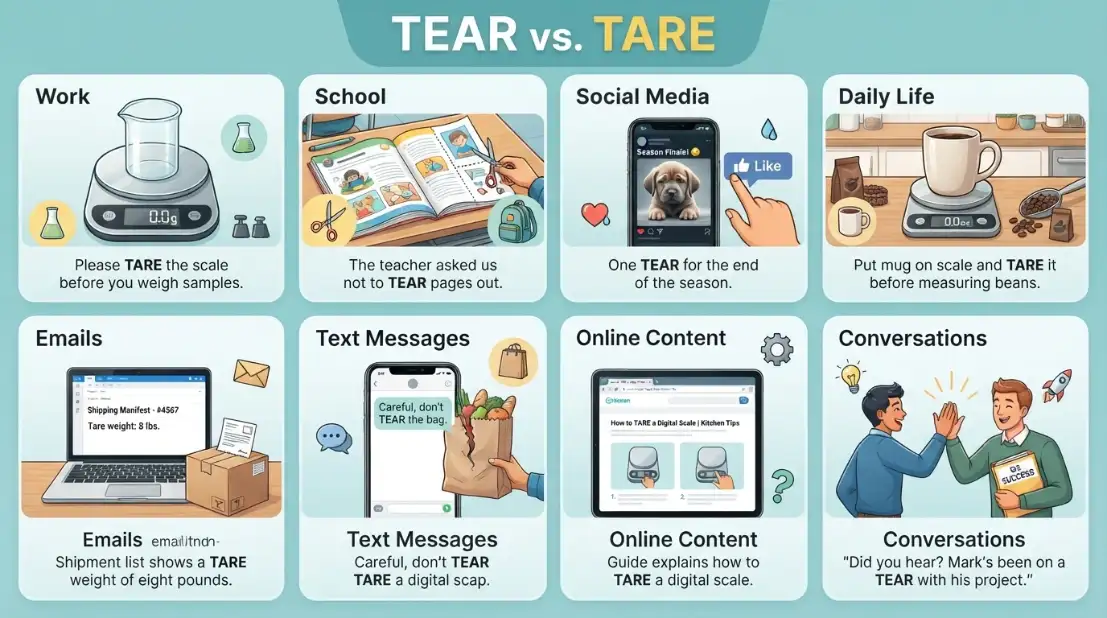
- Work: Please tare the scale before you weigh the samples.
- School: The teacher asked us not to tear pages out of the workbook.
- Social media: One tear for the end of the season. 😢
- Daily life: I put my coffee mug on the scale and tare it before I measure the beans.
- Emails: The shipment list shows a tare weight of eight pounds.
- Text messages: Careful, don’t tear the bag.
- Online content: This guide explains how to tare a digital scale.
- Conversations: “Did you hear? Mark’s been on a tear with his new project.”
Tear vs Tare in Different Contexts
- Education: Science classes use a tare to balance a container, and grammar lessons use this pair to teach homophones.
- Business and shipping: Packing lists separate the product weight from the packaging weight so costs are clear.
- Cooking: Set the mixing bowl on the scale, tare it, then add the sugar.
- Retail and marketing: Some reusable produce bags carry a tag with their tare weight, so shoppers aren’t charged for the bag.
- Technology: Many digital scales include a tare button for zeroing a container.
- Measurement words: Kitchens and labs bring up other spelling traps too, like celsius vs celcius.
Why People Search Tear vs Tare
We don’t have live Google Trends figures for this keyword, so we won’t quote numbers or regional rankings. We can explain what likely drives the search.
- The two words are homophones in the rip sense, so the ear can’t tell them apart.
- Digital scales show a “tare” button, which sends people to look up the word.
- Shipping and packaging terms bring “tare weight” into everyday work.
- The idiom “on a tear” may sound like a weight word to some readers.
Related Searches and Questions
These are common queries based on what competing guides cover and where readers get stuck. They are not copied from Google’s own question box.
- Tare button on a scale: It subtracts the container’s weight so only the contents show.
- Tare weight on vehicles: It means the vehicle’s weight without a load.
- Tear weight: This is a misspelling of tare weight.
- Tares in the Bible: This refers to the weed meaning, a weed in grain fields.
- Tare vs tar: Tar is a different word for a thick, sticky substance.
- Tare vs tier: Tier means a level or layer, and it sounds like the eye meaning of tear in some accents.
- Tare in cooking: It means zeroing the scale after you place the bowl.
- Tare sauce for ramen: It’s a Japanese seasoning base, a separate sense of the same spelling.
- Tear sound differences: The rip meaning rhymes with “bear,” and the eye meaning rhymes with “ear.”
- Tare vs unladen weight: Both describe a vehicle’s weight without its load.
- Tare vs counterweight: A counterweight is one meaning of tare in lab work.
Frequently Asked Questions About Tear vs Tare
Tear vs tare: which one is correct?
Both are correct words with different jobs. Use tare for container weight and scales, and tear for ripping or a drop from the eye.
Are tear and tare pronounced the same?
Tare sounds like the rip meaning of tear. The eye meaning of tear sounds different.
What is tare weight?
It is the weight of an empty container or vehicle. You subtract it from the gross weight to get the net weight.
How do you tare a kitchen scale?
Place your empty bowl on the scale and press the tare button. The display resets to zero, and you can add your food.
What is the past tense of tear?
It is “tore.” The past participle is “torn.”
What is the past tense of tare?
It is “tared,” as in “I tared the scale.”
Is tare a real word or a misspelling?
It is a real word with its own entry in Merriam-Webster. It is not a misspelling of tear.
Does tare have any other meaning?
Yes. It can also mean a weed that grows in grain fields.
Final Verdict: Tear vs Tare
Tare and tear are two separate words. Tare belongs to weighing, and tear belongs to ripping and crying. The easiest memory rule is the weighing test: if a scale or container is involved, write tare. If something is ripped or an eye is watering, write tear.
Conclusion
The tear vs tare question looks tricky because the words can sound the same. In writing, though, the job each one does is clear. Tare is the weight of the container you subtract, and tear is for rips and eyes.
Next time you see a button on a scale, remember it isn’t a typo. It simply tells the scale to ignore the bowl so only the food shows. One quick check before you hit send is usually enough: ask yourself, “Am I weighing something, or ripping or crying?”
If you write recipes, product labels, or shipping notes, keep this pair in mind and read each sentence once for meaning.
Last updated: November 2026

Hi, I’m Toseef Mustafa, the creator of CompareWordz.com and a qualified English linguistics professional. My expertise includes English vocabulary, spelling, grammar, word meanings, and commonly confused words. I aim to explain language differences through clear explanations, accurate information, and practical examples. My goal is to help readers understand English better and use the right words with confidence.