


Have you ever wondered whether to write Celsius or Celcius? You’re not alone! Many people
confuse these two spellings, especially when discussing temperature, weather, or science.
However, only Celsius is the correct spelling, while Celcius is a common misspelling.
In this guide, Celsius vs. Celcius: 5 Key Differences Explained, we’ll explore the correct
spelling, meaning, pronunciation, and common usage of the word. You’ll also discover a
simple memory trick to help you remember the correct spelling forever.
Celsius or Celcius? Here’s the Quick Answer
Celsius is correct. Celcius is a common misspelling. The word comes from Anders Celsius, a Swedish astronomer, so it’s spelled C-E-L-S-I-U-S and starts with a capital letter. Whenever you doubt celsius or celcius, remember this: Celsius has an S, like Sweden.
- “It’s 25 degrees Celsius today.”
- “Water freezes at 0°C.”
- “Bake it at 180 degrees Celsius.”
Where the Word Celsius Comes From
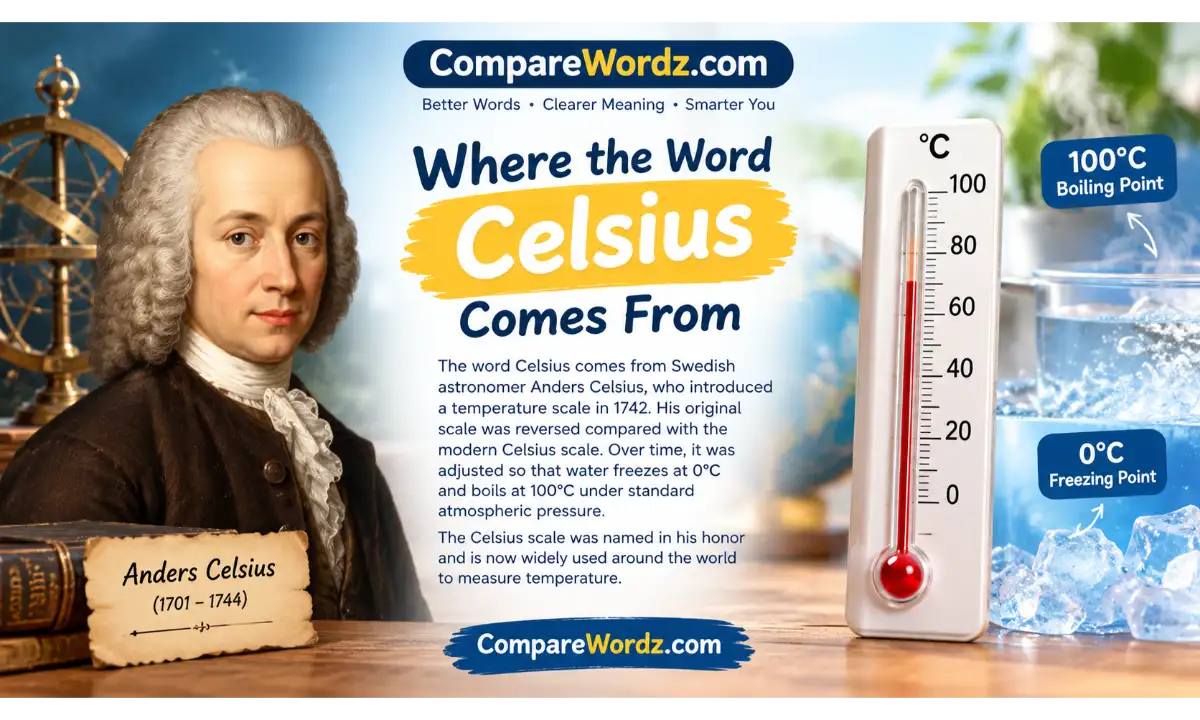
Anders Celsius (1701–1744) was an astronomer at Uppsala University in Sweden. He proposed a temperature scale in the 1740s based on the freezing and boiling points of water. His first version was upside down, with 0 for boiling and 100 for freezing. It was flipped soon after, and that’s the scale we use today.
For a long time, many people called it the “centigrade” scale. In 1948, the international body that sets measurement standards officially adopted the name “degree Celsius.” You can read more in the Encyclopaedia Britannica entry on Anders Celsius and in NIST’s SI units guidance.
Why People Write “Celcius”
Say the word out loud: SEL-see-us. The middle sound is “see.” In English, that sound is often spelled with a “c,” as in cell, celery, and cycle. So your brain offers “Celcius” as a reasonable guess.
There’s a second reason. Most of us learn this word by hearing it, in weather reports and science class, not by reading it slowly. When you only hear a word, the spelling is a guess.
Slips like this happen with all kinds of words. If you’ve ever wondered whether to write misspell or mispell, you’ve run into the same problem. The word for getting spelling wrong is itself easy to get wrong.
How to Remember the Spelling

Break it into three small pieces: Cel – si – us.
Then picture the Swedish scientist. The S sits right where you’re tempted to put a C. If you can see that S, the rest follows.
How to Write Celsius Correctly
Getting the spelling right is step one. Here’s how the unit looks in a sentence.
| Form | Example | When to use it |
|---|---|---|
| Full unit name | 30 degrees Celsius | Formal writing, first mention |
| Short form, no space | 30°C | Most US websites and news |
| Short form, with space | 30 °C | SI style, science and technical writing |
Both short forms are fine. Pick one and stay consistent within a piece of writing.
Celsius vs. Fahrenheit: Quick Conversions
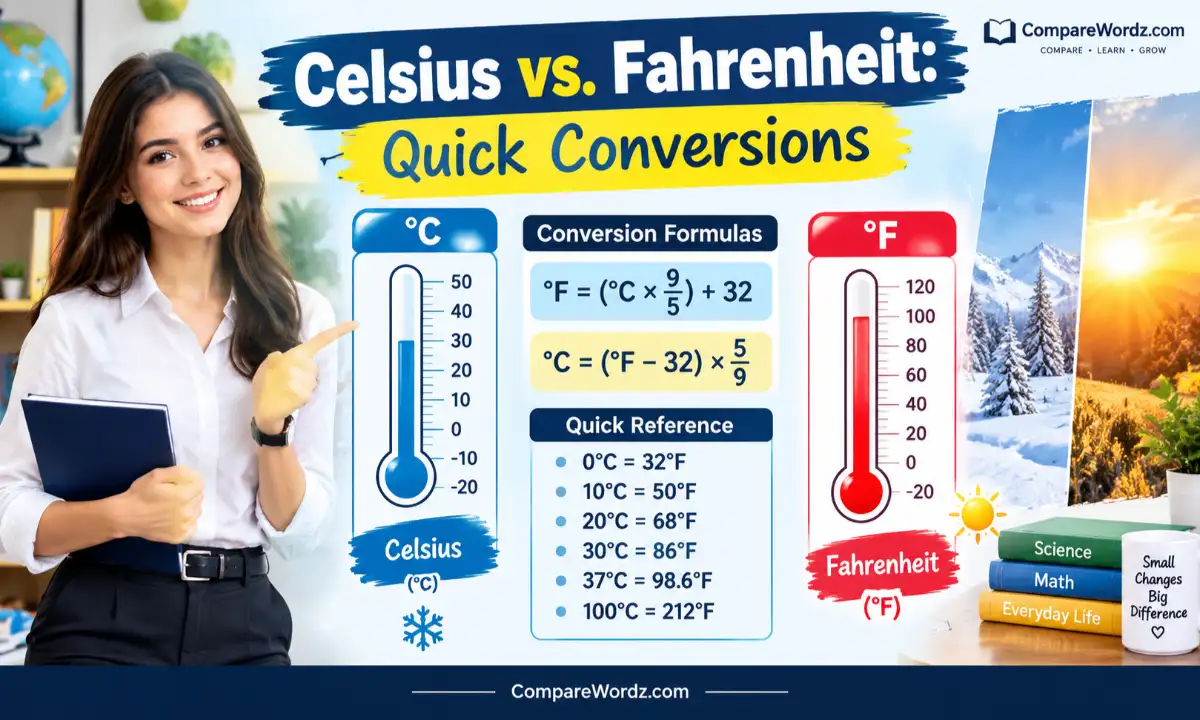
In the United States, you’ll see Fahrenheit on weather apps and home thermostats. Celsius is the standard in science, medicine, and most other countries.
| Celsius | Fahrenheit | What it feels like |
|---|---|---|
| 0°C | 32°F | Water freezes |
| 10°C | 50°F | Cool jacket weather |
| 20°C | 68°F | Comfortable room |
| 25°C | 77°F | Warm day |
| 37°C | 98.6°F | Typical body temperature |
| 100°C | 212°F | Water boils (at sea level) |
To convert Celsius to Fahrenheit, multiply by 9, divide by 5, and add 32. To go the other way, subtract 32, multiply by 5, and divide by 9.
Common Mistakes (and Why They Happen) Celsius vs Celcius:
1. Writing “Celcius.”
Right: Celsius. People swap the S for a C because the middle of the word sounds like “see.”
2. Writing “celsius” in lowercase.
Right: Celsius. It’s a person’s name, so it keeps the capital letter. People forget because words like “meter” are lowercase. The word “degree” stays lowercase.
3. Saying “Celsius degrees.”
Right: degrees Celsius. English usually puts the unit word first, as in “degrees Fahrenheit.”
4. Writing “°K” for Kelvin.
Right: K. Kelvin is written without the degree sign. People add it because they’re copying °C and °F.
5. Flipping the symbol to “C°.”
Right: °C. The degree sign goes first, then the letter. The reversed version shows up in casual typing, probably because we say “C” before “degrees.”
Real-Life Examples Celsius vs Celcius:
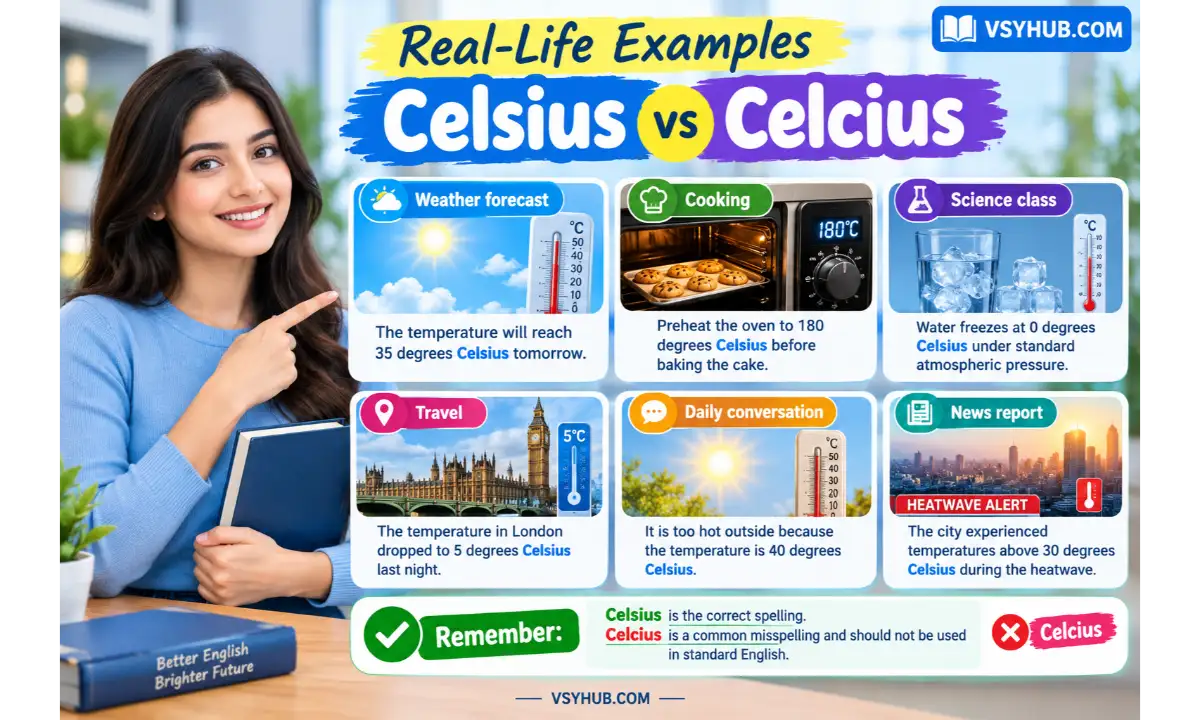
- Cooking: A recipe from a UK or Australian blog says “bake at 200°C.” That’s about 392°F, and most people round to 400°F. Those recipes often list liquids by volume too. If that word ever trips you up, see volume or volumn.
- Travel: A forecast says “high of 30 degrees Celsius.” That’s 86°F, so pack light clothes.
- School: A science worksheet asks, “At what temperature does water boil in degrees Celsius?” The answer is 100.
- Social media: A caption like “It’s 3°C and I regret leaving my coat” reads naturally. Note the degree sign before the C.
Expert Tips Celsius vs Celcius: Amazing 5 Key Differences Explained
- Give both units for a US audience. Writing “180°C (356°F)” saves readers from doing math or searching.
- Use the rough mental shortcut. Double the Celsius number and add 30. For 20°C, you get 70°F, close to the real 68°F. It gets less accurate in extreme heat or cold.
- Check your device’s unit setting. Many oven apps, car dashboards, and smart thermostats switch between °C and °F. If a number looks strange, check the setting first.
- Spell it out once, then shorten. In an article or report, write “degrees Celsius” the first time, then use °C after that. If you also write about thermometers and other measuring tools, the instrument word has its own trap: see gauge or gage.
Celsius vs Celcius: Amazing 5 Key Differences Explained
Understanding Celsius vs Celcius: Amazing 5 Key Differences Explained can help you avoid a common spelling mistake in English. Although these two words look almost identical, only one is correct. Let’s explore the five key differences to make the distinction clear.
. Correct Spelling
Celsius is the correct spelling used in English, while Celcius is a common misspelling.
. Meaning
Celsius refers to a temperature scale in which water freezes at 0°C and boils at 100°C under standard atmospheric pressure. Celcius has no separate recognized meaning in standard English.
. Pronunciation
Both spellings are often intended to sound the same, but the correct word is spelled Celsius.
. Usage
Celsius is widely used in weather forecasts, scientific measurements, classrooms, and everyday conversations. Celcius should be avoided in formal and academic writing.
. Memory Trick
Remember that Celsius contains an “S,” just like “Science.” This simple trick can help you recall the correct spelling whenever you write about temperature.
In short, when comparing Celsius vs Celcius: Amazing 5 Key Differences Explained, remember that Celsius is always the correct choice for the temperature scale.
Related Questions
Is centigrade the same as Celsius?
Yes, they describe the same scale. “Celsius” became the official name in 1948, and it’s the one to use today.
What’s the difference between Celsius and Kelvin?
One degree is the same size on both. Kelvin starts at absolute zero, so you add 273.15 to a Celsius number to get Kelvin.
Why does the US still use Fahrenheit?
Mostly habit and cost. The Metric Conversion Act of 1975 made metric use voluntary in the US, and everyday life never fully switched.
Frequently Asked Questions
Is it celsius or celcius?
It’s Celsius. “Celcius” is a misspelling of the Swedish scientist’s name.
How do you pronounce Celsius?
Say it as “SEL-see-us,” with the stress on the first syllable.
What is 20 Celsius in Fahrenheit?
20°C equals 68°F.
Is it Celcius or Celsius on a thermometer?
It’s Celsius. Whether a thermometer shows °C, °F, or both, the Celsius scale is always spelled with an S.
Final Verdict
The correct spelling is Celsius, never “Celcius.” It’s named after Anders Celsius, a Swedish astronomer. Remember: Celsius has an S, like Sweden. Write “degrees Celsius” in full, and use °C for the short form.
Conclusion
Next time you’re typing a temperature and hesitate over celsius or celcius, picture Sweden and the S will appear. The mistake is easy to make and easy to fix.
If you write for readers in the US, add the Fahrenheit number in brackets. It’s a small habit that makes your writing clearer, and it takes about two seconds.
Body temperature information here is general and not medical advice. For health questions, check with a doctor or an official health source.

Hi, I’m Toseef Mustafa, the creator of CompareWordz.com and a qualified English linguistics professional. My expertise includes English vocabulary, spelling, grammar, word meanings, and commonly confused words. I aim to explain language differences through clear explanations, accurate information, and practical examples. My goal is to help readers understand English better and use the right words with confidence.