

You’ve typed a sentence about your grandparents and their grandkids, and now one word
looks wrong. Is it descendants or descendents? You type it both ways and stare at the screen.
Spell checkers don’t always help, because both can look plausible.
Stay with it for a minute. This one has a clear answer, and you’ll also see where the other
spelling comes from.
Quick Answer
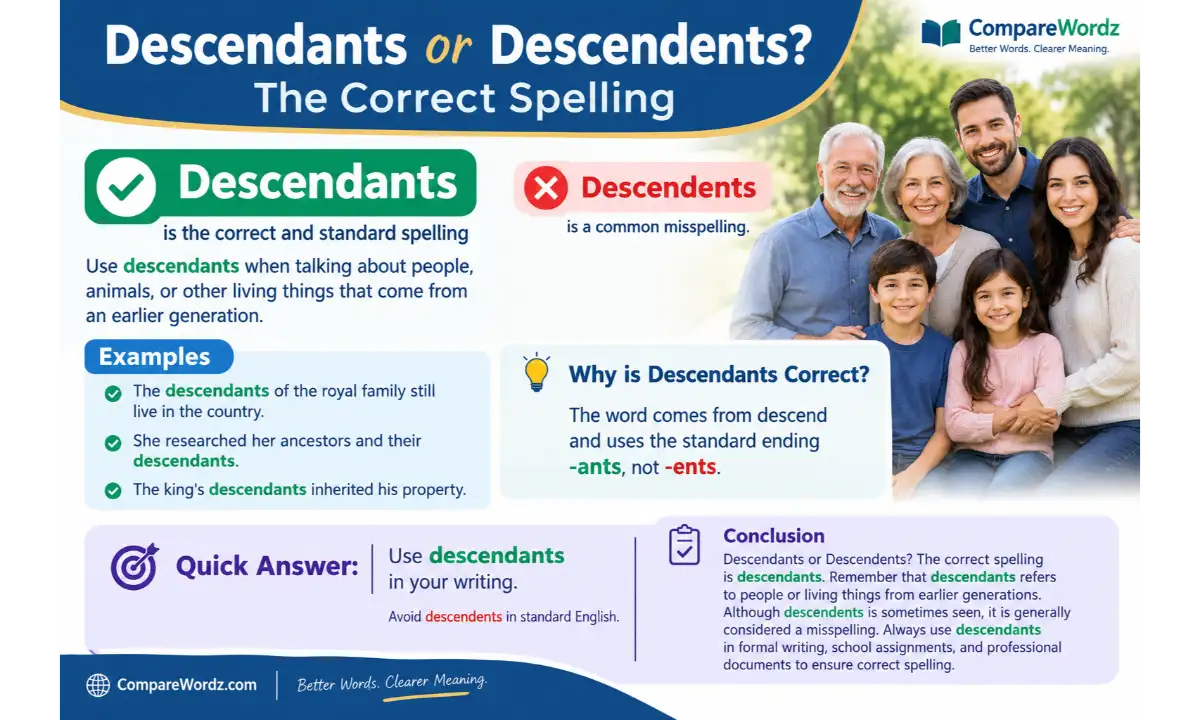
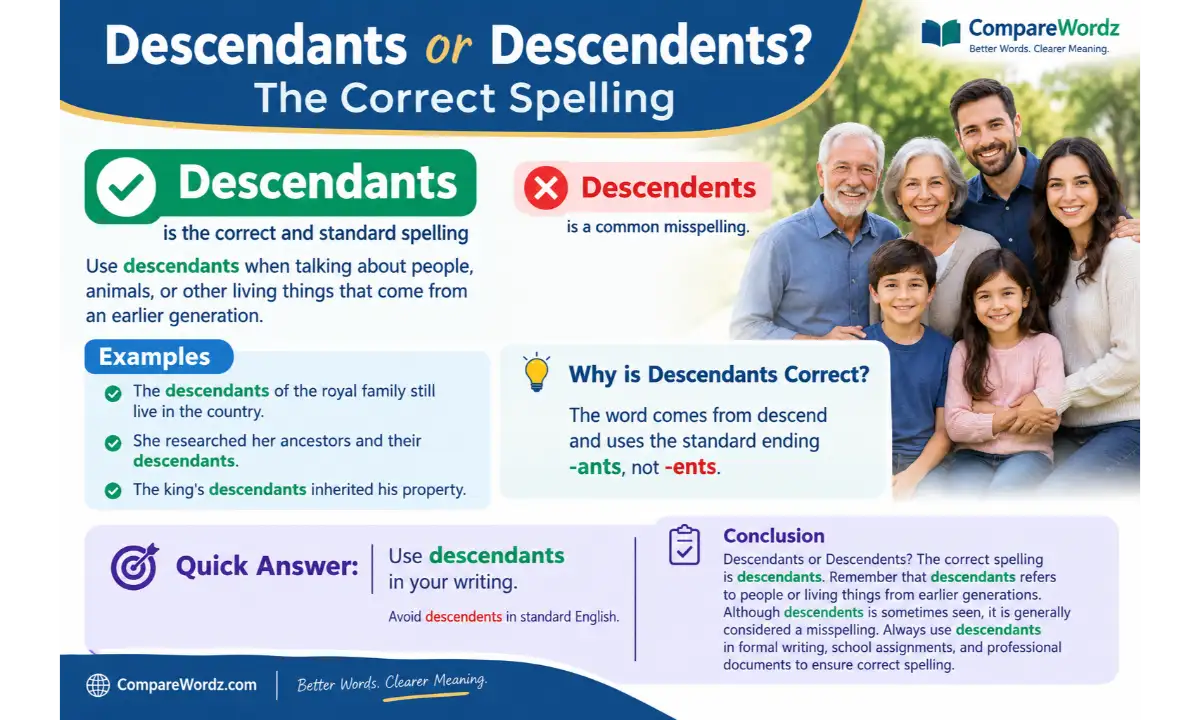
The correct spelling is descendants, with -ant. When you’re choosing between descendants
or descendents, go with -ant. “Descendents” shows up as a rare variant, but it’s not the form
most editors and teachers expect.
Rule: the noun ends in -ant.
- She’s a descendant of early settlers.
- Their descendants still live in the same town.
- The museum invited the founder’s descendants to the opening.
What Does “Descendant” Mean?
A descendant is a person who comes from a particular ancestor or family line. Your children, grandchildren, and great-grandchildren are all your descendants, even the ones you’ll never meet.
The word works beyond people, too. Dogs are descendants of wolves in the usual scientific view, and Spanish, French, and Italian are descendants of Latin. In computer science, a descendant is a node that sits below another node in a tree. It can act as an adjective, but you’ll almost always see it as a noun.
Descendant Meaning in a Family
In family terms, a descendant is anyone in the line that comes after you: your children, then their children, and so on down the generations.
Some people expect the word to cover more than it does. Your spouse isn’t your descendant, because they joined the family by marriage. Your siblings, nieces, and nephews aren’t either, because they come from your parents or siblings, not from you. Adopted children are usually treated as a parent’s children, but inheritance rules vary by place, so check the actual document for anything legal.
Genealogists often say direct descendant for someone connected through an unbroken line of parents and children. Cousins are relatives, but they aren’t direct descendants of the same person.
Is It Descendants or Descendents? What Dictionaries Say
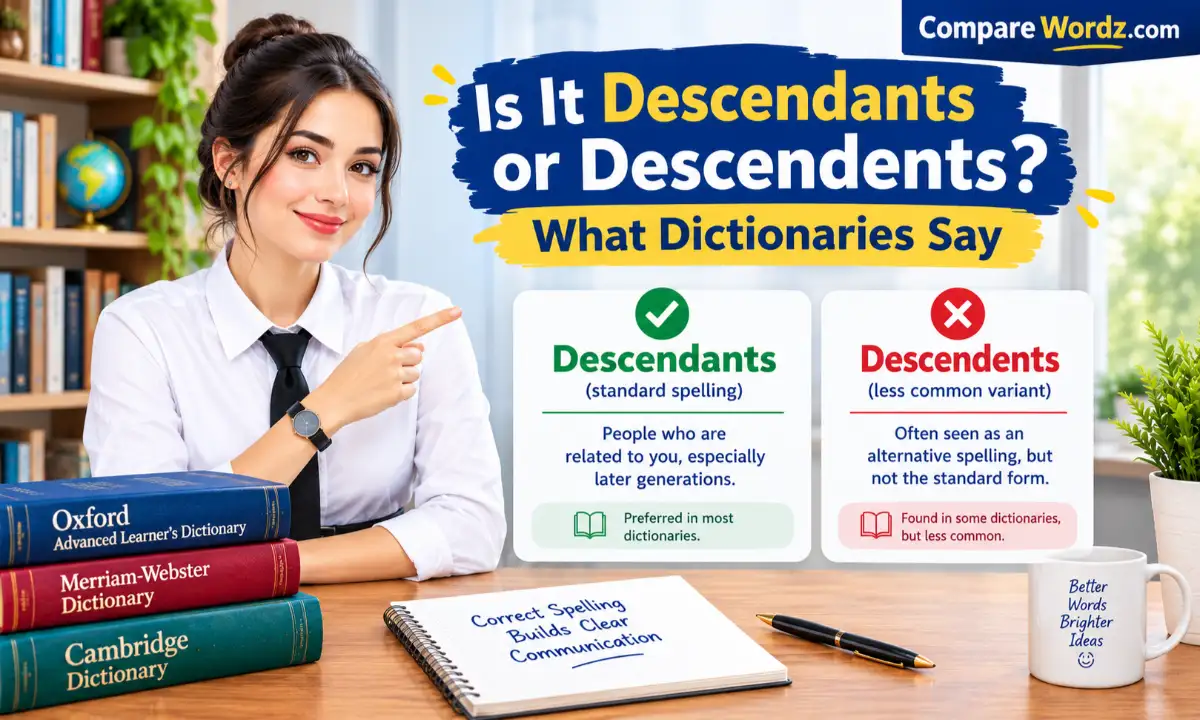
Major dictionaries, including Merriam-Webster and Cambridge, treat descendant as the main spelling. Some dictionaries also record descendent as a variant, so you may spot it in older books or casual writing.
A recorded variant isn’t a recommended one. It only shows the spelling has been used. If you write “descendants,” nobody will question it. If you write “descendents,” a careful editor might change it.
I’d still open one of those dictionary pages and check it yourself. Entries get updated, and your teacher, publisher, or style guide may have its own preference.
How to Pronounce Descendant
Say it as dih-SEN-dunt. In IPA, that’s /dɪˈsɛndənt/. The stress falls on the middle syllable.
This is the real source of the mix-up. The last syllable is a weak “uh” sound, so -ant and -ent sound the same. Your ear can’t help you here, which is why so many people guess.
Why People Mix Up -ant and -ent
English borrowed words from Latin and French, and the two languages don’t always agree. The Latin root of descend would point toward -ent. But the word we use came in largely through French, which uses -ant.
There’s no neat rule to rescue you. Resident, president, and student take -ent, while defendant, assistant, and tenant take -ant. For words like these, memorize the spelling instead of relying on a pattern.
There’s also a US and UK wrinkle with a nearby word. British English often uses dependant for the noun and dependent for the adjective, while American English usually uses dependent for both. Descendant has no such split.
Descendant vs. Ancestor
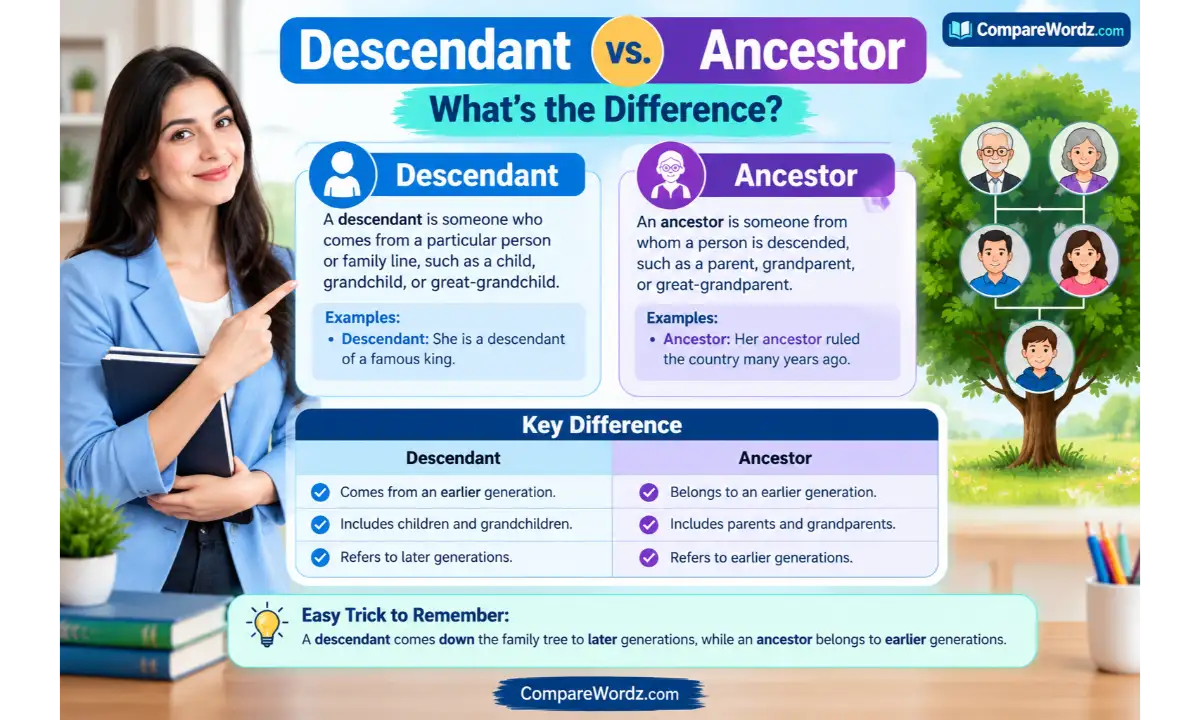
A descendant comes after you in the family line, and an ancestor comes before you. Picture a family tree: ancestors are the roots and trunk, and descendants are the branches.
Two more words get tangled in here. Offspring means a person’s or animal’s children, usually just the next generation. Heir means someone who inherits property or a title, and an heir isn’t always a descendant. A niece can inherit a house without being a descendant of the owner.
Synonyms for Descendants
The closest everyday synonym is offspring, though it usually means children only. Progeny is a formal word that covers all descendants. Posterity means all future generations as a group, and lineage refers to the line of descent itself rather than the people in it. Scion points to a single descendant, often of a well-known family, and issue is a legal term you’ll see in wills.
For normal writing, “descendants” or “offspring” is the safest choice. Keep “progeny” and “issue” for formal or legal settings.
Antonym of Descendants
The clearest opposite is ancestors. You can also use forebears, forefathers, or progenitors. Predecessor works too, but it’s looser, since it also covers someone who held a job before you.
Descendant in Astrology
If you got here from a birth chart, the spelling is the same: Descendant, with -ant. In astrology, it’s the point opposite the Ascendant (your rising sign). It marks the start of the seventh house, which astrologers connect with partnerships and close one-on-one relationships.
Astrology isn’t backed by scientific evidence, so treat it as a personal or cultural tradition. You may see “descendent” on astrology sites, but it’s the same nonstandard spelling.
“Descended From” or “Descendant Of”?
Many spelling guides skip this, but it trips people up. The two phrases are different parts of speech, so they take different prepositions.
“He’s descended from Vikings” uses the verb. “He’s a descendant of Vikings” uses the noun. Writing “a descendant from Vikings” sounds natural because “from” carries over from the verb form, but it’s not standard.
Plural and Possessive
Add an s for the plural: descendants. Add ‘s for one owner: the descendant’s story. Add an apostrophe after the s for several owners: the descendants’ stories.
An apostrophe never makes a plural. “The descendant’s gathered at the church” is wrong. You want “The descendants gathered at the church.”
Common Mistakes
Writing “descendents.” This is the big one. People type it because the ending sounds identical to -ant, and the spelling looks fine at a glance. Fix: Her descendants moved to Texas.
Dropping the first “s.” “Decendants” is a very common typo, probably because the “sc” in descend feels like extra letters. The word starts with de-s-c-e-n-d, the same as the verb.
Putting an apostrophe in the plural. Writers see a word ending in s and reach for ‘s by habit. It should be “the founder’s descendants,” not “descendant’s.”
Mixing up descendant and decedent. Decedent is a legal term for a person who has died. It looks close, but it means something very different. If you mean the people who inherited the farm, you want descendants.
Calling in-laws descendants. “His wife is a descendant of the family” is a mistake, because she married into it. Their children are his descendants.
Real-Life Examples
Seeing the word in context helps it stick. Here are a few that match everyday writing:
- School: “The class traced the town’s first mayor to his living descendants.”
- Family post: “I just learned I’m a descendant of a ship’s carpenter, which explains a lot about my garage.”
- Work email: “The historical society will host a dinner for descendants of the founding families.”
- Social media: “Four generations, one table. All of Grandma Rosa’s descendants showed up.”
Expert Tips
Search your draft before you publish. Use Find to look for “descendent” and “decendant.” Spelling pairs like these slip past tired eyes, and this takes about ten seconds.
Quote old records exactly. Historical documents often spell words differently from today. If you’re quoting a letter or ship record, keep the original and add [sic] to show it isn’t your error.
Don’t claim a famous ancestor without proof. Genealogy readers check. If you can’t prove the line, write “family stories say” instead.
Be careful with legal wording. If you’re writing about wills or inheritance, the exact words in the document matter. This is general information, not legal advice, so ask a licensed attorney about a real case.
If you like word pairs like this, our guide on congratulations or congradulations covers another common one.
Related Questions
Is “descendant” a noun or an adjective? Mostly a noun. The adjective use exists but is rare in everyday writing.
Can a language or idea have descendants? Yes. Spanish is a descendant of Latin, and a modern design can descend from an older one.
Is a stepchild a descendant? In everyday speech, people often say yes, but legal rules differ by place. Check the wording of any legal document.
Frequently Asked Questions
Is it descendants or descendents?
Descendants is correct. Descendents is a rare variant that most writers should avoid.
Is “descendent” ever correct?
Some dictionaries list it as a variant, mainly for the adjective. “Descendant” is safer everywhere.
Are grandchildren descendants?
Yes. Children, grandchildren, and every generation after them count.
Is the spelling different in British and American English?
No. Both use “descendant” with -ant.
What is the plural of descendant?
Add an s: descendants, with no apostrophe.
Final Verdict
The answer is descendants, with -ant. Descendents is a rare variant you can skip. Here’s a memory trick: picture ants marching down the branches of a family tree. Ants go down the tree, and so do descendants.
Conclusion
Descendants or descendents feels like a coin toss until you know the answer, and then it’s easy. Use -ant, keep apostrophes out of the plural, and say the word aloud if you need a pause to think. Whether you’re writing a school essay, a family story, or reading your birth chart, the spelling doesn’t change. Before you publish, give your draft one quick search and you’re done.

Hi, I’m Toseef Mustafa, the creator of CompareWordz.com and a qualified English linguistics professional. My expertise includes English vocabulary, spelling, grammar, word meanings, and commonly confused words. I aim to explain language differences through clear explanations, accurate information, and practical examples. My goal is to help readers understand English better and use the right words with confidence.