


Have you ever wanted to praise someone but felt unsure whether to write complimented or complemented?
These two words sound exactly alike, yet their meanings are different. Choosing the wrong spelling can change the message you want to share.
This confusion is common among English learners, students, and even experienced writers.
You may encounter these words in school assignments, workplace emails, fashion articles, social media posts, and everyday conversations.
People often search for their meanings, correct spelling, pronunciation, grammar rules, and sentence examples.
The good news is that remembering one simple rule makes the difference easy. In this guide, you’ll learn how to use both words correctly and avoid common mistakes.
Quick Answer: Complimented vs. Complemented
Both spellings are correct English words, but they have different meanings.
- Complimented: Praised someone or said something nice about them.
- Complemented: Improved, matched, or completed something by adding another useful or suitable thing.
Examples:
- My teacher complimented my handwriting.
- Her blue shoes complemented her white dress.
- Everyone complimented Sarah on her presentation.
- The sauce complemented the grilled chicken.
- My manager complimented me on my hard work.
Simple Rule:
- Compliment = Praise.
- Complement = Complete or improve.
Use complimented when someone expresses admiration. Use complemented when two things work well together or one improves another.
What Do Complimented and Complemented Mean?
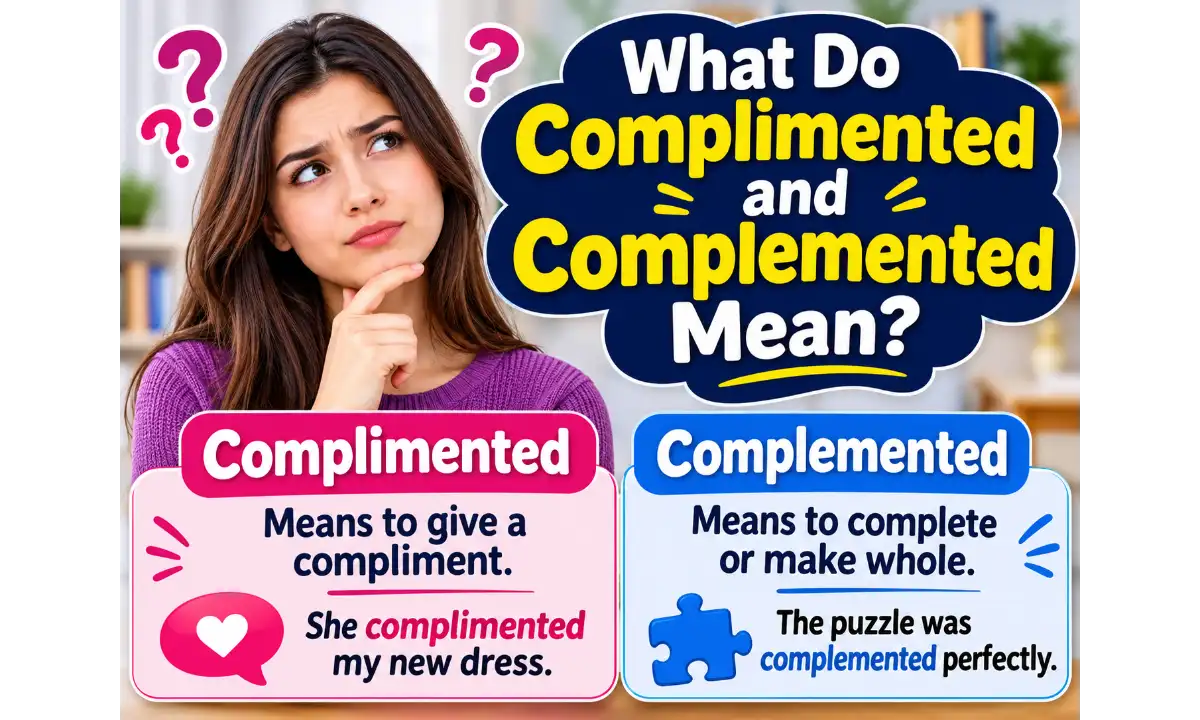
Understanding each word separately makes it easier to recognize the correct spelling in a sentence.
What Does Complimented Mean?
Complimented is the past tense and past participle of the verb compliment. It means praising someone or expressing admiration for their appearance, skills, behavior, or achievements.
A compliment is usually a positive remark that makes someone feel appreciated.
For example, imagine wearing a new outfit to work. Your colleague says it looks beautiful. Your colleague has complimented you.
Examples of Complimented:
- My friends complimented my new hairstyle.
- The teacher complimented Sarah on her excellent writing.
- Customers complimented the restaurant’s friendly staff.
- My parents complimented me on my exam results.
- The manager complimented the team for completing the project.
Common synonyms:
- Praised.
- Admired.
- Commended.
- Appreciated.
- Congratulated.
Opposites:
- Criticized.
- Insulted.
- Disapproved.
- Condemned.
What Does Complemented Mean?
Complemented is the past tense and past participle of the verb complement. It means improving, enhancing, matching, or completing something by adding another thing that works well with it.
This word commonly describes clothing, colors, food, music, skills, personalities, and ideas.
For example, a silver necklace may look beautiful with a black dress. The necklace complemented the dress.
Examples of Complemented:
- Her blue jacket complemented her white shirt.
- The fresh salad complemented the main dish.
- His experience complemented her technical skills.
- The curtains complemented the room’s furniture.
- Her calm personality complemented his energetic nature.
Common synonyms:
- Enhanced.
- Improved.
- Completed.
- Matched.
- Balanced.
Opposites:
- Clashed.
- Conflicted.
- Contradicted.
- Disrupted.
The Origin of Complimented and Complemented
These words have similar historical roots, but their meanings developed differently over time.
Origin of Compliment
The word compliment entered English during the 16th century through French and Italian. Its earlier meaning was connected with politeness, respect, and expressions of courtesy.
Over time, it developed its familiar modern meaning: expressing admiration or saying something positive about another person.
Today, people use compliments to show appreciation in personal and professional situations.
Origin of Complement
The word complement developed through Old French from the Latin word complementum, meaning something that completes or fills up.
Its modern meaning relates to something that completes, improves, or enhances another thing.
Although the words share historical connections, their present-day meanings are different.
For further reading, see Etymonline’s explanation of compliment and Etymonline’s explanation of complement.
How To Pronounce Complimented and Complemented
One reason people confuse these words is their pronunciation. Both have the same standard pronunciation.
Pronunciation: KOM-pluh-men-tid.
| Word | Easy Pronunciation | Syllables |
|---|---|---|
| Complimented | KOM-pluh-men-tid | 4 |
| Complemented | KOM-pluh-men-tid | 4 |
Pronunciation Breakdown
- Kom: Start with a clear K sound.
- Pluh: Pronounce this part quickly.
- Men: Give this syllable a light sound.
- Tid: Finish with the ending sound.
Easy speaking trick: Say both words aloud. You will notice that they sound alike, even though their meanings are different.
Never choose the spelling based only on pronunciation. Always consider the meaning of your sentence.
British English vs. American English Usage
Both words have the same spelling and basic meanings in British and American English.
There may be slight differences in accent, but the grammar and spelling rules remain the same.
| Feature | British English | American English | Notes |
|---|---|---|---|
| Complimented | Correct | Correct | Means praised |
| Complemented | Correct | Correct | Means improved or matched |
| Spelling | Same | Same | No spelling variation |
| Grammar | Same | Same | Past tense verb |
| Pronunciation | Accent variation | Accent variation | Same basic pronunciation |
| Professional usage | Common | Common | Both are appropriate |
English speakers in the UK, US, Canada, Australia, India, and Pakistan use these words with the same basic meanings.
Which One Should You Use?
The correct choice depends on what you want to express. Neither spelling is better than the other. Both are correct, but they cannot replace each other.
Use Complimented When Talking About Praise
Choose complimented when someone expresses admiration or says something positive.
Examples:
- Informal: My friend complimented my new haircut.
- Academic: The professor complimented the student’s research.
- Workplace: My supervisor complimented my performance.
- Email: The client complimented our team’s presentation.
- Social media: Everyone complimented her beautiful photographs.
Use Complemented When Talking About Matching or Improving
Choose complemented when something matches, supports, or improves another thing.
Examples:
- Clothing: Her handbag complemented her evening dress.
- Food: The sauce complemented the grilled chicken.
- Business: His marketing skills complemented her sales experience.
- Education: The practical lesson complemented the textbook.
- Design: The background color complemented the website’s layout.
Quick Usage Table
| Situation | Correct Word | Example |
|---|---|---|
| Someone praises you | Complimented | She complimented my work. |
| Two colors look good together | Complemented | Blue complemented white. |
| A manager appreciates an employee | Complimented | He complimented his team. |
| Two skills work well together | Complemented | Their skills complemented each other. |
Common Mistakes With Complimented and Complemented
Even experienced English writers sometimes confuse these words. Here are seven common mistakes and their corrections.
Using Complemented for Praise
❌ Incorrect: She complemented my new hairstyle.
✅ Correct: She complimented my new hairstyle.
Explanation: The sentence describes someone praising your appearance. Therefore, complimented is correct.
Memory tip: Praise always connects with compliment.
Using Complimented for Matching Colors
❌ Incorrect: The blue curtains complimented the white walls.
✅ Correct: The blue curtains complemented the white walls.
Explanation: The curtains and walls look attractive together. They improve the room’s appearance.
Memory tip: Think of complementary colors when describing matching colors.
Confusing Compliment With Complement
❌ Incorrect: I gave him a complement about his presentation.
✅ Correct: I gave him a compliment about his presentation.
Explanation: A compliment is praise or a kind remark. A complement is something that completes or improves another thing.
Memory tip: You give someone a compliment to show appreciation.
Thinking One Spelling Is Always Wrong
❌ Incorrect idea: Complemented is a spelling mistake.
✅ Correct explanation: Both spellings are correct English words.
Explanation: Their meanings are different. You must select the word that matches your sentence.
Memory tip: Never judge either spelling without checking its meaning.
Using Complimented Instead of Complemented in Design
❌ Incorrect: The font complimented the website’s design.
✅ Correct: The font complemented the website’s design.
Explanation: The font improves the website’s overall appearance.
Memory tip: Design elements complement each other.
Confusing Complimentary With Complementary
❌ Incorrect: The two colors are complimentary.
✅ Correct: The two colors are complementary.
Explanation: Complimentary usually means free of charge or expressing praise. Complementary describes things that work well together.
Memory tip: Complimentary coffee is free. Complementary colors work well together.
Choosing a Word Based Only on Sound
❌ Incorrect approach: Both words sound the same, so either spelling works.
✅ Correct approach: Choose the spelling according to the intended meaning.
Explanation: Pronunciation cannot tell you which spelling to use. Context provides the answer.
Memory tip: Understand the sentence before choosing the word.
Complimented and Complemented in Everyday Examples
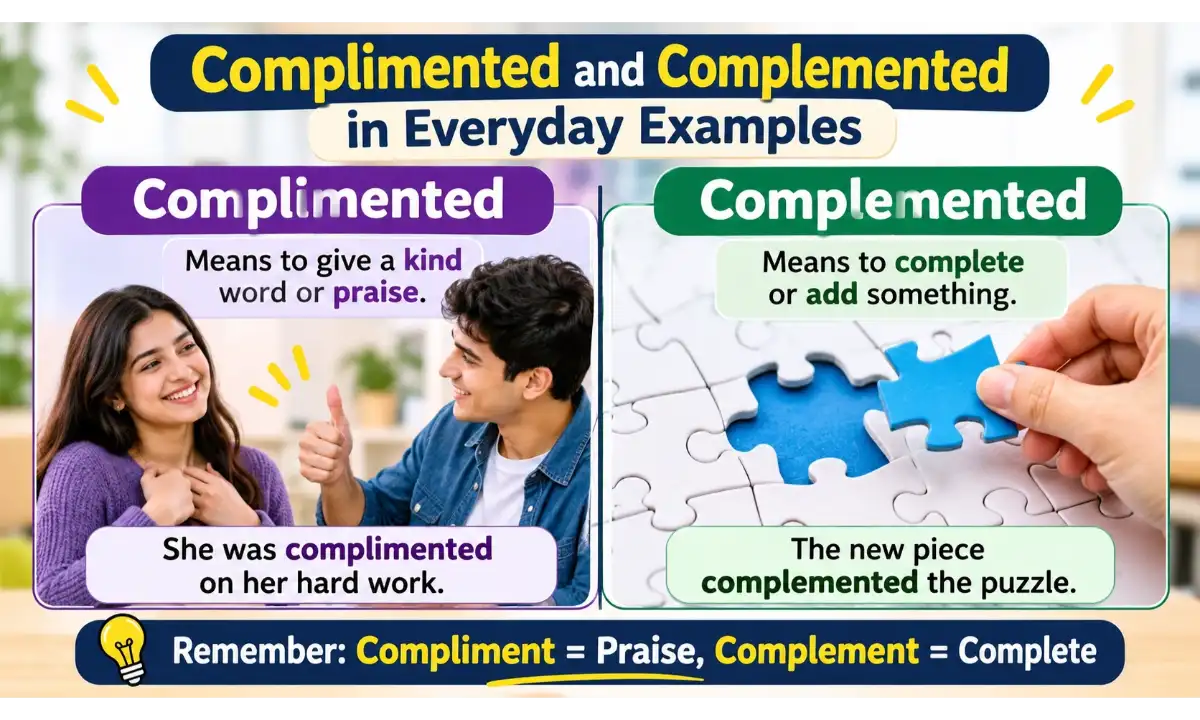
Real-life examples make the difference easier to understand. Here are natural sentences from common situations.
Workplace Examples
- My manager complimented my excellent customer service.
- Her communication skills complemented his leadership abilities.
- The director complimented the team for completing the project early.
School and Education Examples
- The English teacher complimented my writing skills.
- The practical experiment complemented the science lesson.
- My classmates complimented my presentation.
Social Media Examples
- Everyone complimented her new Instagram profile picture.
- The background music complemented the video perfectly.
- My followers complimented the design of my latest post.
Daily Life Examples
- My mother complimented my cooking.
- The new sofa complemented our living room.
- My neighbor complimented my garden.
Email Examples
- Thank you for your feedback. My supervisor complimented the report.
- The attached charts complemented the written explanation.
- I appreciate your kind words about my work.
Text Message Examples
- You look amazing! Everyone complimented your outfit.
- That jacket really complemented your shoes.
- My teacher complimented me today!
Online Content Examples
- The editor complimented the writer’s clear explanation.
- The images complemented the article’s main points.
- The colors complemented the website’s overall design.
How These Words Work in Different Contexts
The meaning stays the same, but the situations where people use these words can change.
In Relationships
People use compliments to express love, respect, and appreciation. Complement describes two personalities or qualities that work well together.
Examples:
- He complimented his partner’s kindness.
- Their different personalities complemented each other.
In Business and Marketing
Businesses use compliments to recognize good work. They also use complement when describing products or services that work well together.
Examples:
- The client complimented our customer support.
- The new service complemented the company’s existing products.
In Fashion and Design
Fashion writers often use complement to describe clothing, accessories, and colors that look good together.
Examples:
- Her handbag complemented her evening dress.
- The shoes complemented the outfit perfectly.
In Food and Cooking
Complement is useful when describing flavors that work well together.
Examples:
- Fresh herbs complemented the soup.
- The sweet sauce complemented the spicy chicken.
In Education and Writing
Complimented describes praise from teachers or classmates. Complemented describes materials or ideas that support each other.
Examples:
- My teacher complimented my grammar.
- The examples complemented the lesson.
Compliment, Complement, Complimentary, and Complementary
These four words are closely related in spelling, but their meanings are different. Understanding all four will help you avoid more English writing mistakes.
| Word | Meaning | Example |
|---|---|---|
| Compliment | Praise or admiration | She gave me a compliment. |
| Complement | Something that completes or improves another thing | The sauce is a perfect complement. |
| Complimentary | Free of charge or expressing praise | The hotel offered complimentary breakfast. |
| Complementary | Working well together or completing each other | They have complementary skills. |
What Does Complimentary Mean?
Complimentary usually means something is provided free of charge. It can also describe words that express praise.
Examples:
- The hotel offers complimentary breakfast.
- The customer received complimentary comments about her work.
What Does Complementary Mean?
Complementary describes things that work well together, match, or improve each other.
Examples:
- Blue and orange are complementary colors.
- Their skills are complementary.
Remember that complimentary and complementary are not interchangeable.
Google Trends and Related Search Behavior
People search for confusing English words because they want to avoid spelling and grammar mistakes.
The main search intent behind this topic is educational. Readers want quick definitions, clear examples, pronunciation help, and an easy way to remember the difference.
Common related searches include:
- Complimented vs complemented meaning.
- Complimented vs complemented examples.
- Complimented vs complemented sentences.
- Complimented vs complemented grammar.
- Difference between compliment and complement.
- Use compliment and complement in a sentence.
- Are compliment and complement pronounced the same?
- Compliment vs complement examples.
- Complimentary vs complementary.
- Complemented meaning in a relationship.
- Complimented meaning in English.
- Complementary colors meaning.
- How to use complimented in a sentence.
- How to spell complemented correctly.
These searches reflect different questions within the same topic. Some readers want a definition, while others need help choosing the correct spelling in a particular sentence.
Google Trends shows relative search interest rather than exact monthly search volumes. Its scores are normalized from 0 to 100 for the selected location and period.
You can compare the two terms using Google Trends.
Complimented vs. Complemented: Detailed Comparison Table
Use this table whenever you need a quick reminder of their differences.
| Feature | Complimented | Complemented |
|---|---|---|
| Correct spelling | Yes | Yes |
| Meaning | Praised | Improved or completed |
| Root word | Compliment | Complement |
| Grammar role | Verb | Verb |
| Verb tense | Past tense | Past tense |
| Pronunciation | Same | Same |
| Main purpose | Express admiration | Show how things work together |
| People | Someone praised a person | Personal qualities may work together |
| Clothing | Praised someone’s outfit | Matched an outfit |
| Colors | Someone praised colors | Colors worked well together |
| Food | Praised a dish | Flavors worked well together |
| Professional use | Appreciating work | Combining useful skills |
| Academic use | Praising achievement | Supporting a lesson |
Complimented vs. Complemented in Professional Life
Choosing the correct word matters in professional communication. A small spelling mistake can change the meaning of a sentence.
Workplace Communication
Use complimented when recognizing someone’s performance or achievements.
Use complemented when explaining how different skills, ideas, or services work well together.
Examples:
- The manager complimented the employee’s dedication.
- Her financial knowledge complemented his business experience.
Professional Emails
Both words are useful in formal emails.
Complimented:
The client complimented your presentation and appreciated your research.
Complemented:
The supporting documents complemented the main proposal.
Business Communication
Companies use these words when discussing employees, products, and customer experiences.
Examples:
- The customer complimented our support team.
- The new software complemented our existing system.
Complimented vs. Complemented for Students and Beginners
English learners often struggle with these words because they have identical pronunciations.
However, learning their meanings makes the difference simple.
Here are three ways to improve your understanding:
- Learn word pairs: Remember compliment with praise and complement with complete.
- Practice short sentences: Write one sentence about praise and another about matching.
- Read examples aloud: Notice how the same sound can have different meanings.
You can also improve your spelling knowledge with these related CompareWordz guides:
Simple Trick to Remember the Difference
You do not need complicated grammar rules to remember these words. Just learn these two connections.
Complimented = Praise
Think of the letter I as a reminder of the phrase “I admire you.”
Example: My colleague complimented my presentation.
Complemented = Complete or Enhance
Think of the word complete. Something that complements another thing helps complete or improve it.
Example: Her accessories complemented her outfit.
Think of It This Way
Imagine two situations.
First, someone tells you that your new hairstyle looks beautiful. They complimented you.
Second, you wear a necklace that matches your dress perfectly. The necklace complemented your dress.
The first situation involves praise. The second involves matching.
That is the easiest way to remember the difference.
Expert Tips to Avoid Confusing These Words
Use these practical tips whenever you are unsure which spelling to choose.
- Check the meaning first: Ask whether the sentence describes praise or improvement.
- Replace the word: Try replacing it with praised. If the sentence still makes sense, use complimented.
- Use complete as a clue: If the sentence describes something completing or enhancing another thing, use complemented.
- Read the full sentence: Context often makes the correct spelling obvious.
- Remember the related forms: Complimentary and complementary follow the same meaning difference.
- Proofread professional writing: Check these words carefully in emails, reports, and assignments.
A useful extra tip is to remember that complimentary can also mean free of charge.
For example, a hotel may offer complimentary breakfast. Meanwhile, complementary colors describe colors that work well together.
Related Searches People Also Ask
Here are additional questions readers may ask when learning these words.
What Is the Difference Between Compliment and Complement?
A compliment is praise or admiration. A complement is something that completes or improves another thing.
What Is the Difference Between Complimentary and Complementary?
Complimentary means free of charge or expressing praise. Complementary means matching, supporting, or completing something.
How Do You Use Compliment and Complement in One Sentence?
She complimented my dress because its colors complemented my shoes.
Can a Person Be Complemented?
Yes. A person’s skills, qualities, or personality can complement another person’s qualities.
Is Complimented a Positive Word?
Yes. It usually describes receiving praise or appreciation.
What Does Complemented Mean in Fashion?
It means that clothing, colors, or accessories look good together.
Can Complemented Mean Completed?
Yes. It can mean that something helped complete or improve another thing, depending on the context.
Why Do People Confuse These Words?
They have similar spellings and identical standard pronunciations, but their meanings differ.
Frequently Asked Questions
Is It Complimented or Complemented?
Both are correct. Use complimented for praise and complemented for something that improves or completes another thing.
Are Complimented and Complemented Pronounced the Same?
Yes. Both are pronounced approximately as KOM-pluh-men-tid. Their pronunciation does not reveal their different meanings.
What Does Complimented Mean in Simple English?
It means someone said something nice about you or praised your appearance, work, or behavior.
What Does Complemented Mean in Simple English?
It means something matched, improved, or completed something else.
How Do You Use Complimented in a Sentence?
Example: My teacher complimented me on my excellent English.
It means the teacher praised your English skills.
How Do You Use Complemented in a Sentence?
Example: Her white shoes complemented her blue dress.
It means the shoes looked attractive with the dress.
Is Complimented a Verb or an Adjective?
It is the past tense and past participle of the verb compliment. It describes an action of praising someone.
Is Complemented a Verb or an Adjective?
It is the past tense and past participle of the verb complement. It describes an action of improving or completing something.
What Is the Difference Between Complementary and Complimentary Colors?
Complementary colors are colors that work well together, often because they contrast. Complimentary colors would suggest colors that offer praise, which is generally not the intended meaning.
Can You Use Both Words in One Sentence?
Yes. For example:
My friends complimented my outfit because the colors complemented each other.
Is Complemented More Formal Than Complimented?
No. Both words are suitable for formal and informal writing. Their meanings determine which one you should use.
Which Word Should English Learners Remember First?
Remember compliment first because it means praise. Then connect complement with complete, improve, and match.
Final Verdict: Which Word Is Correct?
Both spellings are correct, but their meanings are different.
- Complimented: Use it when someone praises or appreciates another person.
- Complemented: Use it when something improves, matches, or completes something else.
Neither word is a replacement for the other. Always choose according to the meaning of your sentence.
Conclusion; Complimented vs. Complemented
Understanding the difference between complimented and complemented is easier than it first appears.
Both words sound alike, but their meanings are not the same. One expresses praise, while the other describes things that work well together.
Use complimented when someone appreciates your work, appearance, or achievements. Use complemented when colors, clothing, skills, or ideas improve each other.
Keep one simple rule in mind: People give compliments, while things complement each other.
With this easy trick, you can use both words confidently in school assignments, workplace emails, and everyday conversations.

Hi, I’m Toseef Mustafa, the creator of CompareWordz.com and a qualified English linguistics professional. My expertise includes English vocabulary, spelling, grammar, word meanings, and commonly confused words. I aim to explain language differences through clear explanations, accurate information, and practical examples. My goal is to help readers understand English better and use the right words with confidence.