


Have you ever written a sentence and wondered if you should use where or were? You are not alone. These two English words look almost identical, but they have completely different meanings and grammatical roles.
Choosing the wrong one can change the meaning of your sentence or make it grammatically incorrect.
Understanding where vs were is important for students, English learners, professionals, and anyone who writes emails or messages. One word helps you ask about a place, while the other describes a past action or condition.
This guide explains their meanings, pronunciation, grammar rules, differences, and everyday uses. You will also learn simple tricks to remember the correct word.
Quick Answer: Where vs Were
Where refers to a place, location, position, or situation. Were is the past-tense form of the verb to be, normally used with you, we, they, and plural subjects.
Examples:
- Where: Where do you live?
- Were: We were at home yesterday.
- Where: Do you know where my phone is?
- Were: They were happy with the results.
Both spellings are correct English words. The right choice depends on your sentence.
Meaning of Where
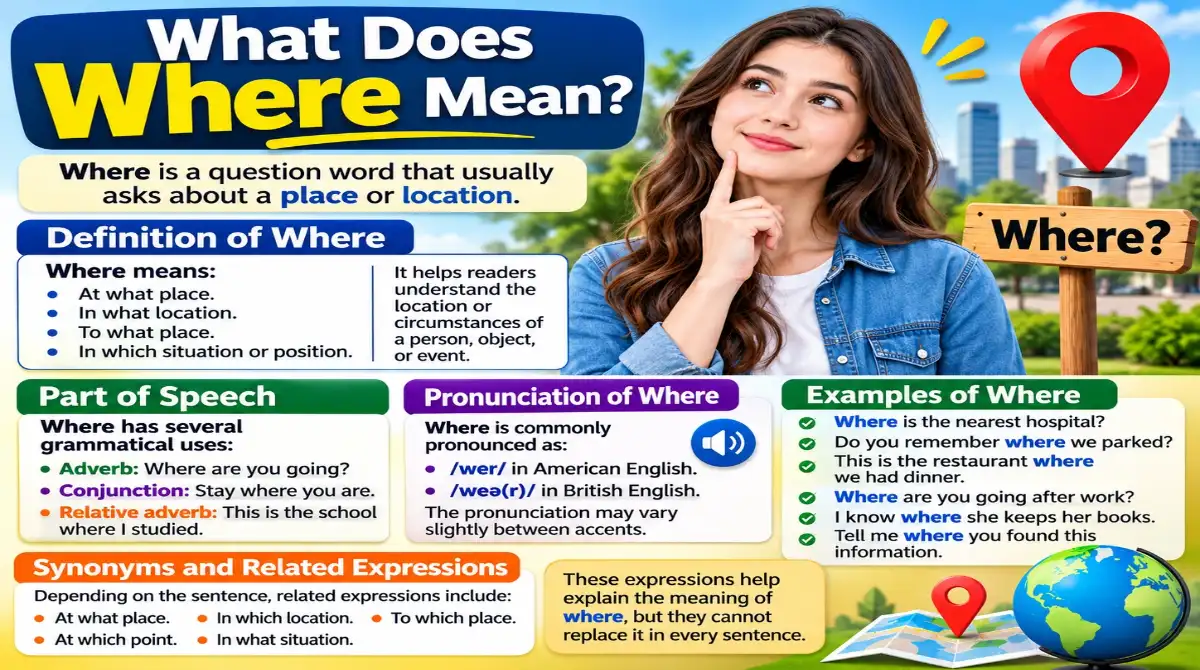
Where is a question word that usually asks about a place or location. It can also connect ideas about places, situations, and positions.
It commonly works as an adverb or conjunction. It can also introduce relative clauses.
Definition of Where
Where means:
- At what place.
- In what location.
- To what place.
- In which situation or position.
It helps readers understand the location or circumstances of a person, object, or event.
Part of Speech
Where has several grammatical uses:
- Adverb: Where are you going?
- Conjunction: Stay where you are.
- Relative adverb: This is the school where I studied.
Pronunciation of Where
Where is commonly pronounced as /wer/ in American English.
In British English, it is commonly pronounced /weə(r)/.
The pronunciation may vary slightly between regional accents.
Examples of Where in Sentences
- Where is the nearest hospital?
- Do you remember where we parked?
- This is the restaurant where we had dinner.
- Where are you going after work?
- I know where she keeps her books.
- Tell me where you found this information.
Synonyms and Related Expressions
Depending on the sentence, related expressions include:
- At what place.
- In which location.
- To which place.
- At which point.
- In what situation.
These expressions help explain the meaning of where, but they cannot replace it in every sentence.
Meaning of Were
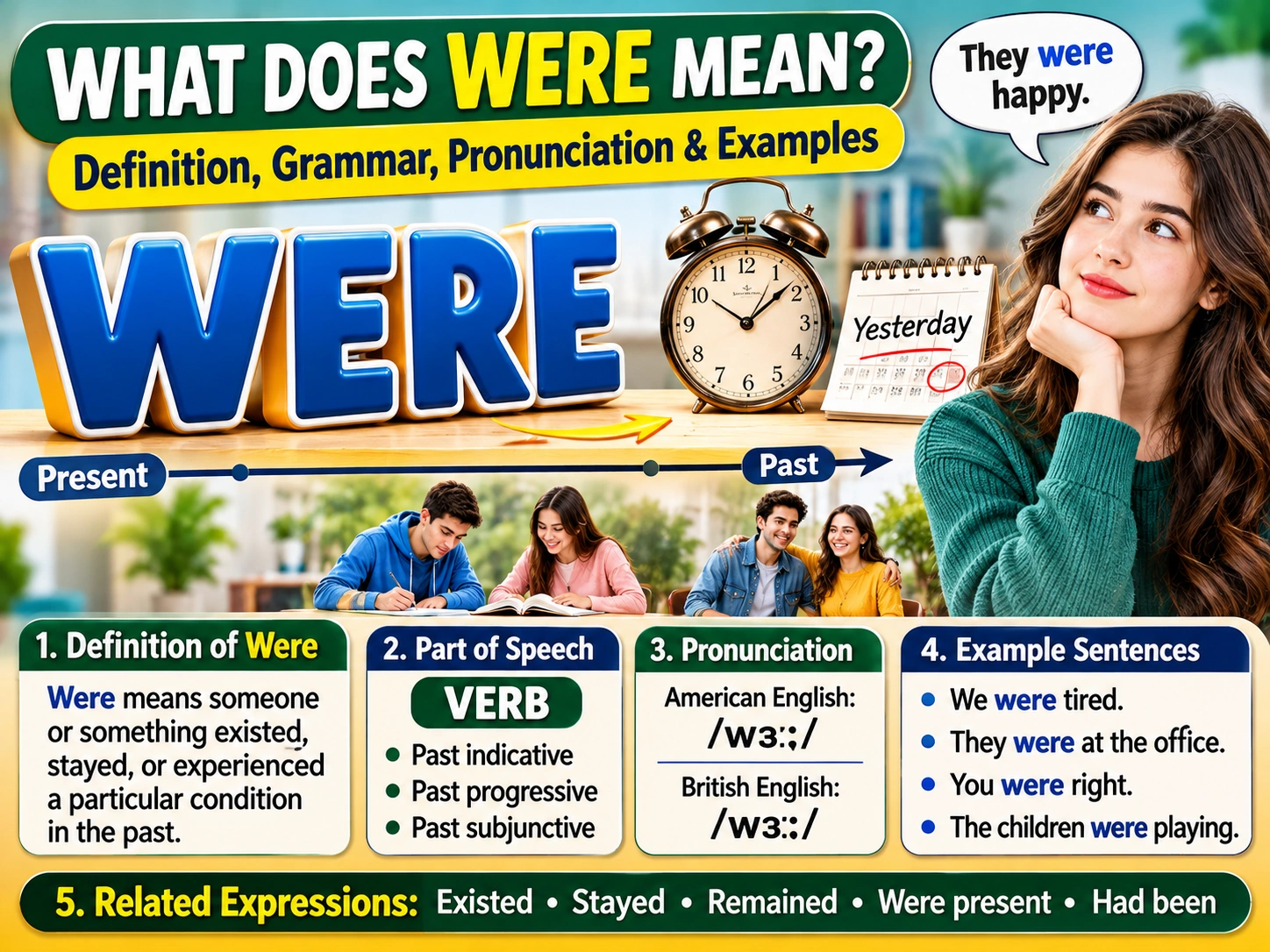
Were is a correct English word and a past-tense form of the irregular verb to be.
It describes a past condition, state, location, or action in progress. It normally appears with you, we, they, and plural nouns.
Definition of Were
Were means that someone or something existed, stayed, or experienced a particular condition in the past.
Examples:
- We were tired after the journey.
- They were at the office yesterday.
- You were right about the answer.
- The children were playing outside.
Part of Speech
Were is a verb.
It is used as:
- Past indicative: They were busy yesterday.
- Past progressive: We were studying English.
- Past subjunctive: If I were you, I would practice daily.
Pronunciation of Were
Were is commonly pronounced /wɝː/ in American English.
In many British accents, it is pronounced /wɜː/.
In unstressed speech, its vowel may become weaker. This is one reason some learners confuse it with where.
Examples of Were in Sentences
- We were late for the meeting.
- They were watching television.
- You were my best friend at school.
- The students were ready for the examination.
- My parents were happy with my results.
- If I were rich, I would travel around the world.
Synonyms and Related Expressions
Were does not have one direct synonym because it is a grammatical form of the verb to be.
Depending on context, related expressions include:
- Existed.
- Stayed.
- Remained.
- Were present.
- Had been.
These expressions have different grammatical structures, so they are not always interchangeable.
Key Differences Between Where and Were
The biggest difference is their meaning and grammatical function. One refers to a place or situation, while the other describes a past state or action.
Meaning
- Where: Asks about or identifies a location or situation.
- Were: Describes a past condition or action.
Example:
- Where were you last night?
- We were at the cinema.
The first word asks about a location. The second describes a past state or location.
Grammar
Where functions as an adverb or conjunction in common usage. Were functions as a verb.
Example:
- Where is your classroom?
- Your classmates were in the classroom.
Spelling
Both words have five letters and begin with the letter W.
However, their middle letters are different:
- Where contains H.
- Were does not contain H.
Pronunciation
The words may sound different in many English accents. However, some speakers pronounce them similarly.
Correct pronunciation depends on the speaker’s accent and speaking style.
Sentence Structure
Where commonly introduces questions about location.
Were usually follows a subject and helps form a past-tense sentence.
Examples:
- Where did you go?
- They were at school.
Where vs Were Comparison Table
| Feature | Where | Were |
|---|---|---|
| Correct spelling | Correct | Correct |
| Main meaning | Place or situation | Past form of be |
| Part of speech | Adverb, conjunction | Verb |
| Pronunciation (US) | /wer/ | /wɝː/ |
| Main purpose | Ask or identify location | Describe past states or actions |
| Common subjects | No fixed subject requirement | You, we, they, plural nouns |
| Question usage | Where are you? | Were you there? |
| Example | Where is my bag? | My bags were missing. |
| Common mistake | Using it instead of were | Using it instead of where |
Remember: Neither word is incorrect. They simply perform different jobs in English.
Word Forms and Important Grammar Rules
Understanding the verb forms of be makes it easier to use were correctly.
Past-Tense Forms of Be
| Subject | Correct past form |
|---|---|
| I | Was |
| You | Were |
| He | Was |
| She | Was |
| It | Was |
| We | Were |
| They | Were |
Examples:
- I was at home.
- You were at home.
- She was happy.
- We were happy.
- They were excited.
Were in Hypothetical Sentences
Were also appears in the subjunctive mood. It describes an unreal, imagined, or hypothetical situation.
Examples:
- If I were taller, I would play basketball.
- If she were here, she could help us.
- I wish I were on vacation.
The expression If I were you is especially common in advice.
For example:
“If I were you, I would check the information again.”
Origin and History of Where and Were
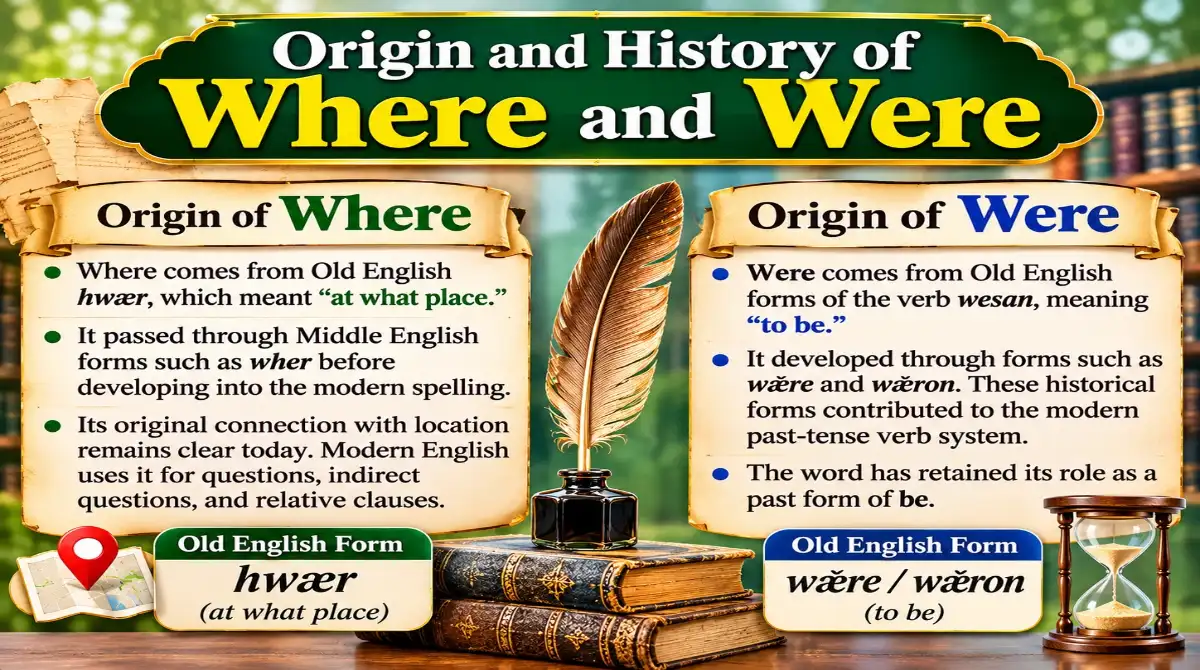
Both words have long histories in the English language, but they developed from different Old English forms.
Origin of Where
Where comes from Old English hwær, which meant “at what place.”
It passed through Middle English forms such as wher before developing into the modern spelling.
Its original connection with location remains clear today. Modern English uses it for questions, indirect questions, and relative clauses.
Origin of Were
Were comes from Old English forms of the verb wesan, meaning “to be.”
It developed through forms such as wǣre and wǣron. These historical forms contributed to the modern past-tense verb system.
The word has retained its role as a past form of be.
For further historical details, see the Online Etymology Dictionary’s entry for where and Dictionary.com’s explanation of were.
British English vs American English
Both words have the same spelling and basic meanings in British and American English.
There is no regional spelling difference between them.
However, pronunciation can vary between accents.
| Feature | American English | British English |
|---|---|---|
| Where | Usually /wer/ | Usually /weə(r)/ |
| Were | Usually /wɝː/ | Usually /wɜː/ |
| Spelling | Where, were | Where, were |
| Meaning | Same | Same |
| Grammar | Same standard rules | Same standard rules |
Does the Meaning Change Between Countries?
No. Where always refers to a place or situation, while were remains a past-tense form of be.
For example:
- American English: Where were you yesterday?
- British English: Where were you yesterday?
Both sentences are correct.
When to Use Where
Use where when asking about a place, identifying a location, or connecting information about a particular situation.
In Questions
Use where to ask someone about a location.
Examples:
- Where is your office?
- Where did you buy those shoes?
- Where are we meeting?
In School and Academic Writing
Students use where to identify places and explain the location of events.
Examples:
- Where does the story take place?
- The chapter explains where the experiment happened.
In Workplace Communication
Use where when asking about files, meetings, documents, or workplace locations.
Examples:
- Where can I find the latest report?
- Please tell me where the meeting will take place.
In Emails and Messages
Examples:
- Could you tell me where to send the application?
- I am not sure where the attachment is saved.
In Daily Conversations
Examples:
- Where are my keys?
- Where should we eat tonight?
- Do you know where the bus stop is?
When to Use Were
Use were when describing past conditions, actions, or situations involving the correct subject.
In Everyday Conversations
Examples:
- We were busy yesterday.
- They were waiting for us.
- You were very helpful.
In School Assignments
Examples:
- The students were excited about the science project.
- The books were on the teacher’s desk.
In Workplace Communication
Examples:
- We were unable to attend the meeting.
- The documents were ready for review.
- You were responsible for the final report.
In Formal Emails
Examples:
- We were pleased to receive your application.
- The requested changes were completed yesterday.
In Hypothetical Statements
Examples:
- If I were the manager, I would improve the process.
- I wish we were closer to the office.
Common Mistakes When Using Where and Were
These mistakes often happen because both words look similar. Learning to recognize their grammatical roles can prevent confusion.
Using Were Instead of Where
Incorrect: Were is the nearest shopping mall?
Correct: Where is the nearest shopping mall?
Explanation: The sentence asks about a location, so where is correct.
Why beginners make this mistake: They focus on how the words look rather than their meanings.
Easy tip: If the sentence asks for a place, use where.
Using Where Instead of Were
Incorrect: We where happy with the results.
Correct: We were happy with the results.
Explanation: The sentence describes a past feeling. It needs the verb were.
Why beginners make this mistake: They may recognize the similar spelling but forget the grammatical role.
Easy tip: If the sentence describes a past condition, check if were is needed.
Confusing Where Were You?
Incorrect: Where was you yesterday?
Correct: Where were you yesterday?
Explanation: Standard English uses were with you, even when addressing one person.
Why beginners make this mistake: They assume a singular person always takes was.
Easy tip: Remember this rule: You were, not you was, in standard English.
Using Where in a Past-Tense Statement
Incorrect: They where at school last Monday.
Correct: They were at school last Monday.
Explanation: The sentence describes where people were in the past. It needs the verb were.
Why beginners make this mistake: They may focus on the location rather than the verb needed to complete the sentence.
Easy tip: Ask yourself if the sentence needs a past form of be.
Confusing Were With We’re
Incorrect: Were going to visit our grandparents.
Correct: We’re going to visit our grandparents.
Explanation: We’re means “we are.” Were is a past-tense verb.
Why beginners make this mistake: The words look and sound similar in fast speech.
Easy tip: Replace we’re with “we are.” If the sentence still makes sense, use we’re.
Using Was Instead of Were With You
Incorrect: You was very kind to me.
Correct: You were very kind to me.
Explanation: Were is the standard past-tense form used with you.
Why beginners make this mistake: Some informal speech uses nonstandard verb forms.
Easy tip: Memorize the common combination: I was, but you were.
Mixing Up Where and Were in a Question
Incorrect: Were did you put my phone?
Correct: Where did you put my phone?
Explanation: The question asks about the phone’s location, so where is required.
Why beginners make this mistake: They may remember that were is used in past-tense questions but overlook the question’s meaning.
Easy tip: Ask whether the missing information is a place or a past action.
Easy Trick to Remember Where vs Were
You do not need to memorize complicated grammar rules to understand these words.
Try this simple memory trick.
Think of it this way:
- Where = Where is the place?
- Were = We were there in the past.
Associate where with a location and were with a past situation.
For example:
“Where were you yesterday?”
The first word asks about the place. The second describes your past situation.
Another helpful trick is to remember the H in where.
Where has an H for “here.” Both words relate to location. This is a memory aid, not an actual spelling rule.
Where vs Were: Everyday Examples
These examples show how both words work in common situations.
At Work
- Where is the new employee’s desk?
- We were busy preparing the presentation.
At School
- Where is your English textbook?
- The students were ready for the test.
In Emails
- Could you tell me where the meeting will happen?
- We were happy to receive your response.
In Text Messages
- Where are you now?
- We were waiting for your reply.
On Social Media
- Where did you take this beautiful picture?
- We were having so much fun yesterday.
In Daily Life
- Where did you leave your wallet?
- My friends were at the restaurant.
In Online Content
- Where can readers find the full guide?
- The instructions were easy to follow.
Different Contexts and Usage
The correct choice depends on what you want to communicate. Both words appear in many types of writing.
Education
Students use where to ask about locations and were to describe past classroom activities.
Example: Where were the students during the school trip?
Business
Where helps employees locate information, while were describes previous business activities.
Example: Where were the original documents stored?
Workplace Communication
Use where to ask about meetings, equipment, and files. Use were to describe past situations.
Example: We were in the conference room where the presentation took place.
Grammar Learning
English learners should understand the difference between question words and verb forms.
Example: Where were you when the teacher arrived?
Marketing and Content Writing
Where can introduce questions about products, services, and locations. Were can describe previous customer experiences or past events.
Examples:
- Where can customers buy this product?
- Customers were satisfied with the service.
Technology
Where can identify the location of digital files, settings, and online resources. Were describes previous system conditions or user activities.
Examples:
- Where is the downloaded file?
- The settings were different before the update.
If spelling and grammar comparisons interest you, explore our guides on misspell or mispell and which or wich.
Google Trends and Search Insights
People search for where vs were because these words have similar spellings and can sound alike in everyday speech.
The confusion often appears in:
- School assignments and grammar exercises.
- English spelling tests.
- Workplace emails.
- Social media captions.
- Text messages and online conversations.
- English-learning lessons.
Another reason is that both words can appear in the same sentence.
For example:
“Where were you when the teacher arrived?”
This sentence uses both words correctly, but each has a different grammatical purpose.
Related searches about we’re and wear also create opportunities for useful supporting content.
No verified live Google Trends comparison or regional search-volume figures are included here. Search interest should be checked directly in Google Trends before making numerical or country-specific claims.
Related Searches and People Also Ask
Here are useful questions related to where and were, with simple answers.
Is Where or Were Correct?
Both are correct English words. Where refers to a location or situation, while were is a past-tense form of be.
What Is the Difference Between Where and Were?
Where asks about a place or identifies a situation. Were describes a past condition or action.
How Do You Use Where in a Sentence?
Use where when asking about or identifying a location.
Example: Where is your school?
How Do You Use Were in a Sentence?
Use were with you, we, they, and plural subjects in the past tense.
Example: They were at home.
Is Were a Past-Tense Word?
Yes. Were is a past-tense form of the irregular verb to be.
Is Where a Question Word?
Yes. Where is commonly used as a question word to ask about a place.
Are Where and Were Homophones?
They are not complete homophones in every English accent. Some speakers pronounce them similarly, while others pronounce them differently.
Why Do People Confuse Where and Were?
Their spellings are similar, and their pronunciation can overlap in some accents. This makes them easy to mix up.
What Is the Difference Between Where, Were, and We’re?
Where refers to a place. Were is a past-tense verb. We’re is a contraction of “we are.”
Can You Use Were With I?
Yes. Were is used with I in hypothetical or unreal expressions.
Example: If I were you, I would study harder.
Is It Where Were You or Were Where You?
“Where were you?” is the standard question when asking about someone’s past location.
What Is the Correct Sentence: Where We Were or Were We Where?
Both can be correct in different contexts.
- Where we were is a statement or part of a larger sentence.
- Were we where we needed to be? is a question.
Does British English Use Where and Were Differently?
No. Their meanings, spellings, and standard grammatical rules are the same in British and American English.
Frequently Asked Questions
Is Where or Were the Correct Spelling?
Both spellings are correct. Use where for a place and were for the past form of be.
What Does Where Mean in Simple English?
Where means “at what place” or “in what location.” It helps someone ask about or identify a place.
What Does Were Mean in Simple English?
Were is a past form of be. It describes a past condition, situation, or action.
How Can I Remember Where and Were?
Connect where with places and were with the past. Ask yourself if the sentence needs a location or a verb.
Is Were Singular or Plural?
Were is normally used with plural subjects, but it also appears with singular you and in hypothetical subjunctive constructions.
Why Do We Say You Were Instead of You Was?
Standard English uses were with you, regardless of whether you are speaking to one person or several people.
Is It Correct to Say If I Were You?
Yes. “If I were you” is a standard subjunctive expression used to give advice about an imagined situation.
Can Where and Were Appear Together?
Yes. For example: “Where were you yesterday?” Where asks about the location, and were is the past-tense verb.
Are Where and Were Pronounced the Same?
Not in every accent. Some speakers pronounce them differently, while others produce very similar sounds.
What Is the Difference Between Were and We’re?
Were is a past-tense form of be. We’re is a contraction meaning “we are.”
Which Word Should I Use in a Question About Location?
Use where. For example, “Where is the library?” asks someone to identify a location.
Can Were Describe a Past Action?
Yes. Were helps form past progressive sentences, such as “They were playing football.”
Final Verdict: Where vs Were
The difference between where and were is simple once you understand their grammatical roles.
- Where is used for places, locations, and situations.
- Were is the past-tense form of be, used with you, we, they, and plural subjects. It also appears in hypothetical expressions.
Neither word is a misspelling. Both are correct, but they cannot replace each other in ordinary sentences.
Remember this easy rule: Where asks about a place, while were describes the past.
Conclusion
Understanding where vs were can make your English writing clearer and more accurate. Although these words look similar, they have different meanings and grammatical purposes. Use where when asking about a location or connecting information about a place.
Use were when describing past conditions, actions, or hypothetical situations. Pay attention to the subject of your sentence and the information you want to communicate. With regular practice, choosing the correct word becomes easier. Remember the simplest trick: where is about a place, and were is about the past.
Keep this rule in mind when writing emails, completing school assignments, sending messages, or speaking English.

Hi, I’m Toseef Mustafa, the creator of CompareWordz.com and a qualified English linguistics professional. My expertise includes English vocabulary, spelling, grammar, word meanings, and commonly confused words. I aim to explain language differences through clear explanations, accurate information, and practical examples. My goal is to help readers understand English better and use the right words with confidence.