
You are ordering supplies for your office. You type, “We need more stationary: pens, notebooks, and envelopes.” Then something feels wrong. Is it stationary or stationery?
You are not alone. The words sound the same, and only one letter sets them apart. The stationary vs stationery mix-up shows up in emails, school papers, shop signs, and job reports.
In this guide, you will learn what each word means, where each one comes from, and how to pick the right one every time. You will also get an easy memory trick, real examples, and the most common mistakes to avoid.
Quick Answer: Stationary vs Stationery
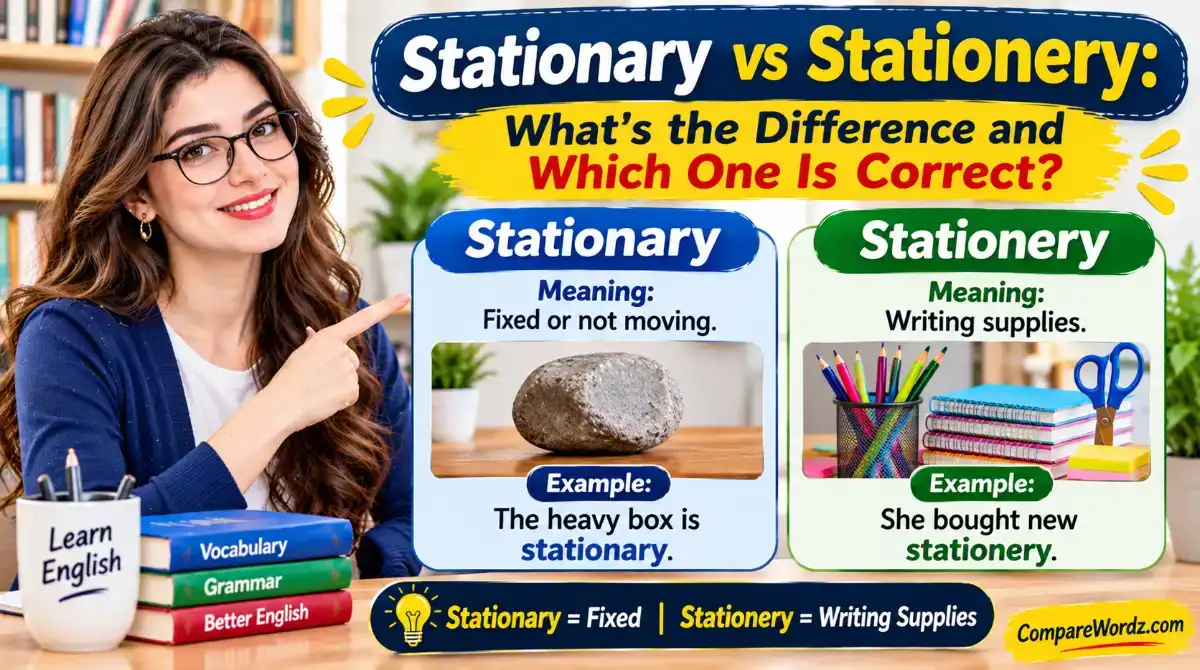
Stationary (with an “a”) is an adjective that means not moving or staying in one place. Stationery (with an “e”) is a noun that means paper, pens, envelopes, and other writing supplies. Both are pronounced the same.
Examples:
- “The car stayed stationary at the red light.”
- “She bought new stationery for school.”
- “Please stay stationary during the photo.”
- “The stationery shop sells cards and notebooks.”
Meaning of Stationary
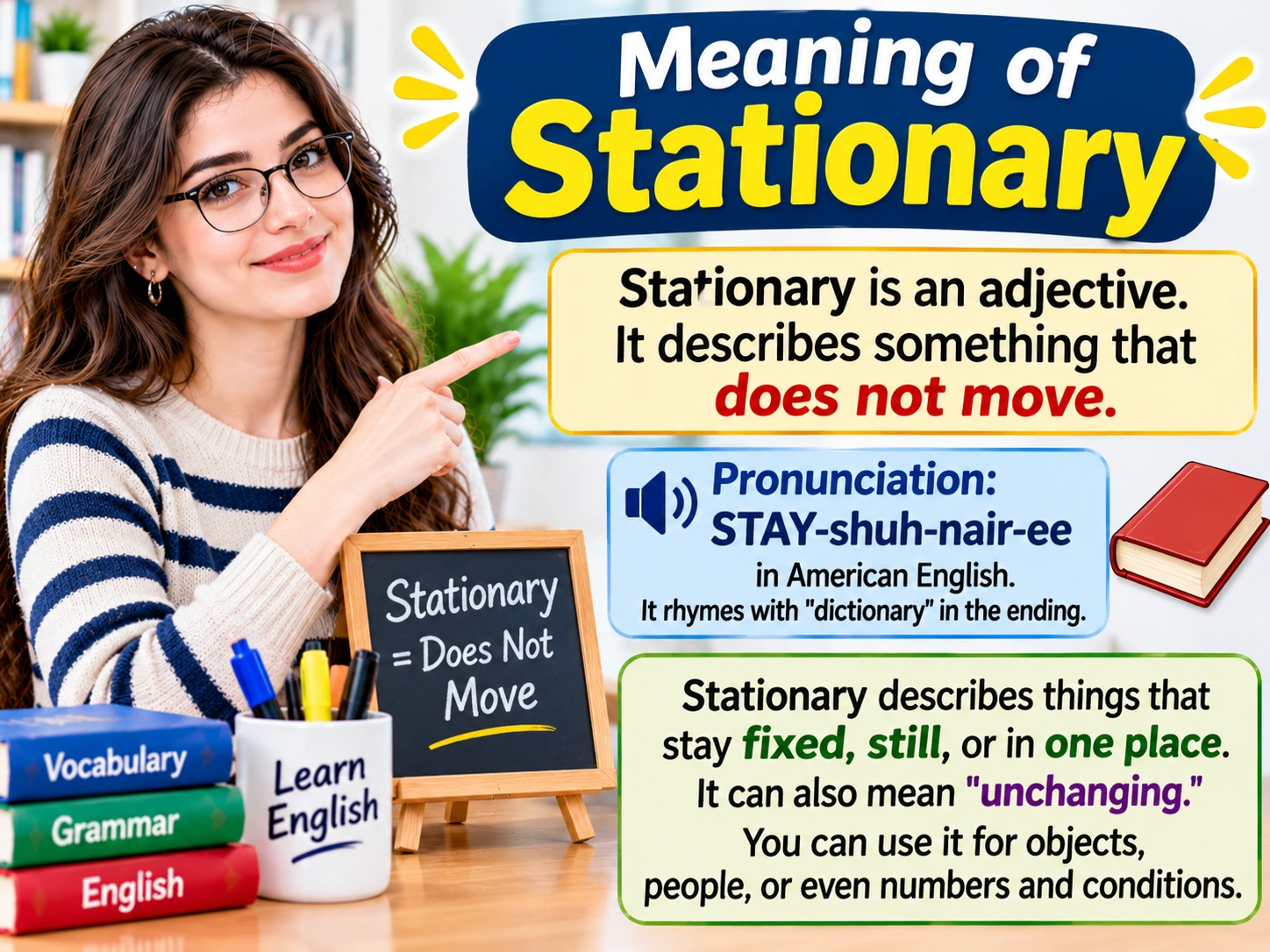
Stationary is an adjective. It describes something that does not move.
Pronunciation: STAY-shuh-nair-ee in American English. It rhymes with “dictionary” in the ending.
Stationary describes things that stay fixed, still, or in one place. It can also mean “unchanging.” You can use it for objects, people, or even numbers and conditions.
Examples:
- The truck remained stationary in traffic.
- A stationary bike stays in one place while you pedal.
- The temperature stayed stationary all week.
- Stand stationary while the camera focuses.
Synonyms: still, motionless, fixed, parked, standing, unmoving, static
Opposite words: moving, mobile, active, changing
Meaning of Stationery
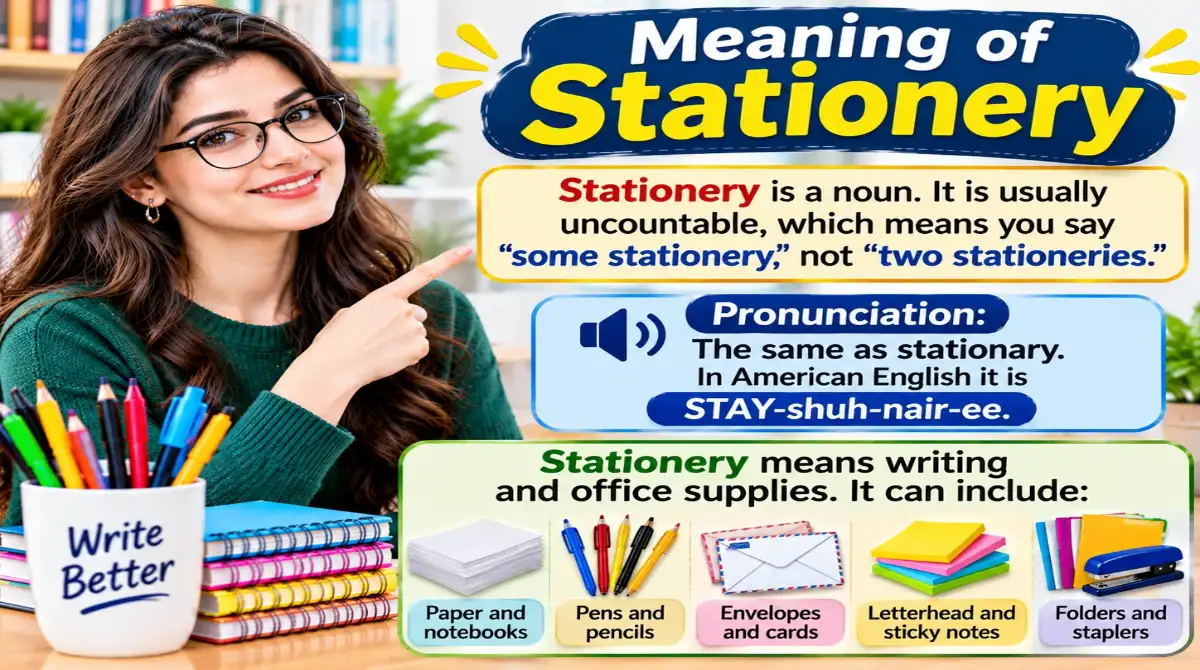
Stationery is a noun. It is usually uncountable, which means you say “some stationery,” not “two stationeries.”
Pronunciation: The same as stationary. In American English it is STAY-shuh-nair-ee.
Stationery means writing and office supplies. It can include:
- Paper and notebooks
- Pens and pencils
- Envelopes and cards
- Letterhead and sticky notes
- Folders and staplers
Examples:
- She printed her wedding invitations on elegant stationery.
- Our school sells stationery at the front office.
- He wrote the letter on company stationery.
- The stationery cupboard is out of pencils.
Related word: A stationer is a person or shop that sells stationery. In British English, you may hear “the stationer’s” for a shop.
Synonyms: writing materials, office supplies, writing paper, paper goods
Both words are correct English words. Neither is a misspelling. They simply do different jobs.
Key Differences Between Stationary and Stationery
Meaning. Stationary is about not moving. Stationery is about paper and writing supplies.
Part of speech. Stationary is an adjective. Stationery is a noun.
Spelling. Stationary ends in -ary. Stationery ends in -ery.
Pronunciation. There is no difference. Both are said the same, so speech will not help you choose.
Usage. Use stationary to describe a thing or person that stays still. Use stationery to name supplies you write on or write with.
A quick test: if you can replace the word with “still,” use stationary. If you can replace it with “paper and pens,” use stationery.
Comparison Table: Stationary vs Stationery
| Feature | Stationary | Stationery |
|---|---|---|
| Correct word? | Yes | Yes |
| Part of speech | Adjective | Noun (uncountable) |
| Meaning | Not moving; fixed; unchanging | Paper, pens, envelopes, and writing supplies |
| Pronunciation | STAY-shuh-nair-ee | STAY-shuh-nair-ee |
| Spelling ending | -ary | -ery |
| Used for | Objects, vehicles, people, conditions | Office and school supplies |
| Example | “The train was stationary.” | “I bought new stationery.” |
| Common mistake | Using it for pens and paper | Using it for something that does not move |
| Memory clue | A for “at rest,” “car,” “stand” | E for “envelope” |
Spelling Rules and Word Forms
This is a spelling topic, so word forms matter more than records or statistics. Here is what to know.
Stationary word family
- stationary (adjective)
- stationarily (adverb, rare)
- stationariness (noun, rare)
- stationarity (noun, used in math and science)
Stationery word family
- stationery (noun)
- stationer (a person who sells stationery)
- stationer’s (the shop, mainly British)
- stationery shop, stationery store, stationery set
The “-ary” vs “-ery” pattern
Many English adjectives end in -ary: ordinary, temporary, necessary, stationary. That is a handy clue. If the word describes something, “-ary” is likely correct.
Many nouns for things, places, or collections end in -ery: bakery, brewery, nursery, stationery. If you are naming a thing, “-ery” is likely correct.
This is not a perfect rule, but it works for this pair. If a similar vowel swap trips you up, see our guide on descendants or descendents.
Origin and History of Stationary and Stationery
The two words are cousins. They share the same ancestor and grew apart over time.
The shared root. Both trace back to Latin statio, meaning “a standing” or “a post.” The adjective “stationary” appeared in the late 1300s, first used to describe planets with no apparent motion.
The medieval shopkeeper. In the Middle Ages, most sellers traveled from town to town. A few sold from a fixed spot. The Latin word stationarius described this kind of tradesman, someone who sold from a “station” or shop.
The bookseller link. Sellers with fixed locations were often bookshops licensed by universities. So the word “stationer” came to mean a seller of books and paper.
The birth of “stationery.” The noun “stationery,” meaning writing materials, is recorded in 1727. It grew from “stationery wares,” meaning goods sold by a stationer.
That means stationery gets its name from a seller who stayed put. Both words are about standing still, in a way. You can read the full entry on Etymonline’s stationery page.
British English vs American English
Here is the good news: there is no spelling difference between British and American English. Both use stationary and stationery. The same is true in Canada, Australia, India, and Pakistan.
The only differences are in everyday wording:
| Feature | American English | British English |
|---|---|---|
| Spelling | stationary / stationery | stationary / stationery |
| Pronunciation | STAY-shuh-nair-ee | STAY-shuh-nuh-ree |
| Shop | “office supply store” or “stationery store” | “stationer’s” or “stationery shop” |
| Storage | “supply closet” | “stationery cupboard” |
| Common phrase | “office supplies” | “stationery” |
Some learners assume the spelling changes like colour/color, but British and American English do not spell these words differently.
South Asia. In India and Pakistan, “stationery shop” and “stationery items” are common phrases. The spelling error “stationary shop” is also very common there, so check the “-ery” ending on signs and in business writing.
When to Use Stationary
Use stationary when you describe something that is still or fixed.
Formal writing and reports
- “The vehicle was stationary when the collision occurred.”
Workplace and business
- “Our stationary bikes are in the fitness room.”
Academic and science writing
- “The experiment used a stationary camera.”
Email and daily life
- “I stayed stationary until the lights turned green.”
Useful phrases: stationary vehicle, stationary bike, stationary target, stationary object, stationary position
When to Use Stationery
Use stationery when you talk about writing and office supplies.
Formal writing
- “All letters must be printed on official stationery.”
Workplace
- “Please order more stationery for the new hires.”
School
- “Students bring their own stationery on the first day.”
Shopping and gifts
- “She loves pretty stationery and journals.”
Weddings and events
- “The couple chose cream stationery for the invitations.”
Useful phrases: stationery shop, stationery set, personalized stationery, company stationery, stationery cupboard
Common Mistakes with Stationary and Stationery
Mistake 1: “Stationary shop”
- Incorrect: I bought pens from the stationary shop.
- Correct: I bought pens from the stationery shop.
- Why it happens: The shop sells goods that are not moving, so “stationary” feels logical.
- Tip: A shop selling pens and paper is a stationery shop.
Mistake 2: “Buy stationary”
- Incorrect: We need to buy stationary for the office.
- Correct: We need to buy stationery for the office.
- Why it happens: Writers spell by sound, and both words sound the same.
- Tip: If you can write on it or in it, use the “e” word.
Mistake 3: “Stationery car”
- Incorrect: The stationery car blocked the road.
- Correct: The stationary car blocked the road.
- Why it happens: “Stationery” is the word people see more often in daily life.
- Tip: A car that is not moving is “at rest.” Use the “a” word.
Mistake 4: “Stationery bike”
- Incorrect: She uses a stationery bike at home.
- Correct: She uses a stationary bike at home.
- Why it happens: Gym talk is less common in writing than store talk.
- Tip: A bike that does not go anywhere is stationary.
Mistake 5: “Stay stationery”
- Incorrect: Please stay stationery during the test.
- Correct: Please stay stationary during the test.
- Why it happens: Writers forget the word is describing a state of not moving.
- Tip: “Stay still” fits the sentence, so choose stationary.
Mistake 6: “Personalized stationary”
- Incorrect: She ordered personalized stationary for her business.
- Correct: She ordered personalized stationery for her business.
- Why it happens: Spell-check often does not flag it, because both are real words.
- Tip: Business cards and letterheads are stationery.
If business spelling is a weak spot, our guide on business or buisness can help.
Easy Trick to Remember
Think of it this way: Stationery has an e like envelope. Stationary has an a like car.
Picture the two in your mind:
- StationEry: envelopes, ink, notebooks
- StationAry: a parked cAr, standing At rest
Here is a second trick. Stationary ends in -ary, and so does ordinary and temporary. These words describe things. Stationery ends in -ery like bakery and nursery, which are things or places.
Everyday Examples
At work
- “Please order more stationery before Friday.”
- “The printer stays stationary on that table.”
At school
- “Don’t forget your stationery for the exam.”
- “The lab stand must remain stationary.”
On social media
- “Found the cutest stationery set at the mall.”
- “Stuck in traffic. We have been stationary for twenty minutes.”
In daily life
- “I keep spare envelopes in my stationery drawer.”
- “The deer stood stationary in the road.”
In email
- “Our new stationery will have the updated logo.”
- “The truck was stationary when the accident happened.”
In text messages
- “Can you pick up some stationery on your way home?”
- “I’m stationary on the highway, so I’m running late.”
Different Contexts and Usage
Education and exams
Teachers often use this pair in spelling tests. Students are asked to fill in the blanks with the correct word.
Business and office life
Companies buy stationery in bulk and print company stationery for letters and invoices. In facilities reports, “stationary equipment” means machines that stay in one place.
Marketing and design
Brands design stationery sets, including letterheads and business cards, as part of their identity.
Fitness and health
A stationary bike is a cycle that stays in place. Gyms also use stationary equipment for indoor workouts.
Science and engineering
Stationary can describe a fixed point, wave, or object in physics, chemistry, or math. A “geostationary” satellite appears fixed over one spot on Earth.
Weddings and events
Invitations, thank-you cards, and menus are all stationery.
Google Trends and Search Insights
I did not have live Google Trends access when writing this, so I am not including figures or regional rankings.
Here is what likely drives the searches:
- Identical sound. You cannot tell the words apart in speech.
- Tiny spelling gap. One vowel changes the meaning completely.
- Spell-check blind spots. Both words are real, so many tools do not flag a wrong choice.
- Shop and school use. People often check the spelling for signs, product pages, emails, and homework.
One writing guide notes that the Washington State University professor Paul Brians says this mix-up is among the most frequent grammar mistakes in English. For regional search interest, check Google Trends directly.
Useful long-tail queries: stationery or stationary, stationary vs stationery meaning, stationery shop spelling, stationary bike, how to remember stationary vs stationery.
Related Searches and People Also Ask
Is it “stationary” or “stationery” for school supplies?
Stationery, with an “e.”
Is it “stationary” or “stationery” for something that is not moving?
Stationary, with an “a.”
How do you pronounce stationery?
STAY-shuh-nair-ee in American English. It is the same as stationary.
Is “stationary shop” correct?
No. A shop that sells paper and pens is a stationery shop.
What does “stationary bike” mean?
A bike that stays in one place while you pedal.
What does “stationary” mean in science?
It means fixed or not changing, as in a stationary point or wave.
Is stationery countable?
No. Say “some stationery,” not “two stationeries.”
What is a stationer?
A person or shop that sells stationery.
What is “company stationery”?
Paper and envelopes printed with a company’s name and logo.
Is “stationery” ever an adjective?
Not in standard use. It is a noun, though “stationery shop” uses it like a describing word.
What is a “stationary target”?
A target that does not move.
Are stationary and stationery related?
Yes. Both come from the Latin root for standing or a fixed post.
Do British and American English spell these differently?
No. The spelling is the same in both.
What does “stationary” mean for prices or numbers?
It means the number is not changing.
Frequently Asked Questions
What is the difference between stationary and stationery?
Stationary means not moving. Stationery means writing supplies like paper and pens.
Are stationary and stationery homophones?
Yes. They sound the same but are spelled differently.
Which one is for pens and paper?
Stationery, with an “e.”
Is “stationary” an adjective?
Yes. It describes things that stay still.
Is “stationery” a noun?
Yes. It names writing and office supplies.
Is “stationary vs stationery” a British or American issue?
No. Both varieties use the same spelling.
Why do people confuse them?
They sound identical and differ by only one letter.
How can I remember which is which?
Stationery has an “e” for envelope. Stationary has an “a” for car or at rest.
Do stationary and stationery come from the same word?
Yes. Both come from the Latin word for a fixed place or post.
Is it “stationery shop” or “stationary shop”?
Stationery shop.
Can spell-check catch the wrong one?
Not always. Both are real words, so check the meaning yourself.
Final Verdict
Stationary means still. Stationery means writing supplies. They sound the same, so the meaning in your sentence is the only guide.
The easiest rule: e for envelope means stationery, and a for car means stationary. When in doubt, ask yourself: “Is it not moving, or is it paper and pens?”
Conclusion
The stationary vs stationery confusion is easy to fix once you link each word to a picture. Stationary belongs to a parked car, a standing person, or a bike that stays in place. Stationery belongs to paper, pens, and envelopes on your desk.
Even their history connects them. Both words grew out of the idea of a fixed place, and stationery got its name from sellers who stayed in one spot rather than traveling.
Before you write, pause for a second and ask yourself if you mean “still” or “supplies.” That one question will solve almost every case.
Memory tip: Stationery has an “e” like envelope. Stationary has an “a” like car. For more help, see the Grammarly guide to stationary vs stationery. If you often swap one shop-related word for another, our post on retailer or retailor is a good next read.

I’m MK Jan Mustafa Kamal, the author of CompareWordz.com, specializing in English linguistics, word meanings, spelling, and language usage.
I hold an M.A. in English and have 8 years of experience in English language and vocabulary studies. My goal is to explain confusing words, spelling differences, grammar rules, and meanings in clear, simple, and accurate language. I focus on providing well-researched, fact-checked, and easy-to-understand content that helps readers use English with confidence. Through CompareWordz.com, I aim to make learning English words and their correct usage easier for everyone.