
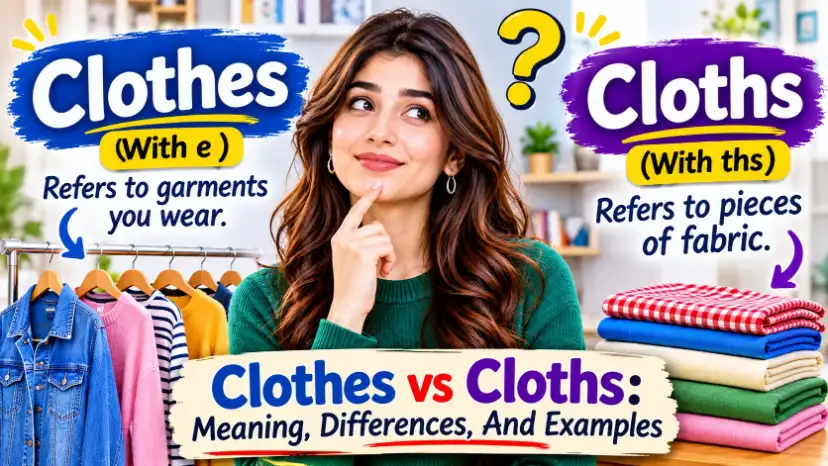
Have you ever wondered If to write clothes or cloths? These words look and sound similar, so it is easy to mix them up. However, they have different meanings and uses.
Clothes refers to garments people wear, such as shirts, pants, dresses, and jackets. Cloths is the plural form of cloth and refers to pieces of fabric or material. Choosing the correct word helps make your writing clear and accurate.
In this guide, you will learn the difference between clothes and cloths, their meanings, pronunciation, origins, and correct usage. You will also find practical examples, common mistakes, and simple memory tips to help you remember which word to use.
Quick Answer: Clothes vs Cloths
Clothes means garments or items people wear. Cloths means pieces of fabric or material, often used for cleaning, covering, or other purposes.
For example:
- I bought new clothes for the winter.
- She used clean cloths to wipe the kitchen counter.
Remember this simple rule: Use clothes when talking about what people wear. Use cloths when talking about pieces of fabric.
What Does Clothes Mean?

Clothes refers to the things people wear to cover and protect their bodies. These items include shirts, trousers, skirts, dresses, coats, socks, and jackets.
It is a plural noun that describes garments as a group. People commonly use it when discussing shopping, fashion, dressing, or personal style.
Examples:
- I need to wash my clothes before Monday.
- She packed warm clothes for her trip.
- His clothes were covered in dust.
- They donated their old clothes to charity.
In everyday English, clothes is the natural word for wearable garments. You can also explore the difference between everyday and every day to understand another commonly confused English word pair.
What Does Cloths Mean?
Cloths is the plural form of the noun cloth. It means separate pieces of fabric or material.
People use cloths for cleaning, polishing, covering objects, sewing, and other practical tasks. A cloth can be made from cotton, microfiber, linen, or another material.
Examples:
- The cleaner used several cloths to wipe the windows.
- Keep the kitchen cloths away from dirty dishes.
- She bought two cotton cloths for her sewing project.
- The workers covered the equipment with protective cloths.
The important point is that cloths refers to pieces of material, not the garments people wear.
Main Differences Between Clothes and Cloths
Although these words look similar, their meanings are different. The easiest way to understand them is to compare their purpose.
| Feature | Clothes | Cloths |
|---|---|---|
| Meaning | Garments people wear | Pieces of fabric |
| Singular form | No ordinary singular noun form | Cloth |
| Word type | Plural noun | Plural noun |
| Main use | Dressing and fashion | Cleaning, covering, and sewing |
| Example | Winter clothes | Cleaning cloths |
| Related word | Clothing | Fabric |
Clothes describes wearable items, while cloths describes individual pieces of material.
Is Clothes Singular or Plural?
Clothes is normally a plural noun. It refers to garments collectively and does not usually have a standard singular form.
You would not normally say one clothe to describe one shirt or one pair of pants. Instead, use expressions such as:
- An item of clothing
- A piece of clothing
- A shirt
- A jacket
- A pair of trousers
Examples:
- My clothes are in the bedroom.
- These clothes look comfortable.
- I bought an item of clothing yesterday.
Remember that clothing is generally an uncountable noun, while clothes is plural. For more help with commonly confused forms, see our guide to chosen or choosen.
Is Cloths a Real Word?
Yes, cloths is a correct English word. It is simply the plural form of cloth.
A cloth is a piece of fabric or material. When you have more than one, you can use cloths.
Examples:
- The shop sells handmade cloths.
- Put the cleaning cloths in the laundry basket.
- The artist used different cloths for the project.
Do not confuse cloths with clothes. One refers to pieces of material, while the other refers to garments.
Cloth, Cloths, Clothes, and Clothing Explained
These four words are related to fabric and garments, but they do not mean exactly the same thing.
| Word | Meaning | Example |
|---|---|---|
| Cloth | Fabric or material | This cloth feels soft. |
| Cloths | Separate pieces of fabric | Wash these cloths. |
| Clothes | Garments people wear | My clothes are ready. |
| Clothing | Garments considered as a group | The store sells winter clothing. |
Use cloth when referring to material, cloths for multiple pieces of material, clothes for wearable garments, and clothing for garments as a general category.
For a more detailed explanation of these related terms, consult the Cambridge Dictionary guide to cloth, clothes, and clothing.
How to Pronounce Clothes and Cloths

The pronunciation of these words can be confusing because they look almost identical. However, their final sounds are different in many English accents.
Clothes: Often pronounced like “klohz.” The final sound is generally a voiced /z/ sound.
Cloths: Often pronounced with a /θs/ ending, similar to the final sounds in cloth followed by an /s/.
The exact pronunciation can vary by accent, and some speakers pronounce the words quite similarly. Listening to both words in example sentences can help you recognize the difference.
Origin of Clothes and Cloths
The words clothes and cloths are connected through the history of English, but they developed into different forms.
Cloth comes from Old English clāþ, which referred to fabric or material. Its plural form became cloths, meaning multiple pieces of fabric.
Clothes developed from the older plural form associated with cloth. Over time, its meaning became closely connected with garments worn on the body.
Today, English uses clothes for garments and cloths for pieces of material.
Clothes vs Cloths in American and British English
The meanings of clothes and cloths are generally the same in American and British English. Neither spelling is an American-only or British-only alternative.
| Word | American English | British English |
|---|---|---|
| Clothes | Garments people wear | Garments people wear |
| Cloths | Pieces of fabric | Pieces of fabric |
| Clothing | Garments in general | Garments in general |
Examples:
- American English: I packed extra clothes for the weekend.
- British English: I packed extra clothes for the weekend.
- American English: Use clean cloths to wipe the table.
- British English: Use clean cloths to wipe the table.
The main difference is meaning, not regional spelling.
When Should You Use Clothes?
Use clothes whenever you are talking about garments that people wear. It is the right choice for conversations about outfits, fashion, shopping, laundry, and personal style.
Common situations include:
Shopping: I need new clothes for the summer.
Travel: Pack comfortable clothes for your holiday.
School: Students should wear clean clothes.
Work: He changed into formal clothes before the meeting.
Daily life: My clothes are drying outside.
If the items can be worn as garments, clothes is usually the correct word.
When Should You Use Cloths?
Use cloths when referring to multiple pieces of fabric or material. These pieces may be used for cleaning, polishing, covering, or making other products.
Common situations include:
Cleaning: Use separate cloths for the kitchen and bathroom.
Housework: I washed the dirty cloths this morning.
Sewing: The tailor selected different cloths for the project.
Polishing: Soft cloths can help clean delicate surfaces.
Covering: The workers placed cloths over the furniture.
If you are describing separate pieces of material rather than wearable garments, use cloths.
Common Mistakes When Using Clothes and Cloths
Even experienced English writers sometimes confuse these words. Here are common mistakes and their correct forms.
1. Using Cloths for Wearable Garments
Incorrect: I bought new cloths for the party.
Correct: I bought new clothes for the party.
Use clothes because the sentence refers to garments.
2. Using Clothes for Cleaning Materials
Incorrect: She used clean clothes to wipe the table.
Correct: She used clean cloths to wipe the table.
Use cloths because the sentence describes pieces of cleaning material.
3. Treating Clothes as a Singular Noun
Incorrect: This clothe is expensive.
Correct: This item of clothing is expensive.
Use an item of clothing when referring to one garment.
4. Writing Cloth Instead of Cloths
Incorrect: The cleaner needs several cloth.
Correct: The cleaner needs several cloths.
The word several requires a plural noun.
5. Assuming Clothes and Cloths Are Interchangeable
Incorrect: Put your cloths in the wardrobe.
Correct: Put your clothes in the wardrobe.
A wardrobe usually holds garments, so clothes is the appropriate word.
6. Confusing Clothing With Clothes
Incorrect: I bought three clothings.
Correct: I bought three items of clothing.
Clothing is generally uncountable. Use items of clothing when counting individual garments.
Clothes vs Cloths in Everyday Sentences
Looking at both words in realistic situations makes their difference easier to remember.
At Home
- My clothes are hanging in the closet.
- Please put the cleaning cloths in the laundry basket.
- I need comfortable clothes for relaxing at home.
- Keep the kitchen cloths clean and dry.
At School
- Students should wear clean clothes.
- The art teacher gave us cloths for our craft project.
- I packed extra clothes for the school trip.
- We used small cloths to clean the classroom tables.
At Work
- He wears formal clothes to the office.
- The staff used soft cloths to clean the equipment.
- She keeps spare clothes in her locker.
- The workers covered the machines with protective cloths.
While Shopping
- I want to buy new clothes for the weekend.
- The store sells colorful cloths for sewing.
- These clothes are available in different sizes.
- The shop has cotton cloths in several patterns.
Clothes vs Cloths in Professional Writing
Choosing the correct word is important in professional communication. A small spelling mistake can change the meaning of a sentence.
In business emails, product descriptions, instructions, and reports, use clothes for garments and cloths for separate pieces of fabric.
Examples:
- Please bring your work clothes tomorrow.
- The cleaning team should use fresh cloths.
- Our store offers affordable children’s clothes.
- These microfiber cloths are suitable for polishing.
Clear word choices make professional writing easier to understand.
Clothes vs Cloths for Students and English Learners
Students learning English can remember the difference with one simple question: Are you talking about something people wear or a piece of fabric?
If you mean shirts, dresses, pants, or jackets, choose clothes.
If you mean material used for cleaning, sewing, or covering, choose cloths.
Try these examples:
- I washed my school ______.
- The cleaner used two ______.
- She bought new ______ for the wedding.
- We need dry ______ to clean the windows.
Answers:
- Clothes
- Cloths
- Clothes
- Cloths
Practicing with short sentences helps build confidence and improve spelling.
An Easy Trick to Remember Clothes vs Cloths
Use this simple memory trick:
Clothes = Things you wear.
Think of shirts, shoes, jackets, and dresses. These are all clothes.
Cloths = Pieces of fabric.
Think of cleaning cloths, cotton cloths, and sewing material.
You can also remember that cloths comes directly from the word cloth. Adding an s makes it plural.
This simple connection can help you choose the correct word whenever you write.
Expert Tips for Using Clothes and Cloths Correctly
Keep these tips in mind to avoid confusion:
- Use clothes when discussing outfits, garments, or things people wear.
- Use cloths when discussing separate pieces of fabric.
- Remember that clothes is normally plural and has no ordinary singular form.
- Use an item of clothing when referring to one garment.
- Use cloth for one piece of material and cloths for multiple pieces.
- Do not assume the words are interchangeable because their spelling looks similar.
- Read your sentence again to check whether you mean garments or fabric.
These rules work in everyday conversations, school assignments, emails, and professional writing.
Related Searches About Clothes vs Cloths
Readers often search for other words connected to clothes and cloths. Here are some useful explanations.
Clothes vs Clothing
Clothes refers to garments people wear and is plural. Clothing refers to garments as a general category and is usually uncountable.
Cloth vs Clothes
Cloth means fabric or material. Clothes means garments worn by people.
Cloth vs Cloths
Cloth is singular, while cloths is its plural form.
Clothes vs Garments
Both words refer to wearable items. Garments is more formal and often appears in fashion and manufacturing contexts.
Clothing vs Apparel
Both refer to garments. Apparel is more common in retail, business, and fashion terminology.
Clothes vs Fabric
Clothes are garments, while fabric is the material used to make them.
Cleaning Cloths vs Cleaning Clothes
Cleaning cloths are pieces of material used to wipe surfaces. Cleaning clothes usually means garments worn while cleaning.
Piece of Cloth vs Piece of Clothing
A piece of cloth is a section of fabric. A piece of clothing is one garment or wearable item.
Frequently Asked Questions
Are Clothes and Cloths the Same?
No. Clothes are garments people wear, while cloths are separate pieces of fabric or material. For example, a shirt is an item of clothing, but a cleaning cloth is a piece of material.
Is Cloths the Plural of Cloth?
Yes. Cloths is the standard plural form of cloth. Use it when referring to two or more separate pieces of fabric.
What Is the Singular of Clothes?
Clothes does not normally have a singular form. Use an item of clothing, a piece of clothing, or the specific garment name, such as shirt or jacket.
Can I Use Cloths to Mean Clothes?
No. In standard English, cloths refers to pieces of fabric, not garments. Use clothes when talking about items people wear.
Is Clothing Singular or Plural?
Clothing is generally an uncountable noun. It takes a singular verb in standard usage. For example, “My clothing is in the suitcase.”
Are Clothes and Cloths Pronounced the Same?
Not usually. Clothes commonly ends with a /z/ sound, while cloths has a final sound sequence involving /θs/. However, pronunciation can vary by accent, and the words may sound similar to some listeners.
Which Word Should I Use for Washing?
Use clothes when referring to garments you wash. Use cloths when referring to cleaning materials that need washing.
For example: “I washed my clothes and the cleaning cloths.”
Is Cloths Correct English?
Yes. Cloths is a correct plural noun. It is the plural of cloth and refers to multiple pieces of fabric.
Final Verdict: Clothes or Cloths?
The correct choice depends on what you want to describe. Clothes refers to garments people wear, while cloths refers to separate pieces of fabric or material.
Use clothes when talking about shirts, trousers, dresses, jackets, and other wearable items. Use cloths when discussing cleaning materials, sewing fabric, or pieces used to cover objects.
Once you remember this simple difference, you can use both words confidently in everyday writing and conversation.
Conclusion
Understanding the difference between clothes and cloths can help you avoid a common English mistake. Although the words look similar, they have different meanings and purposes.
Remember that clothes are things people wear, while cloths are pieces of fabric. Use the examples and memory trick in this guide whenever you feel unsure.
With regular practice, choosing the correct word will become easier.

Hi, I’m Toseef Mustafa, the creator of CompareWordz.com and a qualified English linguistics professional. My expertise includes English vocabulary, spelling, grammar, word meanings, and commonly confused words. I aim to explain language differences through clear explanations, accurate information, and practical examples. My goal is to help readers understand English better and use the right words with confidence.