


Opened or openned is a common spelling confusion in English. Have you ever typed “opened” and wondered whether it should have two n’s?
Many English verbs double their final consonant before adding -ed, but open follows a different spelling rule.
The correct spelling is opened, while openned is incorrect in standard English.
In this guide, you’ll learn why opened is correct, how to use it in sentences, why people misspell it as openned, and an easy trick to remember the correct spelling.
Quick Answer : Opened or Openned
Opened is the correct spelling. Openned is incorrect.
- ✅ Opened — correct
- ❌ Openned — incorrect
The base verb is open, and its past tense and past participle are formed by adding -ed:
open + ed = opened
Examples:
- She opened the door.
- I opened the email.
- The store opened at nine.
Easy memory rule: Open has one “n” before -ed, so write opened, not openned.
What Does Opened Mean?
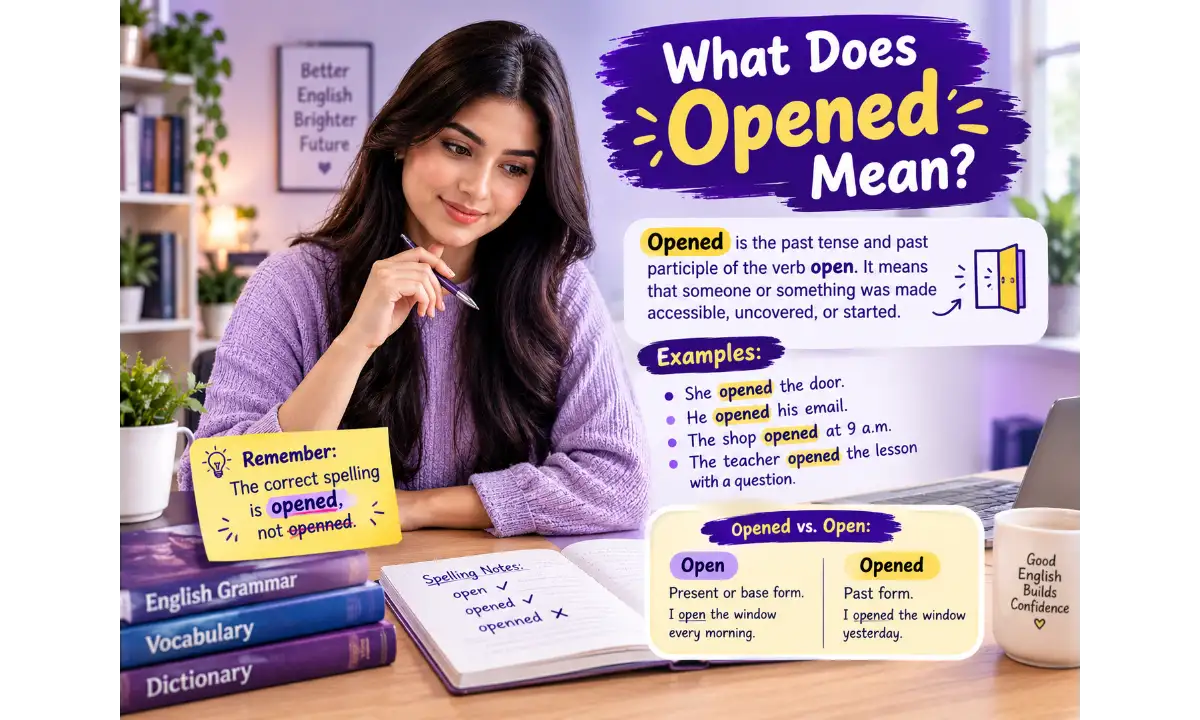
Opened is the past tense and past participle of the verb open.
The verb open means to move something so that it is no longer closed or blocked. It can also mean to begin an activity, event, business, or discussion.
When you say opened, you are usually talking about something that happened in the past.
For example:
She opened the window.
This means she moved the window so that it was no longer closed.
The word can also describe starting something:
The teacher opened the meeting with a short introduction.
Here, opened means started.
Opened vs Openned
The main difference is simple: opened is a real and correct English spelling, while openned is a misspelling.
| Word | Correct? | Meaning | Example |
|---|---|---|---|
| Opened | ✅ Yes | Past tense of open | He opened the box. |
| Openned | ❌ No | Incorrect spelling | He openned the box. |
There is no standard English verb openn that becomes openned.
The correct form remains:
open → opened
Why Is Opened Correct?

The confusion usually comes from the spelling rule about doubling the final consonant.
English sometimes doubles the final consonant before adding -ed. For example:
- stop → stopped
- plan → planned
- shop → shopped
This can make learners think that open should become openned.
But open does not follow that pattern.
The correct spelling is:
open + ed = opened
The final n is not doubled.
A useful point is that the consonant-doubling rule depends on factors such as syllable structure and stress. Open does not meet the pattern that would require doubling the final consonant.
Is Openned a Word?
No. Openned is not the standard spelling of the past tense of open.
If you see openned in a message, social media post, document, or other writing, it is normally just a spelling mistake.
For formal, academic, professional, and everyday English, use:
opened
For example:
❌ I openned the file.
✔ I opened the file.
Examples of Opened in Sentences
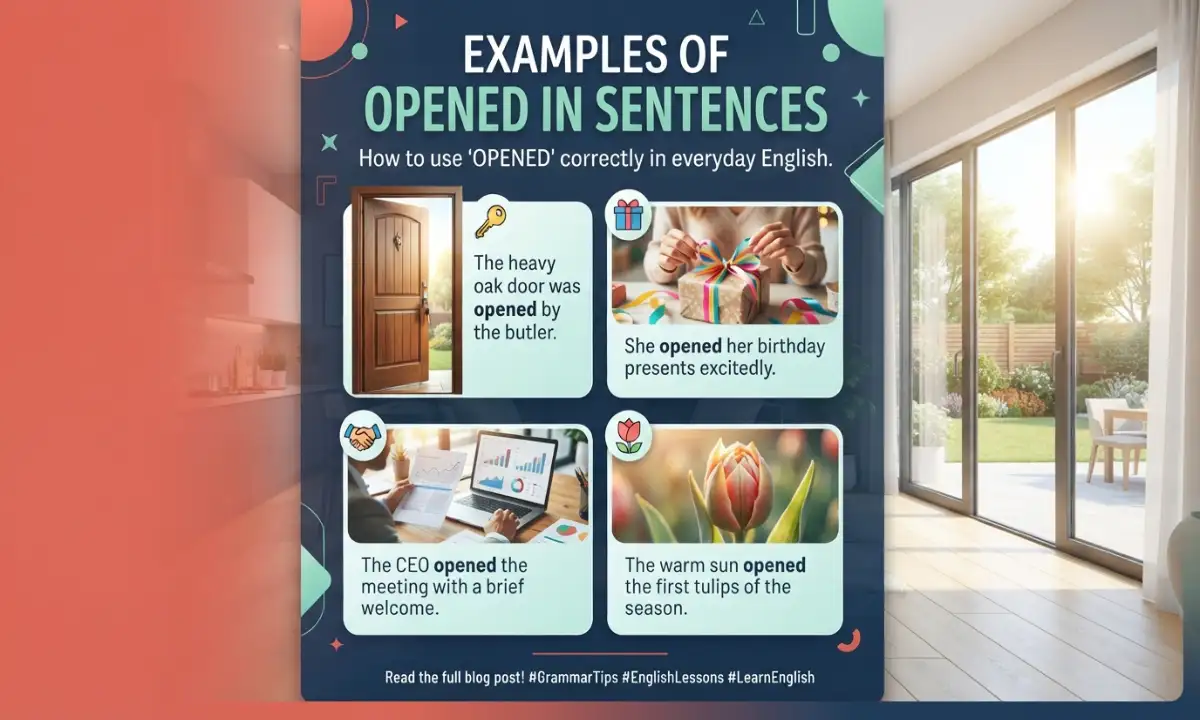
Here are some natural examples of opened in everyday English.
Everyday Life
- I opened the door for my neighbor.
- She opened the window.
- He opened the package carefully.
- We opened the gift together.
School
- The teacher opened the book.
- I opened my notebook.
- She opened the lesson with a question.
- The students opened their textbooks.
Work
- I opened the email this morning.
- She opened the document and reviewed it.
- The manager opened the meeting with a short speech.
- He opened the new office last month.
Technology
- I opened the app.
- She opened the file on her computer.
- He opened the link in a new tab.
- The program opened automatically.
Business
- The company opened a new branch.
- The restaurant opened at 11 a.m.
- They opened the store last year.
- The business opened its doors to customers.
Opened as a Past Tense Verb
Opened is commonly used as the simple past tense of open.
The basic pattern is:
Subject + opened + object
Examples:
Sarah opened the box.
Tom opened the door.
We opened the email.
It tells the reader that the action happened in the past.
Compare these forms:
| Time | Correct Form | Example |
|---|---|---|
| Present | open | I open the door. |
| Past | opened | I opened the door. |
| Past participle | opened | I have opened the door. |
| Present participle | opening | I am opening the door. |
Notice that none of these forms uses openned.
Opened as a Past Participle
Opened can also work as a past participle.
It commonly appears with helping verbs such as has, have, and had.
Examples:
- She has opened the package.
- We have opened the store.
- He had opened the email before lunch.
It can also appear in passive constructions:
- The door was opened by the teacher.
- The new store was opened last week.
- The package was opened carefully.
Why Do People Write Openned?

There are several reasons people may write openned.
One reason is that English has many verbs that double their final consonant before -ed.
For example:
plan → planned
stop → stopped
admit → admitted
Because learners see these patterns, they may incorrectly apply the same rule to open.
Another reason is pronunciation. When people say opened, the ending can sound like a separate syllable. This may make the spelling feel less obvious.
Typing quickly can also lead to accidental extra letters.
Regardless of the reason, the standard spelling is still opened.
Opened vs Opening
Another common spelling question involves the -ing form.
The correct forms are:
- open
- opened
- opening
- opens
Not:
- ❌ openned
- ❌ openning
Examples:
She opened the door.
She is opening the door.
The difference is that opened uses -ed, while opening uses -ing.
Common Spelling Mistakes in Opened or Openned
Mistake 1: Writing Openned
❌ He openned the door.
✔ He opened the door.
Why it is wrong: The final n in open is not doubled before -ed.
Beginner tip: Remember open + ed = opened.
Mistake 2: Writing Openning
❌ She is openning the box.
✔ She is opening the box.
Why it is wrong: The word open does not double its final n before -ing.
Mistake 3: Adding an Extra N Automatically
❌ I have openned the file.
✔ I have opened the file.
Why it happens: Learners may remember consonant-doubling examples such as planned or stopped and apply the rule too broadly.
Mistake 4: Confusing Opened With Open
❌ Yesterday, I open the email.
✔ Yesterday, I opened the email.
Why it is wrong: The sentence describes a completed action in the past, so the past form opened is needed.
Mistake 5: Using Opened After Will
❌ I will opened the door.
✔ I will open the door.
Why it is wrong: After will, use the base form of the verb.
The pattern is:
will + open
not:
will + opened
British English vs American English
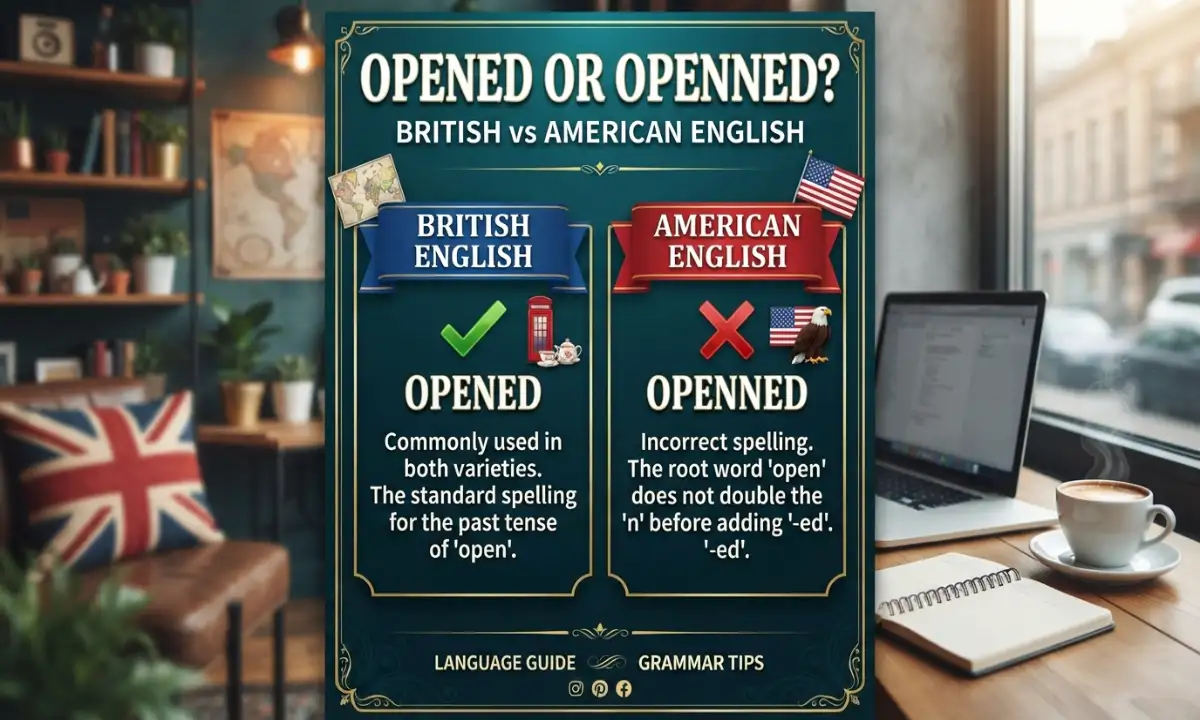
There is no spelling difference between British English and American English for this word.
| Feature | British English | American English |
|---|---|---|
| Correct spelling | opened | opened |
| Incorrect spelling | openned | openned |
| Base form | open | open |
| Past form | opened | opened |
| -ing form | opening | opening |
Both varieties use opened.
So if you are writing for readers in the United States, United Kingdom, Canada, Australia, or other English-speaking regions, opened is the safe standard spelling.
Which One Should You Use?
Use opened in every standard English situation.
Formal writing
Use opened in reports, essays, applications, and official documents.
The company opened a new office in June.
Academic writing
Use opened when describing a past action.
The researcher opened the discussion with a brief explanation.
Workplace communication
Use opened in emails and business messages.
I opened the attachment and reviewed the document.
Texting and social media
You should still write opened.
I just opened your message.
Although informal writing often contains spelling mistakes, openned does not become correct simply because the context is casual.
Beginner Guide to Remembering Opened
If you often confuse opened and openned, use this simple process.
Start with the base word:
OPEN
Then add ED:
OPEN + ED
The result is:
OPENED
Do not add another N.
You can memorize the pattern as:
OPEN → OPENED
not:
OPEN → OPENNED
This small visual rule is usually enough to prevent the mistake.
Simple Trick to Remember Opened
Think of the word as a locked door.
OPEN + ED = OPENED
Imagine opening a door and saying:
“I OPENED it.”
The word open already has the n you need. You do not need another one.
Think of it this way:
One N in open, one N in opened.
That makes the correct spelling easy to remember.
Expert Spelling Tip
Do not apply consonant-doubling rules automatically to every English verb.
Words such as stop → stopped and plan → planned have their own spelling pattern. Open does not follow the same pattern.
When you are unsure, first identify the base word and then check how its past tense is normally formed.
For this word:
open → opened
That is the form you should use.
Frequently Asked Questions
Is “opened” spelled with one n?
Yes. Opened has only one n.
Is “openned” ever correct?
No. Openned is not the standard spelling of the word.
Why does “opened” not double the n?
The spelling pattern for open does not require doubling the final consonant before -ed.
What is the correct spelling of the past tense of open?
The correct past tense is opened.
Is “openning” also wrong?
Yes. The correct spelling is opening, with one n.
Can “opened” be a past participle?
Yes. For example, “She has opened the door.”
Is “opened” the same in British and American English?
Yes. Both British and American English use opened.
What is an easy way to remember opened?
Remember: OPEN + ED = OPENED.
Final Verdict
Opened is correct, while openned is incorrect.
The base verb is open, and adding -ed gives you opened. You do not double the final n.
The easiest rule to remember is:
Open → Opened → Opening
Never add an extra n.
Conclusion
The spelling confusion between opened and openned is understandable because English has several verbs that double their final consonant. However, open does not follow that pattern.
Use opened when talking about something that happened in the past or has been completed. Use opening for the -ing form.
Remember: One N is enough — open becomes opened, not openned

Hi, I’m Toseef Mustafa, the creator of CompareWordz.com and a qualified English linguistics professional. My expertise includes English vocabulary, spelling, grammar, word meanings, and commonly confused words. I aim to explain language differences through clear explanations, accurate information, and practical examples. My goal is to help readers understand English better and use the right words with confidence.
2 thoughts on “Opened or Openned: Which Spelling Is Correct? Guide 2026”
Comments are closed.