
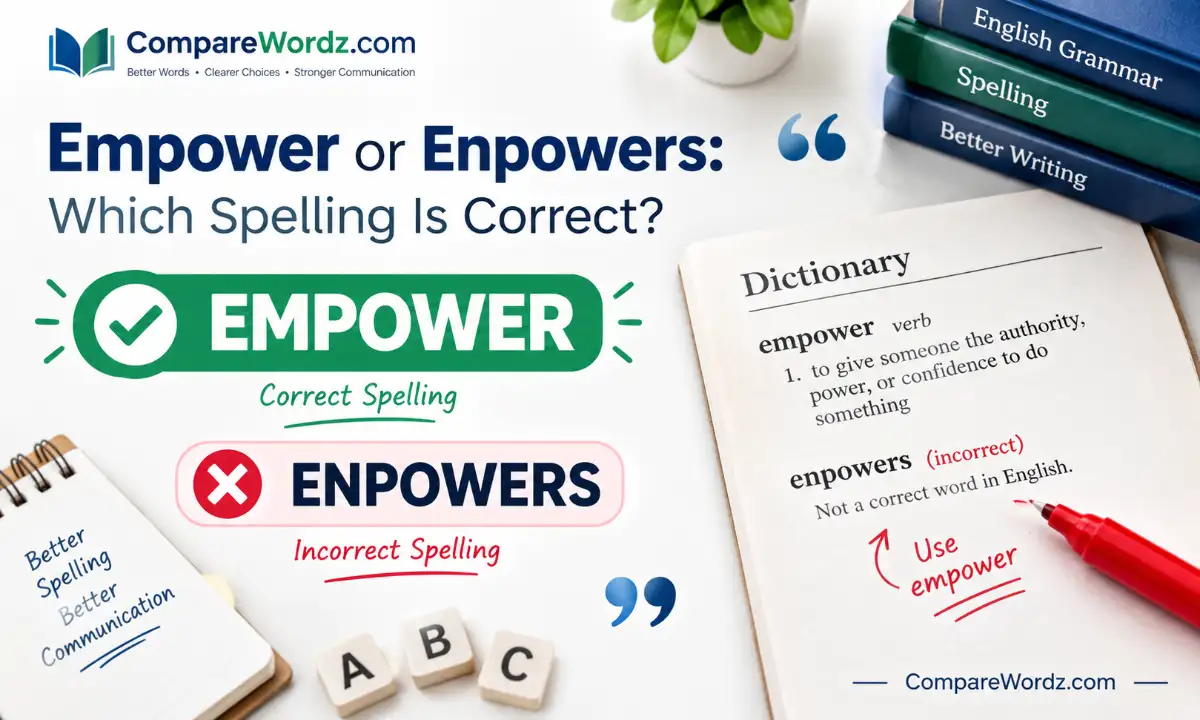
Empower or enpower is a common spelling question, but empower is the correct spelling in standard English.
The word enpower is generally considered a misspelling of empower.
Add a clear meaning and exampleExplain why enpower is incorrect
The confusion is understandable. English has many common words that begin with en-, such as enable, encourage, and enrich.
That pattern can make enpower look like a reasonable spelling.
However, when you mean to give someone power, authority, ability, freedom, or confidence, the established standard form is empower.
The word appears in everyday, academic, business, legal, and professional English.
It can describe giving someone official authority, but it can also describe helping a person or group gain the ability or confidence to act independently.
So, if you are writing an essay, email, report, application, or website, choose empower.
Main Difference in One Line
Empower is the standard spelling of the verb, while enpower is generally a misspelling when the intended word is empower.
Quick Answer
Correct: empower
Incorrect for the intended meaning: enpower
Examples:
- The training will empower employees to make better decisions.
- Good education can empower students to think independently.
- The law empowers the agency to investigate complaints.
There is no British or American spelling difference here. Both varieties use empower.
What Is the Main Difference? Empower or Enpowers
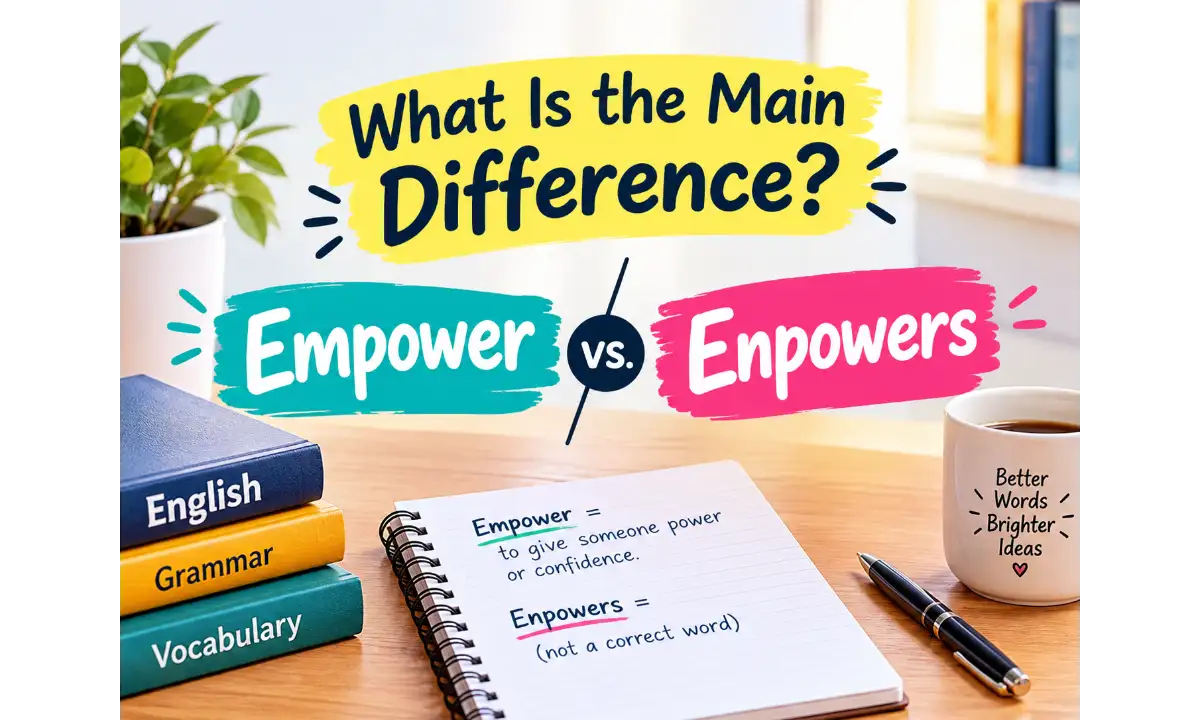
The difference is mainly about standard spelling, not two competing meanings.
Empower is an established verb. Depending on the context, it can mean giving someone official authority or giving them the ability, freedom, confidence, or means to do something.
For example:
The board empowered the director to approve the budget.
Here, empowered means the director was given authority.
Now consider:
The program empowers young people to develop useful skills.
In this sentence, the focus is on ability, opportunity, and greater independence.
By contrast, enpower is not the standard spelling to use for these meanings. If you see it in ordinary modern writing, it is generally best understood as a spelling error for empower.
That makes the practical choice simple: when you mean the established English verb, write empower.
Comparison Table
| Feature | Empower | Enpower |
|---|---|---|
| Standard form | Yes | No, when intended as empower |
| Word type | Verb | Usually a spelling error |
| Meaning | Give power, authority, ability, or freedom | Usually intended to mean empower |
| British English | Used | Not the standard form |
| American English | Used | Not the standard form |
| Formal writing | Appropriate | Avoid |
| Related noun | Empowerment | Not enpowerment |
What Does “Empower” Mean?

Empower is a transitive verb. In simple terms, it means giving someone the power, authority, ability, freedom, or means to do something.
Cambridge gives two important areas of meaning: giving someone official authority or freedom to act, and supporting someone’s ability to do something. Collins also includes the ideas of authority, ability, and giving people the means to become stronger or more successful.
The word can therefore appear in several settings.
Authority
The new rules empower local officials to take action.
Here, the officials receive formal authority.
Ability or opportunity
The course empowers students to build practical skills.
The meaning is broader than legal permission. The course helps students gain the ability to act.
Confidence and independence
Learning to manage money can empower young adults.
In this context, the word suggests greater control, confidence, and independence.
The related noun is empowerment, which refers to the process of gaining or giving greater power, freedom, rights, or control.
What About “Enpower”?

If you are using enpower to mean “give power” or “give authority,” use empower instead.
For example:
❌ The workshop will enpower new employees.
✅ The workshop will empower new employees.
The incorrect form may look plausible because English contains many familiar words beginning with en-. However, English spelling does not always follow a predictable pattern. A word that looks as though it should follow the spelling of another word may still have its own established form.
It is therefore safer to learn this word as:
empower
rather than trying to form it from a general spelling pattern.
Examples in Sentences
Here are some natural examples showing how the verb works in different contexts:
- Education:
Good teaching can empower students to solve problems independently. - Workplace:
The manager empowers staff to handle routine customer issues. - Leadership:
Strong leaders often empower team members instead of controlling every decision. - Law:
The legislation empowers the commission to review complaints. - Technology:
Affordable software can empower small businesses to compete online. - Personal development:
Learning a new skill can empower someone to pursue better career opportunities.
A common grammar pattern is:
empower + person or group + to + verb
For example:
The program empowers workers to make decisions.
The passive form is also common:
Workers are empowered to make decisions.
These patterns are consistent with dictionary examples of the verb.
When to Use Which?
For standard modern English, there is usually no difficult choice.
Use “empower” when you mean:
- Give someone official authority.
- Give someone the ability or means to act.
- Help someone become more confident or independent.
- Give a person or group greater control over decisions.
Do not use “enpower” as an alternative spelling.
It is not a British version of empower, and it is not an American version either. If you are writing for a school, university, workplace, publication, or professional audience, empower is the form to use.
Empower, Enable, or Authorize?
These words are related, but they are not always interchangeable.
Empower can involve authority, ability, confidence, or greater control:
The organization empowers employees to suggest changes.
Enable usually focuses on making something possible or giving someone the ability to do something:
The software enables users to edit files remotely.
Authorize is more specific. It normally refers to giving official permission or approval:
The director authorized the payment.
Choosing the right word depends on what you want to emphasize.
British vs American English
Unlike words such as colour/color or organise/organize, empower does not have separate British and American spellings.
| English variety | Standard form |
|---|---|
| British English | empower |
| American English | empower |
The pronunciation differs slightly between British and American English, but the spelling remains the same. Cambridge lists pronunciations for both varieties.
So, enpower is not a regional spelling.
Grammar Rule: Forms of “Empower”
Because empower is a regular verb, its main forms are easy to learn.
| Form | Example |
|---|---|
| empower | We empower our staff. |
| empowers | The policy empowers workers. |
| empowered | The training empowered the team. |
| empowering | The experience is empowering. |
| empowerment | The program supports employee empowerment. |
The past tense and past participle are empowered. The noun is empowerment. Collins lists empowered as the past tense and past participle and identifies empowerment as a derived noun.
A useful structure to remember is:
subject + empower + person/group + to + verb
Example:
The course empowered participants to communicate more confidently.
You can also use:
person/group + be empowered + to + verb
Example:
Employees are empowered to make routine decisions.
Trick to Remember
The easiest memory trick is to connect the verb with its noun:
empower → empowerment
Both forms begin with emp.
You can also remember the meaning:
Give someone power = empower.
If you are about to write enpower, pause and think of empowerment. That makes the correct spelling easier to recall.
Common Mistakes
Mistake 1: Adding “n”
❌ The program will enpower workers.
✅ The program will empower workers.
Mistake 2: Treating it as a regional spelling
❌ Enpower is the British form.
✅ Empower is used in both British and American English.
Mistake 3: Thinking it only means legal authority
Empower can refer to formal authority, but it can also describe ability, confidence, independence, or greater control.
Mistake 4: Using it when another word is more precise
Sometimes enable or authorize communicates your meaning better. Check what you actually want to say before choosing the verb.
Frequently Asked Questions
Is “enpower” the correct spelling of empower?
No. When you mean the standard verb meaning to give someone power, authority, ability, or freedom, the correct spelling is empower.
What does empower mean?
Empower means to give someone power, authority, ability, freedom, or the means to act. The exact meaning depends on the context.
Is empower British or American English?
It is used in both British and American English. There is no separate regional spelling of the word.
What is the past tense of empower?
The past tense is empowered.
Example:
The training empowered employees to make better decisions.
What is the noun form of empower?
The main noun form is empowerment.
Example:
The program focuses on employee empowerment.
The noun refers to the process of gaining or giving greater power, freedom, rights, or control.
Can I use enpower in formal writing?
It is best to avoid it when you mean empower. In formal writing, use the established spelling empower.
Is empower the same as enable?
Not exactly. Enable usually means making something possible or giving someone the ability to do something. Empower can include that idea but often adds a sense of power, authority, confidence, freedom, or control.
Conclusion
When choosing between empower or enpower, the standard form is empower.
Use it when you mean giving someone authority, ability, freedom, confidence, or the means to act. It is used in both British and American English and works naturally in everyday, academic, business, legal, and professional writing.
Enpower should generally be treated as a spelling mistake when the intended word is empower.
The easiest rule is:
Give someone power or greater ability to act = empower.

Hi, I’m Toseef Mustafa, the creator of CompareWordz.com and a qualified English linguistics professional. My expertise includes English vocabulary, spelling, grammar, word meanings, and commonly confused words. I aim to explain language differences through clear explanations, accurate information, and practical examples. My goal is to help readers understand English better and use the right words with confidence.