

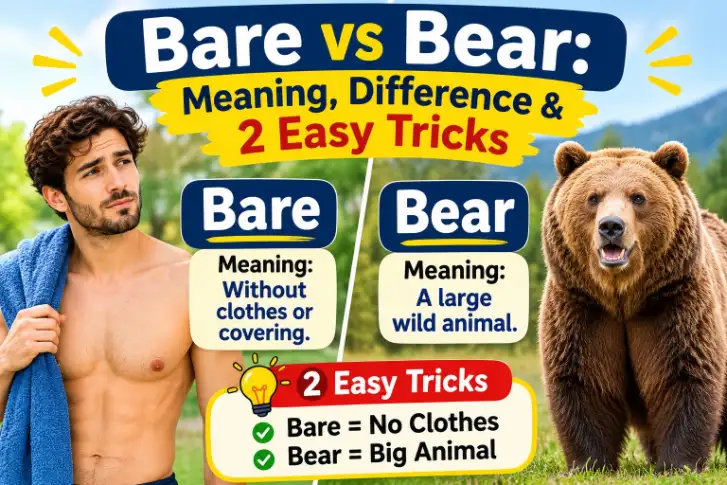
You’re writing a quick email and you type, “Please bare with me.” Something feels off, but you can’t tell what. Is it bare or bear? You’re not alone, because the words sound exactly the same and many people mix them up every day.
This guide explains the bare vs bear question in plain language. You’ll learn what each word means, where each one comes from, and how to use them in emails, school papers, and everyday talk.
We’ll also cover common phrases like bear with me and bare necessities, so you can write them right every time, even when you’re typing fast.
Bare vs Bear: Quick Answer
Bare and bear sound the same but mean different things. Bare means uncovered or empty, like bare feet. Bear can mean to carry or put up with something, or it can be the animal. Say “bear with me,” “bear in mind,” and “bare feet.”
- She walked across the sand in bare feet.
- Please bear with me while I find the file.
- I can’t bear loud noise at night.
- We saw a bear near the campsite.
What Does Bare Mean?
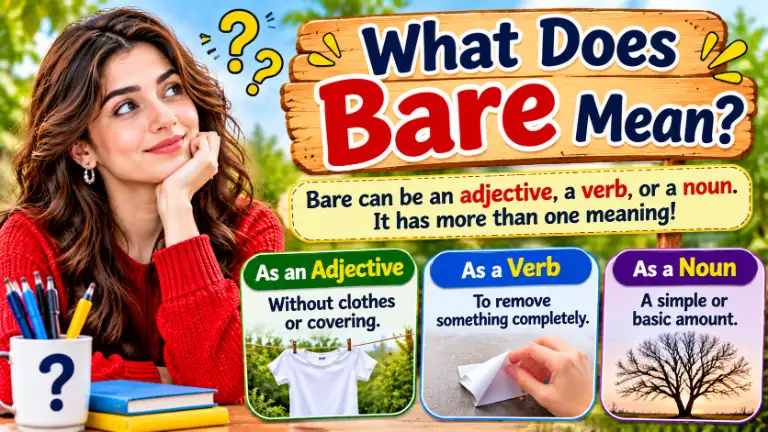
Bare is mainly an adjective, and it can also be a verb.
As an adjective, it means uncovered, empty, or reduced to the basics. Bare feet and bare walls are common examples. It can also mean only the minimum, as in bare necessities.
As a verb, it means to uncover or show. The verb bare has only one meaning: to uncover, as in bare your shoulders or a dog baring its teeth. You can bare your teeth, bare your soul, or bare your arms.
Pronunciation: Often written /bɛr/ in American English. It rhymes with care and share.
Examples:
- The room had bare white walls.
- He bared his heart in a long letter.
- The dog bared its teeth.
Synonyms: uncovered, naked, exposed, empty, plain.
Related words: barely, bareback, barefoot, bared, baring.
What Does Bear Mean?
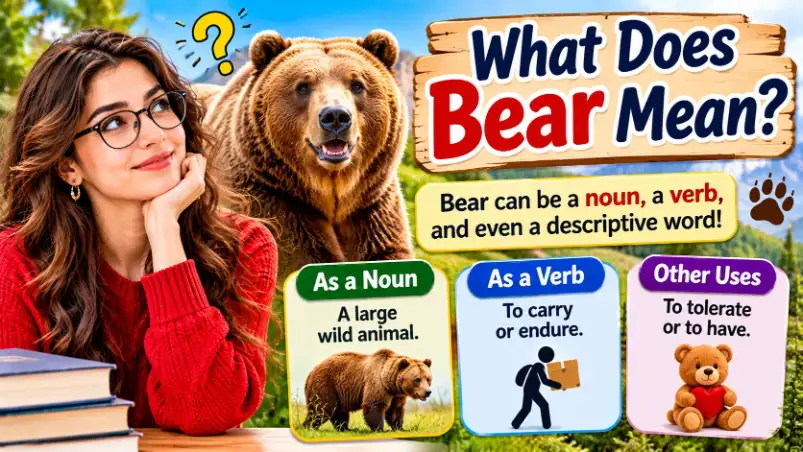
Bear is two different words that share one spelling. It’s a fully valid word and not a mistake for bare.
As a noun, it names the large furry animal. It can also describe a person who resembles a bear, or something hard to deal with, like “the oven is a bear to clean.” In finance, a bear is someone who expects prices to fall.
As a verb, bear has many meanings:
- To carry or support weight.
- To put up with something, as in “I can’t bear the heat.”
- To give birth to, or produce, as in “the tree bears fruit.”
- To turn in a direction, as in “bear left at the fork.”
Common uses include bearing children, the right to bear arms, bearing up under stress, and “it bears repeating.”
Pronunciation: Exactly the same as bare.
Synonyms (verb): carry, endure, tolerate, stand, support.
Key Differences Between Bare and Bear
The biggest difference is meaning. Bare is about being uncovered or minimal. Bear is about carrying, enduring, or the animal.
Spelling: Bare ends with “are.” Bear has “ear.”
Grammar: Bare is an adjective and a verb. Bear is a noun and a verb.
Pronunciation: There’s no difference. They’re homophones.
Usage: Bare shows up with clothing, rooms, and the bare minimum. Bear shows up with patience, weight, animals, and markets.
Bare vs Bear Comparison Table
| Feature | Bare | Bear |
|---|---|---|
| Correct spelling? | Yes | Yes |
| Main part of speech | Adjective and verb | Noun and verb |
| Core meaning | Uncovered, empty, minimal; to uncover | To carry or endure; the animal |
| Pronunciation | /bɛr/ (US) | /bɛr/ (US) |
| Typical subjects | Feet, walls, truth, necessities | Weight, pain, patience, animals |
| Example | The shelves were bare. | I can’t bear the noise. |
| Common mistake | Writing “bare with me” | Writing “bare necessities” as “bear necessities” |
Spelling Rules and Word Forms
Both words are simple to change, but their forms differ.
| Word | Present | Third person | Past | -ing form |
|---|---|---|---|---|
| Bare (verb) | bare | bares | bared | baring |
| Bear (verb) | bear | bears | bore | bearing |
The adjective bare also has comparative forms: barer and barest. The noun bear becomes bears in the plural.
Bear has two past participles, borne and born. Borne is the correct form in all cases except those about childbirth, as in “you have borne the cost” vs. “I wasn’t born yesterday.”
Related word: bearable (can be endured). For a spelling check on that one, see bearable or bareable.
Origin and History of Bare and Bear
Where Bare Comes From
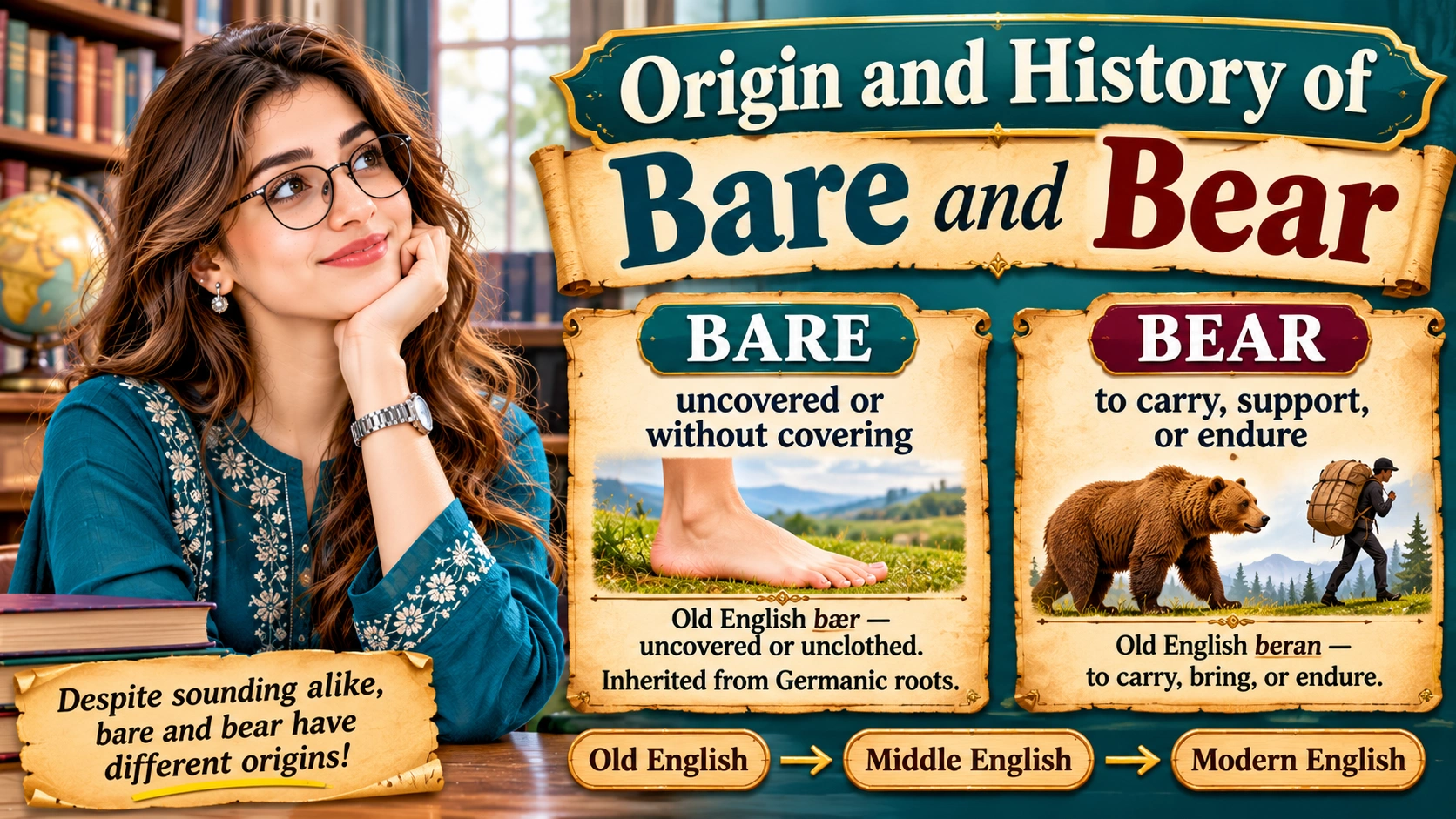
Bare is very old. It comes from Old English bær, meaning naked, uncovered, or unclothed, from Proto-Germanic *bazaz. The sense “sheer, absolute” appeared around 1200, from the idea of something “complete in itself.” That’s why we say “the bare facts.”
Where Bear Comes From
The verb bear also goes back to Old English. It comes from Old English beran, meaning to carry, bring forth, endure, or support.
The animal has a different story. It comes from Old English bera, from a Proto-Germanic word meaning “the brown one.” So bare and bear are unrelated, even though they look similar.
British English vs American English
There is no spelling difference between British and American English here. Both words are spelled the same, and they stay identical to each other in both accents. The vowel may sound a little different, often written /bɛr/ in the US and /bɛə/ in the UK. The same rules apply to readers in Canada, Australia, India, and Pakistan.
| Feature | American English | British English |
|---|---|---|
| Bare spelling | bare | bare |
| Bear spelling | bear | bear |
| Pronunciation | Same as each other | Same as each other |
| Meanings | Same | Same |
When to Use Bare
Use bare when something is uncovered, empty, or reduced to the basics.
- Formal and academic writing: “The report lays bare the problems in the budget.”
- Workplace writing: “We only have the bare minimum of staff today.”
- Daily conversation: “The cupboards were bare, so we ordered pizza.”
- Emails: “Here are the bare facts so far.”
When to Use Bear
Use bear when you mean to carry, endure, give birth to, or the animal.
- Formal and academic writing: “The bridge must bear heavy traffic.”
- Workplace writing: “Please bear in mind that deadlines may shift.”
- Daily conversation: “I can’t bear this hot weather.”
- Emails: “Bear with us as we update the system.”
Bear is not wrong in any of these uses. It’s only wrong when you mean uncovered or empty.
Common Mistakes with Bare and Bear
Mistake: Writing bare with me
- Incorrect: Please bare with me.
- Correct: Please bear with me.
- Why: The phrase means be patient. Bare would mean uncover.
- Why beginners miss it: The words sound alike, so the spelling gets mixed up.
- Tip: Think “carry” or “tolerate.” Pick bear.
Mistake: Writing bare in mind
- Incorrect: Bare in mind that it closes at five.
- Correct: Bear in mind that it closes at five.
- Why: “Bear in mind” means take into account.
- Why beginners miss it: Bare is more common in everyday writing.
- Tip: You carry a thought in mind. Bear.
Mistake: Writing bear necessities
- Incorrect: Pack only the bear necessities.
- Correct: Pack only the bare necessities.
- Why: Bare necessities means only what’s needed.
- Why beginners miss it: The song title can stick in your head with the animal.
- Tip: Necessities stripped down are bare.
Mistake: Writing bear feet
- Incorrect: He walked in bear feet.
- Correct: He walked in bare feet.
- Why: Uncovered feet are bare.
- Why beginners miss it: Bear is a more familiar spelling.
- Tip: If nothing covers it, use bare.
Mistake: Writing bare for enduring
- Incorrect: I can’t bare the pain.
- Correct: I can’t bear the pain.
- Why: Enduring something is bear.
- Why beginners miss it: Bare and bear sound the same when read aloud.
- Tip: Ask “Is it about enduring?” If yes, bear.
Mistake: Writing bear for uncovering
- Incorrect: She bore her soul to him.
- Correct: She bared her soul to him.
- Why: Uncovering feelings is bare.
- Why beginners miss it: Bear has more meanings, so it comes to mind first.
- Tip: Bare your soul means uncover your soul.
Mistake: Trusting spell check
- Incorrect: That’s the bear minimum.
- Correct: That’s the bare minimum.
- Why: Both words are real, so spell check often misses the error.
- Why beginners miss it: Software checks spelling, not meaning.
- Tip: Reread any sentence with either word before you send it. For more spelling traps, see misspell or mispell.
Easy Trick to Remember Bare vs Bear
Think of it this way: bear has “ear” inside. When you ask someone to bear with you, you’re asking them to lend an ear. Bare means nothing on top, like a bare floor with no rug.
Another quick check is to swap in a simple word:
- If “uncovered” fits, use bare.
- If “carry” or “put up with” fits, use bear.
Everyday Examples of bare vs bear
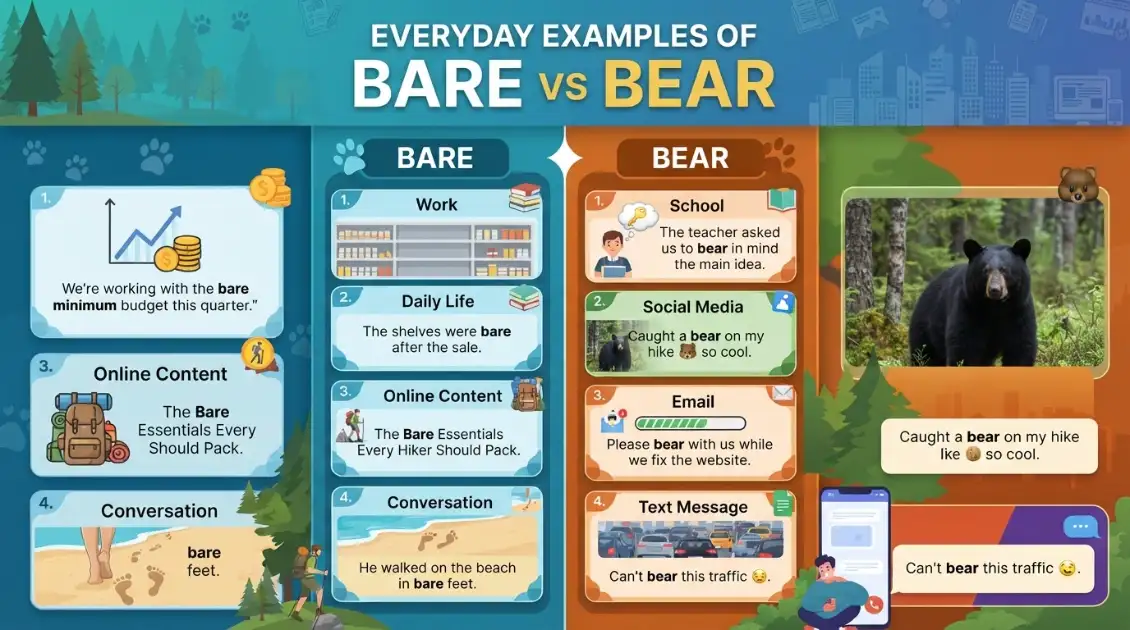
Work: “We’re working with the bare minimum budget this quarter.”
School: “The teacher asked us to bear in mind the main idea.”
Social media: “Caught a bear on my hike 🐻 so cool.”
Daily life: “The shelves were bare after the sale.”
Email: “Please bear with us while we fix the website.”
Text message: “Can’t bear this traffic 😩.”
Online content: “The Bare Essentials Every Hiker Should Pack.”
Conversation: “He walked on the beach in bare feet.”
Different Contexts and Usage
Workplace and Business
At work, “bear with me” asks for patience. “The bare minimum” describes the lowest acceptable effort. You’ll also hear “bear the cost,” which means to pay or take on an expense.
Finance
In the stock market, a bear market means prices are falling. The word bear is a noun used like an adjective in this phrase. Bear is properly a noun and is only used like an adjective in the financial phrase bear market.
Home and Design
Bare describes empty spaces, like bare walls, bare floors, and bare shelves. Designers also talk about bare wood, meaning wood with no paint or stain.
Fashion and Beauty
Bare appears in bare shoulders, bare arms, and a bare face. A bare face means no makeup. There’s an important difference between the “right to bear arms,” which means to carry weapons, and the “right to bare arms,” which means uncovered arms.
Nature and Wildlife
Bear is the animal in sentences about camping, parks, and wildlife. Bears can also be described as brown, black, or polar, depending on the species.
Emotion and Writing
Writers use bare for honesty, as in “lay bare” or “bare your soul.” They use bear for emotional strength, as in “I can’t bear to say goodbye.”
Slang and Pop Culture
In some informal slang, bare can mean “a lot of,” as in “bare people.” You won’t see this in formal writing. The song “The Bare Necessities” is a popular reminder that this phrase uses bare.
Education and Grammar Learning
Teachers use bare and bear to show how homophones work. Other near matches worth practicing include everyday or every day.
Google Trends and Search Insights
I couldn’t pull live Google Trends figures, so I won’t quote numbers or regional rankings. What I can say is why people keep searching this pair.
What drives the searches:
- The words are homophones, so your ear gives no clue.
- Bear has many meanings, which adds to the confusion.
- Spell check usually stays quiet, since both are real words.
- Common phrases like “bear with me” are easy to mistype.
Useful long-tail searches include: bear with me or bare with me, bare minimum or bear minimum, bare necessities meaning, bear in mind meaning, and bear market meaning.
Related Searches and People Also Ask
Is it bear with me or bare with me? It’s bear with me. It means be patient.
Is it bear in mind or bare in mind? It’s bear in mind. It means keep something in your thoughts.
Is it bare feet or bear feet? It’s bare feet, meaning feet with no shoes.
Is it bear arms or bare arms? Bear arms means carry weapons. Bare arms means uncovered arms.
Is it bare necessities or bear necessities? It’s bare necessities, meaning only what you need.
Is it bare minimum or bear minimum? It’s bare minimum, meaning the least possible.
What does lay bare mean? It means to reveal or uncover something.
What does bear market mean? It’s a time when stock prices keep falling.
Is it bared or beared? It’s bared, for uncovering. Beared is not a standard word.
What is the past tense of bear? It’s bore, with borne or born as the participle.
Is bare a verb? Yes, but only for uncovering.
What does grin and bear it mean? It means put up with something unpleasant without complaining.
Frequently Asked Questions
Are bare and bear homophones?
Yes. They sound exactly the same but have different spellings and meanings.
How many words are there in bare vs bear?
There are three. Bare is one word, and bear is two: the animal and the verb.
Can bear be an adjective?
Almost never. The main exception is the finance phrase bear market.
What is the plural of bear?
The plural is bears.
Does spell check catch bare vs bear mistakes?
Usually not. Both are real words, so you need to reread the sentence.
Can bare and bear appear in the same sentence?
Yes. For example, “The bear’s bare paws left prints in the snow.”
Do bare and bear share the same root?
No. Bare comes from an old word for naked, while bear comes from words for carrying or for the brown animal.
Is bare ever used to mean “a lot of”?
Only in some informal slang. Avoid it in school or work writing.
Final Verdict
Use bare when something is uncovered, empty, or reduced to the basics. Use bear when you mean to carry, endure, give birth to, or the animal.
The easiest rule: bear has “ear,” and you lend an ear when you bear with someone. Bare means nothing on top.
Conclusion
The bare vs bear question comes down to one idea. Bare is about being uncovered or reduced to the basics, while bear is about carrying, enduring, or the animal. They sound the same, so your ears won’t help you. Your eyes and the meaning will.
Before you hit send, ask yourself one thing: is something uncovered, or is something being carried or tolerated? Pick bare for the first and bear for the second. For an extra check, the Merriam-Webster guide to bare vs bear is a handy reference. And if you’re ever unsure, remember this tip: bear has “ear,” and you lend an ear when you bear with someone.

I’m MK Jan Mustafa Kamal, the author of CompareWordz.com, specializing in English linguistics, word meanings, spelling, and language usage.
I hold an M.A. in English and have 8 years of experience in English language and vocabulary studies. My goal is to explain confusing words, spelling differences, grammar rules, and meanings in clear, simple, and accurate language. I focus on providing well-researched, fact-checked, and easy-to-understand content that helps readers use English with confidence. Through CompareWordz.com, I aim to make learning English words and their correct usage easier for everyone.