


Have you ever stopped while writing because you could not decide between wear and ware? These words sound exactly alike, but their meanings are different. One describes clothing, accessories, or damage caused by regular use.
The other refers to products and manufactured goods. This confusion can appear in school assignments, workplace emails, product descriptions, and everyday conversations.
People often search for the wear vs ware meaning, correct spelling, pronunciation, examples, and usage rules. Knowing the difference will help you write clearly and avoid common spelling mistakes.
In this guide, you’ll learn the meaning, pronunciation, examples, usage, grammar rules, common mistakes, expert tips, and simple explanations in easy English.
Quick Answer: Wear vs Ware
Both wear and ware are correct English words. However, they have different meanings and uses.
- Wear: A verb meaning to have clothes, shoes, or accessories on your body. It can also describe damage caused by regular use. As a noun, it can refer to clothing or the condition of something used over time.
- Ware: A noun referring to goods, products, or manufactured objects.
Examples:
- I wear a blue shirt every Monday.
- The store sells beautiful kitchenware.
- These shoes show signs of wear.
- She collects handmade glassware.
- My father wears reading glasses.
Simple Rule: You wear clothes, but you buy ware.
What Does Wear vs Ware Mean?
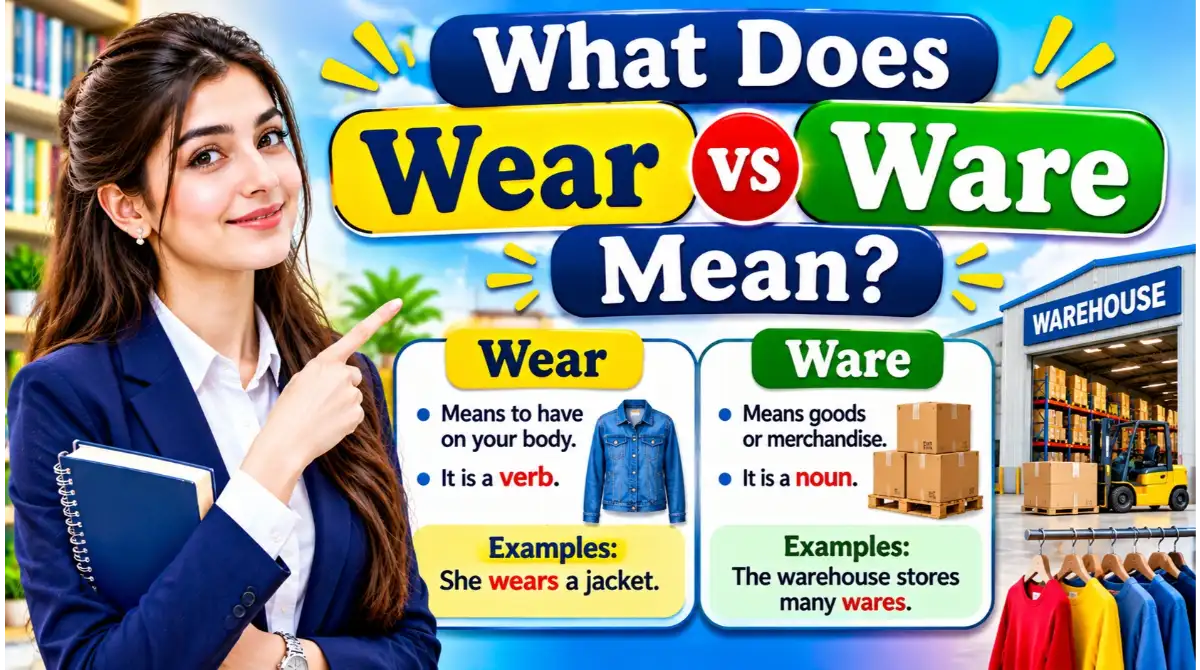
The easiest way to understand these words is to look at their meanings separately. Although they share the same pronunciation, they cannot replace each other in every sentence.
What Does Wear Mean?
Wear means to have something on your body, such as clothes, shoes, glasses, or jewelry. It is commonly used as a verb.
It can also describe damage that develops when something is used repeatedly.
For example:
- I wear comfortable shoes to work.
- She wears a beautiful necklace.
- Please wear your school uniform.
- The carpet shows signs of wear.
- My old shoes are starting to wear out.
Wear also appears in expressions related to appearance and clothing.
For example, you can wear a smile, wear a uniform, or wear formal clothes.
Synonyms of Wear
The synonyms depend on the meaning:
- Put on.
- Dress in.
- Have on.
- Don.
- Clothing.
- Apparel.
- Attire.
For the damage-related meaning, useful alternatives include deterioration, damage, and erosion, depending on the context.
Related Words
- Wearing.
- Wore.
- Worn.
- Wearable.
- Wearer.
- Wear and tear.
- Wear out.
- Worn-out.
What Does Ware Mean?
Ware is a noun that refers to goods, products, or manufactured objects. It is often used in compound words to describe products by their material or purpose.
For example:
- Kitchenware includes cooking tools and kitchen equipment.
- Glassware refers to objects made from glass.
- Tableware includes plates, cups, and serving items.
- Silverware commonly refers to eating utensils.
- Housewares include useful products for the home.
The word can also refer to merchandise displayed or offered for sale.
For example:
The street vendor displayed his wares at the market.
Synonyms of Ware
Depending on the sentence, related words include:
- Goods.
- Products.
- Merchandise.
- Items.
- Commodities.
- Stock.
Related Compound Words
| Word | Meaning |
|---|---|
| Kitchenware | Products used in a kitchen. |
| Glassware | Objects made from glass. |
| Tableware | Plates, cups, and serving products. |
| Silverware | Eating utensils and table items. |
| Hardware | Tools and physical equipment. |
| Software | Computer programs and applications. |
| Housewares | Products used around the home. |
| Earthenware | Objects made from baked clay. |
What Is the Opposite of Wear or Ware?
Neither word has one universal opposite.
- For wear meaning putting on clothes, remove or take off can express the opposite action.
- For wear meaning damage, preserve or protect may express the opposite idea.
- Ware has no direct opposite because it describes goods or products.
The Origin of Wear vs Ware
These words have different histories, even though their modern pronunciations are alike.
History of Wear
The word wear comes from Old English werian, which meant to clothe, cover, or put something on.
Its meaning developed over time. It became associated with both clothing and the gradual damage caused by repeated use.
That history helps explain expressions such as:
- Wear out.
- Wear down.
- Wear away.
- Wear and tear.
History of Ware
The word ware comes from Old English waru, meaning goods or merchandise.
People used it to describe products and objects made, collected, or offered for sale.
Today, it remains common in product-related words such as kitchenware, glassware, and tableware.
How to Pronounce Wear vs Ware

One reason people confuse these words is that they sound the same.
Both are pronounced with one syllable. Their pronunciation is generally represented as /wer/ in American English and /weə(r)/ in traditional British English transcription.
| Word | Simple pronunciation | Syllables |
|---|---|---|
| Wear | Wair | 1 |
| Ware | Wair | 1 |
Speaking Tip: Say both words aloud. You will notice that their sounds are alike, even though their spellings and meanings are different.
Do not try to pronounce the final letters separately. The correct choice depends on the sentence, not the sound.
British English vs American English Usage
There is no major spelling difference between British and American English for these words.
Both varieties use wear for clothing and damage, and ware for goods and products.
| Feature | British English | American English | Notes |
|---|---|---|---|
| Clothing | Wear | Wear | Same spelling. |
| Products | Ware | Ware | Same spelling. |
| Damage | Wear | Wear | Same meaning. |
| Kitchen products | Kitchenware | Kitchenware | Same spelling. |
| Pronunciation | /weə(r)/ | /wer/ | Accent differences. |
| Wear out | Wear out | Wear out | Same expression. |
You can use both words in academic assignments, workplace communication, business writing, and everyday conversations.
Which One Should You Use?
Your choice depends on what you are describing.
Use wear when talking about:
- Clothes and fashion.
- Shoes and accessories.
- Glasses and jewelry.
- Uniforms and protective clothing.
- Damage caused by regular use.
- Something becoming weaker or less useful.
Use ware when talking about:
- Manufactured products.
- Kitchen equipment.
- Glass objects.
- Household goods.
- Commercial merchandise.
- Products made from particular materials.
Quick Usage Table
| Situation | Correct word | Example |
|---|---|---|
| Clothing | Wear | Wear a jacket. |
| Footwear | Wear | I wear running shoes. |
| Damage | Wear | The tires show wear. |
| Kitchen products | Ware | Buy new kitchenware. |
| Glass products | Ware | The shop sells glassware. |
| Merchandise | Ware | The seller displayed his wares. |
Common Mistakes With Wear vs Ware
These mistakes often happen because both words sound alike. Understanding the sentence meaning will help you avoid them.
Using Ware Instead of Wear for Clothing
❌ I ware a blue shirt.
✔ I wear a blue shirt.
Explanation: Use wear when describing clothes you have on your body.
Correction Tip: Remember that clothing belongs with wear.
Using Wear Instead of Ware for Kitchen Products
❌ The shop sells kitchenwear.
✔ The shop sells kitchenware.
Explanation: Kitchenware refers to cooking tools, utensils, and other kitchen products.
Correction Tip: Product categories often use the ending -ware.
Writing Ware Out Instead of Wear Out
❌ My shoes are starting to ware out.
✔ My shoes are starting to wear out.
Explanation: Wear out means to become damaged or unusable through regular use.
Correction Tip: Remember the expression wear and tear.
Confusing Signs of Wear With Signs of Ware
❌ The machine shows signs of ware.
✔ The machine shows signs of wear.
Explanation: Wear describes damage caused by friction, age, or repeated use.
Correction Tip: When discussing damaged equipment, use wear.
Using Ware for Clothing Products
❌ The company sells formal ware.
✔ The company sells formal wear.
Explanation: Formal wear describes clothing worn at special events or professional occasions.
Correction Tip: Clothing categories commonly use wear, as in sportswear and footwear.
Confusing Wear With Where
❌ Where your safety glasses.
✔ Wear your safety glasses.
Explanation: Where refers to a place or location. Wear refers to putting something on your body.
Correction Tip: Check whether your sentence describes a location or an action.
Treating Both Words as Interchangeable
❌ The store sells kitchen wear.
✔ The store sells kitchenware.
Explanation: Kitchenware is the standard spelling for products used in a kitchen.
Correction Tip: Learn common compound words instead of relying only on pronunciation.
Wear vs Ware in Everyday Examples
Real-life sentences make the difference easier to understand.
At Work
- Employees must wear their identification badges.
- Workers should wear safety shoes.
- The factory checks equipment for signs of wear.
- The company manufactures glassware.
At School
- Students wear uniforms every day.
- Our science laboratory contains glassware.
- Please wear your sports shoes.
- The teacher explained the meaning of kitchenware.
On Social Media
- I love to wear comfortable outfits.
- Check out my new kitchenware collection.
- These shoes show signs of wear.
- Our store has beautiful glassware available.
In Daily Conversations
- What should I wear tonight?
- I need new kitchenware for my apartment.
- My old shoes are worn out.
- Where did you buy that glassware?
In Emails and Professional Messages
- Please wear formal clothes for tomorrow’s meeting.
- Our store offers high-quality kitchenware.
- The equipment shows signs of regular wear.
- We are introducing a new range of glassware.
Wear, Wore, and Worn: What’s the Difference?
These three words belong to the same verb family. However, they are used in different grammatical situations.
| Word | Grammar role | Example |
|---|---|---|
| Wear | Present form | I wear glasses. |
| Wore | Simple past | I wore glasses yesterday. |
| Worn | Past participle | I have worn these shoes before. |
Wear
Use wear when describing a present action or a regular habit.
Example: She wears a uniform to school.
Wore
Use wore when talking about something that happened in the past.
Example: He wore a black jacket yesterday.
Worn
Use worn with helping verbs such as has, have, and had.
Example: These shoes have been worn many times.
Remember: Wear, wore, and worn are forms of the same verb. Ware is a different noun.
Wear vs Where vs Ware
Another common spelling problem involves three words: wear, where, and ware.
All three sound alike in many English accents, but their meanings are different.
| Word | Meaning | Example |
|---|---|---|
| Wear | Put on clothing or describe damage. | Wear your coat. |
| Where | Refers to a place or location. | Where is your coat? |
| Ware | Refers to goods or products. | Buy kitchenware. |
When to Use Where
Where is used when asking about a location or position.
Examples:
- Where do you live?
- Where is my phone?
- Where can I buy glassware?
Easy Trick: If your sentence asks about a place, use where. If it describes clothing, use wear. If it describes products, use ware.
Wear and Tear: Meaning and Examples
Wear and tear is a common English expression. It refers to the normal damage that happens when something is used over time.
It is often used when discussing cars, furniture, machines, buildings, and household products.
Examples:
- My shoes show signs of wear and tear.
- The old sofa has normal wear and tear.
- The car’s tires have suffered considerable wear and tear.
- Regular cleaning can help reduce wear and tear on furniture.
The expression is especially common in product warranties, rental agreements, insurance discussions, and maintenance reports.
Wear Out or Ware Out: Which Is Correct?
The correct expression is wear out, not ware out.
Wear out is a phrasal verb. It describes something becoming damaged or unusable after repeated use.
It can also describe a person becoming extremely tired.
Examples:
- My favorite shoes have started to wear out.
- Heavy use can wear out a machine.
- Running all day can wear you out.
- The old carpet is completely worn out.
Remember: Wear out is always the correct spelling when describing damage or exhaustion.
Wear vs Ware in Different Contexts
Both words appear in different industries and situations.
Fashion and Clothing
Wear is widely used in the fashion industry to describe clothing and accessories.
Common examples include:
- Casual wear.
- Formal wear.
- Sportswear.
- Menswear.
- Womenswear.
- Footwear.
Manufacturing and Retail
Ware is common in product descriptions, manufacturing, and retail businesses.
Examples include:
- Kitchenware manufacturing.
- Glassware production.
- Ceramic ware.
- Metalware.
- Household goods.
Business and Marketing
Businesses use these words when describing their products and services.
For example:
- A clothing company sells casual wear.
- A kitchen store sells kitchenware.
- A manufacturer produces ceramic ware.
- A fashion brand promotes summer wear.
Technology
The ending -ware also appears in several technology-related terms.
| Term | Meaning |
|---|---|
| Hardware | Physical parts of a computer. |
| Software | Computer programs and applications. |
| Firmware | Software built into electronic devices. |
| Malware | Software designed to cause harm. |
| Freeware | Software available at no cost. |
These terms are related through their spelling patterns, but each has its own meaning.
Wear vs Ware for Students and English Beginners
English learners often find homophones confusing because pronunciation does not always show the correct spelling.
You can improve your understanding by following these steps:
- Identify what the sentence is describing.
- Check whether it refers to clothing or products.
- Look for words connected with damage or repeated use.
- Learn common compound words such as kitchenware and glassware.
- Practice using each spelling in original sentences.
Quick Practice
Choose the correct word in each sentence.
Test your understanding
5 questions
1. I ___ a white shirt to school.wearware
2. This shop sells kitchen___.wearware
3. My shoes are starting to ___ out.wearware
4. The store sells beautiful glass___.wearware
5. The carpet shows signs of ___.wearware
Check my answers
Expert Tips to Remember Wear vs Ware
A few simple habits can help you avoid these spelling mistakes.
- Focus on meaning: Do not choose a spelling based only on sound.
- Learn word families: Remember wear, wore, and worn together.
- Recognize compound words: Kitchenware, glassware, and tableware are useful examples.
- Learn common expressions: Practice wear out and wear and tear.
- Proofread carefully: Read the complete sentence before publishing.
- Use reliable dictionaries: Check unfamiliar expressions instead of guessing.
For more commonly confused English words, explore these related guides:
- Gauge or Gage: Which Spelling Is Correct?
- Everyday or Every Day: What’s the Difference?
- Occurred or Occured: The Correct Spelling
For dictionary definitions, consult the Cambridge Dictionary: Wear and Oxford Learner’s Dictionary: Ware.
Related Searches and Common Questions
Readers searching for this topic may also have these questions.
Is wear a real English word?
Yes. Wear is a correct word used for clothing, accessories, and damage caused by repeated use.
Is ware a real English word?
Yes. Ware is a noun referring to products, goods, and manufactured objects.
What is the difference between wear and wear out?
Wear can describe putting on clothes or damage. Wear out means something becomes damaged or a person becomes exhausted.
What does wear and tear mean?
It describes normal damage caused by regular use over time.
Can ware refer to clothing?
Not usually. Wear is the standard word for clothing, while ware generally refers to products.
Is kitchenware or kitchenwear correct?
Kitchenware is correct. It describes products and equipment used in kitchens.
Is glasswear or glassware correct?
Glassware is correct when referring to objects made from glass.
What are the synonyms of wear?
Depending on the meaning, related words include put on, dress in, apparel, attire, and clothing.
What are the synonyms of ware?
Related words include goods, products, merchandise, items, and commodities.
Are wear and ware pronounced the same?
Yes. They are homophones and have the same pronunciation in standard English accents.
What is the past tense of wear?
The simple past tense is wore. The past participle is worn.
Is wear a noun or a verb?
Wear can be both. It can describe putting on clothing or refer to clothing and damage.
Final Verdict: Wear vs Ware
Both words are correct, but their meanings are different.
- Wear: Clothing, accessories, and damage caused by use.
- Ware: Goods, products, and manufactured objects.
Use wear when discussing what someone puts on or how something becomes damaged. Use ware when describing products and merchandise.
Conclusion
Understanding wear vs ware becomes simple when you focus on the meaning instead of pronunciation. Both words sound alike, but they serve different purposes in English. Wear describes clothing, accessories, and damage caused by regular use, while ware refers to manufactured goods and products.
Learning their common expressions, compound words, and sentence patterns will help you avoid spelling mistakes in everyday writing. Remember one simple rule: you wear clothes, but you buy ware. This small trick can make a big difference in your English writing.

Hi, I’m Toseef Mustafa, the creator of CompareWordz.com and a qualified English linguistics professional. My expertise includes English vocabulary, spelling, grammar, word meanings, and commonly confused words. I aim to explain language differences through clear explanations, accurate information, and practical examples. My goal is to help readers understand English better and use the right words with confidence.