

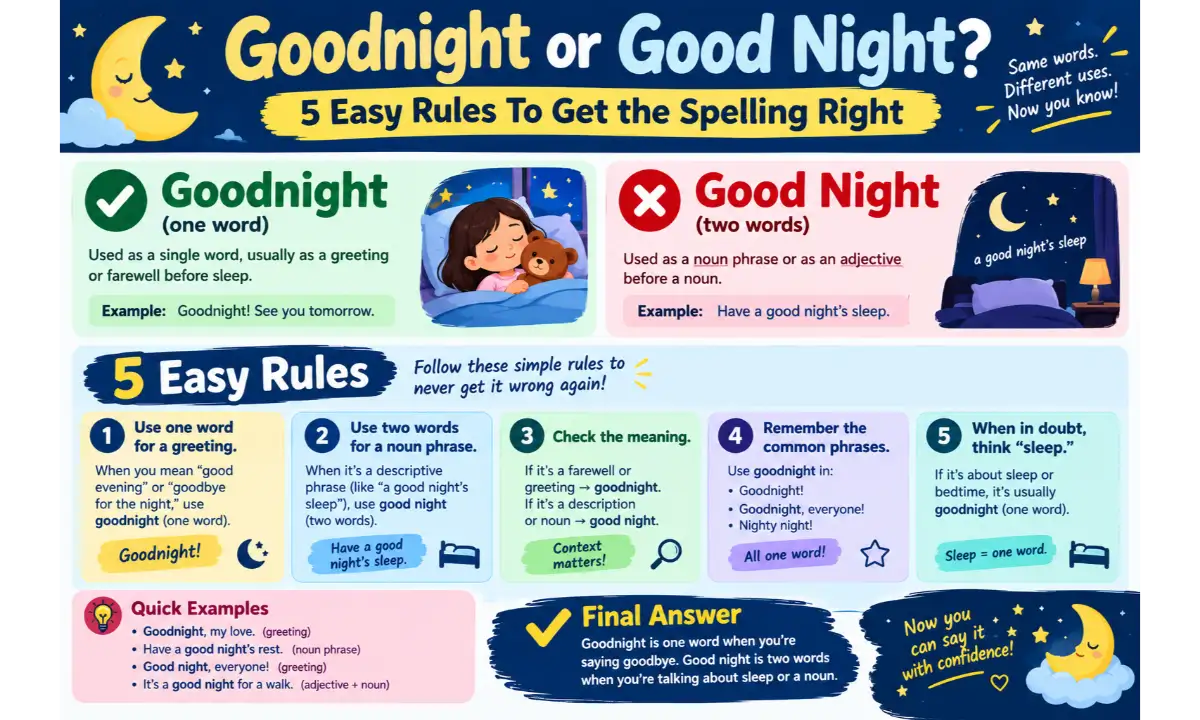
Goodnight or good night—which spelling should you use when saying goodbye before bed?
Both forms are accepted in English, but good night is the conventional choice for a standard farewell,
while goodnight is also common in informal conversations. The right choice depends on how you use the expression.
In this guide, you will learn the difference between goodnight and good night, discover their meanings, and see practical examples
for everyday conversations, text messages, and formal writing. You will also learn five easy rules to help you remember the correct spelling.
Quick Answer: Goodnight or Good Night?
Good night is the standard two-word spelling used to say goodbye in the evening or before going to sleep. Goodnight is an accepted one-word alternative, especially in informal farewells. The one-word form is also common in expressions such as goodnight kiss and goodnight story.
Here are a few examples.
- Good night, Mom. See you in the morning.
- Goodnight, sweetheart. Sleep well.
- She gave her daughter a goodnight kiss.
- We had a good night at the wedding.
Notice the difference in the last two examples. In goodnight kiss, the one-word form describes a kiss associated with bedtime. In a good night, the adjective good describes the noun night.
What Is the Difference Between Goodnight and Good Night?
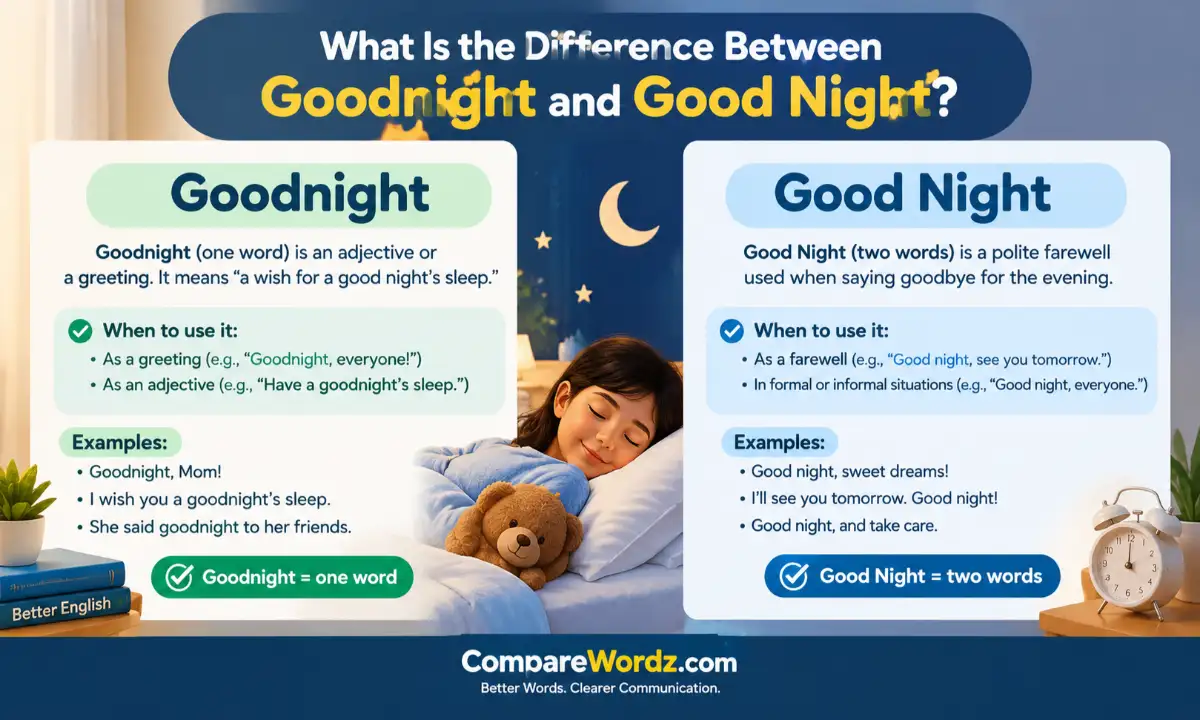
The main difference is how the words are written and used in a sentence. Both forms can express a farewell, but their grammatical roles and contexts can differ.
| Good night | Goodnight |
|---|---|
| Written as two words. | Written as one word. |
| The conventional spelling for a farewell. | An accepted alternative, especially in informal farewells. |
| Can describe a pleasant night or experience. | Commonly appears in bedtime-related compounds. |
| Example: Have a good night. | Example: She gave him a goodnight hug. |
For everyday and professional writing, good night is a reliable default when saying goodbye. However, goodnight is also recognized in English, so it is not automatically a spelling mistake.
What Does Good Night Mean?
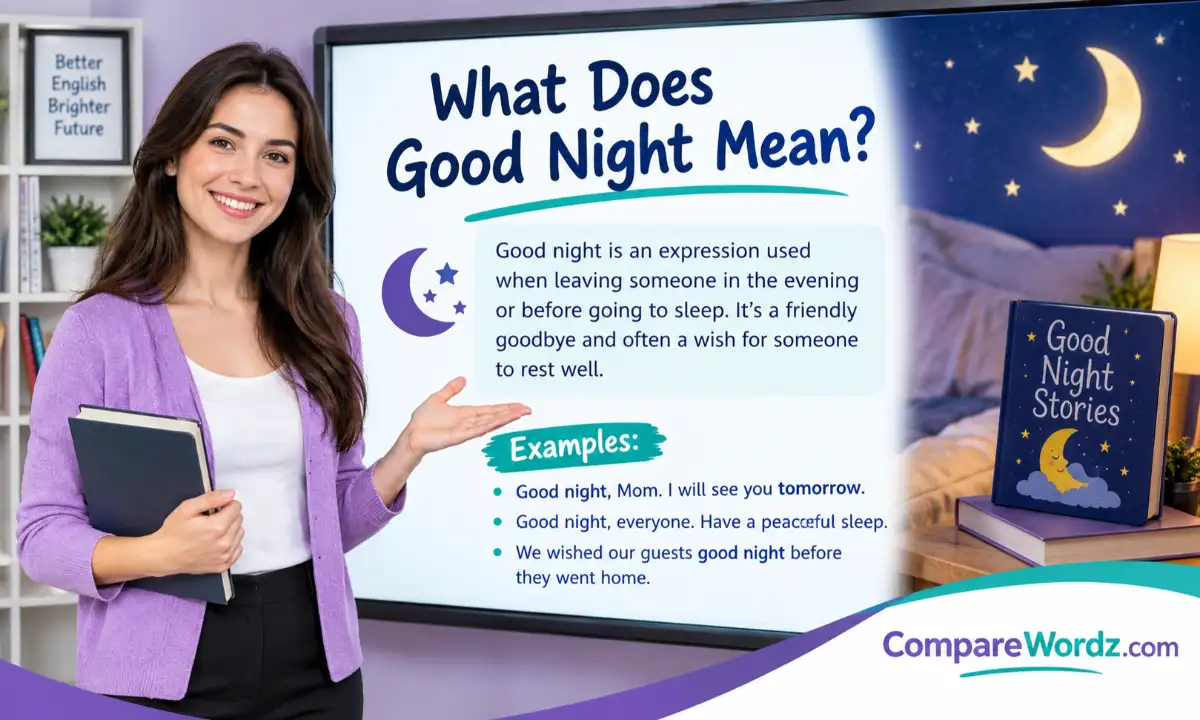
Good night is an expression used when leaving someone in the evening or before going to sleep. It communicates a friendly goodbye and often expresses a wish for someone to rest well.
The phrase can also describe an enjoyable evening or nighttime experience.
Examples of Good Night in Sentences
- Good night, Dad. I will see you tomorrow.
- She said good night to her friends before leaving.
- Good night, everyone. Have a peaceful sleep.
- We wished our guests good night before they went home.
- Have a good night, and enjoy your weekend.
- We had a good night at the concert.
- They spent a good night celebrating their anniversary.
In the sentence We had a good night at the concert, the words describe an enjoyable experience rather than a farewell.
What Does Goodnight Mean?
Goodnight is a recognized one-word form of the expression used to say goodbye at night. It is particularly common in informal conversations, affectionate messages, and bedtime-related expressions.
The word can also appear in compounds that describe something associated with going to sleep.
Examples of Goodnight in Sentences
- Goodnight, my love. Sweet dreams!
- The mother gave her baby a goodnight kiss.
- Dad read a goodnight story to his children.
- I sent my best friend a goodnight message.
- The little girl asked for a goodnight hug.
- They said their goodnights before leaving the party.
In goodnight story, the word describes a story associated with bedtime. This is a common use of the one-word spelling.
When Should You Use Good Night or Goodnight?
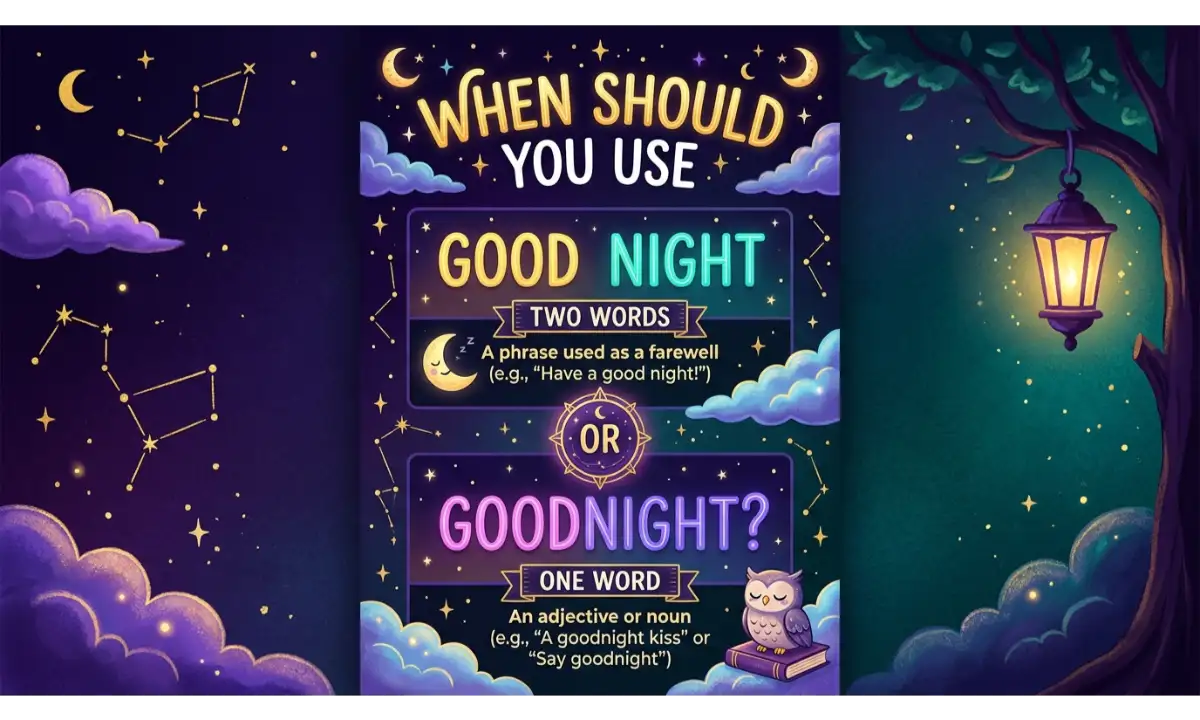
Choosing the right form becomes easier when you consider the sentence’s meaning, purpose, and level of formality.
1. Use Good Night for a Standard Farewell
When you want to end a conversation or leave someone in the evening, good night is the conventional choice.
Examples:
- Good night! See you tomorrow.
- Good night, Sarah. Take care.
- I said good night before going upstairs.
- Have a good night!
- It was lovely seeing you. Good night.
This form works well in everyday conversations, school assignments, and professional communication.
2. Use Goodnight in Casual Messages
Goodnight is also widely used in informal conversations, particularly when messaging friends, family members, or someone close to you.
Examples:
- Goodnight! Talk to you tomorrow.
- Goodnight, bestie. Sweet dreams!
- I am going to bed now. Goodnight!
- Goodnight, everyone. See you soon.
- Sleep well, and goodnight!
Both spellings are understandable in these situations, although good night remains the conventional two-word form.
3. Use Goodnight in Bedtime-Related Expressions
The one-word spelling commonly appears before nouns associated with bedtime, sleep, or nighttime routines.
Examples:
- She gave her son a goodnight kiss.
- Grandma read a goodnight story.
- He sent his wife a goodnight message.
- The children said a goodnight prayer.
- Her little brother wanted a goodnight hug.
These expressions are familiar in everyday English and are useful to learn as complete phrases.
4. Use Good Night When Describing an Enjoyable Evening
When good modifies the noun night, write the words separately.
Examples:
- We had a good night at the restaurant.
- They enjoyed a good night with their friends.
- I hope you have a good night.
- The team had a good night after winning the game.
Here, good describes the quality of the night or experience. The expression is not being used as a single-word bedtime compound.
5 Easy Tricks to Remember Goodnight or Good Night
You do not need to memorize complicated grammar rules to understand this spelling difference. These five simple tricks can help.
Remember the Standard Farewell
When you are unsure which form to use in formal writing, choose good night as two words.
Example: Good night, everyone. See you in the morning.
Ask What the Words Mean
Think about whether you are saying goodbye or describing an experience.
Examples:
- Good night, Mom. This is a farewell.
- We had a good night. This describes an enjoyable experience.
Understanding the meaning makes the spelling easier to remember.
Look at the Following Noun
When the expression describes something associated with bedtime, the one-word form is common.
Example: She gave her daughter a goodnight kiss.
Remember familiar combinations such as goodnight kiss, goodnight story, and goodnight message.
Consider Your Writing Style
For professional emails, school assignments, and formal messages, good night is generally the safer choice for a farewell.
For casual text messages, goodnight is also widely understood and accepted.
Memorize Two Simple Examples
Learning one example of each use can help you remember the distinction.
- Good night! Sleep well.
- She gave her son a goodnight kiss.
The first is a conventional two-word farewell. The second uses goodnight to describe a kiss associated with bedtime.
Common Mistakes to Avoid
Even though both spellings are used, a few common mistakes can make your writing less clear.
Mistake 1: Assuming goodnight is always incorrect.
Goodnight is recognized in English and is commonly used as an informal farewell and in compounds such as goodnight kiss.
Mistake 2: Writing goodnight when describing a pleasant night.
When you mean that an evening or experience was enjoyable, use good night.
Correct: We had a good night at the party.
Mistake 3: Confusing good evening with good night.
Good evening is generally used to greet someone when meeting them in the evening. Good night is normally used when saying goodbye or before going to sleep.
Mistake 4: Adding a hyphen unnecessarily.
For common modern usage, write good night as two words or goodnight as one word, depending on the context. A hyphenated form may appear in some dictionaries or styles, but it is not necessary in ordinary examples such as goodnight kiss.
Frequently Asked Questions
Is goodnight one word or two?
Both forms exist. Good night is written as two words, while goodnight is written as one. The two-word form is the conventional choice for a standard farewell.
Is goodnight grammatically correct?
Yes. Goodnight is accepted in English, particularly as an informal farewell and in compounds such as goodnight kiss. Good night remains the conventional choice for a standard farewell.
Should I write good night or goodnight in a text message?
Both are understandable. Good night is the traditional two-word form, while goodnight is common in casual messages to friends, family, and loved ones.
Is it a good night or a goodnight?
Use a good night when describing an enjoyable evening or experience.
Example: We had a good night at the wedding.
Use goodnight in familiar bedtime expressions.
Example: She gave her child a goodnight kiss.
What is the difference between good night and good evening?
Good evening is generally used to greet someone when you meet them in the evening. Good night is generally used when parting ways or preparing to sleep.
How do you reply to good night?
You can respond with a friendly expression such as:
- Good night to you too.
- Sleep well.
- Sweet dreams.
- Thank you. You too.
- See you tomorrow.
Choose a reply that suits your relationship with the person and the conversation.
Final Verdict: Goodnight or Good Night?
Both goodnight and good night are accepted in English, but their most natural uses can differ. Good night is the conventional spelling for a standard farewell, while goodnight is also common in informal farewells and bedtime expressions such as goodnight kiss and goodnight story.
When describing an enjoyable evening, use a good night. When saying goodbye, good night is a reliable choice, especially in formal writing.
Remember the context, learn a few common examples, and you will find it easier to choose the right spelling every time.

I’m MK Jan Mustafa Kamal, the author of CompareWordz.com, specializing in English linguistics, word meanings, spelling, and language usage.
I hold an M.A. in English and have 8 years of experience in English language and vocabulary studies. My goal is to explain confusing words, spelling differences, grammar rules, and meanings in clear, simple, and accurate language. I focus on providing well-researched, fact-checked, and easy-to-understand content that helps readers use English with confidence. Through CompareWordz.com, I aim to make learning English words and their correct usage easier for everyone.