
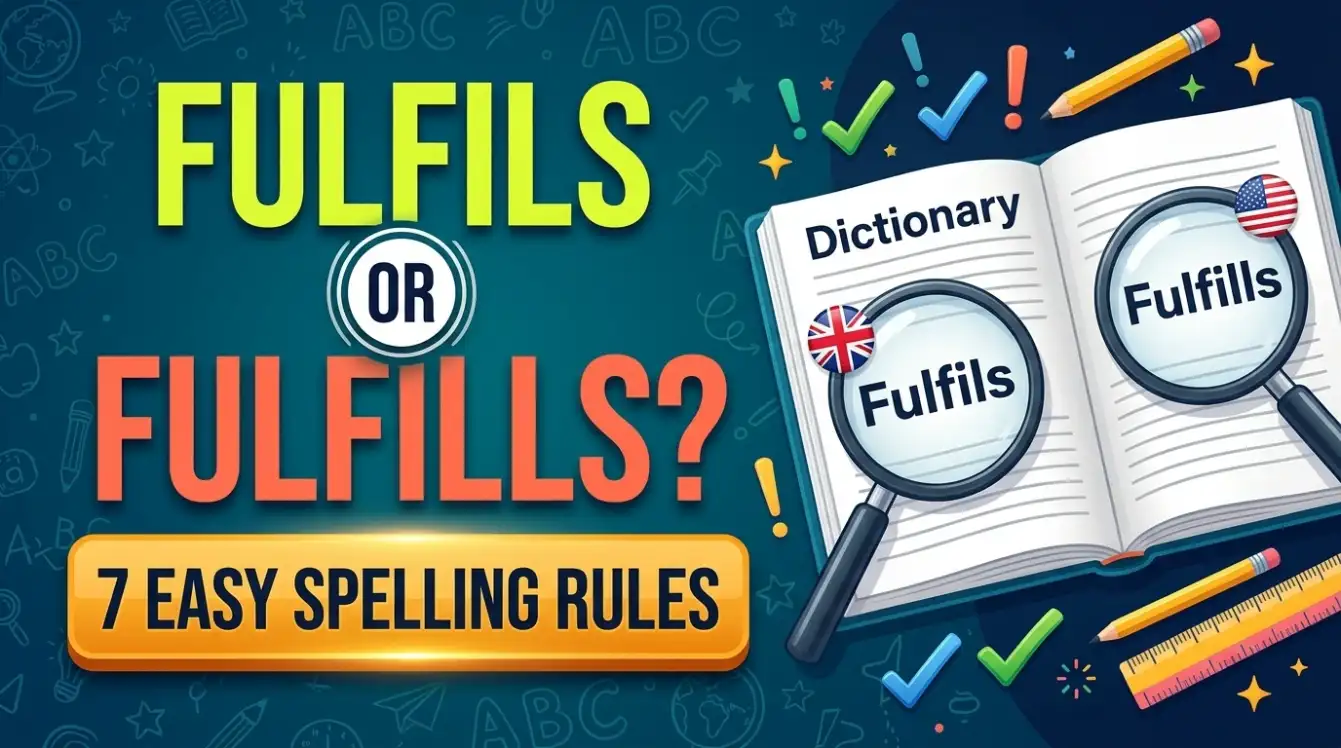
Have you ever wondered whether to write fulfils or fulfills? Both spellings are correct, but their usage depends mainly on the English variety you follow. American English prefers fulfills, while British English traditionally uses fulfils.
Both words mean completing something, meeting a requirement, or making a promise come true. This spelling difference often confuses English learners, students, writers, and professionals.
Understanding the difference helps you avoid mistakes in emails, essays, articles, and workplace documents.
In this guide, you will learn their meanings, pronunciation, grammar rules, examples, regional differences, and seven easy tips for remembering the correct spelling.
Quick Answer: Fulfils or Fulfills?
Both fulfils or fulfills are correct spellings of the same verb. Fulfils is traditionally preferred in British English, while fulfills is standard American English.
- British English: She fulfils her responsibilities.
- American English: She fulfills her responsibilities.
Both sentences mean that she completes or carries out her responsibilities. The meaning and pronunciation remain the same. Only the spelling changes.
Meaning of Fulfils
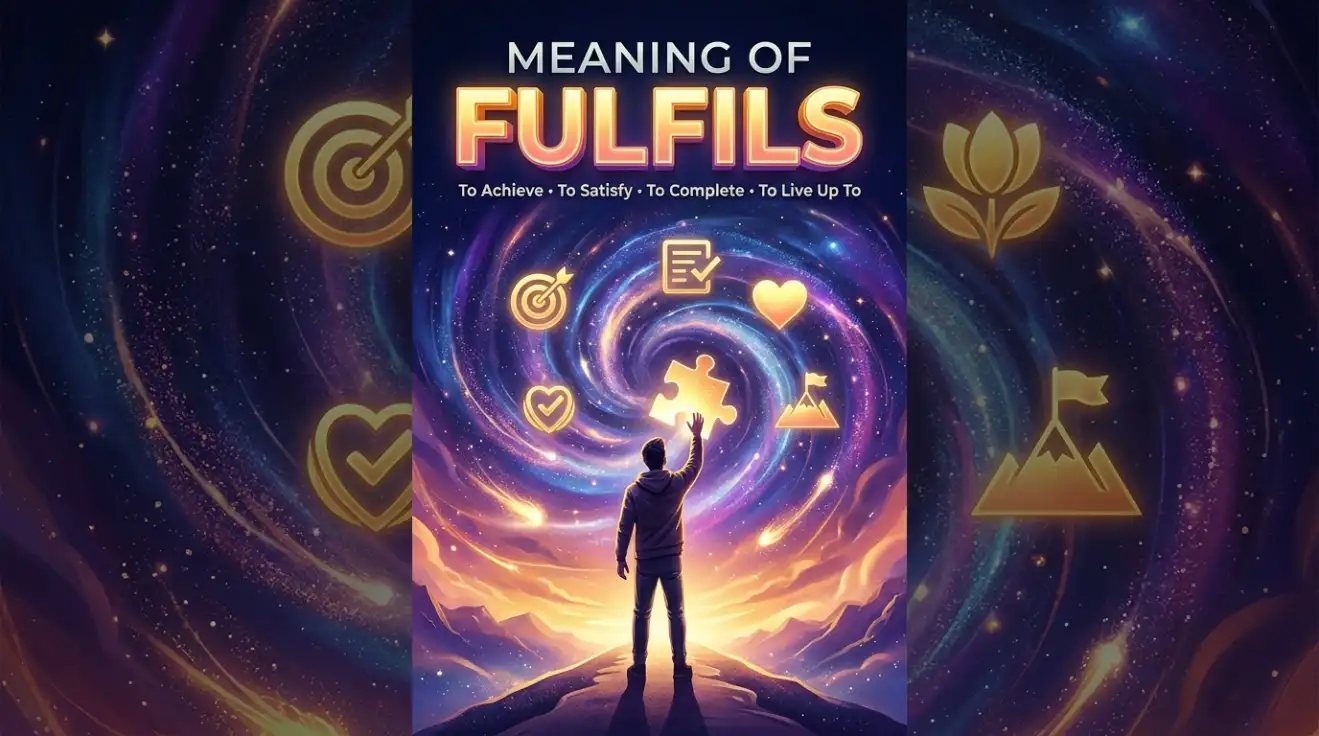
Fulfils is the British English spelling of the third-person singular form of fulfil. It means completing something, meeting a requirement, satisfying a need, or making something happen as expected.
It is used with singular subjects such as he, she, it, or a person’s name.
Pronunciation: Full-FILZ
Part of speech: Verb
Examples of fulfils
- She fulfils her promise to help the community.
- The new course fulfils the school’s requirements.
- This product fulfils the needs of many customers.
- He fulfils his duties as a manager.
- The charity fulfils an important purpose.
Synonyms of fulfils
Depending on the sentence, synonyms include:
- Completes
- Satisfies
- Achieves
- Carries out
- Meets
- Performs
- Accomplishes
The best synonym depends on the context. For example, fulfils a promise can mean keeps a promise, while fulfils a requirement means meets a requirement.
Meaning of Fulfills
Fulfills is the American English spelling of the same verb form. It has exactly the same meaning as fulfils.
American writers use fulfills when a person, organization, product, or situation completes something or meets an expectation.
Pronunciation: Full-FILZ
Part of speech: Verb
Examples of fulfills
- He fulfills his responsibilities at work.
- The program fulfills the needs of new students.
- She fulfills her dream of becoming a teacher.
- This service fulfills every requirement.
- The company fulfills customer orders quickly.
Synonyms of fulfills
- Completes
- Meets
- Satisfies
- Accomplishes
- Achieves
- Carries out
- Delivers
The spelling fulfills is commonly used in American books, newspapers, academic writing, and business communication.
Key Differences Between Fulfils and Fulfills
The main difference is their spelling convention. Neither spelling is grammatically wrong.
Fulfils follows the traditional British spelling pattern, which uses one L in the base verb’s final syllable.
Fulfills follows the American spelling pattern, which doubles the final L in the base verb.
Both forms:
- Have the same meaning.
- Are pronounced the same way.
- Function as verbs.
- Work with singular subjects.
- Describe completing an obligation, need, promise, or expectation.
When comparing fulfils or fulfills, remember that your audience determines which spelling is more appropriate. Follow one English spelling style consistently throughout your writing.
Fulfils vs Fulfills Comparison Table
| Feature | Fulfils | Fulfills |
|---|---|---|
| Correct spelling | Yes | Yes |
| English variety | British English | American English |
| Meaning | Completes or satisfies | Completes or satisfies |
| Pronunciation | Full-FILZ | Full-FILZ |
| Part of speech | Verb | Verb |
| Subject | He, she, it, singular noun | He, she, it, singular noun |
| Example | She fulfils her duty. | She fulfills her duty. |
| Common region | UK and British-style publications | United States |
| Spelling pattern | One L in the base form | Double L in the base form |
Spelling and Grammar Rules
The difference between fulfils and fulfills becomes easier when you understand how the verb changes.
The base verb: fulfil or fulfill
The base verb has two regional spellings.
- British English: fulfil
- American English: fulfill
Both mean completing something, satisfying a need, or meeting an expectation.
Examples:
- I want to fulfil my goals.
- I want to fulfill my goals.
The third-person singular: fulfils or fulfills
Add the appropriate ending for he, she, it, or a singular noun.
- British: fulfil → fulfils
- American: fulfill → fulfills
Examples:
- She fulfils her duties.
- She fulfills her duties.
The past tense: fulfilled
Both spelling systems use fulfilled with a double L.
Examples:
- He fulfilled his promise.
- They fulfilled the requirements.
- The company fulfilled the order.
The spelling does not change to fulfiled in British English.
The present participle: fulfilling
Both varieties use fulfilling with a double L.
Examples:
- Teaching is a fulfilling career.
- She is fulfilling her dream.
- The work feels fulfilling.
The spelling fulfiling is incorrect.
The noun: fulfilment or fulfillment
The noun also follows regional spelling preferences.
- British English: fulfilment
- American English: fulfillment
Examples:
- She found fulfilment in helping others.
- He experienced fulfillment after completing the project.
Origin and History of Fulfil and Fulfill
The word fulfil has roots in older English forms and is connected to the idea of filling something completely or bringing it to completion.
The spelling developed over time, and modern English adopted regional conventions for the final L.
American spelling often doubles the final L in words such as fulfill, enroll, and install. British English traditionally keeps a single L in the base forms fulfil, enrol, and instal.
However, both varieties double the L in certain forms, including fulfilled and fulfilling.
This spelling pattern explains why these words look different but remain grammatically identical.
British English vs American English
British and American English use different spellings for several words. Fulfils and fulfills are another example.
| Word Form | British English | American English |
|---|---|---|
| Base verb | Fulfil | Fulfill |
| Third-person singular | Fulfils | Fulfills |
| Past tense | Fulfilled | Fulfilled |
| Past participle | Fulfilled | Fulfilled |
| Present participle | Fulfilling | Fulfilling |
| Noun | Fulfilment | Fulfillment |
British English
British writers commonly use fulfil, fulfils, and fulfilment.
Examples:
- The teacher fulfils her responsibilities.
- The company must fulfil its agreement.
- He found fulfilment in his career.
American English
American writers use fulfill, fulfills, and fulfillment.
Examples:
- The teacher fulfills her responsibilities.
- The company must fulfill its agreement.
- He found fulfillment in his career.
Canadian English
Canadian English often combines British and American spelling conventions. Both forms may appear, depending on the publication, writer, or style guide.
For professional writing in Canada, follow the spelling style required by your organization.
Australian English
Australian English generally follows British spelling conventions. Fulfil, fulfils, and fulfilment are commonly preferred.
If you write for international readers, choose one spelling style and use it consistently throughout your document.
When to Use Fulfils
Use fulfils when writing in British English or when your publication follows British spelling conventions.
Formal writing
Use fulfils in British-style reports, official documents, academic writing, and professional correspondence.
Example: The revised policy fulfils all legal requirements.
Academic writing
Students writing in British English can use fulfils in essays, research papers, and assignments.
Example: The experiment fulfils the objectives of the research.
Workplace communication
Use fulfils when writing for a British organization or following its house style.
Example: The employee fulfils the responsibilities outlined in the contract.
Everyday conversation
British speakers may use the word naturally when discussing goals, promises, or responsibilities.
Example: This job fulfils my career ambitions.
Online content
Use fulfils in British-targeted blog posts, educational content, and websites that follow UK English.
For example, if you are writing an article for British readers, keep related spellings consistent. You can also explore towards or toward to understand another spelling variation.
When to Use Fulfills
Use fulfills when writing in American English or following an American spelling style.
Formal writing
Use fulfills in American business reports, official letters, and professional documents.
Example: The agreement fulfills the conditions outlined in the proposal.
Academic work
American students should use fulfills in essays, assignments, and research papers.
Example: The study fulfills the requirements for the final project.
Workplace communication
Use fulfills in American business communication, especially when discussing responsibilities, contracts, or customer needs.
Example: Our department fulfills every request within the required timeframe.
Emails
Use fulfills in emails written in American English.
Example: This solution fulfills the client’s expectations.
Online content
American blogs, news websites, product descriptions, and educational articles commonly use fulfills.
Example: The software fulfills the needs of small businesses.
Common Mistakes
Here are seven spelling and grammar mistakes people often make with this word.
Mistake: Fullfills
Incorrect example: She fullfills her promise.
Correct example: She fulfills her promise.
Simple explanation: The word begins with ful, not full.
Why beginners make this mistake: They confuse fulfill with the adjective full.
Easy correction tip: Remember that the word starts with one L. American English doubles the L in the second part, not at the beginning.
Mistake: Fulfilles
Incorrect example: He fulfilles his duties.
Correct example: He fulfills his duties.
Simple explanation: The third-person singular form ends in S, not ES.
Why beginners make this mistake: They apply the rule used with words such as watches or fixes.
Easy correction tip: Add S directly to fulfill.
Mistake: Fulfiled
Incorrect example: She fulfiled her dream.
Correct example: She fulfilled her dream.
Simple explanation: The past tense uses a double L in both spelling systems.
Why beginners make this mistake: They assume British English keeps one L in every word form.
Easy correction tip: Always write fulfilled with two Ls.
Mistake: Fulfiling
Incorrect example: He is fulfiling his responsibilities.
Correct example: He is fulfilling his responsibilities.
Simple explanation: The present participle uses a double L.
Why beginners make this mistake: They remove or retain letters incorrectly when adding ING.
Easy correction tip: Remember the correct spelling is fulfilling.
Mistake: Fulfils in American writing
Incorrect example: The company fulfils every order.
Correct example: The company fulfills every order.
Simple explanation: The sentence is understandable, but American style generally prefers fulfills.
Why beginners make this mistake: They mix British and American spelling conventions.
Easy correction tip: Choose American English for US audiences and keep the spelling consistent.
Mistake: Fulfills in British-style writing
Incorrect example: The school fulfills its responsibilities.
Correct example: The school fulfils its responsibilities.
Simple explanation: British English generally prefers fulfils.
Why beginners make this mistake: They learn American spellings from online content.
Easy correction tip: Follow the regional spelling style used in your document.
Mistake: Mixing related forms
Incorrect example: She fulfils the promise and has fulfillled her duty.
Correct example: She fulfils the promise and has fulfilled her duty.
Simple explanation: The base form and past participle follow different spelling patterns.
Why beginners make this mistake: They assume every form follows the same L rule.
Easy correction tip: Memorize the forms: fulfil, fulfils, fulfilled, fulfilling.
Easy Trick to Remember
Think of it this way:
- UK = fulfil, fulfils, fulfilment.
- US = fulfill, fulfills, fulfillment.
- Both = fulfilled, fulfilling.
Think of American English as adding an extra L to the base verb. British English usually keeps one L in the base verb’s final syllable.
Remember that the past tense and ING form use two Ls in both varieties.
This simple pattern can help you spell the word correctly without memorizing every sentence.
Everyday Examples
Work
- British: The manager fulfils her daily responsibilities.
- American: The manager fulfills her daily responsibilities.
School
- British: This assignment fulfils the course requirements.
- American: This assignment fulfills the course requirements.
Social media
- British: Finally, a hobby that fulfils my creative side!
- American: Finally, a hobby that fulfills my creative side!
Daily life
- British: Cooking fulfils his passion for food.
- American: Cooking fulfills his passion for food.
Emails
- British: Our service fulfils your needs.
- American: Our service fulfills your needs.
Text messages
- British: This plan fulfils everything I wanted.
- American: This plan fulfills everything I wanted.
Online content
- British: The guide fulfils its purpose by explaining the process.
- American: The guide fulfills its purpose by explaining the process.
Conversations
- British: My new job fulfils my ambitions.
- American: My new job fulfills my ambitions.
Different Contexts and Usage
Education
Students should follow the spelling style required by their school or university.
British-style assignments use fulfils, while American-style assignments use fulfills.
Business
Businesses use the word when discussing promises, contracts, customer needs, duties, and orders.
Examples:
- The supplier fulfils the contract.
- The supplier fulfills the contract.
E-commerce
In online shopping, fulfill or fulfil often refers to processing and completing customer orders.
For example, a warehouse fulfills an order by preparing and sending the purchased products.
Personal goals
The word can describe achieving a dream, ambition, or personal purpose.
Example: She fulfills her dream of becoming a doctor.
Professional communication
Use the spelling that matches your audience or organization.
Consistency matters more than switching between regional forms.
Google Trends and Search Insights
People searching for fulfils or fulfills usually want a quick spelling answer. They may be writing an email, completing an assignment, editing an article, or checking a grammar rule.
The main confusion comes from British and American English spelling conventions. Both forms are valid, but readers want to know which one suits their country or audience.
Common search intentions include:
- Checking the correct spelling.
- Understanding the meaning.
- Comparing British and American English.
- Learning how to use the word in a sentence.
- Checking the past tense and ING form.
- Understanding fulfilment and fulfillment.
This keyword has a clear informational intent. A direct answer, comparison table, simple examples, and spelling rules are especially helpful.
Live numerical Google Trends data was not verified for this article. Therefore, no search volumes, trend percentages, or regional popularity figures are claimed.
Related Searches and People Also Ask
Is fulfils or fulfills correct?
Both are correct. Fulfils is traditionally British English, while fulfills is American English.
What does fulfils mean?
It means completes, satisfies, carries out, or meets a requirement or expectation.
What does fulfills mean?
It has the same meaning as fulfils. It is the American spelling.
Is fulfils British or American?
Fulfils is the traditional British spelling.
Is fulfills American English?
Yes. Fulfills is the standard American spelling.
How do you spell fulfils?
Spell it F-U-L-F-I-L-S.
How do you spell fulfills?
Spell it F-U-L-F-I-L-L-S.
Is fulfilled spelled with one L or two?
Fulfilled has two Ls in both British and American English.
Is fulfilling correct?
Yes. Fulfilling is correct in both spelling systems.
Is fulfilment or fulfillment correct?
Both are correct. Fulfilment is British English, and fulfillment is American English.
What is the difference between fulfil and fulfill?
They have the same meaning. The difference is regional spelling.
What is the third-person form of fulfil?
In British English, it is fulfils. In American English, it is fulfills.
Can I use fulfils in an American article?
You can, but fulfills is more consistent with American spelling conventions.
What is a synonym for fulfills?
Depending on the context, synonyms include completes, achieves, satisfies, meets, and accomplishes.
Frequently Asked Questions
Is fulfils or fulfills correct?
Both are correct. Fulfils is commonly used in British English, while fulfills is standard American English. They have the same meaning and pronunciation.
What is the difference between fulfils and fulfills?
The difference is spelling, not meaning. British English generally uses fulfils, while American English uses fulfills.
Does fulfils mean the same as fulfills?
Yes. Both words mean completing something, meeting a requirement, satisfying a need, or carrying out a responsibility.
How do you pronounce fulfils and fulfills?
Both are pronounced approximately full-FILZ. The extra L in fulfills does not change the pronunciation.
Is fulfills grammatically correct?
Yes. Fulfills is the third-person singular form of the American verb fulfill. For example, “He fulfills his duties.”
Is fulfils grammatically correct?
Yes. Fulfils is the third-person singular form of the British verb fulfil. For example, “She fulfils her duties.”
Is fulfilled British or American?
Fulfilled is correct in both British and American English. Both spelling systems use two Ls in this form.
Is fulfilling spelled with one L or two?
Fulfilling uses two Ls in both British and American English. The spelling fulfiling is incorrect.
Which spelling should I use in an SEO article?
Choose the spelling that matches your target audience. Use fulfills for American readers and fulfils for British readers. Keep related spellings consistent.
Is fulfilment or fulfillment correct?
Both are correct. British English generally uses fulfilment, while American English prefers fulfillment.
Final Verdict
Fulfils and fulfills are both correct spellings of the same word. The main difference is regional style.
Use fulfils for British English and fulfills for American English. Both mean completing something, satisfying a requirement, or meeting an expectation.
Remember the easiest rule: British English uses one L in fulfil and fulfils. American English doubles the L in fulfill and fulfills. Both use fulfilled and fulfilling.
Conclusion
The choice between fulfils or fulfills depends on the English spelling style you follow. Neither word is incorrect, and both carry the same meaning. They describe completing a duty, satisfying a need, meeting an expectation, or making a promise come true.
Use fulfils in British English and fulfills in American English. If you write for an international audience, choose one spelling convention and maintain it throughout your content. Consistency makes your writing easier to read and more professional.
The easiest way to remember the difference is to associate fulfils with British English and fulfills with American English. Keep the double L in fulfilled and fulfilling in both varieties. Once you learn this simple rule, choosing the correct spelling becomes easy.

I’m MK Jan Mustafa Kamal, the author of CompareWordz.com, specializing in English linguistics, word meanings, spelling, and language usage.
I hold an M.A. in English and have 8 years of experience in English language and vocabulary studies. My goal is to explain confusing words, spelling differences, grammar rules, and meanings in clear, simple, and accurate language. I focus on providing well-researched, fact-checked, and easy-to-understand content that helps readers use English with confidence. Through CompareWordz.com, I aim to make learning English words and their correct usage easier for everyone.