

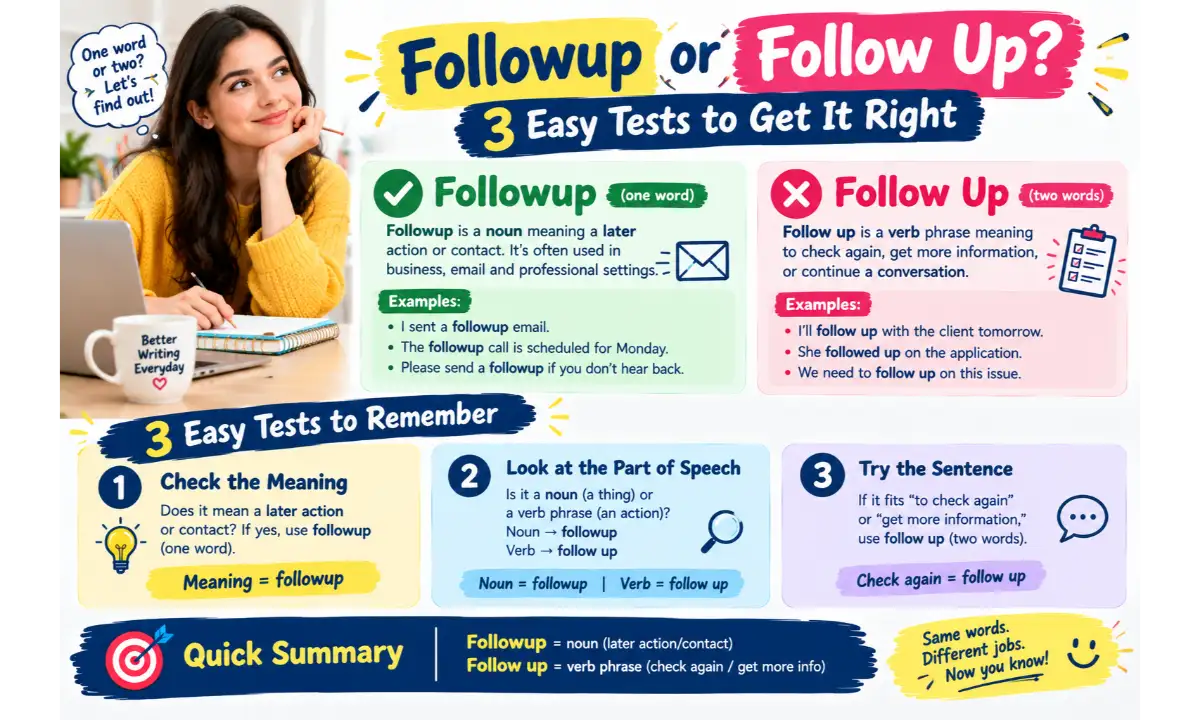
Have you ever wondered whether to write followup, follow up, or follow-up? These forms look similar, but only certain spellings are appropriate in standard writing.
Consider these examples:
- I’ll followup tomorrow.
- I’ll follow-up tomorrow.
- I’ll follow up tomorrow.
The third sentence is correct because follow up is a verb phrase. When you use the expression as a noun or adjective, however, the standard spelling is follow-up. Understanding this difference can help you write clearer emails, messages, reports, and everyday sentences.
In this guide, you’ll learn the difference between followup or follow up, discover three easy tests for choosing the correct form, and see examples that show how to use each expression naturally.
Quick Answer: Followup or Follow Up?
Use follow up as a verb, follow-up as a noun or adjective, and generally avoid followup as one word in standard edited writing.
- Follow up: I’ll follow up with you tomorrow.
- Follow-up: Thanks for the follow-up.
- Follow-up email: She sent a follow-up email.
The easiest rule to remember is this: Use two words for the action and a hyphen for the noun or adjective.
The CDC’s writing guidance on follow up, follow-up, and followup also explains this distinction.
What Does Follow Up Mean?
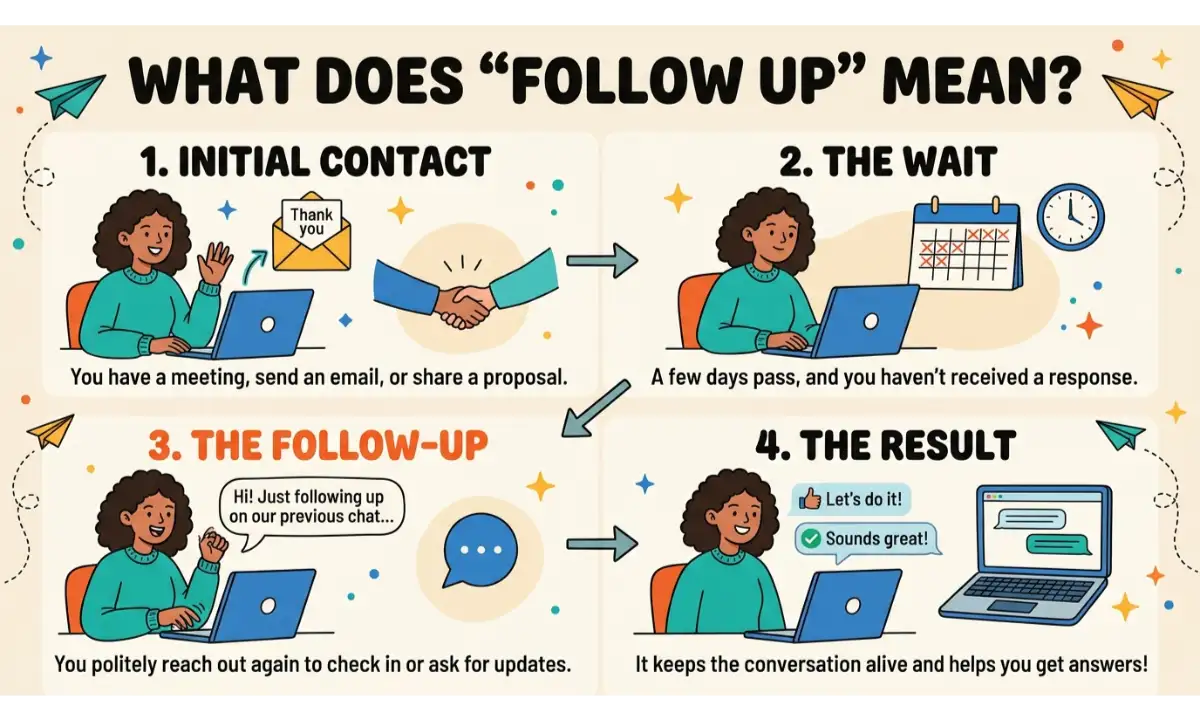
Follow up is a verb phrase that means to take another step, check on something, continue a conversation, or obtain additional information.
For example, you might follow up with a customer after a meeting or follow up on a job application after submitting it.
Examples:
- I’ll follow up with you next week.
- She followed up on her application.
- Please follow up with the customer tomorrow.
- The journalist will follow up with additional questions.
Notice that the space remains between follow and up. This is true whether you use the present, past, or continuous form.
What Does Follow-Up Mean?
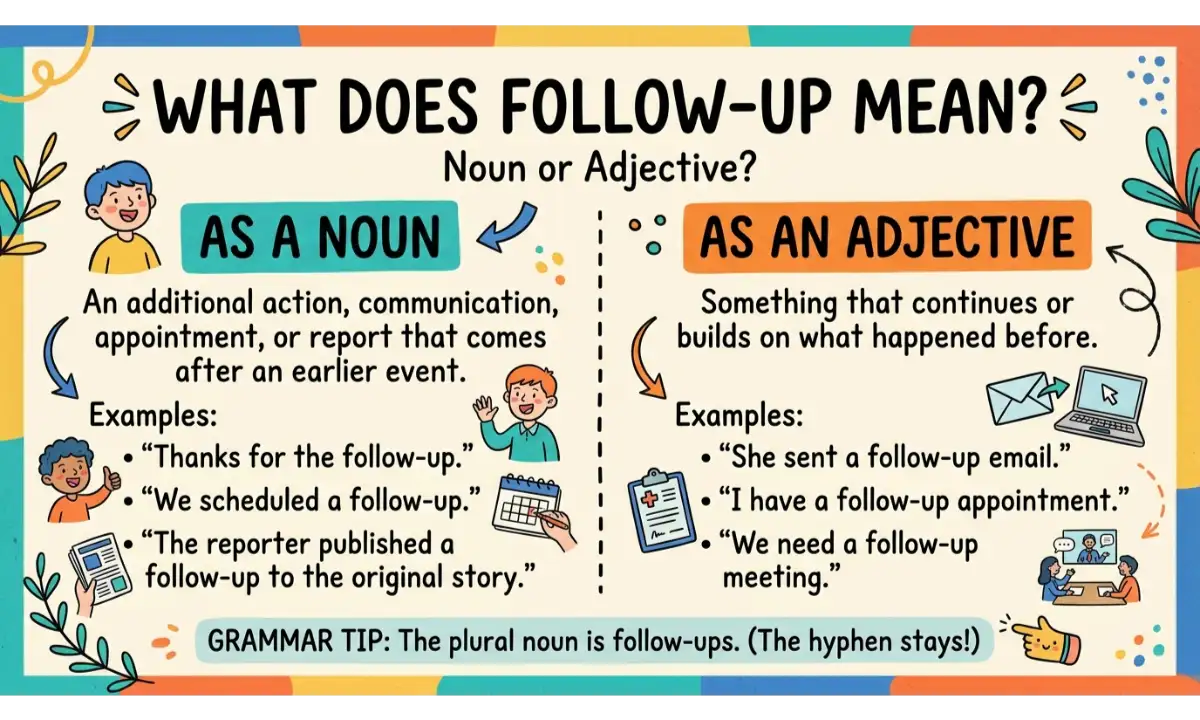
Follow-up is a noun or adjective.
As a noun, it describes an additional action, communication, appointment, or report that comes after an earlier event.
As an adjective, it describes something that continues or builds on what happened before.
Examples of the noun:
- Thanks for the follow-up.
- We scheduled a follow-up.
- The reporter published a follow-up to the original story.
Examples of the adjective:
- She sent a follow-up email.
- I have a follow-up appointment.
- We need a follow-up meeting.
The plural noun is follow-ups. The hyphen stays when you make the noun plural.
Follow Up or Follow-Up: What’s the Difference?
The difference between follow up and follow-up depends on how the expression functions in a sentence.
| Expression | Grammar role | Example |
|---|---|---|
| Follow up | Verb | I will follow up tomorrow. |
| Follow-up | Noun | Thanks for the follow-up. |
| Follow-up | Adjective | Send a follow-up email. |
| Follow-ups | Plural noun | We have two follow-ups scheduled. |
Compare these sentences:
Verb: “I need to follow up on my request.”
Noun: “I sent a follow-up about my request.”
Adjective: “I sent a follow-up email about my request.”
The meaning is related in all three sentences, but the grammatical role changes the spelling.
Is Follow-Up Hyphenated?
Yes, when follow-up functions as a noun or adjective in standard usage.
Examples:
- We arranged a follow-up.
- She booked a follow-up appointment.
- He wrote a follow-up report.
However, do not add a hyphen when using the verb phrase.
Correct: “I will follow up tomorrow.”
Incorrect: “I will follow-up tomorrow.”
Remember that the hyphen is not optional simply because the sentence concerns a follow-up action. It depends on the word’s grammatical function.
Is Followup One Word Correct?
For ordinary professional, academic, and edited writing, followup is best avoided.
The CDC recommends follow up for the verb and follow-up for the noun or adjective. Dictionary and style-guide treatment can vary, so consult your preferred reference if you are following a particular publication’s rules.
Examples:
- Standard verb: I will follow up tomorrow.
- Standard noun: I received a follow-up.
- Standard adjective: She sent a follow-up message.
If a company, application, or product officially uses Followup in its name, preserve that proper name. Otherwise, the two-word and hyphenated forms are the safer choices.
Three Easy Tests to Choose the Correct Form
Use these three tests to make the right choice quickly.
1. Try Changing the Verb to the Past Tense
If the expression describes an action, you can often change it to followed up.
Examples:
- Today: I follow up with clients.
- Yesterday: I followed up with clients.
- Tomorrow: I will follow up with clients.
Correct: “I will follow up tomorrow.”
This is a useful clue that you need the two-word verb phrase.
2. Check Whether It Names a Thing
If the expression names an additional action, communication, or event, use follow-up.
Examples:
- Thanks for the follow-up.
- The follow-up was helpful.
- We scheduled a follow-up.
Here, follow-up acts as a noun rather than describing an action in the sentence.
3. Check Whether It Describes Another Noun
If the expression describes an email, meeting, appointment, or another noun, use the hyphenated adjective.
Examples:
- A follow-up email
- A follow-up meeting
- A follow-up appointment
- A follow-up question
In “a follow-up email,” the expression describes the type of email. That is why the hyphen is appropriate.
These tests are practical clues rather than absolute grammatical rules. Always consider the expression’s role in the complete sentence.
Follow Up With or Follow Up On?
Both expressions are correct, but they are commonly used in different contexts.
Use follow up with when referring to a person or group.
- I will follow up with my manager.
- She followed up with the customer.
- Please follow up with me next week.
Use follow up on when referring to an issue, request, task, or subject.
- I need to follow up on my application.
- He followed up on the complaint.
- We should follow up on that question.
The choice depends on what you want to emphasize: the person you contact or the matter you revisit.
Follow-Up Email or Follow Up Email?
Both expressions may appear in writing, but they serve different grammatical purposes.
Use follow-up email when describing an email.
Example: “I sent a follow-up email after the interview.”
Use follow up when describing the action of contacting someone again.
Example: “I will follow up by email after the interview.”
Incorrect: “I will follow-up by email.”
The quickest way to decide is to ask whether you are describing a message or telling someone what action will happen.
Common Follow-Up Spelling Mistakes
| Incorrect | Correct | Explanation |
|---|---|---|
| I will follow-up tomorrow. | I will follow up tomorrow. | The verb has no hyphen. |
| Send a follow up email. | Send a follow-up email. | The expression describes email. |
| I need a followup. | I need a follow-up. | The hyphenated noun is the safer standard form. |
| We followed-up yesterday. | We followed up yesterday. | The past-tense verb keeps the space. |
| Two follow ups are due. | Two follow-ups are due. | The plural noun keeps the hyphen. |
Checking the part of speech before choosing the spelling will help you avoid these common mistakes.
How to Pronounce “Follow Up” and “Follow-Up”
Follow up and follow-up are pronounced the same way. The hyphen changes the spelling, not the pronunciation.
Pronunciation
follow up
FAH-loh up
Real-Life Examples of Follow Up
- At work: “I’ll follow up with my manager tomorrow.”
- In an email: “I’m following up on my previous message.”
- At a doctor’s office: “I have a follow-up appointment next week.”
- With a friend: “I’ll follow up with you later.”
- During a job search: “She followed up on her job application.”

Frequently Asked Questions
Is it followup or follow up?
Use follow up as a verb and follow-up as a noun or adjective. Avoid followup in ordinary edited writing unless a particular style guide or proper name requires it.
Is follow-up one word or two?
It is written with a hyphen when used as a noun or adjective. The verb phrase follow up consists of two separate words.
What is the plural of follow-up?
The plural is follow-ups.
Example: “I have two follow-ups to complete today.”
Is follow-up a noun or an adjective?
It can be either. In “Thanks for the follow-up,” it is a noun. In “Send a follow-up email,” it is an adjective describing email.
Should I write follow-up call or follow up call?
Write follow-up call when describing the call.
Example: “We scheduled a follow-up call for Friday.”
Is it follow up with or follow up on?
Both are correct. Use follow up with when focusing on a person or group and follow up on when focusing on a request, issue, or task.
Can I use followup in formal writing?
It is best to avoid the one-word form in formal writing. Use follow up for the verb and follow-up for the noun or adjective unless your chosen style guide specifies otherwise.
Final Verdict
When deciding between followup or follow up, remember the simple rule: follow up describes an action, while follow-up names or describes something related to that action. Avoid followup in ordinary edited writing, and check the sentence’s grammatical structure whenever you are unsure.
Last updated: October 2026

I’m MK Jan Mustafa Kamal, the author of CompareWordz.com, specializing in English linguistics, word meanings, spelling, and language usage.
I hold an M.A. in English and have 8 years of experience in English language and vocabulary studies. My goal is to explain confusing words, spelling differences, grammar rules, and meanings in clear, simple, and accurate language. I focus on providing well-researched, fact-checked, and easy-to-understand content that helps readers use English with confidence. Through CompareWordz.com, I aim to make learning English words and their correct usage easier for everyone.