


Have you ever written sneak peak when you meant sneak peek? Many English learners make this mistake because both words sound exactly the same. However, their meanings are completely different.
Understanding peek vs peak can help you avoid spelling mistakes in emails, school assignments, social media posts, and professional writing.
One word describes a quick look, while the other refers to the highest point or level of something. In this guide, you will learn their definitions, pronunciation, grammar, origins, and everyday uses.
You will also discover easy tricks to remember the correct spelling and choose the right word confidently.
Quick Answer: Peek vs Peak
Peek means to look quickly, secretly, or briefly at something. It can also describe a quick look.
Peak means the highest point, level, or degree of something. It can function as a noun, verb, or adjective.
Examples:
- Peek: She took a peek inside the gift box.
- Peek: The children peeked through the window.
- Peak: We reached the peak of the mountain.
- Peak: Sales usually peak during December.
Both spellings are correct. Your intended meaning determines which word you should use.
What Does Peek Mean?
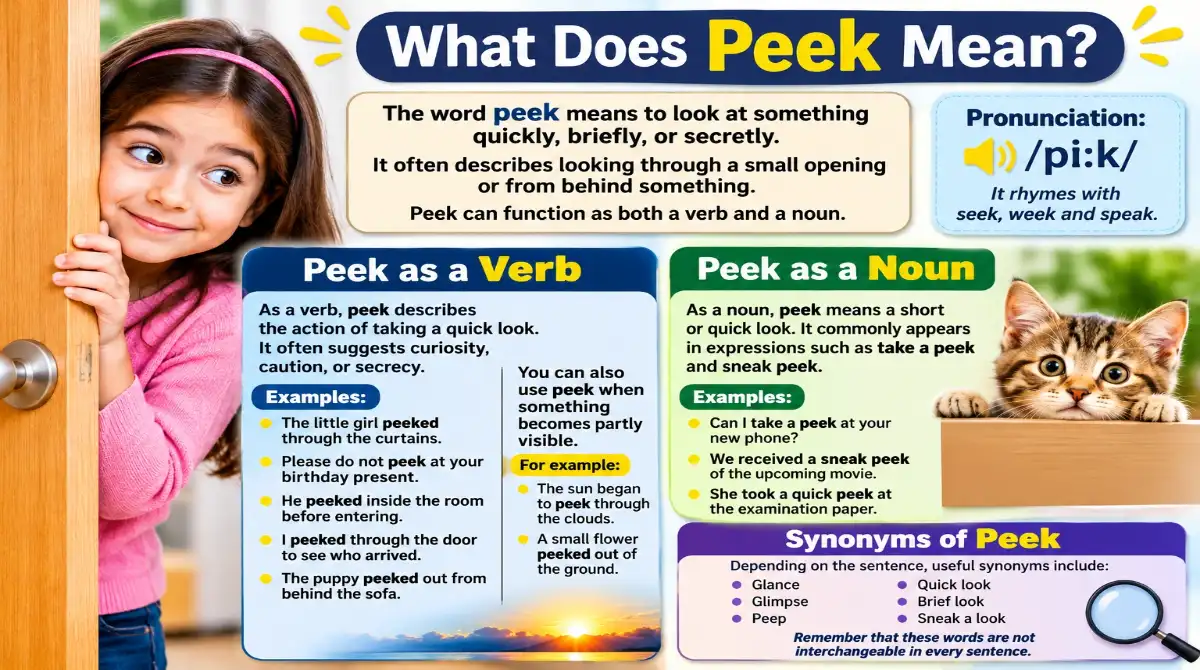
The word peek means to look at something quickly, briefly, or secretly.
It often describes looking through a small opening or from behind something.
Peek can function as both a verb and a noun.
Pronunciation: /piːk/
It rhymes with seek, week, and speak.
Peek as a Verb
As a verb, peek describes the action of taking a quick look.
It often suggests curiosity, caution, or secrecy.
Examples:
- The little girl peeked through the curtains.
- Please do not peek at your birthday present.
- He peeked inside the room before entering.
- I peeked through the door to see who arrived.
- The puppy peeked out from behind the sofa.
You can also use peek when something becomes partly visible.
For example:
- The sun began to peek through the clouds.
- A small flower peeked out of the ground.
Peek as a Noun
As a noun, peek means a short or quick look.
It commonly appears in expressions such as take a peek and sneak peek.
Examples:
- Can I take a peek at your new phone?
- We received a sneak peek of the upcoming movie.
- She took a quick peek at the examination paper.
Synonyms of Peek
Depending on the sentence, useful synonyms include:
- Glance.
- Glimpse.
- Peep.
- Quick look.
- Brief look.
- Sneak a look.
Remember that these words are not interchangeable in every sentence.
What Does Peak Mean?
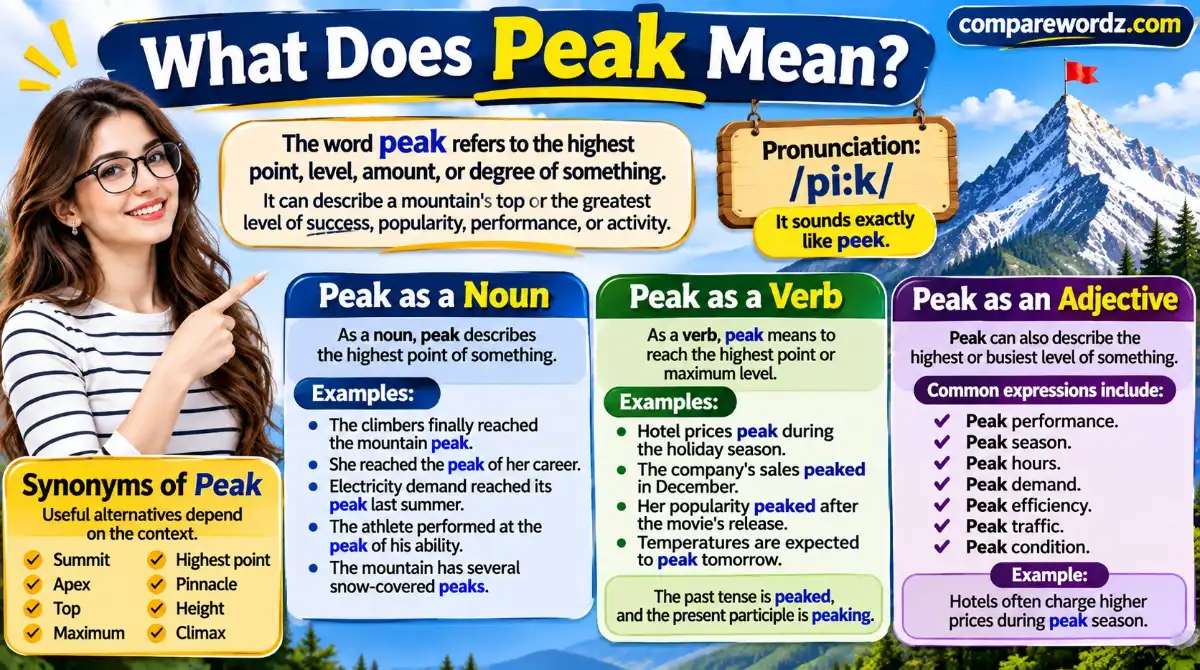
The word peak refers to the highest point, level, amount, or degree of something.
It can describe a mountain’s top or the greatest level of success, popularity, performance, or activity.
Pronunciation: /piːk/
It sounds exactly like peek.
Peak functions as a noun, verb, and adjective.
Peak as a Noun
As a noun, peak describes the highest point of something.
It can refer to a physical mountain or an important stage in someone’s life.
Examples:
- The climbers finally reached the mountain peak.
- She reached the peak of her career.
- Electricity demand reached its peak last summer.
- The athlete performed at the peak of his ability.
- The mountain has several snow-covered peaks.
Peak as a Verb
As a verb, peak means to reach the highest point or maximum level.
Examples:
- Hotel prices peak during the holiday season.
- The company’s sales peaked in December.
- Her popularity peaked after the movie’s release.
- Temperatures are expected to peak tomorrow.
The past tense is peaked, and the present participle is peaking.
Peak as an Adjective
Peak can also describe the highest or busiest level of something.
Common expressions include:
- Peak performance.
- Peak season.
- Peak hours.
- Peak demand.
- Peak efficiency.
- Peak traffic.
- Peak condition.
Example:
Hotels often charge higher prices during peak season.
Synonyms of Peak
Useful alternatives depend on the context.
- Summit.
- Apex.
- Top.
- Maximum.
- Highest point.
- Pinnacle.
- Height.
- Climax.
These words can help make your writing more varied.
Peek vs Peak: Key Differences
The main difference is simple: peek relates to looking, while peak relates to the highest point.
Both words are correct English spellings. However, using one in place of the other can change your sentence’s meaning.
Here are the important differences:
Meaning: Peek describes a quick look. Peak describes the highest point or level.
Grammar: Peek is mainly a verb and noun. Peak works as a noun, verb, and adjective.
Pronunciation: Both have the same pronunciation, /piːk/.
Spelling: Peek contains two letter E’s. Peak contains the letters E and A.
Usage: Peek appears in phrases such as sneak peek. Peak appears in phrases such as peak performance and peak season.
Word forms: Peeked and peeking come from peek. Peaked and peaking come from peak.
Peek vs Peak Comparison Table
| Feature | Peek | Peak |
|---|---|---|
| Correct spelling | Yes | Yes |
| Main meaning | A quick look | Highest point |
| Pronunciation | /piːk/ | /piːk/ |
| Noun | Yes | Yes |
| Verb | Yes | Yes |
| Adjective | Not in standard everyday usage | Yes |
| Past tense | Peeked | Peaked |
| Present participle | Peeking | Peaking |
| Common phrase | Sneak peek | Peak performance |
| Related expression | Take a peek | Peak season |
| Example | Peek inside the box. | Reach the mountain peak. |
| Common mistake | Sneak peak | Peek performance |
Neither word is incorrect. The correct choice depends on the meaning you want to express.
Important Word Forms and Grammatical Differences
Understanding the different forms of peek and peak makes it easier to use them correctly.
Peek, Peeked, and Peeking
These forms all relate to looking.
| Word form | Usage | Example |
|---|---|---|
| Peek | Present tense | I peek inside the room. |
| Peeks | Third-person present | She peeks through the window. |
| Peeked | Past tense | He peeked at the answer. |
| Peeking | Present participle | The child is peeking outside. |
Important: Peeked never means reaching the highest point.
Peak, Peaked, and Peaking
These forms relate to reaching or describing a maximum level.
| Word form | Usage | Example |
|---|---|---|
| Peak | Base form | Prices may peak soon. |
| Peaks | Third-person present | Demand peaks in summer. |
| Peaked | Past tense | Sales peaked last month. |
| Peaking | Present participle | Interest is peaking. |
Peak also has a plural noun form: peaks.
For example:
The mountain range has several beautiful peaks.
Why These Forms Matter
Consider these two sentences:
- The sun peeked over the mountains.
- The temperature peaked at noon.
The first sentence describes something becoming visible. The second describes temperature reaching its highest level.
The spelling changes because the intended meanings are different.
Spelling Rules and Important Linguistic Differences
Peek and peak belong to a group of words called homophones.
Homophones sound alike but have different spellings and meanings.
Other examples include:
- See and sea.
- Right and write.
- Pair and pear.
- Flour and flower.
- Their and there.
Peek and peak follow the same pronunciation but communicate different ideas.
Another important word is pique.
Peek vs Peak vs Pique
Pique is a third word with the same pronunciation.
It usually means to stimulate someone’s interest, curiosity, or attention.
Examples:
- The documentary piqued my interest.
- Her unusual question piqued his curiosity.
- The mysterious advertisement piqued everyone’s attention.
Compare these expressions:
| Expression | Meaning |
|---|---|
| Sneak peek | A preview or quick look |
| Mountain peak | The highest point of a mountain |
| Pique interest | Create interest or curiosity |
| Peak performance | The highest level of performance |
Avoid writing sneak peak or peak my interest when you mean a preview or increased curiosity.
The correct expressions are sneak peek and pique my interest. dictionary.com+2
Origin and History of Peek and Peak

Although peek and peak sound alike today, their histories and development are different.
Origin of Peek
The word peek dates back to Middle English.
Historical records show that it was used in the late 14th century. Its early meaning involved looking quickly or secretly.
Its precise origin is uncertain. Etymological sources suggest a possible connection with Middle Dutch words meaning to look.
Over time, peek developed into a common English word for taking a quick or hidden look.
The noun form, meaning a brief glance, became established later.
Today, people commonly use it in expressions such as:
- Take a peek.
- Sneak peek.
- Peek inside.
- Peek through the window.
Etymology, Origin & Meaning+1
Origin of Peak
The word peak appeared in English around the early 16th century.
It is generally connected to the Middle English word pike, meaning a sharp point or pointed object.
Its meaning later developed to describe the pointed top of a mountain.
By the late 18th century, peak was also being used figuratively for the highest point of achievement or development.
Its modern meanings include:
- Mountain summit.
- Highest level.
- Maximum performance.
- Greatest popularity.
- Busiest period.
Etymology, Origin & Meaning+1
The two words developed separately, even though modern English speakers pronounce them alike.
British English vs American English
There is no major spelling difference between peek and peak in British and American English.
Both varieties use the same spellings, meanings, and basic grammatical forms.
The pronunciation is also the same in standard British and American English.
| Feature | American English | British English |
|---|---|---|
| Quick look | Peek | Peek |
| Highest point | Peak | Peak |
| Pronunciation | /piːk/ | /piːk/ |
| Past tense of peek | Peeked | Peeked |
| Past tense of peak | Peaked | Peaked |
| Sneak peek | Correct | Correct |
| Peak season | Correct | Correct |
Regional Usage Examples
American English:
- Let’s take a peek at the new office.
- Traffic reaches its peak around 5 p.m.
British English:
- Have a peek inside the cupboard.
- Tourist numbers peak during the summer holidays.
The examples may use different everyday vocabulary, but the words themselves follow the same spelling rules.
You can confidently use peek and peak in the USA, UK, Canada, Australia, India, and Pakistan.
When to Use Peek
Use peek when your sentence describes looking quickly, secretly, or briefly.
It is especially useful when talking about curiosity, surprises, hidden objects, or something becoming partly visible.
In Everyday Conversations
Use peek when asking someone to look briefly.
Examples:
- Can I take a peek at your new watch?
- Don’t peek before the surprise!
- I just wanted to peek inside.
In Emails and Workplace Communication
Peek can introduce a quick preview of a document, project, or presentation.
Examples:
- Please take a peek at the attached report.
- Here is a sneak peek of our upcoming presentation.
- I wanted to give you a quick peek at the new design.
In Education
Students and teachers can use peek when describing a brief look at something.
Examples:
- The student peeked at the answer sheet.
- Take a peek at the next chapter before class.
- The teacher peeked inside the classroom.
In Marketing and Social Media
Peek is especially common in promotional language.
Examples:
- Get a sneak peek at our new collection.
- Here’s a first peek at our upcoming product.
- Take a sneak peek behind the scenes.
When to Use Peak
Use peak when discussing the highest point, maximum level, or greatest degree of something.
It is common in business, education, sports, travel, science, and everyday conversations.
In Business and Marketing
Peak describes the highest level of sales, demand, or customer activity.
Examples:
- Online sales peaked during the holiday season.
- Our website receives peak traffic in December.
- The company reached its peak revenue last year.
In Education
Students can use peak when discussing maximum results or performance.
Examples:
- Her academic performance reached its peak.
- Student attendance peaked during the first week.
- The graph shows a peak in test scores.
In Sports and Fitness
Peak often describes an athlete’s best physical condition or highest level of performance.
Examples:
- The runner reached peak fitness before the competition.
- The athlete peaked at the right time.
- Our team performed at its peak during the final.
In Travel and Tourism
Peak is useful when discussing busy travel periods.
Examples:
- Hotel prices increase during peak season.
- Flights are expensive during peak travel periods.
- The beach attracts more visitors during peak months.
In Science and Technology
Peak describes the maximum value of a measurement or signal.
Examples:
- The temperature peaked at 40°C.
- The graph shows a peak in electricity usage.
- The machine operates at peak efficiency.
Common Mistakes When Using Peek and Peak
Even experienced writers sometimes confuse these words because they sound identical.
Here are seven mistakes to avoid.
Writing Sneak Peak Instead of Sneak Peek
Incorrect: We received a sneak peak of the new movie.
Correct: We received a sneak peek of the new movie.
Explanation: Sneak peek means a short or secret preview.
Why beginners make this mistake: They associate the spelling with the familiar word peak.
Easy tip: Remember that a peek is something you see with your eyes.
Writing Peek Performance Instead of Peak Performance
Incorrect: The athlete delivered peek performance.
Correct: The athlete delivered peak performance.
Explanation: Peak performance means the highest level of ability.
Why beginners make this mistake: Both words have the same pronunciation.
Easy tip: Think of peak as the top of a mountain.
Using Peaked Instead of Peeked
Incorrect: She peaked through the curtains.
Correct: She peeked through the curtains.
Explanation: Peeked describes looking briefly.
Why beginners make this mistake: They confuse the past-tense forms.
Easy tip: If someone is looking, use peeked.
Using Peeked Instead of Peaked
Incorrect: Sales peeked during the holiday season.
Correct: Sales peaked during the holiday season.
Explanation: Peaked means sales reached their highest level.
Why beginners make this mistake: The two past-tense forms sound alike.
Easy tip: Maximum sales means peaked.
Writing Peek Season Instead of Peak Season
Incorrect: Hotel prices increase during peek season.
Correct: Hotel prices increase during peak season.
Explanation: Peak season is the busiest period for an activity or business.
Why beginners make this mistake: They hear the same pronunciation and overlook the meaning.
Easy tip: The busiest period is the highest point of activity.
Writing Peek Hours Instead of Peak Hours
Incorrect: The roads are crowded during peek hours.
Correct: The roads are crowded during peak hours.
Explanation: Peak hours are periods of maximum activity or demand.
Why beginners make this mistake: They connect the phrase with a quick look instead of maximum traffic.
Easy tip: Think of the busiest hours as the highest activity level.
Writing Peak My Interest Instead of Pique My Interest
Incorrect: The unusual story peaked my interest.
Correct: The unusual story piqued my interest.
Explanation: Piqued means stimulated or increased someone’s interest.
Why beginners make this mistake: Pique, peek, and peak are homophones.
Easy tip: Remember that pique is the special spelling used in the expression pique my interest.
For more spelling guidance, explore CompareWordz articles about misspell or mispell and occurred or occured.
Peek vs Peak: Everyday Examples
Seeing both words in natural sentences can help you understand their differences.
Here are examples from common situations.
At Work
- Please take a peek at the updated project file.
- Our customer demand usually peaks in December.
- The manager gave us a sneak peek at the new office.
- The company achieved peak productivity last quarter.
At School
- The student peeked at the answer before submitting the test.
- Our science teacher explained the mountain peak.
- Take a peek at the next lesson.
- The school’s academic results peaked last year.
In Daily Life
- I took a peek inside the refrigerator.
- The sun peeked through the clouds.
- We reached the peak after a long walk.
- My energy levels peak in the morning.
In Emails
- Please take a quick peek at my attached document.
- Our sales figures peaked during the final quarter.
- I am sharing a sneak peek of the upcoming changes.
On Social Media
- Sneak peek of our new summer collection!
- Take a peek at my weekend adventures.
- This video shows the mountain peak.
- Our latest campaign reached peak engagement.
In Text Messages
- Can I get a sneak peek?
- Don’t peek at your birthday gift!
- Traffic is at its peak right now.
- The excitement peaked after the announcement.
Different Contexts and Usage
Peek and peak appear in many fields. Understanding their contextual meanings helps you choose the right spelling.
Business and Marketing
Businesses use peak when discussing maximum sales, customer demand, and performance.
Peek is useful when introducing a preview of a new product.
Examples:
- The business reached peak sales in November.
- Customers received a sneak peek of the new collection.
Education and Grammar Learning
English teachers often explain these words as homophones.
Students should learn their meanings instead of relying only on pronunciation.
Examples:
- The student peeked through the classroom door.
- The mountain’s peak was covered with snow.
Technology and Websites
Technology professionals use peak when discussing maximum website traffic, processing loads, and system performance.
Peek can describe briefly viewing a file, screen, or preview.
Examples:
- Website traffic peaked after the product launch.
- The developer took a peek at the website’s source code.
- The server experienced peak demand during the event.
Science and Research
Researchers use peak to describe the highest value shown in measurements, graphs, and experiments.
Examples:
- The graph displays a peak in energy consumption.
- Researchers recorded peak temperatures during the experiment.
Peek is less common in formal scientific writing, but it remains correct when describing a brief look.
Content Creation and Publishing
Content creators frequently use sneak peek to attract attention before releasing new material.
Examples:
- Get a sneak peek at our next article.
- The creator shared a preview of the upcoming video.
- The trailer gives viewers a sneak peek of the series.
Google Trends and Search Insights
The keyword peek vs peak reflects a common English spelling and vocabulary problem.
People search for this comparison because both words sound identical. However, their meanings are different.
Why Do People Search for Peek vs Peak?
Several situations create confusion:
- People are unsure about the spelling of sneak peek.
- Students confuse peeked with peaked.
- Writers use peak when describing a quick look.
- Professionals confuse peak performance with peek performance.
- English learners want to understand homophones.
Related Search Intent
The most useful search variations include:
| Search query | What the searcher wants |
|---|---|
| Peek vs peak | Understand the difference |
| Peek or peak | Choose the correct word |
| Sneak peek or sneak peak | Check the correct expression |
| Peeked or peaked | Understand past-tense forms |
| Peak meaning | Learn the definition |
| Peek meaning | Understand the quick-look meaning |
| Peak performance meaning | Understand the expression |
| Peek inside meaning | Learn a common phrase |
| Peak season meaning | Understand seasonal usage |
| Peek pronunciation | Learn how to say the word |
Search Insights for Content Creators
A useful article should answer the spelling question immediately.
Readers should not have to scroll through a long introduction to discover the correct expression.
Including clear examples, a comparison table, pronunciation guidance, and short answers can make the page more useful.
No verified Google Trends comparison or regional search-volume figures are available here. Therefore, no numerical popularity claims are made.
Related Searches and People Also Ask
These related questions cover common spelling, meaning, pronunciation, and grammar concerns.
Is It Sneak Peek or Sneak Peak?
The correct expression is sneak peek.
It means a short or secret preview of something.
Example: We received a sneak peek of the new movie.
Are Peek and Peak Homophones?
Yes. Both words have the same pronunciation, /piːk/, but different spellings and meanings.
What Does Peek Mean in Simple English?
Peek means to take a quick or secret look at something.
Example: I peeked inside the box.
What Does Peak Mean in Simple English?
Peak means the highest point or greatest level of something.
Example: The mountain peak looks beautiful.
Is Peek a Noun or a Verb?
Peek can be both a noun and a verb.
As a verb, it means to look quickly. As a noun, it means a brief look.
Is Peak a Noun or a Verb?
Peak can be a noun, verb, or adjective.
Examples include mountain peak, sales peaked, and peak performance.
What Is the Difference Between Peeked and Peaked?
Peeked means looked briefly or secretly.
Peaked means reached the highest point or level.
What Does Peak Performance Mean?
Peak performance means performing at the highest possible level of ability or efficiency.
Example: The athlete achieved peak performance during the final.
What Does Sneak Peek Mean?
A sneak peek is a brief preview of something before its full release.
Example: The company shared a sneak peek of its new product.
Is Peak Season Correct English?
Yes. Peak season describes the busiest or most popular period for an activity, business, or destination.
Is Peek Inside Correct Grammar?
Yes. Peek inside is a common expression meaning to look briefly inside something.
Example: She decided to peek inside the cupboard.
What Does Pique My Interest Mean?
Pique my interest means to make me curious or interested in something.
Example: The unusual discovery piqued my interest.
Can Peak Be Used as an Adjective?
Yes. Peak can describe the highest or maximum level of something.
Example: The machine operates at peak efficiency.
Is Peeked a Correct Word?
Yes. Peeked is the standard past-tense form of peek.
Example: The child peeked through the window.
Is Peaked a Correct Word?
Yes. Peaked is the standard past-tense form of peak.
Example: Demand peaked during the holiday season.
Frequently Asked Questions
Is Peek or Peak Correct?
Both are correct English words. Peek means a quick look, while peak means the highest point or level.
How Do You Remember Peek vs Peak?
Remember that peek has two E’s like two eyes. Use it when talking about looking. Use peak for the top of something.
What Is the Opposite of Peak?
The opposite depends on the context. Words such as bottom, lowest point, minimum, and low can express the opposite meaning.
What Is the Past Tense of Peek?
The past tense is peeked.
Example: She peeked through the window.
What Is the Past Tense of Peak?
The past tense is peaked.
Example: Sales peaked during the summer.
Does Peek Mean to Look Secretly?
Yes. Peek often means looking quickly or secretly, especially from behind something or through a small opening.
What Does Peak Mean in Slang?
In some British informal usage, peak can describe something unfortunate, disappointing, or difficult. Its meaning depends on the conversation and context.
Is Sneak Peek One Word or Two?
Sneak peek is written as two separate words.
It describes a short preview or an early look at something.
Are Peek, Peak, and Pique Pronounced the Same?
Yes. All three are pronounced /piːk/ in standard English. However, their meanings and spellings differ.
Can Peak Describe a Person’s Success?
Yes. Peak can describe the highest point of someone’s career, success, popularity, or performance.
Example: She reached the peak of her professional career.
Final Verdict: Peek vs Peak
The difference between peek vs peak comes down to meaning.
- Peek means to look quickly, briefly, or secretly.
- Peak means the highest point, level, or degree.
- Pique means to stimulate someone’s interest or curiosity.
Both peek and peak are correct spellings. Neither is a replacement for the other.
The easiest way to remember the difference is to connect peek with eyes and peak with the top of a mountain.
Always check the meaning before choosing your spelling.
Conclusion
Understanding peek vs. peak is easier when you remember what each word describes. Peek relates to looking, while peak refers to the highest point or maximum level of something.
Both words have the same pronunciation, but their spelling and grammatical uses are different. Use peek when describing a quick look, a secret glance, or a preview.
Choose peak when discussing mountains, performance, sales, popularity, or maximum activity. Also, remember the third word, pique, when talking about curiosity or interest.
A simple memory trick can prevent many common mistakes. Think of the two E’s in peek as two eyes looking at something. Use peak for the top of a mountain.
For more details, read Merriam-Webster’s guide to Peek vs. Peak vs. Pique.

I’m MK Jan Mustafa Kamal, the author of CompareWordz.com, specializing in English linguistics, word meanings, spelling, and language usage.
I hold an M.A. in English and have 8 years of experience in English language and vocabulary studies. My goal is to explain confusing words, spelling differences, grammar rules, and meanings in clear, simple, and accurate language. I focus on providing well-researched, fact-checked, and easy-to-understand content that helps readers use English with confidence. Through CompareWordz.com, I aim to make learning English words and their correct usage easier for everyone.