
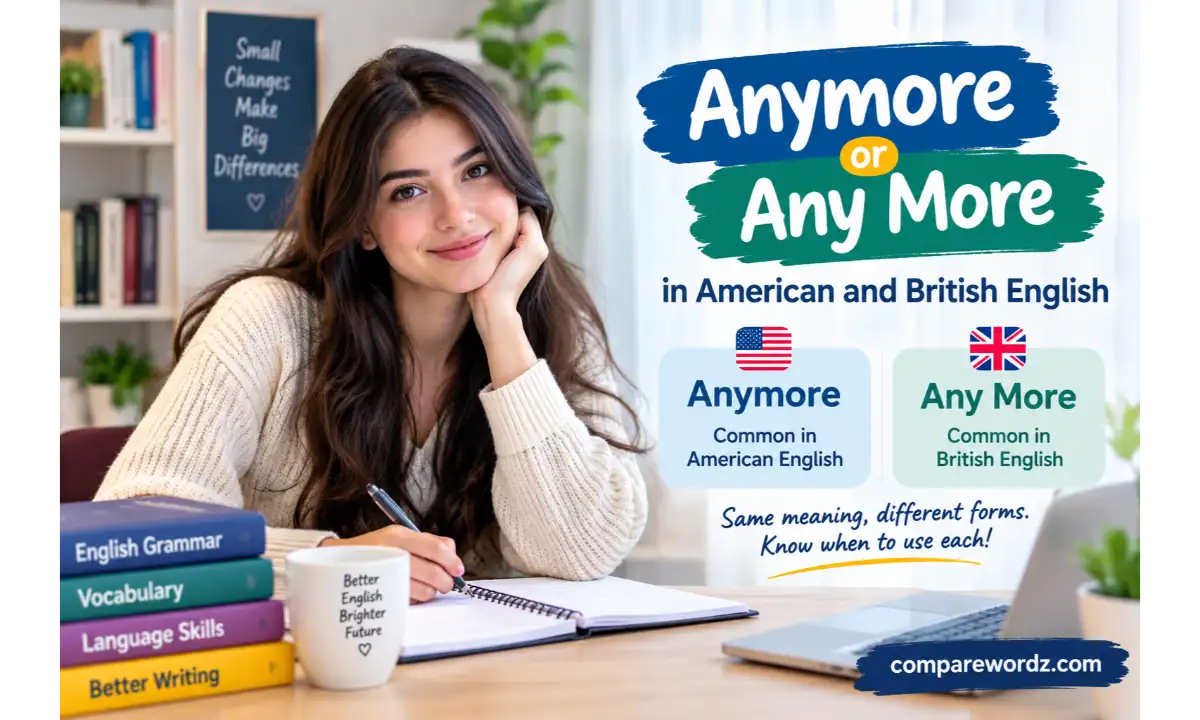
Anymore or any more? Both spellings are correct, but they have different uses.
The right choice depends on what you mean and If you are following American or British English.
For example, She doesn’t work here anymore means she no longer works here.
In contrast, Do you need any more time? asks whether someone needs additional time.
The difference is easy to remember once you know the basic rule.
In this guide, you’ll learn four quick tests, see common mistakes, explore everyday examples, and answer a short quiz to check your understanding.
Anymore or Any More: The Quick Answer
In American English, use anymore as one word when you mean “any longer.” Use any more as two words when you mean “additional” or “to a greater degree.”
| Form | Meaning | Example |
|---|---|---|
| Anymore | Any longer; no longer | I don’t live there anymore. |
| Any more | An additional amount | Would you like any more coffee? |
| Any more | To a greater degree | This task isn’t any more difficult than the last one. |
Easy rule to remember:
- Anymore: Something no longer happens or is no longer true.
- Any more: You mean an additional amount or degree.
One important detail: British English commonly uses any more as two words for both meanings. So, I don’t live there any more is normal British English.
4 Easy Tests to Choose the Correct Form
These four tests can help you choose the right spelling, especially when writing in American English.
1. The “Any Longer” Test
Replace anymore with any longer. If the sentence keeps its meaning, the one-word form is usually correct in American English.
Examples:
- I don’t watch that show anymore.
- She doesn’t work here anymore.
- We don’t use that computer anymore.
- He doesn’t call me anymore.
Try this sentence:
She doesn’t work here anymore.
You can also say, She doesn’t work here any longer.
Both sentences have the same basic meaning. Therefore, anymore is the usual American English choice.
2. The “Additional” Test
Ask yourself whether you mean something extra or an additional amount. If you do, use any more as two words.
Examples:
- Do you need any more time?
- Would you like any more soup?
- Are there any more questions?
- We don’t have any more tickets.
For example, Would you like any more soup? asks whether someone wants an additional serving.
A helpful trick is to replace any more with any additional. If the sentence still makes sense, two words are generally the right choice.
3. The “Of” Test
When you mean an additional amount and the expression is followed by of, use any more as two words.
Examples:
- I can’t take any more of this noise.
- We don’t need any more of those boxes.
- She doesn’t want any more of the cake.
- There isn’t any more of that milk.
In each example, any more refers to an additional amount.
For instance, I can’t take any more of this noise means the speaker cannot tolerate an additional amount of noise.
This is a useful shortcut, but always consider the full sentence rather than relying on one word alone.
4. The Comparison Test
When more is used to compare a quality or degree, write any more as two words.
Examples:
- This road isn’t any more dangerous than the old one.
- The second question isn’t any more difficult than the first.
- This phone isn’t any more expensive than that one.
- She didn’t run any more quickly than her teammate.
In these sentences, more helps compare two things. It does not mean that an action has stopped.
For example, This phone isn’t any more expensive than that one compares the prices of two phones.
Anymore or Any More in American and British English
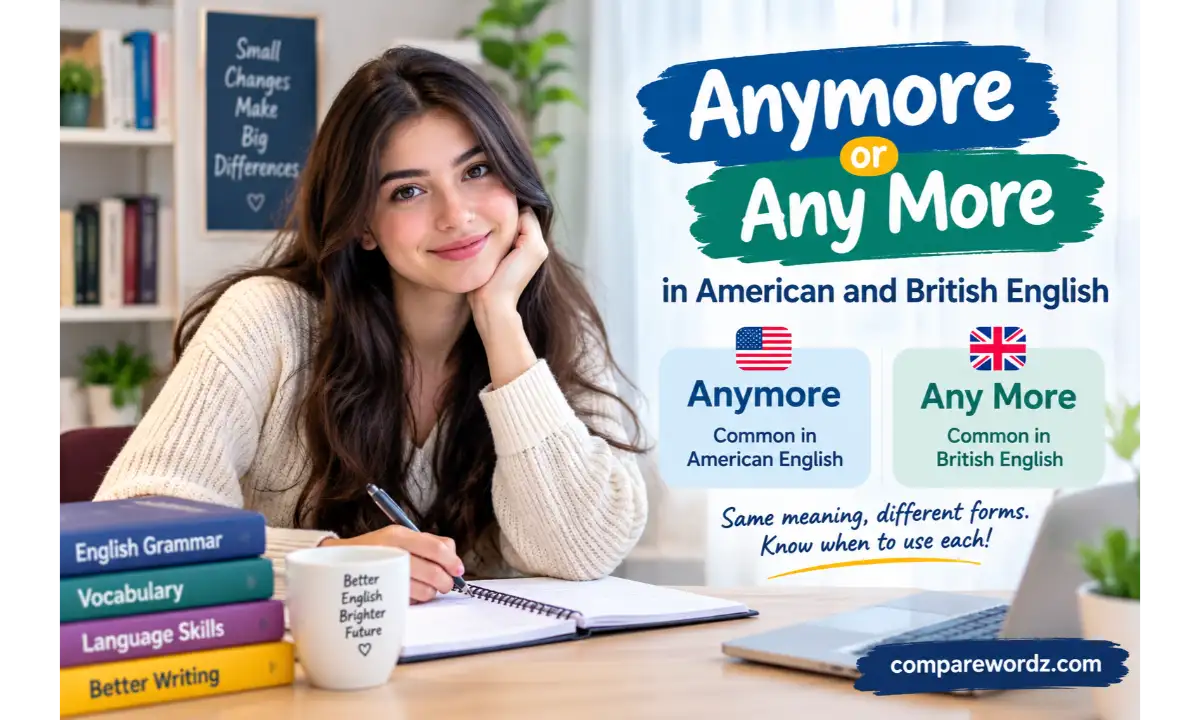
American and British English differ in how they commonly spell this expression when it means “any longer.”
In standard American English:
- I don’t work there anymore.
- She doesn’t visit us anymore.
In British English, the two-word form is commonly used for the same meaning:
- I don’t work there any more.
- She doesn’t visit us any more.
However, both American and British writers use any more when referring to additional amounts.
For example:
- Do you need any more help?
- Is there any more milk?
- Are there any more questions?
If you write for an American audience, use anymore to mean “any longer.” If you follow British English conventions, any more is commonly preferred for both meanings.
The key is to choose the appropriate convention for your audience and use it consistently.
Common Mistakes With Anymore and Any More
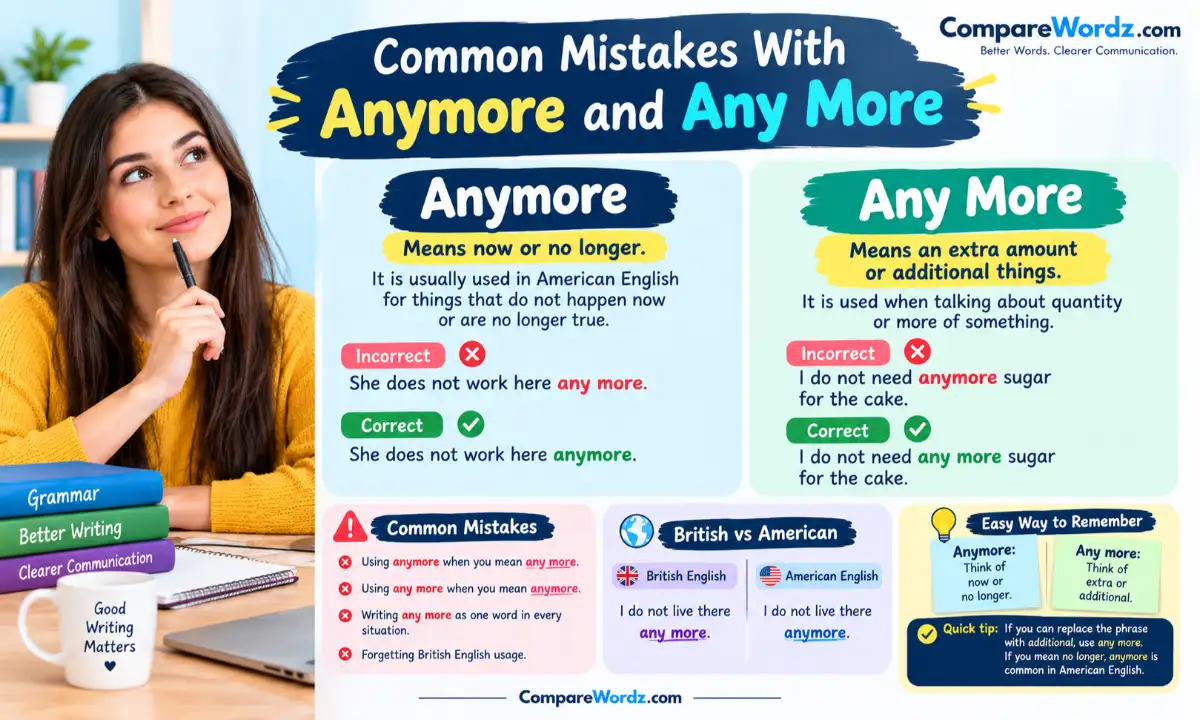
Because both forms are correct in different situations, writers sometimes choose the wrong one.
| Incorrect in standard American English | Correct form | Why? |
|---|---|---|
| Do you want anymore tea? | Do you want any more tea? | The question asks about an additional amount. |
| I can’t take anymore of this. | I can’t take any more of this. | The expression refers to an additional amount. |
| It isn’t anymore expensive. | It isn’t any more expensive. | The sentence makes a comparison. |
| Anymore questions? | Any more questions? | The speaker is asking about additional questions. |
| She doesn’t call any more. | She doesn’t call anymore. | In American English, this means she no longer calls. |
The final example is not wrong in British English, where any more is commonly used for the same meaning.
Compare these two sentences:
I don’t want any more.
This means you don’t want an additional amount of something.
I don’t want to do this anymore.
This means you no longer want to do something.
The meaning of the sentence helps you decide which form to use.
Anymore vs. No More: What’s the Difference?
Anymore and no more can have related meanings, but they are not interchangeable in every sentence.
Anymore usually means “any longer” in American English.
Examples:
- He doesn’t live here anymore.
- I don’t use that account anymore.
- They don’t sell that model anymore.
No more usually means that nothing additional is available, wanted, or permitted.
Examples:
- There is no more milk in the fridge.
- We have no more tickets.
- No more talking during the exam!
Compare these sentences:
I don’t want any more cake.
I want no more cake.
Both express a desire for no additional cake, although the second may sound more emphatic.
Now consider I don’t live here anymore. This means the speaker no longer lives there. In everyday American English, replacing anymore with no more would sound unnatural.
When you mean that something has stopped happening, no longer is another useful alternative.
Anymore or Any More: Everyday Examples
Here are a few more examples showing how both forms work in familiar situations.
At Work
- We don’t use that template anymore.
- Does anyone have any more questions before the meeting ends?
- The company doesn’t offer that service anymore.
At School
- Our teacher doesn’t give us printed worksheets anymore.
- Do we need any more sources for the assignment?
- Are there any more exercises to complete?
In Daily Life
- He doesn’t drink coffee anymore.
- There isn’t any more milk in the fridge.
- Would you like any more soup?
In Online Conversations
- I don’t use that app anymore.
- Are there any more updates about the event?
- Any more spoilers and I’m leaving the conversation.
Notice the difference: anymore describes something that no longer happens, while any more refers to additional items, amounts, or degrees.
Quick Practice: Test Your Understanding
Choose anymore or any more to complete each sentence. These questions follow standard American English conventions.
- She doesn’t work at that store ______.
- Would you like ______ rice?
- I can’t take ______ of this noise.
- This phone isn’t ______ expensive than the old one.
- We don’t write letters ______.
- Are there ______ questions before we finish?
Answers and explanations
- Anymore — She no longer works at that store.
- Any more — The question asks about an additional amount of rice.
- Any more — The expression refers to an additional amount of noise.
- Any more — The sentence compares the prices of two phones.
- Anymore — In American English, this means we no longer write letters.
- Any more — The speaker is asking about additional questions.
If you answered all six correctly, you’ve understood the main distinction. If not, revisit the four tests and focus on the meaning of each sentence.
Frequently Asked Questions
Is it anymore or any more?
Both are correct. In American English, anymore means “any longer,” while any more refers to an additional amount or degree. British English commonly uses any more for both meanings.
What does anymore mean?
In common American English, anymore means “any longer” or “no longer.” For example, I don’t work there anymore means I no longer work there.
Can any more appear at the end of a sentence?
Yes. For example, Would you like any more? is correct when the conversation makes clear what additional amount or item is being discussed.
Is anymore a real word?
Yes. Anymore is an established English word listed in major dictionaries, including Merriam-Webster. It is commonly used in American English to mean “any longer.”
Is it any more information or anymore information?
In standard American English, any more information is the usual form because it refers to additional information. For example, Do you need any more information?
Final Verdict
Choosing between anymore and any more becomes easy when you focus on meaning.
In American English, use anymore when you mean “any longer,” as in She doesn’t work here anymore. Use any more when you mean an additional amount or degree, as in Do you need any more time?
Remember this simple rule: any longer = anymore; any additional amount or degree = any more.
If you’re writing for a British audience, remember that any more is commonly used for both meanings. Consider your audience, check the meaning of your sentence, and keep your spelling consistent.

I’m MK Jan Mustafa Kamal, the author of CompareWordz.com, specializing in English linguistics, word meanings, spelling, and language usage.
I hold an M.A. in English and have 8 years of experience in English language and vocabulary studies. My goal is to explain confusing words, spelling differences, grammar rules, and meanings in clear, simple, and accurate language. I focus on providing well-researched, fact-checked, and easy-to-understand content that helps readers use English with confidence. Through CompareWordz.com, I aim to make learning English words and their correct usage easier for everyone.